INS Vikrant 1961 vs 2022: Old Vikrant vs New Vikrant Compared
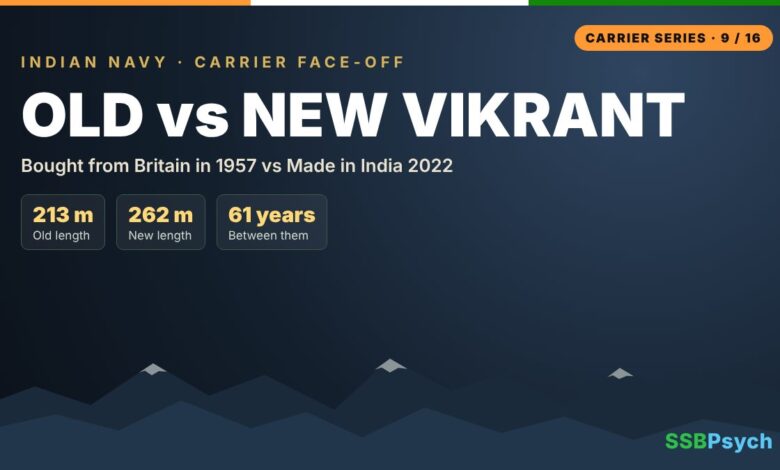
Some names are too proud to retire. When India’s first aircraft carrier was scrapped, the Navy promised the name would come back, and in 2022 it did, on a ship built entirely in India. This is the story of INS Vikrant 1961 vs 2022: the old Vikrant that India bought from Britain and the new Vikrant that India designed and built at Kochi.
In this guide we compare the two ships side by side: size, weight, speed, crew, aircraft, launch method, cost and history. We explain each difference in plain language, show what each ship did best, share what India learned in the 61 years between them, and finish with a fun verdict. A perfect read for NDA, CDS, AFCAT and SSB aspirants.

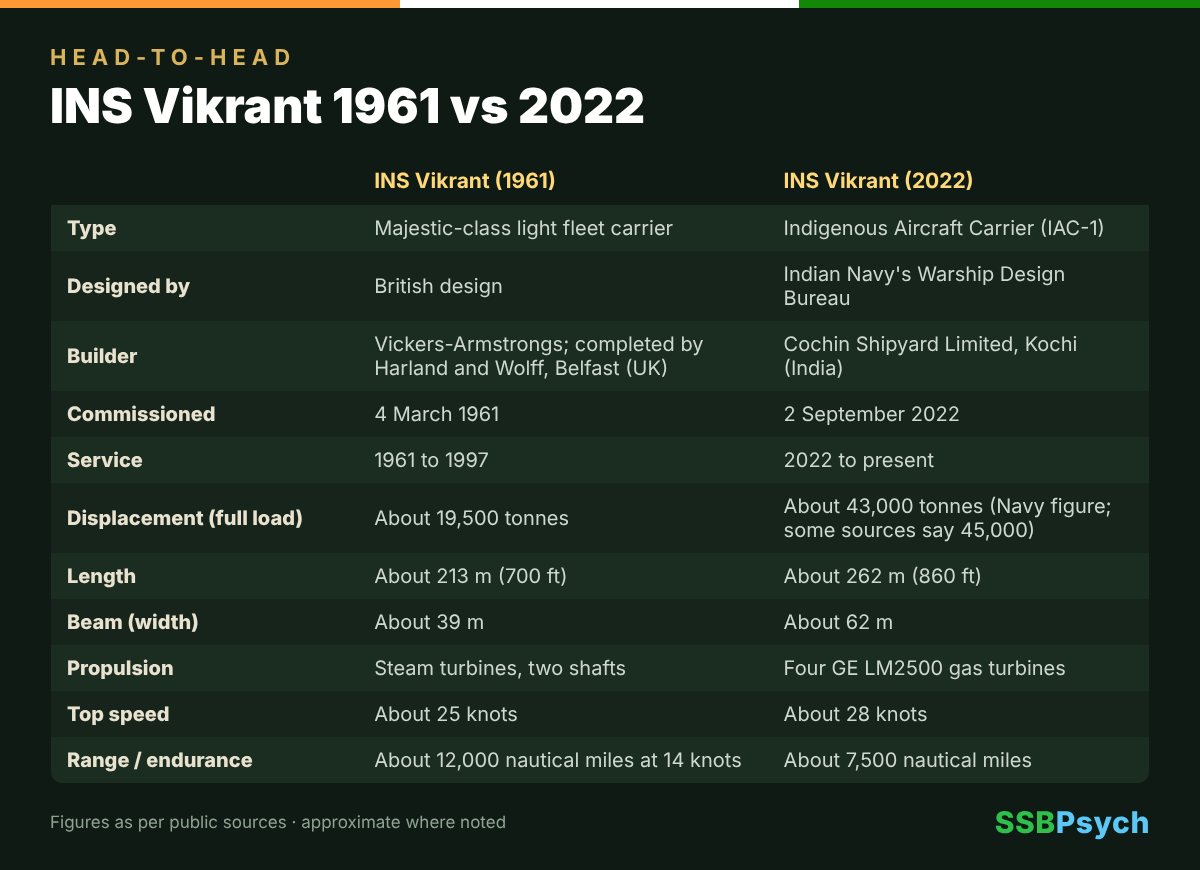
INS Vikrant 1961 vs 2022: The Comparison Table
The key numbers are below, rounded from public and official sources. Where figures differ between sources, we say so.
INS Vikrant 1961 vs 2022: Side-by-Side Comparison
| INS Vikrant (1961) | INS Vikrant (2022) | |
|---|---|---|
| Type | Majestic-class light fleet carrier | Indigenous Aircraft Carrier (IAC-1) |
| Designed by | British design | Indian Navy’s Warship Design Bureau |
| Builder | Vickers-Armstrongs; completed by Harland and Wolff, Belfast (UK) | Cochin Shipyard Limited, Kochi (India) |
| Commissioned | 4 March 1961 | 2 September 2022 |
| Service | 1961 to 1997 | 2022 to present |
| Displacement (full load) | About 19,500 tonnes | About 43,000 tonnes (Navy figure; some sources say 45,000) |
| Length | About 213 m (700 ft) | About 262 m (860 ft) |
| Beam (width) | About 39 m | About 62 m |
| Propulsion | Steam turbines, two shafts | Four GE LM2500 gas turbines |
| Top speed | About 25 knots | About 28 knots |
| Range / endurance | About 12,000 nautical miles at 14 knots | About 7,500 nautical miles |
| Crew | About 1,110 | About 1,700 (reported) |
| Aircraft | About 21 to 23: Sea Hawk, Alize, helicopters; later Sea Harrier | About 30: MiG-29K, Ka-31, MH-60R, Dhruv; Rafale M on order |
| Launch method | Steam catapult, then 9.75 degree ski-jump | STOBAR: ski-jump take-off, arrester wire landing |
| Cost (reported) | Not widely reported | About Rs 20,000 crore (reported in 2022) |
| Famous for | 1971 war strikes and blockade | First carrier designed and built in India |
Same Name, Different Birth Stories
Old INS Vikrant (1961): Bought From Britain
The first Vikrant was laid down in 1943 as HMS Hercules, a British light carrier. When World War II ended she was left unfinished. India bought her in 1957, had her completed in Belfast with improvements, and commissioned her on 4 March 1961. A newly independent India could not yet build such a ship, so buying a ready hull was the smart shortcut.
New INS Vikrant (2022): Made in India
The new Vikrant was designed by the Indian Navy’s own Warship Design Bureau and built by Cochin Shipyard Limited in Kochi. Her keel was laid in 2009, she was floated out in 2013, and Prime Minister Narendra Modi commissioned her on 2 September 2022. On the same day the Navy unveiled its new naval ensign. She made India one of a small group of countries that can design and build an aircraft carrier at home.
Size: How Much Bigger Is the New Vikrant?
Warships are weighed by displacement, the weight of water a ship pushes aside as it floats, which equals the ship’s own weight. Old Vikrant weighed about 19,500 tonnes fully loaded. The new Vikrant weighs about 43,000 tonnes according to the Navy’s figure, with some sources quoting about 45,000. Either way, the new ship is more than twice as heavy.
In length, old Vikrant was about 213 metres, close to two football fields. The new Vikrant is about 262 metres long and 62 metres wide. She has 14 decks and about 2,300 compartments, so new sailors often need weeks to learn their way around.
Winner on size: the new Vikrant, easily.
Engines and Speed: Steam vs Gas Turbines
Old Vikrant ran on steam turbines. Boilers burned fuel to boil water, and the steam spun turbines that turned two propeller shafts. It is like a giant pressure cooker pushing a fan. Steam plants are reliable when young, but they need long warm-up times and lots of maintenance as they age. Old Vikrant’s boilers were a weak spot; in 1971 one had a crack and her speed was restricted.
The new Vikrant uses four gas turbines made by General Electric. A gas turbine works much like a jet engine fixed inside the ship: it burns fuel to spin a turbine directly. Gas turbines start quickly, deliver power fast and need fewer people to run. That gives the new Vikrant a top speed of about 28 knots against about 25 knots for the old one. A knot is one nautical mile per hour, roughly 1.85 km per hour.
For range, the old ship’s listed figure was about 12,000 nautical miles at a slow 14 knots, while the new ship’s official endurance is about 7,500 nautical miles. The numbers are measured differently, and the new ship is meant to be refuelled at sea by fleet tankers, so do not read this as the old ship being better at long voyages in practice.
Crew: From 1,100 to About 1,700
Old Vikrant carried about 1,110 people. The new Vikrant carries about 1,700 according to reports, and she was designed with accommodation for women officers and sailors. Her galleys make thousands of meals a day, and she has her own medical complex. Like all Indian carriers, she is commanded by an officer of Captain rank.
Aircraft and Launch: Catapult vs STOBAR
Old Vikrant began with a steam catapult, a slingshot built into the deck that flings a plane to flying speed in seconds, and arrester wires to catch landing aircraft. She flew Sea Hawk fighter-bombers and Alize anti-submarine aircraft. In her late 1980s refit the catapult was replaced by a 9.75 degree ski-jump so she could fly Sea Harrier jump jets.
The new Vikrant uses STOBAR, Short Take-Off But Arrested Recovery. Jets roar up a curved ski-jump ramp at the bow to get airborne, and land by snagging an arrester wire with a hook under the tail. Picture a skateboarder leaving a ramp: the upward throw buys the jet extra seconds to reach flying speed.
She can operate about 30 aircraft. Today these include supersonic MiG-29K fighters, Kamov Ka-31 early warning helicopters, MH-60R multi-role helicopters and HAL Dhruv helicopters. In April 2025 India signed a deal with France for 26 Rafale M fighters for carrier use, with deliveries reported to start around 2030. The jump from 1950s Sea Hawks to supersonic fighters shows how far Indian naval aviation has travelled.
INS Vikrant 1961 vs 2022 Timeline
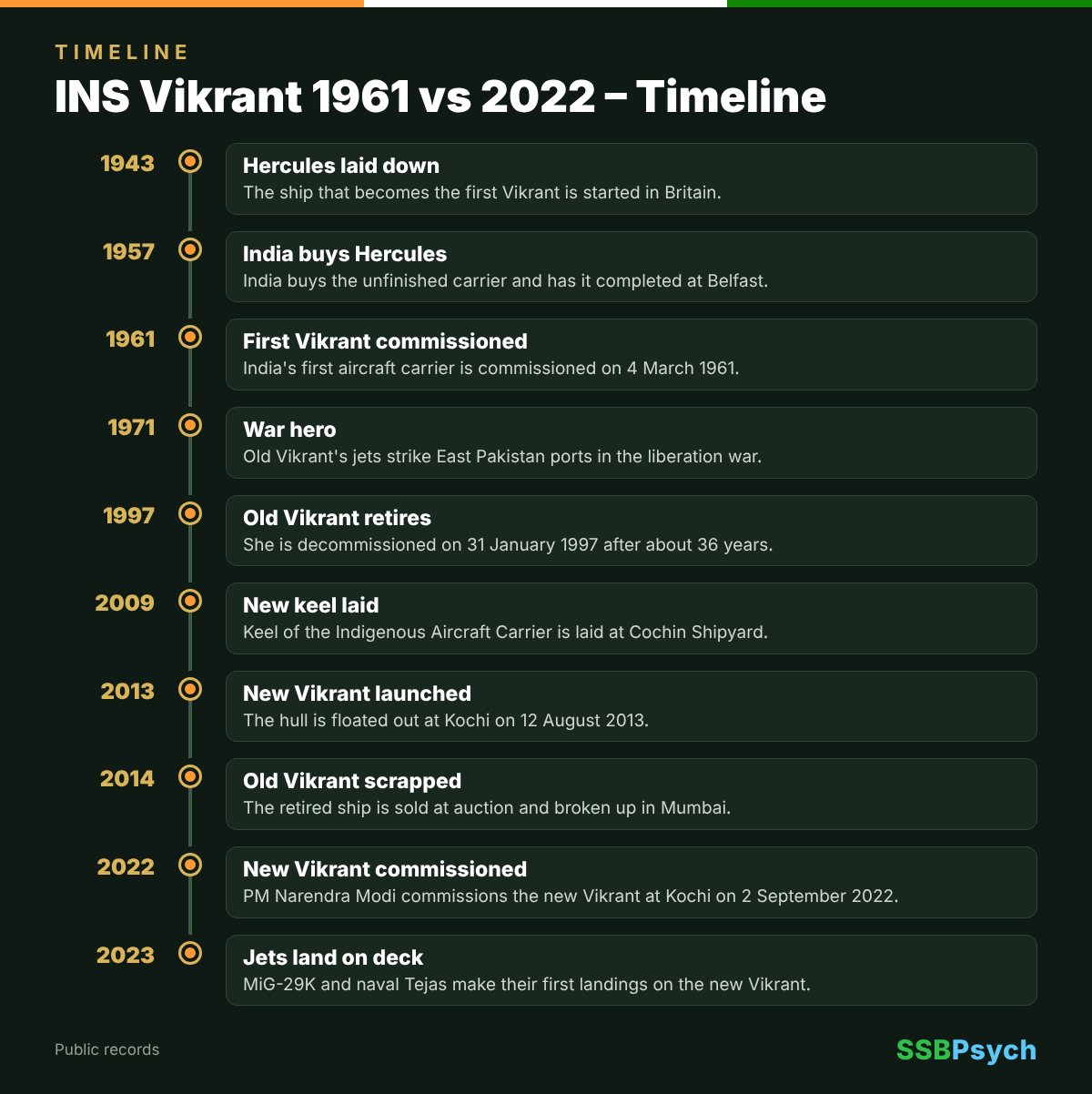
- 1943 – Hercules laid down: The ship that becomes the first Vikrant is started in Britain.
- 1957 – India buys Hercules: India buys the unfinished carrier and has it completed at Belfast.
- 1961 – First Vikrant commissioned: India’s first aircraft carrier is commissioned on 4 March 1961.
- 1971 – War hero: Old Vikrant’s jets strike East Pakistan ports in the liberation war.
- 1997 – Old Vikrant retires: She is decommissioned on 31 January 1997 after about 36 years.
- 2009 – New keel laid: Keel of the Indigenous Aircraft Carrier is laid at Cochin Shipyard.
- 2013 – New Vikrant launched: The hull is floated out at Kochi on 12 August 2013.
- 2014 – Old Vikrant scrapped: The retired ship is sold at auction and broken up in Mumbai.
- 2022 – New Vikrant commissioned: PM Narendra Modi commissions the new Vikrant at Kochi on 2 September 2022.
- 2023 – Jets land on deck: MiG-29K and naval Tejas make their first landings on the new Vikrant.
Aircraft, Weapons and Sensors
- Hawker Sea Hawk fighter-bombers (old Vikrant)
- Breguet Alize anti-submarine aircraft (old Vikrant)
- Sea Harrier jump jets (old Vikrant, later years)
- MiG-29K carrier fighters (new Vikrant)
- Kamov Ka-31 early warning helicopters (new Vikrant)
- MH-60R multi-role helicopters (new Vikrant)
- HAL Dhruv advanced light helicopters (new Vikrant)
- Rafale M fighters ordered in 2025 for the new carrier, with deliveries reported from 2030
Operations: Then and Now
The old Vikrant’s greatest moment came in December 1971. Her Sea Hawks attacked ports and shipping at Chittagong, Cox’s Bazar, Khulna and Mongla, and she helped enforce a naval blockade of East Pakistan. Her crew won two Maha Vir Chakras and twelve Vir Chakras.
The new Vikrant is still writing her story. In February 2023 the MiG-29K and the naval Tejas made their first landings on her deck, and in May 2023 she saw her first night landing. She has trained alongside INS Vikramaditya in twin-carrier drills. After the Pahalgam terror attack in April 2025, she was reported to have led a carrier battle group forward in the Arabian Sea, a clear signal of readiness.
Operations and Missions
- 1971 – Bangladesh Liberation War: Old Vikrant’s Sea Hawks hit Chittagong, Cox’s Bazar, Khulna and Mongla.
- 2001-2012 – Museum ship: Old Vikrant welcomed visitors as a museum in Mumbai.
- 2023 – First jet landings: MiG-29K and naval Tejas landed on the new Vikrant in February 2023.
- 2023 – Night landing: A MiG-29K made the first night landing on the new Vikrant in May 2023.
- 2023-24 – Twin-carrier operations: New Vikrant sailed alongside INS Vikramaditya in joint carrier drills.
- 2025 – Arabian Sea deployment: After the Pahalgam attack, the new Vikrant led a carrier group forward in the Arabian Sea (reported).

Which Was Better at What, and Why?
- Combat record: Old Vikrant. She fought a war and helped win it.
- Size and air power: New Vikrant. More than twice the weight and supersonic jets.
- Speed and quick response: New Vikrant, thanks to modern gas turbines.
- Self-reliance: New Vikrant. Designed and built in India, with warship-grade steel and many systems made in India.
- Cost: New Vikrant was reported to cost about Rs 20,000 crore in 2022. The old ship’s purchase price is not widely reported, but buying an unfinished hull was far cheaper.
- Historic importance: A tie. One started Indian carrier aviation; the other proved India can build its own carriers.
Why Is Building a Carrier at Home So Hard?
An aircraft carrier is not just a big ship. It is a floating airport, fuel depot, hospital, power station and command centre, all packed into one hull that must survive storms, salt water and enemy attack. Thousands of systems have to work together: engines, radars, aircraft lifts, arrester wires, fire-fighting, fuel lines and communications. Very few countries have the design skills and industry to build one.
For the old Vikrant, India skipped this problem by buying a hull Britain had already designed and built. For the new Vikrant, Indian designers, the shipyard and hundreds of Indian suppliers had to solve each challenge themselves, including making special high-strength warship steel in India. That is why the new ship is seen as a milestone for the Make in India effort, and why the old and new Vikrant together tell a story of a nation growing up.
Why Bring Back the Name Vikrant?
Navies around the world reuse the names of famous ships to keep their spirit alive. Giving India’s first home-built carrier the name of India’s first carrier, the hero of 1971, was a way to link a proud past to a confident future. In that sense, the new ship carries forward both a famous name and a fighting legacy.
What India Learned Between the Two Vikrants
The 61 years between the two commissionings were a long classroom. Old Vikrant taught the Navy how to fly from a ship, how to guard a carrier with escorts and how to use air power in war. INS Viraat added jump-jet experience, and INS Vikramaditya brought STOBAR operations with supersonic fighters. Every one of those lessons went into the new Vikrant’s design.
India also learned that relying on foreign second-hand ships brings delays, costly spares and limited control. Building at home is slow at first, and the new Vikrant took about 13 years from keel laying to commissioning, but it creates jobs, skills and a supply chain of Indian companies. The next carrier can be built faster because the experience now stays in India.
The Fun Verdict: INS Vikrant 1961 vs 2022
Think of it as a grandfather and grandson who share the same name. The grandfather is a decorated war veteran with stories that make everyone proud. The grandson is taller, stronger, faster and built with skills the family learned over three generations.
On paper, the new Vikrant wins nearly every round: size, speed, aircraft, technology and self-reliance. The old Vikrant keeps the medals: first carrier, real combat and a place in the story of Bangladesh’s birth. The best part? The new ship carries the old one’s name and spirit forward, so in a way, both win.
Did You Know?
- The old Vikrant was laid down in 1943; the new one’s keel was laid in 2009, 66 years later.
- The new Navy ensign was unveiled on the day the new Vikrant was commissioned.
- The new Vikrant has about 2,300 compartments spread over 14 decks.
- The new Vikrant’s Sanskrit motto means ‘I defeat those who dare to fight against me’.
- Old Vikrant served as a museum in Mumbai before being scrapped in 2014.
- Metal from the old Vikrant went into Bajaj’s V motorcycle, launched in 2016.
- Vikrant means ‘courageous’ or ‘bold’.
Want more? Read our full profiles of both Vikrants in this series and try the quiz below. Questions on India’s carriers are common in SSB interviews and GK papers, and the old vs new Vikrant story is a favourite of interviewers.
Quiz: Test Your Knowledge of INS Vikrant 1961 vs 2022
Click an option to see if you are right. Your score updates live.
INS Vikrant 1961 vs 2022: Frequently Asked Questions
The old Vikrant (1961) was a British-built light carrier of about 19,500 tonnes. The new Vikrant (2022) was designed and built in India, weighs about 43,000 tonnes and flies supersonic MiG-29K fighters.
The Navy reused the name to honour India’s first carrier, which became famous in the 1971 war. Reviving the names of famous retired ships is a common naval tradition.
Reports at her commissioning in 2022 put the cost at about Rs 20,000 crore. Some later sources quote a higher total project figure.
Yes, much bigger. She is about 262 metres long and about 62 metres wide, compared with about 213 metres and 39 metres for the old Vikrant.
She retired in 1997, served as a museum ship in Mumbai until 2012, and was sold for scrap in 2014.
This is part 9 of 16 in SSBPsych’s Indian Navy aircraft carrier series – a new post every day at 2 PM.
Sources: en.wikipedia.org, en.wikipedia.org, indiannavy.nic.in, pib.gov.in.
Preparing for NDA, CDS, AFCAT or your SSB? Join SSBPsych’s online and offline batches – explore our courses or call +91 8076540582.