Mirage 2000 in Indian Air Force: Specs, Weapons, Kargil, Balakot
When India needs to hit a target with pinpoint accuracy, one jet has earned a special reputation: the Mirage 2000. The Indian Air Force calls it Vajra, the thunderbolt of Indra. Since 1985 this sleek French fighter has guarded Indian skies, turned the tide at Kargil in 1999 and led the Balakot air strike in 2019. Pilots love it, and it has one of the best safety records in the IAF’s fighter fleet.
In this guide you will learn why India bought the Mirage 2000, its history in the IAF, how its engine and delta wing work in simple words, the weapons it carries, the missions that made it famous, where it is based and who flies it, its strengths and limits, and its future. A quiz and FAQ at the end will help you revise for NDA, CDS, AFCAT and SSB.

Mirage 2000 Specifications
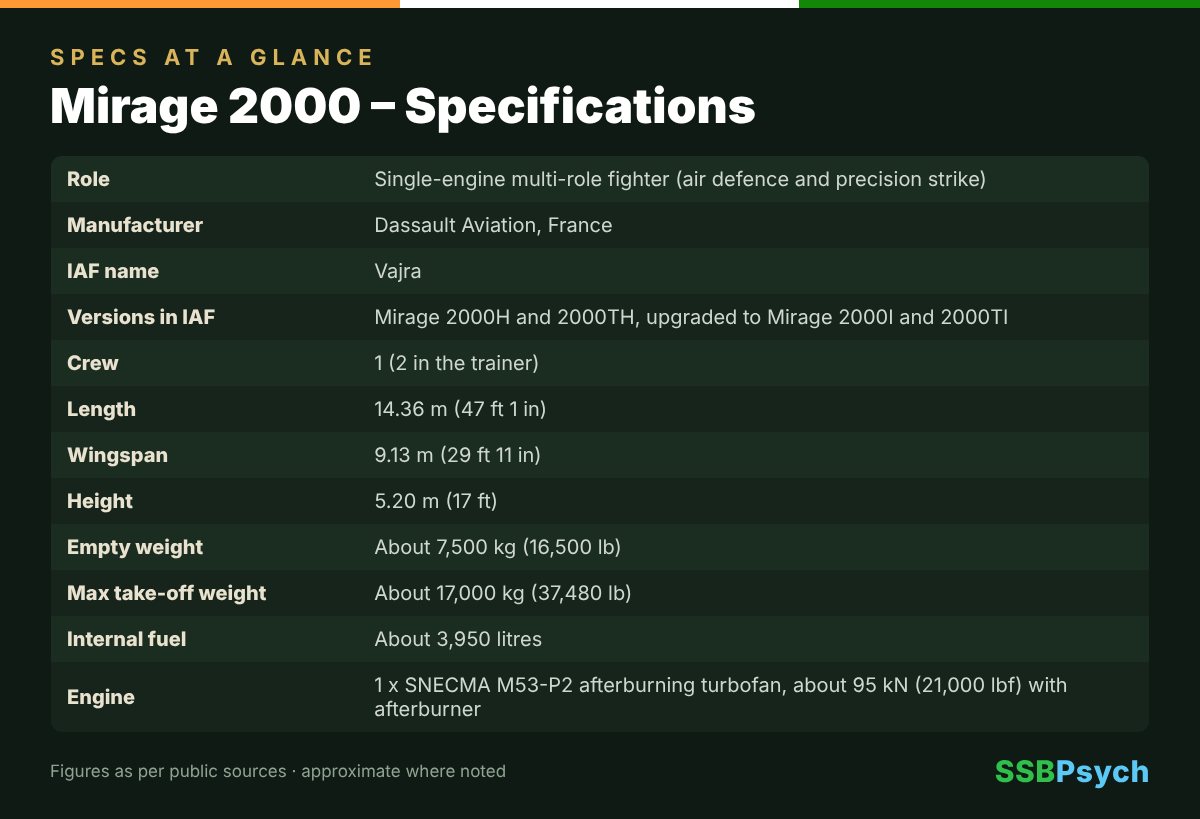
| Role | Single-engine multi-role fighter (air defence and precision strike) |
| Manufacturer | Dassault Aviation, France |
| IAF name | Vajra |
| Versions in IAF | Mirage 2000H and 2000TH, upgraded to Mirage 2000I and 2000TI |
| Crew | 1 (2 in the trainer) |
| Length | 14.36 m (47 ft 1 in) |
| Wingspan | 9.13 m (29 ft 11 in) |
| Height | 5.20 m (17 ft) |
| Empty weight | About 7,500 kg (16,500 lb) |
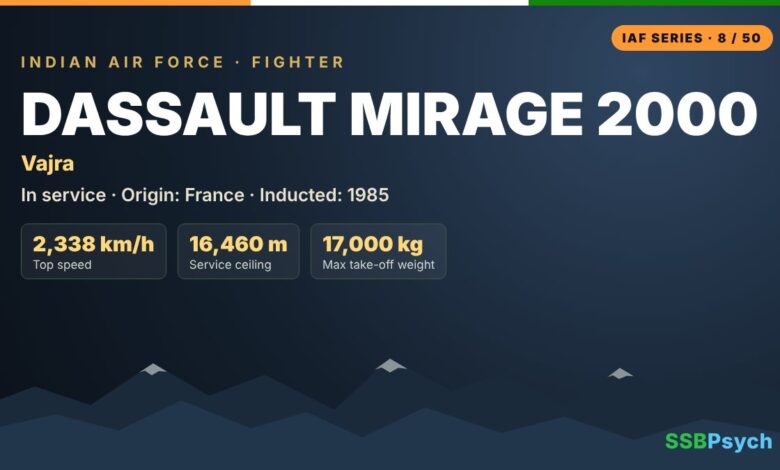
| Max take-off weight | About 17,000 kg (37,480 lb) |
| Internal fuel | About 3,950 litres |
| Engine | 1 x SNECMA M53-P2 afterburning turbofan, about 95 kN (21,000 lbf) with afterburner |
| Max speed | About 2,338 km/h (Mach 2.2) at high altitude |
| Service ceiling | About 16,460 m (54,000 ft) |
| Built-in guns | 2 x 30 mm DEFA 554 cannons |
| First flight | 10 March 1978 (prototype) |
| Inducted in IAF | 1985 (first aircraft handed over in June 1985) |
| Number in IAF | 49 bought new in the 1980s, plus used French airframes acquired in 2021, some for spares |
Why India Needed the Mirage 2000
In the early 1980s, Pakistan began receiving American F-16 fighters, which were among the most modern jets of the time. India needed an answer quickly. The Mirage 2000 from France’s Dassault Aviation was new, fast and agile, and had modern radar and electronics. On 13 April 1982, India signed a deal for 36 single-seat and 4 twin-seat jets. In 1986 it ordered nine more, bringing the total to 49.
The Mirage 2000 gave the IAF something it had never had before: a true multi-role fighter that could defend the skies and also strike targets on the ground with great precision. Many years later, India would turn to Dassault again for the Rafale.
History of the Mirage 2000 in the IAF
The first prototype of the Mirage 2000 flew in France on 10 March 1978. India’s first aircraft were handed over in June 1985 and joined No. 7 Squadron, the Battle Axes. The jet was given the Indian name Vajra. Over time, the fleet came to equip three squadrons: No. 1 Squadron (the Tigers), No. 7 Squadron (the Battle Axes) and No. 9 Squadron (the Wolf Pack).
By the 2000s, the jets needed new electronics to stay effective. In July 2011, India approved a major upgrade for 51 aircraft. The upgraded version, called the Mirage 2000I (and 2000TI for the trainer), got a modern glass cockpit that works with night vision goggles, a new Thales RDY-3 multi-mode radar, a fully integrated electronic warfare suite, better navigation and the ability to fire MICA missiles. The first two upgraded jets were handed over in France on 25 March 2015, and HAL upgraded the remaining aircraft in Bengaluru.
Dassault ended Mirage 2000 production in 2007, so finding spare parts is a challenge. To solve this, India obtained 24 retired Mirage 2000s from France in 2021. Some were to be made fit to fly, while others were to be taken apart and used for spares. This kind of smart planning keeps the fleet flying longer.
Engine and Performance Explained Simply
The Mirage 2000 has one SNECMA M53-P2 engine. It is a turbofan, which means it uses a large fan at the front to push some air around the hot core of the engine. It also has an afterburner that sprays extra fuel into the exhaust for a big burst of power, producing about 95 kN of thrust. That push is roughly equal to the weight of nearly ten tonnes.
Top speed is about Mach 2.2, or around 2,338 km/h at high altitude. Mach 1 is the speed of sound, so Mach 2.2 means more than twice as fast as sound. A Vande Bharat train is designed for about 180 km/h, so the Mirage at full speed is roughly thirteen times faster. It could cross the width of India, about 3,000 km, in a little over an hour if it had the fuel to do so at that speed.
Its service ceiling, the highest height at which it can still climb usefully, is about 16,460 m, nearly twice the height of Mount Everest. The jet weighs about 7.5 tonnes when empty and can take off at about 17 tonnes with fuel and weapons. Internal tanks hold about 3,950 litres of fuel, the same as roughly 85 to 100 car fuel tanks, and extra drop tanks can be added for longer missions.
The Mirage 2000 has a big triangle-shaped wing called a delta wing, with no separate tail wings. Delta wings are great for high speed and give a lot of room for fuel and weapons. Older delta-winged jets were hard to handle at low speed, but the Mirage 2000 uses a computer-controlled fly-by-wire system. Instead of cables, the pilot’s stick sends electronic signals to a computer, which moves the control surfaces. This makes the jet very agile and safe to fly.
Weapons and Missiles
- 2 x 30 mm DEFA 554 internal cannons
- MICA beyond-visual-range air-to-air missiles (upgraded Mirage 2000I)
- R-550 Magic II short-range air-to-air missiles
- Super 530D medium-range air-to-air missiles
- Spice 2000 precision-guided bombs (used at Balakot)
- Laser-guided bombs (used in the Kargil War)
- Unguided free-fall bombs
- External fuel tanks
The weapons list shows why the Mirage is called multi-role. For air combat, it carries MICA missiles that can hit enemy jets beyond visual range, meaning targets too far away to see, as well as short-range missiles and two powerful 30 mm cannons. For ground attack, it can carry laser-guided bombs and Spice 2000 kits, which use satellite and camera guidance to hit a target very precisely.
How does a laser-guided bomb find its target? A laser beam, shone from the aircraft or from another source, paints a small invisible spot on the target. A sensor in the nose of the bomb looks for the reflected laser light, and small fins steer the bomb towards that spot as it falls. Imagine a cricket ball that could change direction in mid-air to follow a torch beam. That is why such bombs can hit a single bunker on a mountain top, something ordinary bombs would very likely miss.
The radar matters just as much as the weapons. A multi-mode radar like the RDY-3 on the upgraded Mirage 2000I can switch between jobs: searching the sky for enemy aircraft, locking on to one target to guide a missile, or mapping the ground below. Think of it as a powerful pair of eyes that can see in the dark and through clouds, far beyond the range of human vision.
Mirage 2000 Missions and Operations
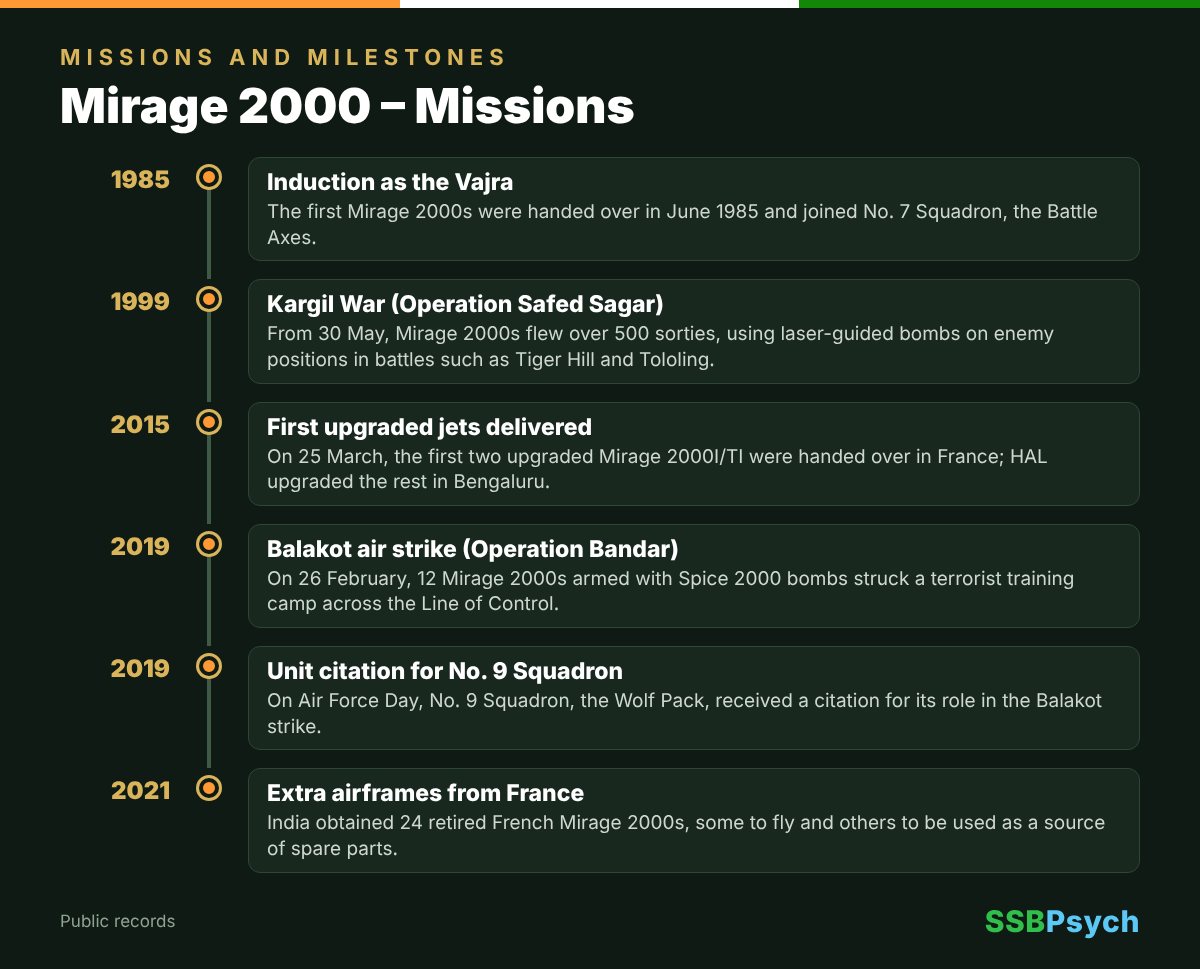
- 1985 – Induction as the Vajra: The first Mirage 2000s were handed over in June 1985 and joined No. 7 Squadron, the Battle Axes.
- 1999 – Kargil War (Operation Safed Sagar): From 30 May, Mirage 2000s flew over 500 sorties, using laser-guided bombs on enemy positions in battles such as Tiger Hill and Tololing.
- 2015 – First upgraded jets delivered: On 25 March, the first two upgraded Mirage 2000I/TI were handed over in France; HAL upgraded the rest in Bengaluru.
- 2019 – Balakot air strike (Operation Bandar): On 26 February, 12 Mirage 2000s armed with Spice 2000 bombs struck a terrorist training camp across the Line of Control.
- 2019 – Unit citation for No. 9 Squadron: On Air Force Day, No. 9 Squadron, the Wolf Pack, received a citation for its role in the Balakot strike.
- 2021 – Extra airframes from France: India obtained 24 retired French Mirage 2000s, some to fly and others to be used as a source of spare parts.

The Mirage 2000 at Kargil and Balakot
During the 1999 Kargil War, enemy soldiers had occupied high peaks on the Indian side of the Line of Control. Hitting small bunkers on mountain tops is very hard. The Mirage 2000 was quickly modified to carry laser-guided bombs, which follow a laser spot pointed at the target. Between May and July 1999, the Mirage squadrons flew over 500 sorties and dropped about 55,000 kg of bombs. Their strikes supported famous battles like Tiger Hill and Tololing.
Twenty years later, after the Pulwama terror attack that killed 40 CRPF personnel, India decided to respond. In the early hours of 26 February 2019, 12 Mirage 2000s carrying Spice 2000 precision bombs struck a terrorist training camp at Balakot across the Line of Control. The strike was named Operation Bandar. No. 9 Squadron later received a unit citation from the Chief of the Air Staff for its role.
Where the Mirage 2000 Is Based and Who Flies It
All three IAF Mirage 2000 squadrons are publicly reported to be based at Maharajpur Air Force Station near Gwalior in Madhya Pradesh, under No. 40 Wing. Gwalior’s central location lets the jets reach both the western and northern borders quickly.
An IAF fighter squadron is usually commanded by a Wing Commander. Under the commanding officer are Squadron Leaders who lead flights, and younger Flight Lieutenants and Flying Officers who fly as wingmen. A large air force station is usually commanded by an Air Commodore or Group Captain.
To become a Mirage pilot, a cadet joins the Air Force Academy at Dundigal and learns to fly on a basic trainer aircraft. Those selected for the fighter stream then move to jet training, finishing on the Hawk advanced jet trainer. After about two to three years of flying training, a new pilot joins a frontline fighter squadron, and only after more experience is he or she ready to fly a complex multi-role jet like the Mirage 2000.
Strengths and Limitations
- Fast and agile, with a top speed of about Mach 2.2
- Fly-by-wire controls make it stable and easy to manoeuvre
- Proven precision strike record at Kargil and Balakot
- Upgraded Mirage 2000I has modern radar, cockpit and MICA missiles
- One of the best flight safety records among IAF fighters
- Only one engine, so engine trouble leaves no backup
- Production ended in 2007, making spare parts harder to find
- Small fleet of about three squadrons
- Older airframes need careful maintenance as they age
Future of the Mirage 2000 in the IAF
Thanks to the upgrade and the extra airframes from France, the IAF expects the Mirage 2000 to keep flying beyond 2035. It works well alongside the Rafale, which also comes from Dassault and shares some equipment, like the MICA missile. In the long run, the Mirage will be replaced by newer fighters, including India’s own designs, but for now it remains one of the IAF’s sharpest strike tools.
Safety is also part of its story. The Mirage 2000 has one of the best flight safety records in the IAF’s fighter fleet. Accidents have still happened over four decades; a crash near Gwalior in February 2025, in which both pilots ejected safely, was reported as the fleet’s 14th accident.
Why the Mirage 2000 Matters for SSB and AFCAT Aspirants
The Mirage 2000 appears often in defence exams because it links to big events: the Kargil War, the Balakot air strike and India-France defence ties. In an SSB interview, if you are asked about a recent IAF operation or about precision weapons, the Mirage gives you clear, factual examples to talk about.
Remember the key points: ordered in 1982, inducted in 1985, named Vajra, based at Gwalior with Nos. 1, 7 and 9 Squadrons, top speed about Mach 2.2, laser-guided bombs at Kargil, Spice 2000 bombs at Balakot on 26 February 2019, and upgraded to the Mirage 2000I standard.
Did You Know?
- Vajra means thunderbolt, the weapon of Indra in Indian mythology.
- The first Mirage 2000 prototype flew on 10 March 1978.
- India’s Mirage 2000s were hurriedly modified to drop laser-guided bombs during the Kargil War.
- Twelve Mirage 2000s took part in the Balakot air strike in 2019.
- The Mirage 2000 has no separate tail wings; its delta wing does the job.
- In 2021 India bought retired French Mirage 2000s partly to use as spare parts.
- The Mirage 2000 and the Rafale both come from France’s Dassault Aviation.
Quiz: Test Your Knowledge of Mirage 2000
Click an option to see if you are right. Your score updates live.
Mirage 2000: Frequently Asked Questions
The Mirage 2000 can fly at about Mach 2.2, roughly 2,338 km/h, at high altitude. That is more than twice the speed of sound.
India ordered the Mirage 2000 in 1982, and the first aircraft were handed over in June 1985. In IAF service it is called the Vajra.
India bought 49 new Mirage 2000s in the 1980s and later obtained used French airframes in 2021, some for spares. The fleet equips three squadrons at Gwalior.
On 26 February 2019, 12 Mirage 2000s carrying Spice 2000 precision bombs struck a terrorist training camp at Balakot across the Line of Control.
It has two 30 mm cannons and can carry MICA and Magic II air-to-air missiles, laser-guided bombs, Spice 2000 precision bombs and unguided bombs.
This is part 8 of 50 in SSBPsych’s Indian Air Force aircraft series – a new aircraft every evening at 6 PM.
Sources: en.wikipedia.org, tribuneindia.com, milavia.net, en.wikipedia.org, freepressjournal.in.
Preparing for NDA, CDS, AFCAT or your SSB? Join SSBPsych’s online and offline batches – explore our courses or call +91 8076540582.