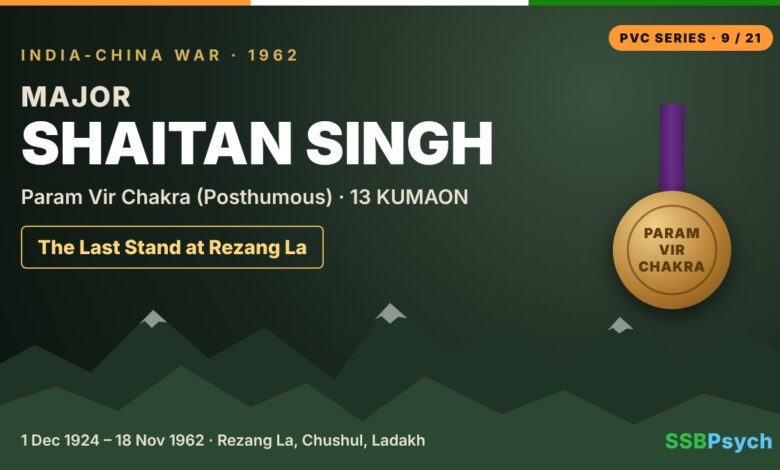
Major Shaitan Singh, PVC: The Hero of Rezang La, 1962 – Full Story (with Quiz)
Some battles are remembered for victories. Rezang La is remembered for something rarer: a company of soldiers who were surrounded, outnumbered and cut off, yet fought on in freezing cold until almost every one of them had fallen. At their head was a quiet officer from the deserts of Rajasthan, Major Shaitan Singh of 13 Kumaon. His leadership on 18 November 1962 earned him the Param Vir Chakra and turned a remote mountain pass in Ladakh into a place of pilgrimage for the Indian Army.
SSB aspirants often hear the phrase “leading from the front”. Major Shaitan Singh is one of the clearest examples of what it really means. In this post we cover his early life, his career, the war background, the battle of Rezang La in detail, his citation and his legacy, followed by Officer Like Qualities and a 10-question quiz to test what you have learned.
Major Shaitan Singh – Quick Facts
| Full name | Shaitan Singh Bhati |
| Born | 1 December 1924, Banasar village, Jodhpur (now Shaitan Singh Nagar, Rajasthan) |
| Father | Lt Col Hem Singh Bhati, OBE |
| Education | Chopasni School and Jaswant College, Jodhpur |
| Joined service | 1 August 1949, Jodhpur State Forces |
| Unit | 13th Battalion, Kumaon Regiment (13 Kumaon), C Company |
| Earlier operations | Naga Hills and the 1961 liberation of Goa |
| Battle | Rezang La, Chushul sector, Ladakh |
| Date of action | 18 November 1962 |
| Altitude | About 16,000 feet |
| Award | Param Vir Chakra (Posthumous) |
Early Life: A Soldier’s Son from Jodhpur
Shaitan Singh Bhati was born on 1 December 1924 in Banasar, a village in the then princely state of Jodhpur. He came from a Rajput family with a strong military tradition. His father, Lieutenant Colonel Hem Singh Bhati, had served in France during the First World War and was awarded the OBE.
He studied at Chopasni School in Jodhpur, where he was known as a keen footballer, and finished school in 1943. He then went to Jaswant College in Jodhpur and graduated in 1947, the year India became independent. Sport, studies and a father who had seen war up close gave him a balanced foundation.
Joining the Army
On 1 August 1949, Shaitan Singh joined the Jodhpur State Forces as an officer. When the princely state merged with India, its forces were absorbed into the Indian Army, and he was transferred to the Kumaon Regiment. He gained valuable experience in operations in the Naga Hills and took part in the 1961 operation that ended Portuguese rule in Goa. He became a captain in 1955 and was promoted to major on 11 June 1962, only months before the battle that would define his life.
The War Background: Chushul, 1962
The India-China war began on 20 October 1962, with attacks in both Ladakh and NEFA. After the first phase, there was a pause of a few weeks, and then the fighting resumed in mid-November. In Ladakh, the key prize was Chushul, with its airfield, which was the lifeline for Indian forces in the area.
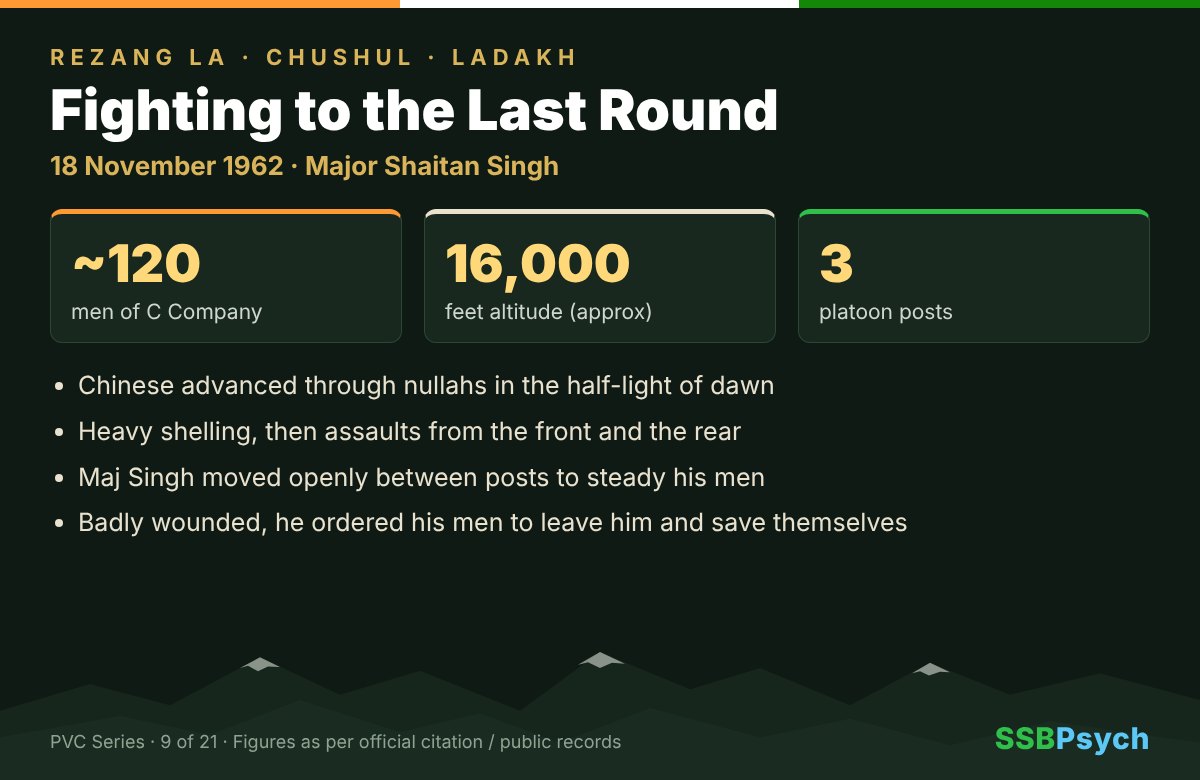
Rezang La is a mountain pass south-east of Chushul, at about 16,000 feet. It was held by C Company of 13 Kumaon, around 120 men, commanded by Major Shaitan Singh. The company was spread across three platoon posts, numbered 7, 8 and 9. The position was isolated from the main defences, and a ridge blocked Indian artillery from giving it effective support. The men were also facing a brutal Ladakh winter, a world away from the plains most of them came from.
The Battle of Rezang La, 18 November 1962
Dawn Attack
In the early hours of 18 November 1962, Chinese troops began moving up through the nullahs (dry stream beds) towards the Indian posts, using the dim light before dawn for cover. Around 5 am the Kumaonis spotted them and opened fire, causing heavy losses. Soon after, Chinese artillery and mortars began pounding the company’s positions.
Attack from the Front
A strong force of several hundred Chinese then advanced from the front. No. 9 Platoon held its fire until the attackers were very close, then opened up with everything it had. The frontal attack was broken with heavy enemy casualties. Having failed head-on, the enemy changed its plan.
Attack from the Rear
Large groups of Chinese troops worked their way around and attacked from the rear. No. 8 Platoon came under heavy machine-gun, artillery and mortar fire. No. 7 Platoon was also attacked from behind. Its surviving soldiers fought hand-to-hand before they were surrounded. Both platoons fought until no one was left standing.
Leading from the Front, Literally
Throughout the battle, Major Shaitan Singh moved from post to post across open ground, under fire, to reorganise the defence and keep his men’s spirits high. A company commander could have stayed in his own trench. He chose to be wherever the danger was greatest. During one of these moves he was seriously wounded in the arm and abdomen.
His soldiers tried to carry him to safety under heavy machine-gun fire. Major Shaitan Singh knew that trying to save him would cost them their own lives. He ordered them to leave him and go. They placed him behind a boulder on the slope, and there he died.
Found Where He Fell
By the end of the day, C Company had been almost wiped out. Of the roughly 120 men, 114 are generally accepted to have been killed, and only a handful survived. When Indian troops were later able to return to the battlefield, they found Major Shaitan Singh’s body at the same boulder where he had fallen. His body was taken to Jodhpur and cremated with full military honours.
According to accounts of the battle, the Chinese troops who took the position covered the Indian dead with blankets and weighed them down with bayonets so the wind would not blow them away. Even an enemy, it seems, recognised that these men had fought with exceptional bravery.
Why Rezang La Mattered
Rezang La fell, but the fight there was far from wasted. The company caused heavy losses to the attacking force and held it up for hours at a point that guarded the approach to Chushul. Within days of the battle, China declared a ceasefire, and Chushul remained in Indian hands. Historians still debate the exact numbers involved, but there is no debate about the spirit of C Company. In a war that brought India much pain, Rezang La became a symbol of pride and of the fighting quality of the Indian soldier.
There is a hard tactical lesson here as well. Because a ridge stood between the company and the guns behind it, the Kumaonis had to fight without proper artillery support. They also lacked the warm clothing and equipment needed for such heights. Modern officers study Rezang La not only to admire the men who fought there, but also to understand how much depends on planning, support and preparation before the first shot is fired.
The Param Vir Chakra Citation (In Simple Words)
Major Shaitan Singh was awarded the Param Vir Chakra posthumously. In simple words, his citation states that he commanded a company at Rezang La in the Chushul sector, which came under massive and repeated Chinese attacks on 18 November 1962. Exposed to heavy fire, he kept moving between his platoon posts to reorganise them and lift his men’s morale. Even after being badly wounded, he went on encouraging them to fight. The company inflicted very heavy losses on the enemy. When he finally fell, he told his men to leave him and save themselves. The citation says that his leadership, courage and devotion to duty inspired his company to fight almost to the very last man.
Legacy of Major Shaitan Singh
- His village, Banasar, has been renamed Shaitan Singh Nagar, and its railway station on the Jodhpur-Jaisalmer line carries the new name.
- The Rezang La War Memorial near Chushul was renovated and rededicated by Defence Minister Rajnath Singh on 18 November 2021.
- His bust and a bronze relief stand at the Param Yodha Sthal of the National War Memorial, New Delhi.
- In January 2023, one of 21 Andaman and Nicobar islands named after PVC recipients was named after him.
- A statue of him stands in a square in Jodhpur, and the Shipping Corporation of India named a tanker MT Major Shaitan Singh, PVC.
- His story has been told in books, a 1988 TV series episode, and the 2025 film 120 Bahadur, in which Farhan Akhtar plays him.
The Indian Army continues to honour the men of Rezang La, and it was on the battle’s anniversary in 2021 that the renovated memorial near Chushul was rededicated. Their stand is studied as a classic example of how a well-led unit can fight beyond what anyone thought possible. It also reminds the nation of the price its soldiers paid in 1962.
For an officer cadet, the most powerful part of the story may be the last order Major Shaitan Singh gave. Badly hurt and close to death, his thought was not for himself but for the two soldiers trying to carry him. Putting your men’s lives before your own is the heart of the officer’s code, and he lived it to the final moment.
Lessons for SSB Aspirants: OLQs in Action
The SSB does not test whether you can recite history – it looks for the qualities of an officer. Here is how Major Shaitan Singh showed them:
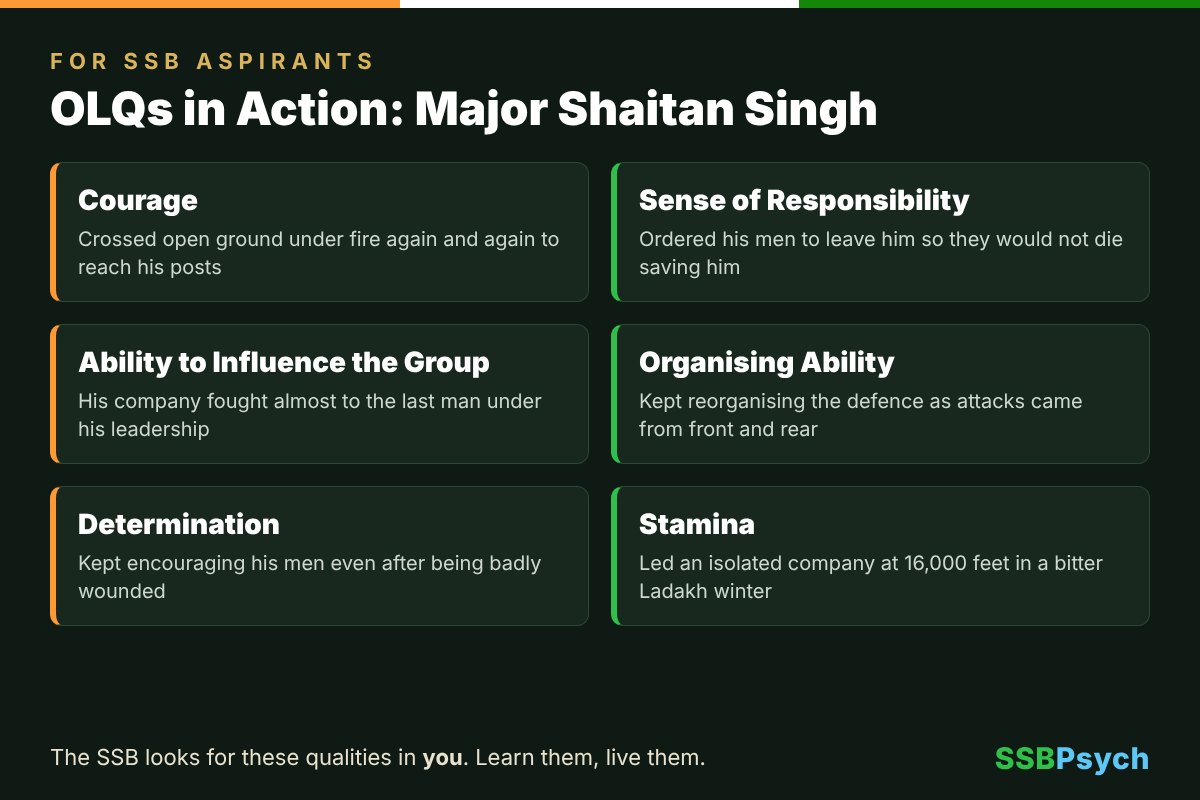
- Courage – Crossed open ground under fire again and again to reach his posts
- Sense of Responsibility – Ordered his men to leave him so they would not die saving him
- Ability to Influence the Group – His company fought almost to the last man under his leadership
- Organising Ability – Kept reorganising the defence as attacks came from front and rear
- Determination – Kept encouraging his men even after being badly wounded
- Stamina – Led an isolated company at 16,000 feet in a bitter Ladakh winter
Tip for your SSB interview: When the IO asks what leadership means to you, avoid textbook definitions. Use an example like Major Shaitan Singh’s final order, then link it to a small moment from your own life where you put your team’s needs before your own.
Practice Corner: WAT and SRT
Write your first spontaneous response to these before you scroll to the quiz. Keep WAT sentences short, positive and action-oriented.
WAT Words
- Sacrifice
- Snow
- Company
- Morale
- Boulder
SRTs
- He is leading a trekking group when a storm hits and two members are exhausted far from camp. He…
- He is injured during a group task and his friends want to stop everything to help him. He…
- He notices that his team’s morale is falling during a long and difficult project. He…
Quiz: How Well Do You Know Major Shaitan Singh?
Test yourself! Click an option to see if you are right. Your score updates live.
Frequently Asked Questions
Why is the Battle of Rezang La famous?
Because C Company of 13 Kumaon, about 120 men under Major Shaitan Singh, fought almost to the last man against a much larger Chinese force on 18 November 1962, inflicting heavy losses.
How did Major Shaitan Singh die?
He was badly wounded while moving between his posts under fire. He ordered the men carrying him to leave him and save themselves, and he died behind a boulder, where his body was later found.
Which regiment did Major Shaitan Singh belong to?
The Kumaon Regiment. He commanded C Company of its 13th Battalion (13 Kumaon).
Where is the Rezang La memorial?
The Rezang La War Memorial is near Chushul in eastern Ladakh. It was renovated and rededicated in November 2021.
Is there a movie on Major Shaitan Singh?
Yes. The 2025 film 120 Bahadur, starring Farhan Akhtar, is based on Rezang La. The 2021 web series 1962: The War in the Hills was also inspired by the battle.
The Param Vir Chakra Series on SSBPsych
This is part 9 of 21 in our series on every Param Vir Chakra awardee. A new hero goes live every morning at 7:30 AM. Also read the story of Captain Vikram Batra, PVC – the Sher Shah of Kargil.
Sources: en.wikipedia.org, en.wikipedia.org, honourpoint.in, www.idsa.in, thehitavada.com.
Preparing for your SSB? Join SSBPsych’s online and offline SSB batches and learn how to show your OLQs with confidence – explore our courses or call +91 8076540582.