Rajput Regiment: History, Motto, War Cry, Battles and Heroes
Some regiments are known for one great battle. The Rajput Regiment is known for many, and also for the men it gave to the nation. It produced Field Marshal K.M. Cariappa, the first Indian Commander-in-Chief of the Indian Army, and Naik Jadunath Singh, whose single-handed charges at Naushera in 1948 earned him the Param Vir Chakra. With a lineage stretching back to 1778 and the war cry of Lord Hanuman on its lips, this regiment lives up to its motto: victory everywhere.
This guide is written for aspirants of NDA, CDS, AFCAT, TES and the SSB interview. It covers the history and lineage of the regiment, a visual timeline, major operations and battle honours, the insignia, motto and war cry, its heroes, life in the regiment, what it means for SSB candidates, and a 10-question quiz at the end.
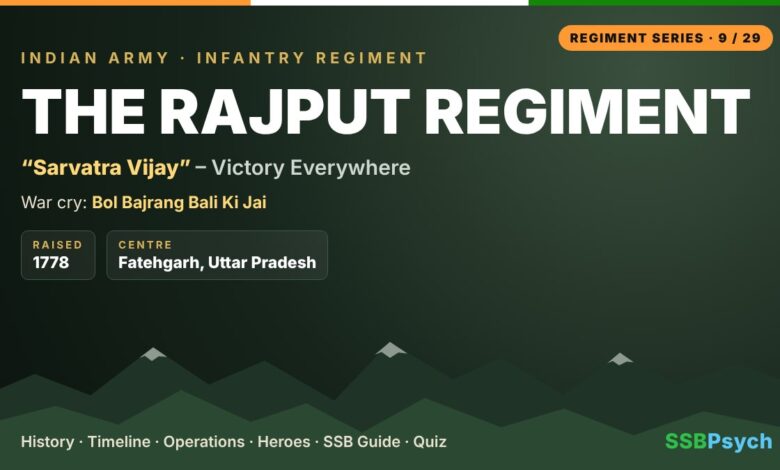
Rajput Regiment – Quick Facts
| Raised | Lineage traced to 1778 (Bengal Native Infantry); grouped as 7th Rajput Regiment in 1922 |
| Regimental Centre | Fatehgarh, Uttar Pradesh |
| Motto | Sarvatra Vijay (Victory Everywhere) |
| War Cry | Bol Bajrang Bali Ki Jai |
| Type | Line infantry |
| Recruitment | Rajputs form the largest share, with Gujars, Muslims, Bengalis and other classes |
| Battalions | Over 20 battalions |
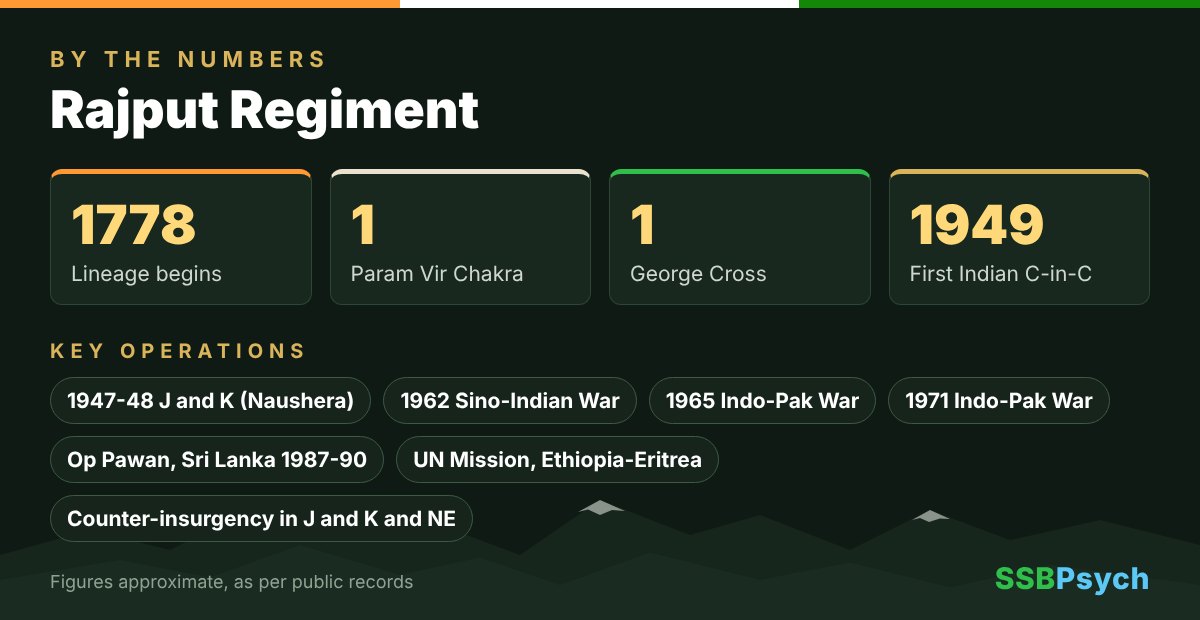
| Notable gallantry | 1 Param Vir Chakra, 1 George Cross and several Maha Vir Chakras |
| Army Chiefs | Gen K.M. Cariappa (later Field Marshal) and Gen V.K. Singh |
| Famous battle | Defence of Taindhar, Naushera, 6 February 1948 |
History of the Rajput Regiment
The Rajput Regiment grew out of the old Bengal Army of the East India Company. Its earliest root is usually traced to 1778, when the 24th Regiment of Bengal Native Infantry was raised. Over the next century several Bengal infantry battalions were raised that would later become part of the regiment, and many of them recruited Rajputs from the Gangetic plains of northern India.
These battalions served in the major wars of the Bengal Army, including campaigns in Afghanistan, Burma and China. Their names changed many times. Some carried royal titles, such as the 2nd Queen Victoria’s Own Rajput Light Infantry and the 7th Duke of Connaught’s Own Rajputs, while another was known as the Lucknow Regiment.
Formation of the 7th Rajput Regiment
In 1922 the British reorganised the Indian Army into large regiments. Five Rajput infantry regiments became the first five battalions of the new 7th Rajput Regiment, and the 16th Rajput Infantry (The Lucknow Regiment) became its training battalion. Fatehgarh in Uttar Pradesh became the home of the regiment, and in 1932 a war memorial in the form of a chhatri was built there with six pillars, one for each battalion of that time.
The World Wars
In the First World War the battalions fought in Mesopotamia, where they faced some of the hardest fighting of the war around Kut al Amara. In the Second World War the Rajputs served in North Africa, including El Alamein, and in Burma, where the 2nd Battalion captured a feature in the Arakan that came to be called Rajput Hill. The 5th Battalion fought in the defence of Hong Kong in 1941 and was taken prisoner. Captain Mateen Ahmed Ansari of this battalion refused to give up his loyalty despite torture by his Japanese captors and was executed in 1943. He was awarded the George Cross posthumously.
In 1942, K.M. Cariappa was given command of a newly raised Rajput machine gun battalion at Fatehgarh, becoming the first Indian officer to command a battalion. At independence the regiment was allotted to India, the numeral 7 was dropped, and it became The Rajput Regiment. In January 1949 Cariappa took over as the first Indian Commander-in-Chief of the Indian Army, a proud moment for the whole regiment.
From Africa to Kohima
The Second World War took Rajput soldiers across three continents. The 3rd Battalion fought in the Western Desert, including the fierce battles on Ruweisat Ridge and at El Alamein in 1942. The 4th Battalion also served in North Africa before moving to the Burma front, where it fought at Kohima, one of the decisive battles of the war in Asia. The 1st Battalion served in the Arakan and later on the Andaman and Nicobar Islands. By 1945 the regiment had built a reputation for steadiness in defence and dash in attack, qualities that would be tested again soon after independence.
Rajput Regiment Timeline: From Raising to Today
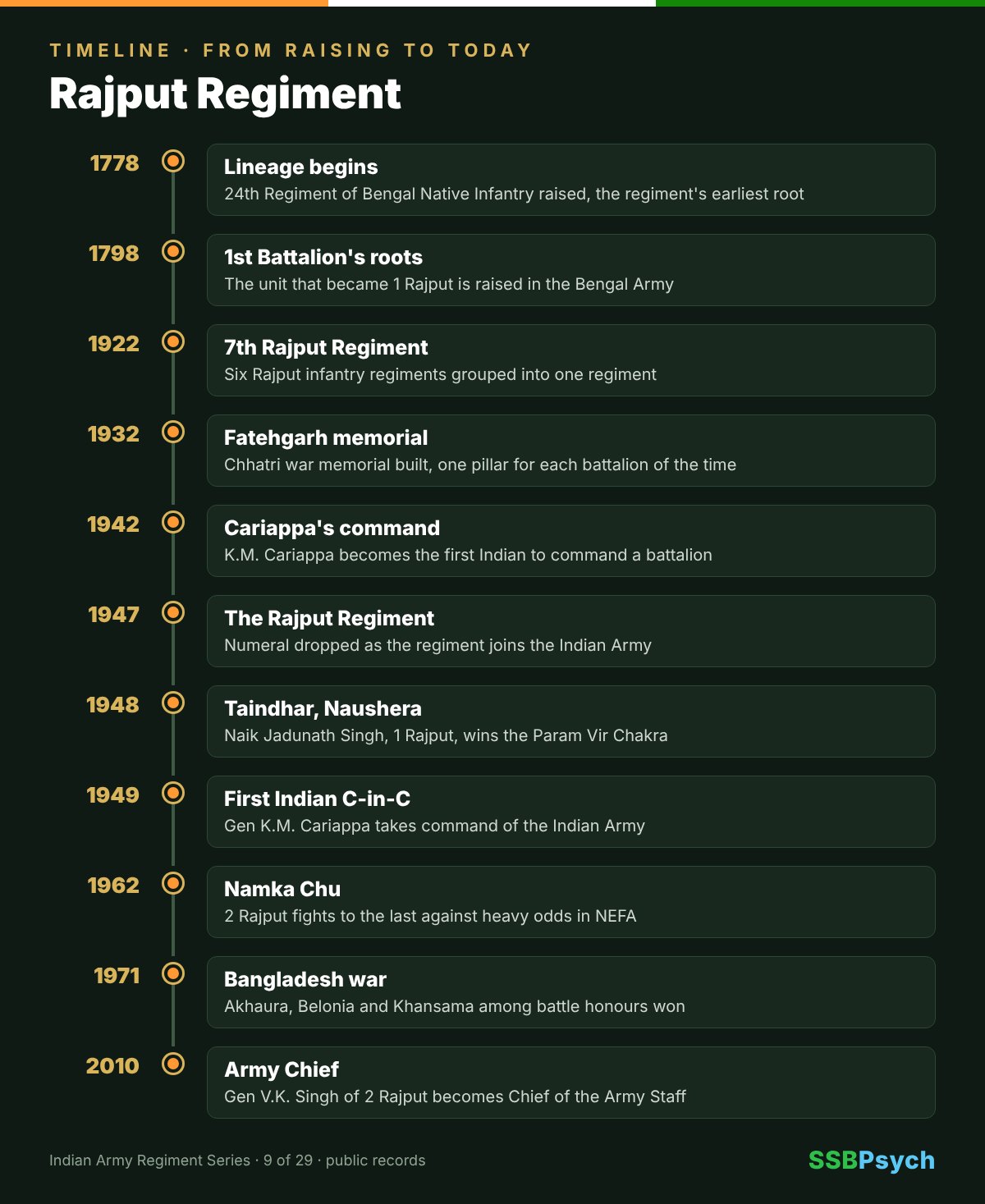
- 1778 – Lineage begins: 24th Regiment of Bengal Native Infantry raised, the regiment’s earliest root
- 1798 – 1st Battalion’s roots: The unit that became 1 Rajput is raised in the Bengal Army
- 1922 – 7th Rajput Regiment: Six Rajput infantry regiments grouped into one regiment
- 1932 – Fatehgarh memorial: Chhatri war memorial built, one pillar for each battalion of the time
- 1942 – Cariappa’s command: K.M. Cariappa becomes the first Indian to command a battalion
- 1947 – The Rajput Regiment: Numeral dropped as the regiment joins the Indian Army
- 1948 – Taindhar, Naushera: Naik Jadunath Singh, 1 Rajput, wins the Param Vir Chakra
- 1949 – First Indian C-in-C: Gen K.M. Cariappa takes command of the Indian Army
- 1962 – Namka Chu: 2 Rajput fights to the last against heavy odds in NEFA
- 1971 – Bangladesh war: Akhaura, Belonia and Khansama among battle honours won
- 2010 – Army Chief: Gen V.K. Singh of 2 Rajput becomes Chief of the Army Staff
Major Operations and Battle Honours
Since independence the regiment has fought in every major war and carried out long counter-insurgency tours. Its post-independence battle honours include Naushera, Zoji La, Khinsar, Madhumati River, Belonia, Khansama and Akhaura.
1947-48: Naushera and Taindhar
The Rajput battalions were among the first troops sent to Jammu and Kashmir. The most famous action was the defence of Naushera by 1 Rajput. On 6 February 1948 the enemy launched wave after wave of attacks on the Taindhar ridge north of Naushera. Naik Jadunath Singh commanded a small forward post that faced the full fury of these assaults. As his men fell wounded one by one, he kept the post fighting, and when the third wave came he charged out alone against the attackers and was killed. His courage saved the post, and he was awarded the Param Vir Chakra posthumously.
1962: Namka Chu
In the Sino-Indian War, 2 Rajput under Lieutenant Colonel M.S. Rikh held positions along the Namka Chu river in NEFA, now Arunachal Pradesh. Poorly equipped and badly outnumbered, the battalion fought on until it was overrun and suffered very heavy casualties. Its stand is remembered as an example of duty in the face of impossible odds.
1965: Kargil, Hajipir and Sialkot
In 1965, 4 Rajput captured heights near Kargil and later fought in the Hajipir area, while other battalions were in action on the Sialkot front in the battles around Phillora and Chawinda.
1971: Liberation of Bangladesh
The 1971 war saw Rajput battalions in action on both fronts. In the east they fought at Akhaura, Belonia, Khansama and along the Madhumati river, and 18 Rajput was among the units that pushed on towards Dhaka. In the west, battalions fought in Rajasthan, Punjab and the Chhamb sector. Several honours from this war appear on the regiment’s colours.
Sri Lanka, Peacekeeping and Counter-Insurgency
Rajput battalions served with the Indian Peace Keeping Force in Sri Lanka, and 27 Rajput served with the United Nations mission in Ethiopia and Eritrea. The regiment has also spent many years on counter-insurgency duty in the North East, Punjab and Jammu and Kashmir.
Rajput Regiment Insignia, Motto and War Cry
The regimental insignia shows a pair of crossed Rajput katars, the traditional push-daggers of Rajput warriors, with three Ashoka leaves on each side. The Lion Capital of Ashoka sits on top, and a scroll below carries the name of the regiment. The katar is a symbol of close-quarter courage, a fitting emblem for an infantry regiment.
The motto is Sarvatra Vijay, meaning victory everywhere. The war cry is Bol Bajrang Bali Ki Jai, which calls on Lord Hanuman, the symbol of strength, loyalty and fearlessness. When Rajput soldiers charge with this cry, they draw on a faith that has carried them through more than two centuries of battle.
The regiment also has a link with the Indian Navy. In 1990 the guided missile destroyer INS Rajput was affiliated with the Rajput Regiment, and the two kept close ties until the ship was decommissioned in May 2021. Such affiliations between Army regiments, Navy ships and Air Force squadrons help build understanding and comradeship across the three services, an idea that matters more than ever as India moves towards joint operations and theatre commands.
Heroes of the Rajput Regiment
Here are some of the most famous names associated with the regiment.
- Naik Jadunath Singh, Param Vir Chakra (posthumous) – 1 Rajput, defended the Taindhar post at Naushera on 6 February 1948.
- Captain Mateen Ahmed Ansari, George Cross (posthumous) – 5/7 Rajput, stood firm under torture as a prisoner of war in Hong Kong.
- Field Marshal K.M. Cariappa – first Indian Commander-in-Chief of the Indian Army (1949 to 1953), whose regimental home was 1/7 Rajput.
- General V.K. Singh – commissioned into 2 Rajput in 1970, Chief of the Army Staff from 2010 to 2012.
- Lieutenant Colonel M.S. Rikh – commanded 2 Rajput in its heroic stand at Namka Chu in 1962.
Role and Life in the Regiment
The Rajput Regiment is a line infantry regiment. Its battalions hold ground, attack enemy positions and carry out counter-insurgency operations. They rotate between high-altitude areas, the Line of Control, the deserts and plains of the west, the forests of the North East and peace stations across India.
Unlike some single-class regiments, the Rajput Regiment has a mixed composition. Rajputs form the largest group, while Gujars, Muslims, Bengalis and soldiers of other classes also serve. This mix teaches officers to lead men from different backgrounds, a valuable skill in an Army that reflects the diversity of India.
The Regimental Centre at Fatehgarh trains every recruit and is the spiritual home of the regiment. Its war memorial and traditions remind young soldiers of the men who went before them. Regimental reunions bring together veterans and serving soldiers, keeping alive the bond between generations.
Daily life in a battalion mixes hard training with strong traditions. Mornings begin with physical training and drills, followed by weapon training, field exercises and administrative work. Festivals are celebrated together in the unit, and places of worship in the unit lines reflect the faiths of its soldiers. These shared customs give the troops a sense of belonging that holds firm under the stress of operations, when every man must trust the soldier next to him.
For a young officer, a Rajput battalion is a place where leadership is tested daily. The soldiers are proud, hardy and loyal, and they expect their officers to share every hardship. The regiment’s history, from Taindhar to Namka Chu, shows what such leadership can achieve.
Lessons from the Rajput Regiment for SSB Aspirants
The story of Naik Jadunath Singh is a perfect example of the qualities SSB assessors look for: courage, initiative, determination and a sense of responsibility for one’s team. He was a junior leader with a handful of men, yet he made decisions under extreme pressure and acted without waiting for orders. Similarly, Cariappa’s career shows how professionalism and integrity can take a soldier to the very top. In your interview, use such examples to explain what leadership means to you. Also remember the lesson of Namka Chu: soldiers can perform heroically even when poorly equipped, but planning, preparation and logistics decide whether their courage is enough. An answer that shows balance, admiring bravery while understanding why the 1962 war went wrong, will impress a board far more than emotional statements.
Rajput Regiment for SSB Candidates: What You Should Know
How officers join
- Officers join the infantry through the National Defence Academy (after Class 12), the Indian Military Academy (via CDS or entries such as TES after Class 12 with PCM) or the Officers Training Academy, Chennai (Short Service Commission).
- Every entry requires clearing the five-day SSB interview and a medical board.
- Arm and regiment are allotted near the end of academy training based on the cadet’s preferences, order of merit and vacancies, so no regiment is guaranteed in advance.
- Officers from any part of India can be commissioned into the Rajput Regiment.
How soldiers join
- Soldiers are recruited as per the regiment’s mixed class pattern, with Rajputs forming the largest share along with Gujars, Muslims, Bengalis and other classes.
- Since 2022, soldiers join as Agniveers under the Agnipath scheme for four years, after which a portion (up to 25 percent as per the scheme) can be selected for regular service.
- Recruits are trained at the Rajput Regimental Centre at Fatehgarh.
Questions you may face in the SSB interview, GD or lecturette
- Why do you want to join the Rajput Regiment or the infantry?
- Who was Naik Jadunath Singh and what did he do at Naushera?
- What is the difference between the Rajput Regiment and the Rajputana Rifles?
- Who was the first Indian Commander-in-Chief of the Indian Army and which regiment was he from?
- Lecturette topic: Lessons of the 1962 Sino-Indian War.
SSBPsych tip: Be ready to explain the difference between the Rajput Regiment and the Rajputana Rifles; mixing them up is a common mistake that interviewers notice.
Read the stories of its Param Vir Chakra heroes: Naik Jadunath Singh.
From the Bengal Native Infantry of 1778 to today’s battalions on the borders, the Rajput Regiment has carried its motto of victory everywhere into every corner of India. Remember its heroes and test your knowledge with the quiz below.
Quiz: How Well Do You Know the Rajput Regiment?
Test yourself! Click an option to see if you are right. Your score updates live.
Rajput Regiment: Frequently Asked Questions
The motto is Sarvatra Vijay, which means victory everywhere.
The Rajput Regimental Centre is at Fatehgarh in Uttar Pradesh.
The war cry is Bol Bajrang Bali Ki Jai, calling on Lord Hanuman.
Naik Jadunath Singh of 1 Rajput was awarded the Param Vir Chakra posthumously for defending the Taindhar post at Naushera on 6 February 1948.
Field Marshal K.M. Cariappa, the first Indian Commander-in-Chief, and General V.K. Singh, Chief of the Army Staff from 2010 to 2012, both belonged to the regiment.
Indian Army Regiments Series on SSBPsych
This is part 9 of 29 in our series on every infantry regiment of the Indian Army – a new regiment every day at 11 AM. Previous in the series: Rajputana Rifles. Also follow our Param Vir Chakra series.
Sources: en.wikipedia.org, en.wikipedia.org, en.wikipedia.org, en.wikipedia.org, en.wikipedia.org.
Preparing for NDA, CDS, AFCAT or your SSB? Join SSBPsych’s online and offline batches – explore our courses or call +91 8076540582.