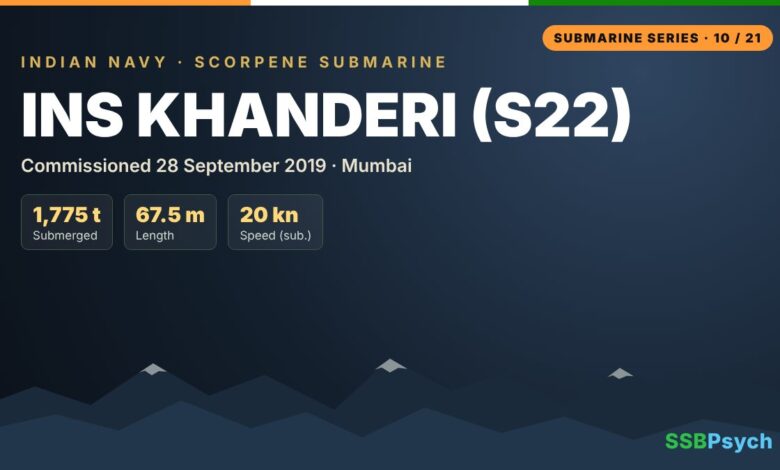
INS Khanderi (S22): Scorpene Submarine Named After a Fort
Off the coast near Mumbai stands a small island fort built by the forces of Chhatrapati Shivaji Maharaj. Centuries later, its name lives on under the sea. INS Khanderi (S22) is the second submarine of India’s Kalvari class, built in Mumbai to the French Scorpene design and commissioned on 28 September 2019. It is now reported to be the first boat in line to receive India’s own Air Independent Propulsion system.
In this post we explain how INS Khanderi was built, how big it is, its weapons and role, life for its crew, the dangers they face, its motto and name, and why its coming upgrade is such big news. We also take a quick look at the first INS Khanderi, which served from 1968 to 1989.

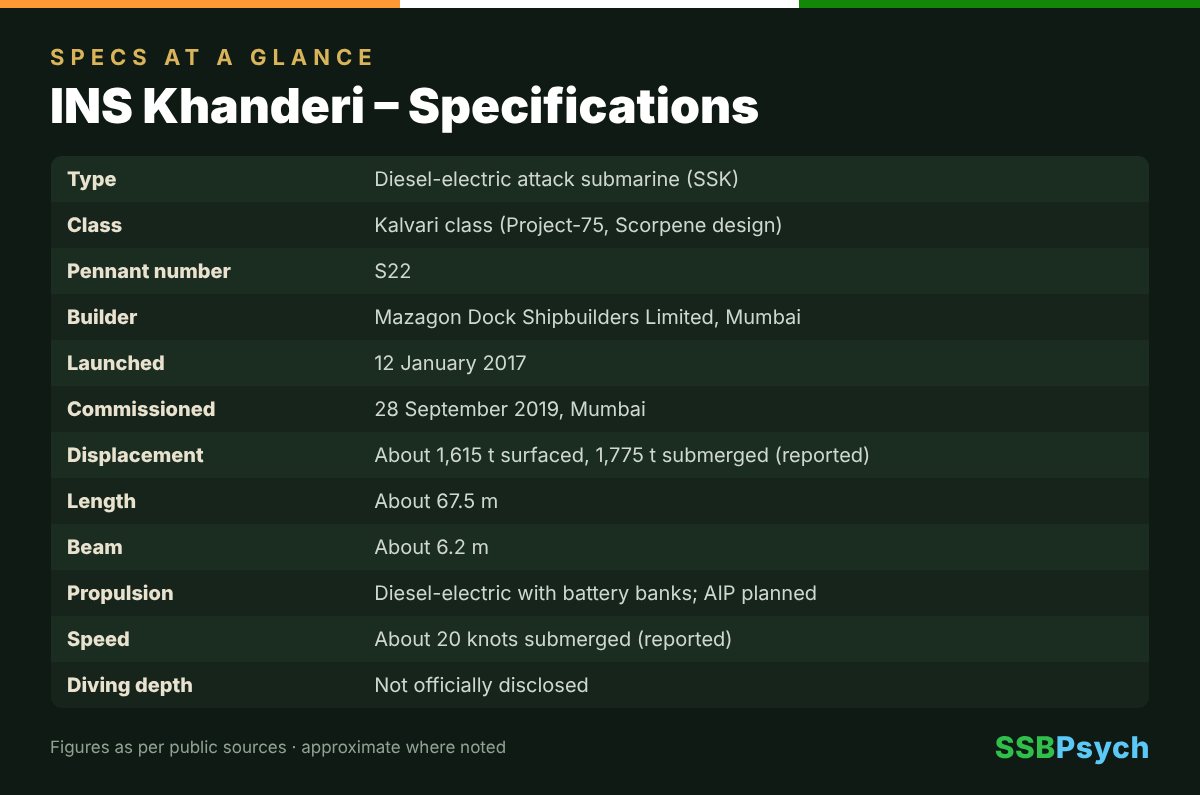
INS Khanderi Specifications
| Type | Diesel-electric attack submarine (SSK) |
| Class | Kalvari class (Project-75, Scorpene design) |
| Pennant number | S22 |
| Builder | Mazagon Dock Shipbuilders Limited, Mumbai |
| Launched | 12 January 2017 |
| Commissioned | 28 September 2019, Mumbai |
| Displacement | About 1,615 t surfaced, 1,775 t submerged (reported) |
| Length | About 67.5 m |
| Beam | About 6.2 m |
| Propulsion | Diesel-electric with battery banks; AIP planned |
| Speed | About 20 knots submerged (reported) |
| Diving depth | Not officially disclosed |
| Crew | About 8 officers and 35 sailors |
| Weapons | Six 533 mm tubes; torpedoes, SM39 Exocet missiles or mines |
| Motto | Akhand, Abhedya, Adrishya |
| Status | In service; AIP refit planned from mid-2026 (reported) |
What Is INS Khanderi?
INS Khanderi is a diesel-electric attack submarine, which navies call an SSK. It charges large batteries with diesel engines and then moves underwater on quiet electric motors. It is one of six boats built under Project-75 at Mazagon Dock Shipbuilders Limited (MDL), Mumbai, with French firm Naval Group, earlier called DCNS, providing the design and technology transfer.
It was commissioned at Mumbai on 28 September 2019 by the Defence Minister. With INS Kalvari already in service, Khanderi’s arrival meant India now had two modern Scorpene boats, and showed that MDL was getting faster at building them.
The First INS Khanderi (1968 to 1989)
The name was first carried by a Soviet-built submarine of the Foxtrot family, one of India’s earliest submarines. That INS Khanderi was commissioned on 6 December 1968 and served for about 21 years until 18 October 1989. When the new Scorpene boat was named Khanderi, it carried forward the memory of those pioneering crews.
How INS Khanderi Was Built
Steel cutting for the new boat took place on 7 April 2009. Like its sister Kalvari, it was built in five large sections, each fitted with pipes, cables and machinery, and then welded together in November 2016. This modular method saves time because many teams can work on different parts at once.
INS Khanderi was launched on 12 January 2017. Launching means the hull is floated for the first time, though much work still remains. It began sea trials on 1 June 2017, where engines, batteries, sensors, weapons and diving were tested step by step. After more than two years of testing, it was delivered to the Navy in September 2019 and commissioned the same month.
INS Khanderi Timeline

- 1968 – First Khanderi: The original INS Khanderi, a Foxtrot-type boat, is commissioned on 6 December 1968.
- 1989 – Old Khanderi retires: The first INS Khanderi is decommissioned on 18 October 1989.
- 2009 – Steel cut: Construction of the new Khanderi begins at MDL on 7 April 2009.
- 2016 – Boot together: Its five hull sections are joined into one in November 2016.
- 2017 – Launched: INS Khanderi is launched at Mumbai on 12 January 2017.
- 2017 – Sea trials: The boat begins sea trials on 1 June 2017.
- 2019 – Commissioned: INS Khanderi is commissioned at Mumbai on 28 September 2019.
- 2022 – Minister at sea: The Defence Minister sails on INS Khanderi off Karwar on 27 May 2022.
- 2026 – AIP refit: A refit adding Indian AIP is reported to begin from mid-2026.
How Big and Fast Is INS Khanderi?
INS Khanderi is about 67.5 metres long, roughly two-thirds the length of a football field, and about 6.2 metres wide. It weighs about 1,615 tonnes on the surface and about 1,775 tonnes when submerged. That is roughly the weight of 1,700 small cars of one tonne each.
Underwater it can reach about 20 knots for short sprints, around 37 km/h. On patrol, though, it creeps along slowly to stay silent and save battery power. Its exact diving depth is not officially disclosed.
Aircraft, Weapons and Sensors
- Six 533 mm torpedo tubes
- Heavyweight torpedoes
- SM39 Exocet anti-ship missiles launched from underwater
- Sea mines as an alternative load
- Up to 18 weapons carried in total (reported)
- Sonar and periscopes for quiet detection
Operations and Missions
- 2022 – Sea sortie with the Defence Minister: Showed its sensors, combat system and weapons during a sortie off Karwar, Karnataka.

Duty and Role of INS Khanderi
INS Khanderi can hunt enemy warships and submarines, lay mines, gather intelligence, keep watch on important sea areas and support special forces. Its stealthy hull shape and quiet machinery help it avoid detection. It was built and commissioned in Mumbai, and Kalvari class boats are widely reported to operate mainly on India’s western seaboard. Exact patrol details are, as always for submarines, kept secret.
On 27 May 2022, the Defence Minister went to sea aboard INS Khanderi during a visit to the Karwar Naval Base in Karnataka. During the sortie the crew demonstrated the submarine’s sensors, combat system and weapons. It was a rare public look at a submarine at work.
INS Khanderi and the AIP Upgrade
Here is why INS Khanderi is in the news. A normal diesel-electric submarine must come close to the surface every few days to run its diesel engines and recharge its batteries through a breathing pipe called a snorkel. That is when it is easiest to detect.
Air Independent Propulsion (AIP) helps solve this. India’s DRDO has developed an AIP system based on fuel cells, which make electricity through a chemical reaction instead of burning fuel with air. Reports say the system will be fitted as an extra hull section, called a plug, which will make the submarine longer. With AIP, the boat can stay underwater for many more days at a time.
According to media reports, INS Khanderi’s refit with AIP is planned to begin in mid-2026. Reports say the integration work is targeted for completion by the end of 2026, with sea trials and full completion of the refit expected later, around 2027 to early 2028. If this works well, the other Kalvari class boats are expected to follow during their own refits. These dates are reported plans and may change.
Crew and Command
INS Khanderi is run by a small crew of about 8 officers and 35 sailors. It is commanded by a Commanding Officer, usually of Commander or Captain rank, supported by officers who look after navigation, weapons, engineering and communications. In such a small team, every person matters, and most are trained to cover more than one role.
Life on Board INS Khanderi
Life on a submarine is a test of patience. There are no windows, little personal space and no sunlight for days. Sailors sleep in narrow bunks, eat in a tiny mess in shifts and save fresh water carefully. Work is divided into watches, so someone is always awake and alert. Even small noises are avoided, because sound travels far in water and could give the boat away.
Despite the hardships, submariners are known for a strong sense of brotherhood. Living so close together, they learn to trust one another completely, and many say this bond is the best part of the job.
AIP vs Nuclear Power: What Is the Difference?
- Nuclear power lets a submarine stay down for months and travel fast, but it is very costly and complex.
- AIP lets a conventional submarine stay down for days or weeks at slow speed, at a much lower cost.
- Batteries alone give the quietest running but only for a short time before recharging.
- An AIP boat still uses its batteries for bursts of speed, and AIP for long, slow, silent patrols.
How INS Khanderi Dives and Surfaces
Every submarine works like a fish that can change its weight. INS Khanderi has ballast tanks that can be flooded with seawater to make it heavy enough to sink, and emptied with compressed air to make it light enough to rise. Small fins called hydroplanes act like the wings of an aeroplane, tilting the boat up or down as it moves. Smaller trim tanks fine-tune its balance so it can hover silently at a chosen depth.
To see above the water without surfacing, the crew raises a periscope, a long tube fitted with lenses and sensors that pokes just above the waves. To hear what is around, the boat relies on sonar, which listens for the faint sounds of ships and other submarines. In submarine warfare, the side that hears first usually wins.
What Makes a Good Submariner?
Sailors who join the submarine arm go through extra medical tests and special training, including how to escape from a stricken boat. They must know the location and use of every key valve and switch, even in the dark. Qualities that help most are a calm mind, team spirit, technical skill and the ability to adapt cheerfully to hard conditions. These happen to be the same qualities that SSB assessors look for in future officers.
Why Does India Need INS Khanderi?
Most of India’s trade and energy imports travel by sea, and the country has a long coastline and important island territories. Submarines like INS Khanderi protect these interests quietly. Their very presence makes any enemy navy cautious, because a hidden submarine could be waiting anywhere. Modern boats like Khanderi also replaced older submarines that were reaching the end of their lives.
Cost and Running Costs
No separate official price for INS Khanderi has been published. The whole Project-75 programme of six submarines has been reported to cost over Rs 23,500 crore. Running costs come from diesel fuel, batteries, regular refits in dry dock, weapons, spare parts and crew training. Adding AIP brings its own extra cost but should make the boat far more useful.
Dangers Faced by the Crew
The sea is unforgiving. Deep underwater, the pressure is enormous, so any leak is serious. Fire in a closed hull produces thick smoke with nowhere to escape. Batteries need careful handling because they can release dangerous gases. Collisions near the surface are another risk. Regular drills, careful maintenance and strict discipline keep these dangers under control.
Name Origin and Motto of INS Khanderi
Khanderi is the name of an island fort off the Maharashtra coast near Mumbai, built by the forces of Chhatrapati Shivaji Maharaj, the Maratha ruler famous for building a strong navy and sea forts to protect his coast. Naming a submarine after this fort honours India’s own early naval tradition.
The submarine’s Sanskrit motto is Akhand, Abhedya, Adrishya. In simple words it means unbroken, impenetrable and invisible, three qualities every submarine crew would love to have.
Shivaji Maharaj understood that whoever controls the sea can protect the land. He built a fleet of fighting ships and a chain of sea forts along the Konkan coast to guard trade and stop raiders. A modern submarine named Khanderi does a similar job today, only from under the waves, which makes the name a perfect fit.
Why INS Khanderi Matters for Aspirants
INS Khanderi links three big exam topics: Project-75, the Maratha naval legacy and India’s push for its own AIP technology. In SSB discussions, it is a good example of how India is steadily moving from buying weapons to designing and upgrading them at home.
Did You Know?
- INS Khanderi is named after an island fort built by Chhatrapati Shivaji Maharaj’s forces.
- Its motto Akhand, Abhedya, Adrishya means unbroken, impenetrable and invisible.
- The first INS Khanderi served the Indian Navy from 1968 to 1989.
- The new Khanderi was launched on 12 January 2017 and commissioned on 28 September 2019.
- It is reported to be the first Kalvari class boat to get India’s own AIP system.
- The AIP plug will make the submarine longer than its sister boats.
Quiz: Test Your Knowledge of INS Khanderi
Click an option to see if you are right. Your score updates live.
INS Khanderi: Frequently Asked Questions
INS Khanderi (S22) is the second Kalvari class Scorpene submarine built by Mazagon Dock in Mumbai. It was commissioned on 28 September 2019.
It is named after the Khanderi island fort near Mumbai built by Chhatrapati Shivaji Maharaj’s forces, and it carries on the name of an earlier submarine that served from 1968 to 1989.
Its Sanskrit motto Akhand, Abhedya, Adrishya means unbroken, impenetrable and invisible.
Yes. Reports say it will be the first Kalvari class boat to be fitted with DRDO’s fuel-cell AIP during a refit planned to start in mid-2026.
Six 533 mm tubes can fire heavyweight torpedoes and SM39 Exocet anti-ship missiles, and the boat can also carry sea mines.
This is part 10 of 21 in SSBPsych’s submarine series – a new post every morning at 10 AM.
Sources: en.wikipedia.org, en.wikipedia.org, en.wikipedia.org, indiannavy.nic.in, pib.gov.in.
Preparing for NDA, CDS, AFCAT or your SSB? Join SSBPsych’s online and offline batches – explore our courses or call +91 8076540582.