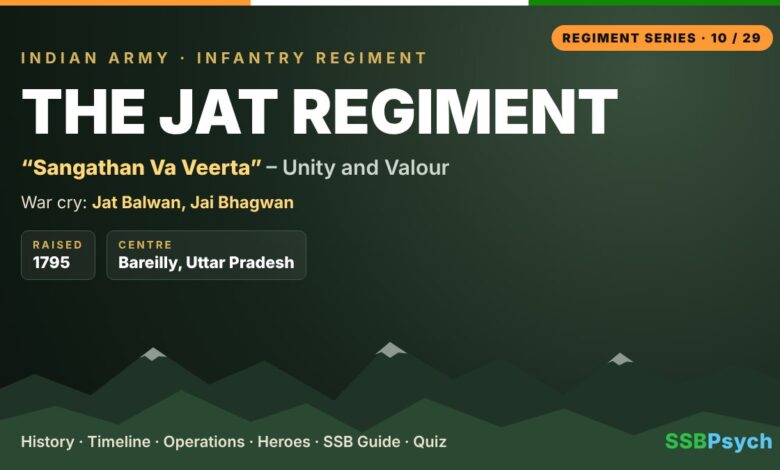
Jat Regiment: History, Motto, War Cry, Battles and Heroes
When people talk about the toughest infantry soldiers of India, the Jat Regiment is always in the conversation. Born from a small militia raised in Calcutta in 1795, it has fought in France and Mesopotamia, in Malaya and Burma, at the gates of Lahore in 1965 and on the icy heights of Kargil in 1999. Its soldiers, drawn mainly from the farming communities of Haryana, Rajasthan, Delhi and western Uttar Pradesh, are known for their sturdiness, stubborn courage and loyalty to the paltan.
This guide is for NDA, CDS, AFCAT, TES and SSB aspirants who want to know the regiment well. We cover its history and lineage, a quick visual timeline, major operations and battle honours, its insignia, motto and war cry, its heroes, life in the regiment, what it means for SSB candidates, and a 10-question quiz at the end.
Jat Regiment – Quick Facts
| Raised | 1795, as the Calcutta Native Militia; grouped as 9th Jat Regiment in 1922 |
| Regimental Centre | Bareilly, Uttar Pradesh |
| Motto | Sangathan Va Veerta (Unity and Valour) |
| War Cry | Jat Balwan, Jai Bhagwan (adopted in 1955) |
| Recruitment | Mainly Jats from Haryana, Rajasthan, Delhi and Uttar Pradesh |
| Battalions | Over 20 regular battalions, plus Rashtriya Rifles and Territorial Army units |
| Notable gallantry | 1 Victoria Cross (World War II), Ashoka Chakras and Maha Vir Chakras |
| Famous battle | Dograi, near Lahore, 1965 |
| Regimental colours | Blue, yellow and green |
| Anniversary | 20 November |
History of the Jat Regiment
The regiment traces its oldest root to 10 July 1795, when the East India Company raised the Calcutta Native Militia as a garrison unit for local guard duties. That unit later became a regular infantry battalion of the Bengal Army and eventually formed the training centre of the regiment. In 1803 another battalion was raised at Fatehgarh that would later become 1 Jat.
Jats from western Uttar Pradesh and the Delhi region were recruited in larger numbers after 1857, and from 1892 the British began forming battalions made up of a single class of soldiers. Battalions such as the 6th Jat Light Infantry and the 10th Jats were among the units that would later form the regiment. After the First World War the 6th Jat Light Infantry received the title Royal, becoming the 6th Royal Jat Light Infantry.
Formation of the 9th Jat Regiment
In the reorganisation of 1922 the British grouped these battalions into the 9th Jat Regiment. The number nine reflected the seniority of one of its older units among the infantry regiments of the time. The training battalion was set up at Bareilly, which has remained the home of the regiment ever since. A battalion from the old Bombay Army, the Mooltan Regiment, also joined and became 2 Jat.
The World Wars
In the First World War the battalions fought in France and Flanders and in Mesopotamia, earning honours such as Neuve Chapelle, Festubert, Shaiba and Ctesiphon. During the Second World War the regiment expanded and fought in North Africa, Malaya, Singapore, Burma, Java and Sumatra. Two battalions were caught in the fall of Malaya and Singapore in 1942, but others fought hard in the Burma campaign, including the battles around Imphal, where the regiment won a Victoria Cross in 1944.
On 28 November 1945 the prefix nine was dropped, and the regiment became simply The Jat Regiment. At partition, Muslim soldiers moved to the Pakistan Army, and Hindu Jats from other regiments joined the Jat Regiment, which was allotted to India.
Jat Regiment Timeline: From Raising to Today
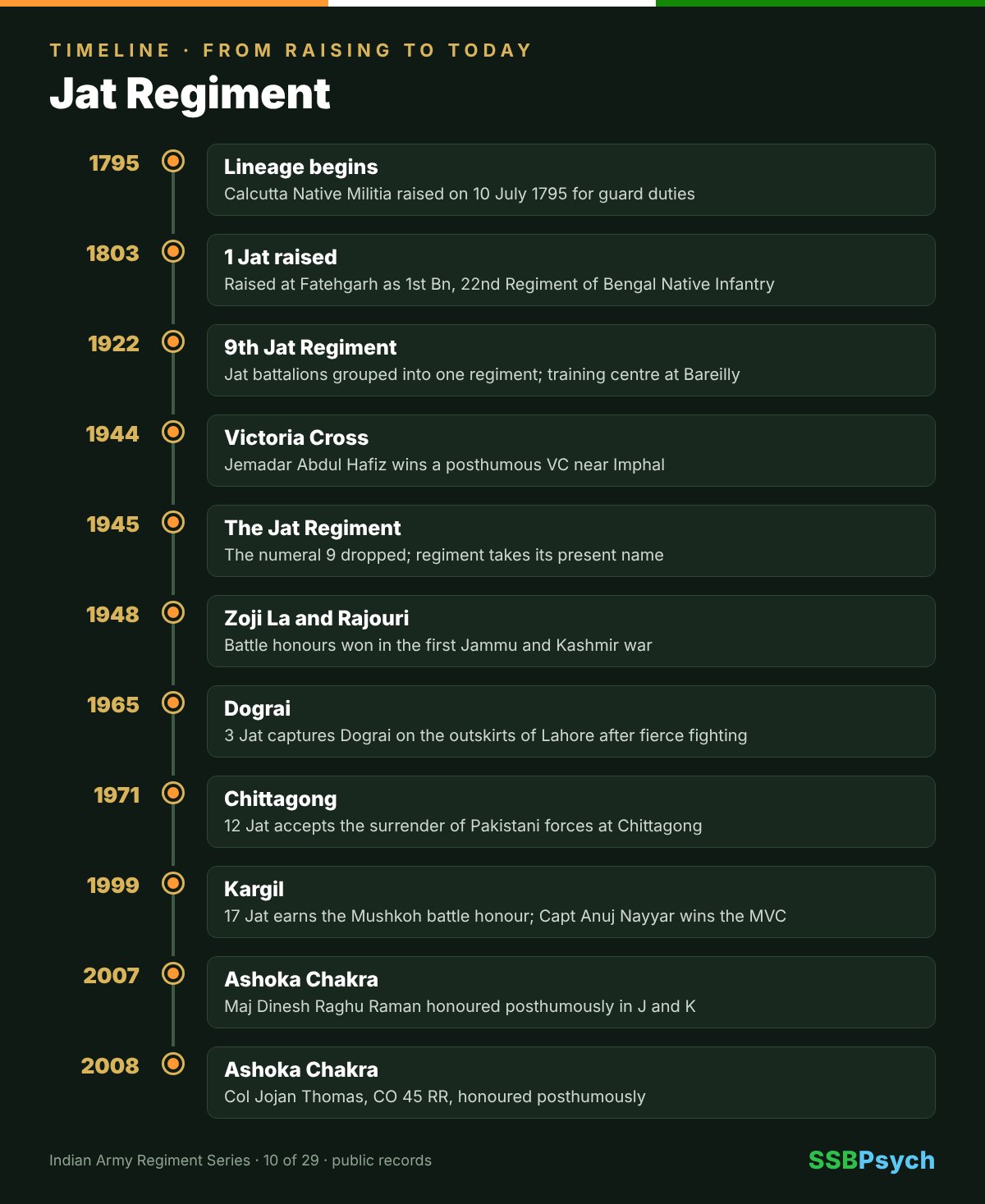
- 1795 – Lineage begins: Calcutta Native Militia raised on 10 July 1795 for guard duties
- 1803 – 1 Jat raised: Raised at Fatehgarh as 1st Bn, 22nd Regiment of Bengal Native Infantry
- 1922 – 9th Jat Regiment: Jat battalions grouped into one regiment; training centre at Bareilly
- 1944 – Victoria Cross: Jemadar Abdul Hafiz wins a posthumous VC near Imphal
- 1945 – The Jat Regiment: The numeral 9 dropped; regiment takes its present name
- 1948 – Zoji La and Rajouri: Battle honours won in the first Jammu and Kashmir war
- 1965 – Dograi: 3 Jat captures Dograi on the outskirts of Lahore after fierce fighting
- 1971 – Chittagong: 12 Jat accepts the surrender of Pakistani forces at Chittagong
- 1999 – Kargil: 17 Jat earns the Mushkoh battle honour; Capt Anuj Nayyar wins the MVC
- 2007 – Ashoka Chakra: Maj Dinesh Raghu Raman honoured posthumously in J and K
- 2008 – Ashoka Chakra: Col Jojan Thomas, CO 45 RR, honoured posthumously
Major Operations and Battle Honours
The Jat Regiment has taken part in every major war of independent India. Its post-independence battle honours include Rajouri, Zoji La, Dograi, Phillora and Mushkoh, along with several theatre honours.
1947-48: Rajouri and Zoji La
In the first war in Jammu and Kashmir, 2 Jat fought in the Naushera area and earned the battle honour Rajouri, while 3 Jat took part in the capture of the Zoji La pass, a vital gateway to Ladakh, and earned the honour Zoji La. In 1948, 6 Jat was also involved in the operation that brought Hyderabad into the Indian Union.
1962 and Operation Ragini
During the Sino-Indian War of 1962, 5 Jat fought in Ladakh. In 1964, 7 Jat evicted Pakistani intruders from the Tangdhar area in an operation called Operation Ragini.
1965: The Battle of Dograi
The most famous chapter in the regiment’s history is the Battle of Dograi in 1965. Dograi was a fortified village on the outskirts of Lahore, close to the Ichhogil canal. 3 Jat first reached it on 6 September but could not hold it. Under its Commanding Officer, Lieutenant Colonel Desmond Hayde, the battalion launched a fresh attack on 20 September and, after more than a day of close and bloody fighting, captured Dograi by 22 September, just before the ceasefire. The battle is studied as a classic example of infantry determination, and Lt Col Hayde was awarded the Maha Vir Chakra. The battalion also earned the battle honour Dograi. In the same war, 5 Jat captured Phillora in the Sialkot sector.
1971: Two Fronts
In 1971 a large number of Jat battalions fought in the west and the east. In the east, Jat units fought in the battles of Madhumati, Comilla and Maynamati, and 12 Jat accepted the surrender of Pakistani forces at Chittagong on 17 December 1971. In the west, battalions defended Fazilka, fought in Poonch and Chhamb, and held the Line of Control.
Sri Lanka, Kargil and Peacekeeping
Jat battalions served with the Indian Peace Keeping Force in Sri Lanka from 1987 to 1990. In the Kargil War of 1999 several battalions took part. 17 Jat fought in the Mushkoh valley around Point 4875 and earned the battle honour Mushkoh and the theatre honour Kargil. The regiment has also served in United Nations missions in the Congo, Sudan and Lebanon, and its battalions have spent many years fighting insurgency in Jammu and Kashmir and the North East.
The story of Captain Anuj Nayyar shows the spirit of the regiment at Kargil. In early July 1999 his company was tasked to capture part of the Pimple complex on the slopes of Point 4875, a key height overlooking the Mushkoh valley. Under heavy fire, he led his men in clearing one enemy bunker after another. He was killed by an enemy rocket during the final stage of the assault, but his company’s success helped secure the feature. He was still in his early twenties and was awarded the Maha Vir Chakra posthumously.
Peacekeeping has become another proud tradition. A Jat battalion served with the Custodian Force in Korea in 1953, and since then Jat units have worn the blue helmets of the United Nations in the Congo, Sudan and Lebanon. In such missions soldiers must protect civilians, keep warring sides apart and win the trust of local people, which calls for patience and discipline as much as fighting skill.
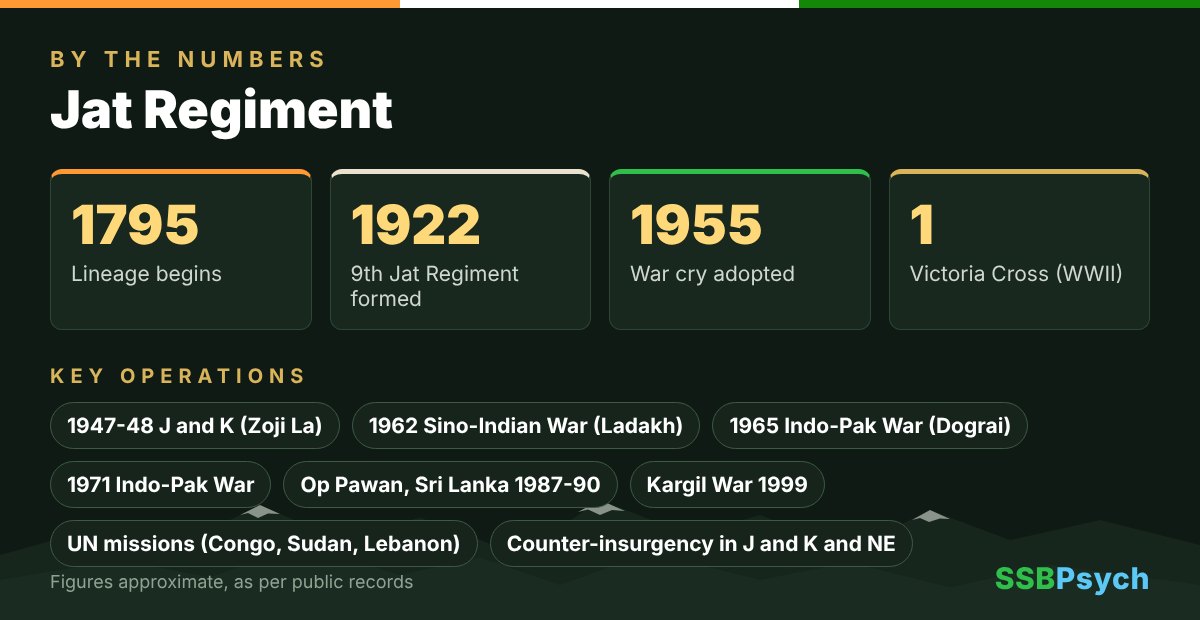
Jat Regiment Insignia, Motto and War Cry
The regimental crest carries the Roman numeral IX, a reminder of the old title 9th Jat Regiment. It is topped by the Lion Capital of Ashoka, and a scroll below bears the name of the regiment. A bugle in the design recalls the light infantry roots of some of its oldest battalions. The regimental colours are blue, yellow and green, taken from the flags of its first three battalions.
The motto is Sangathan Va Veerta, meaning unity and valour. It reflects the belief that a unit is strongest when its men stand together. The war cry, adopted in 1955, is Jat Balwan, Jai Bhagwan, which roughly means the Jat is mighty, victory to God.
Heroes of the Jat Regiment
The regiment’s roll of honour is long. Here are some of its best known heroes.
- Jemadar Abdul Hafiz, Victoria Cross (posthumous) – 9th Jat Regiment, led an attack on a hill near Imphal on 6 April 1944.
- Lt Col (later Brig) Desmond Hayde, Maha Vir Chakra – commanded 3 Jat in the capture of Dograi in September 1965.
- Major Asa Ram Tyagi, Maha Vir Chakra (posthumous) – 3 Jat, fell in the fighting for Dograi in 1965.
- Captain Anuj Nayyar, Maha Vir Chakra (posthumous) – 17 Jat, led the assault on the Pimple complex at Point 4875, Kargil, in July 1999.
- Major Dinesh Raghu Raman, Ashoka Chakra (posthumous) – Jat Regiment officer serving with 34 Rashtriya Rifles, killed fighting terrorists in October 2007.
- Colonel Jojan Thomas, Ashoka Chakra (posthumous) – commissioned into 11 Jat, killed while commanding 45 Rashtriya Rifles in Kupwara in August 2008.
Role and Life in the Regiment
Like every infantry regiment, the Jat Regiment fights on foot to capture and hold ground. Its battalions rotate between high-altitude posts, the Line of Control, counter-insurgency areas, the deserts and plains of the west and peace stations across India. One battalion, the old 1 Jat, was converted into a mechanised infantry battalion in 1981, showing how the regiment has adapted to modern warfare.
Most soldiers come from Jat farming families in Haryana, Rajasthan, Delhi and Uttar Pradesh, and many have fathers and grandfathers who served in the same regiment. This creates a strong family feeling inside each battalion. Jat soldiers are known for their physical strength, frankness and straightforward nature. They respect officers who are fair, fit and willing to lead from the front.
Counter-insurgency has shaped the modern regiment. Jat officers and soldiers serving with Rashtriya Rifles battalions in Jammu and Kashmir have earned many gallantry awards, including two Ashoka Chakras in 2007 and 2008. Such operations demand sharp intelligence work, small-team leadership and great care to protect innocent civilians while hunting down armed terrorists.
The Jat Regimental Centre at Bareilly trains every recruit and preserves the regiment’s history. It displays the famous portraits of Subedar Major Mauji Ram, painted in the 1920s, which have become part of regimental lore. Sport is a big part of life in Jat battalions, and the regiment has produced many athletes and wrestlers.
What the Jat Regiment Teaches SSB Aspirants
The Battle of Dograi is a favourite topic in interviews and group discussions because it shows how persistence wins battles. 3 Jat lost Dograi once, but it did not give up. The commanding officer planned carefully, kept his men motivated and attacked again. That combination of planning, determination and leadership by example is exactly what SSB assessors look for in a future officer. Use such examples to show that you understand leadership as action, not just as a title. You can also draw on the regiment’s motto. Unity and valour go together: a group task at the SSB, like a battle, is won when every member contributes and the leader keeps the team united towards one goal. Showing that you can bring people together is often more valuable than showing that you can shine alone.
Jat Regiment for SSB Candidates: What You Should Know
How officers join
- Officers join the infantry through the National Defence Academy (after Class 12), the Indian Military Academy (via CDS or entries such as TES after Class 12 with PCM) or the Officers Training Academy, Chennai (Short Service Commission).
- Every entry requires clearing the five-day SSB interview and a medical board.
- Arm and regiment are allotted near the end of academy training based on the cadet’s preferences, order of merit and vacancies, so no regiment is guaranteed in advance.
- Officers from any part of India can be commissioned into the Jat Regiment and lead its troops.
How soldiers join
- Soldiers are recruited mainly from Jats of Haryana, Rajasthan, Delhi and Uttar Pradesh, as per the regiment’s recruitment pattern.
- Since 2022, soldiers join as Agniveers under the Agnipath scheme for four years, after which a portion (up to 25 percent as per the scheme) can be selected for regular service.
- Recruits are trained at the Jat Regimental Centre in Bareilly.
Questions you may face in the SSB interview, GD or lecturette
- Why do you want to join the Jat Regiment or the infantry?
- What happened at the Battle of Dograi in 1965?
- What does the motto Sangathan Va Veerta teach a young officer?
- Name a Kargil War hero from the Jat Regiment.
- Lecturette topic: The 1965 Indo-Pak War and its lessons.
SSBPsych tip: Prepare the Battle of Dograi as a short story with a clear lesson about persistence and planning; SSB boards respond well when you connect history to your own experience of not giving up.
From a militia in Calcutta to the heroes of Dograi and Kargil, the Jat Regiment has lived up to its motto of unity and valour. Remember its story and test your knowledge with the quiz below.
Quiz: How Well Do You Know the Jat Regiment?
Test yourself! Click an option to see if you are right. Your score updates live.
Jat Regiment: Frequently Asked Questions
The motto is Sangathan Va Veerta, which means unity and valour.
The Jat Regimental Centre is at Bareilly in Uttar Pradesh.
The war cry is Jat Balwan, Jai Bhagwan, meaning the Jat is mighty, victory to God. It was adopted in 1955.
In September 1965, 3 Jat captured the fortified village of Dograi near Lahore after fierce fighting. It is one of the best known infantry actions of the 1965 war.
Soldiers are recruited mainly from Jats of Haryana, Rajasthan, Delhi and Uttar Pradesh, now through the Agnipath scheme. Officers from any background can be commissioned into the regiment.
Indian Army Regiments Series on SSBPsych
This is part 10 of 29 in our series on every infantry regiment of the Indian Army – a new regiment every day at 11 AM. Previous in the series: Rajput Regiment. Also follow our Param Vir Chakra series.
Sources: en.wikipedia.org, en.wikipedia.org, en.wikipedia.org, en.wikipedia.org, en.wikipedia.org.
Preparing for NDA, CDS, AFCAT or your SSB? Join SSBPsych’s online and offline batches – explore our courses or call +91 8076540582.