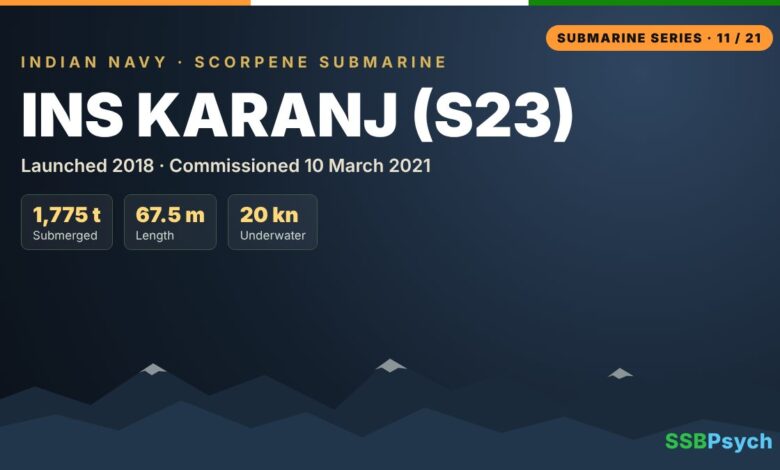
INS Karanj (S23): India’s Silent Scorpene Hunter Explained
Imagine a steel hunter that slips under the waves, switches off almost every noise it makes, and waits for hours without anyone knowing it is there. That is INS Karanj, pennant number S23, the third Kalvari-class submarine of the Indian Navy. Built in Mumbai and commissioned on 10 March 2021, it is one of the quietest diesel-electric boats India has ever operated.
In this guide we will cover everything an NDA, CDS, AFCAT or SSB aspirant should know about INS Karanj: what kind of submarine it is, how big it is, what weapons it carries, how many sailors live inside, why India needed it, what it cost, how deep it can dive, what dangers its crew face, and the proud story behind its name. Keep scrolling, because the facts get more interesting as we go deeper.

What Is INS Karanj?
INS Karanj is a diesel-electric attack submarine. In simple words, it is an underwater warship whose main job is to find and, if war comes, sink enemy ships and submarines. It belongs to the Kalvari class, which is India’s version of the French Scorpene design. Six of these boats were built under a programme called Project 75 at Mazagon Dock Shipbuilders Limited (MDL) in Mumbai, with design help and technology transfer from France’s Naval Group, earlier called DCNS.
Karanj was the third boat of the six. The first two were INS Kalvari (2017) and INS Khanderi (2019). After Karanj came INS Vela, INS Vagir and INS Vagsheer. Together these six form the most modern conventional submarine squadron in the Indian Navy today.
What does diesel-electric mean?
Think of a hybrid car. When the submarine is on the surface or just below it with a breathing pipe called a snorkel poking out, its diesel engines run generators that charge a huge bank of batteries. When it dives deep, the noisy diesels are switched off and the boat runs silently on battery power alone, driving an electric motor that turns the propeller. Batteries are almost silent, and silence is the biggest weapon a submarine has.
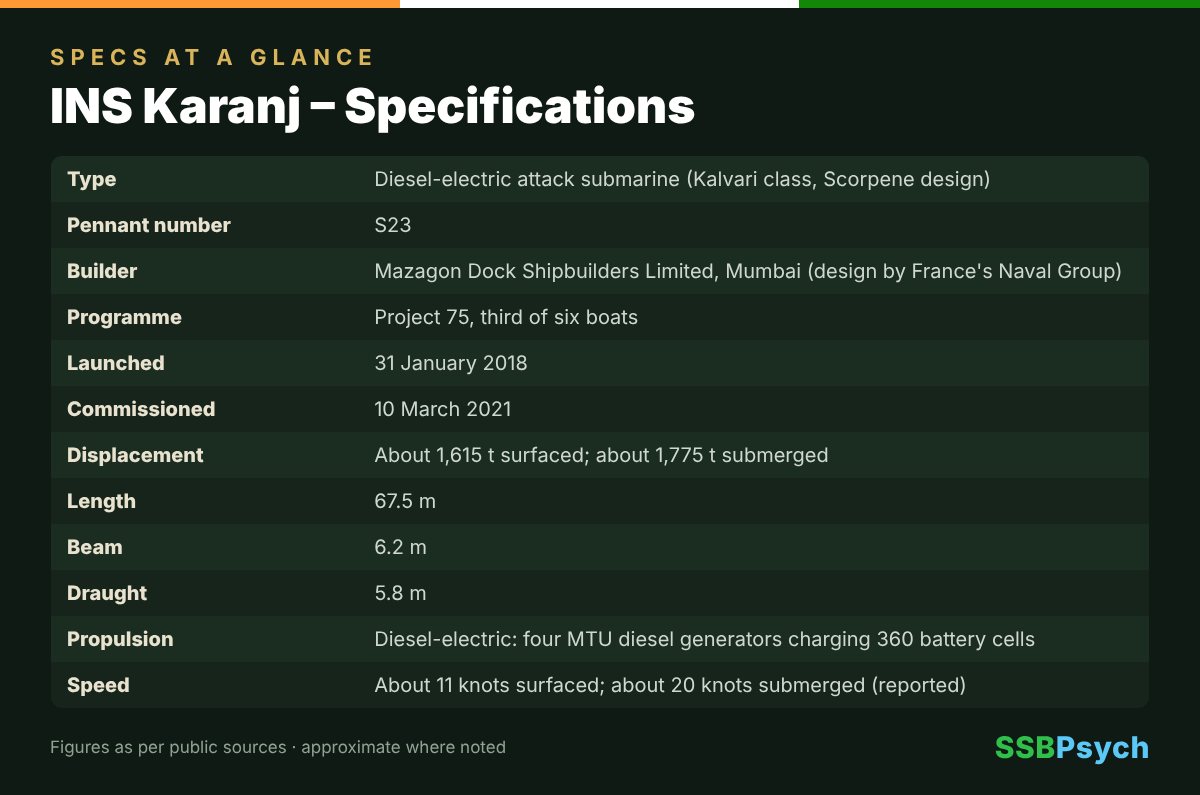
INS Karanj Specifications
| Type | Diesel-electric attack submarine (Kalvari class, Scorpene design) |
| Pennant number | S23 |
| Builder | Mazagon Dock Shipbuilders Limited, Mumbai (design by France’s Naval Group) |
| Programme | Project 75, third of six boats |
| Launched | 31 January 2018 |
| Commissioned | 10 March 2021 |
| Displacement | About 1,615 t surfaced; about 1,775 t submerged |
| Length | 67.5 m |
| Beam | 6.2 m |
| Draught | 5.8 m |
| Propulsion | Diesel-electric: four MTU diesel generators charging 360 battery cells |
| Speed | About 11 knots surfaced; about 20 knots submerged (reported) |
| Range / endurance | About 6,500 nautical miles at 8 knots (reported); about 50 days at sea |
| Diving depth | Test depth reported around 350 m; operational limits are classified |
| Crew | About 43 (8 officers and 35 sailors, as reported) |
| Status | In active service |
How Big Is INS Karanj?
INS Karanj is about 67.5 metres long, roughly the length of five or six city buses parked nose to tail, and about 6.2 metres wide. When fully submerged it displaces about 1,775 tonnes. Displacement simply means the weight of water the hull pushes aside, which equals the weight of the boat. That is about as heavy as 1,400 small hatchback cars put together.
Compared with a nuclear submarine like INS Arihant, Karanj is small and nimble. That compact size is deliberate. A smaller hull is easier to hide, works well in shallow coastal waters near India’s shores, and makes less noise as it moves.
Duty and Role: What Does INS Karanj Do?
The Navy describes Scorpene boats as capable of many kinds of missions. In plain language, INS Karanj can be asked to do the following jobs:
- Anti-surface warfare: hunting enemy warships and supply ships with torpedoes and missiles.
- Anti-submarine warfare: tracking and attacking enemy submarines.
- Intelligence gathering: quietly watching and listening to ships, ports and signals.
- Mine laying: placing sea mines to block an enemy harbour or sea lane.
- Area surveillance: keeping an eye on key stretches of the Arabian Sea and Indian Ocean.
Just the fact that an enemy does not know where Karanj is creates fear. Navies call this deterrence: an opponent has to think twice before sending ships near Indian waters because a silent submarine might be waiting.
INS Karanj Timeline
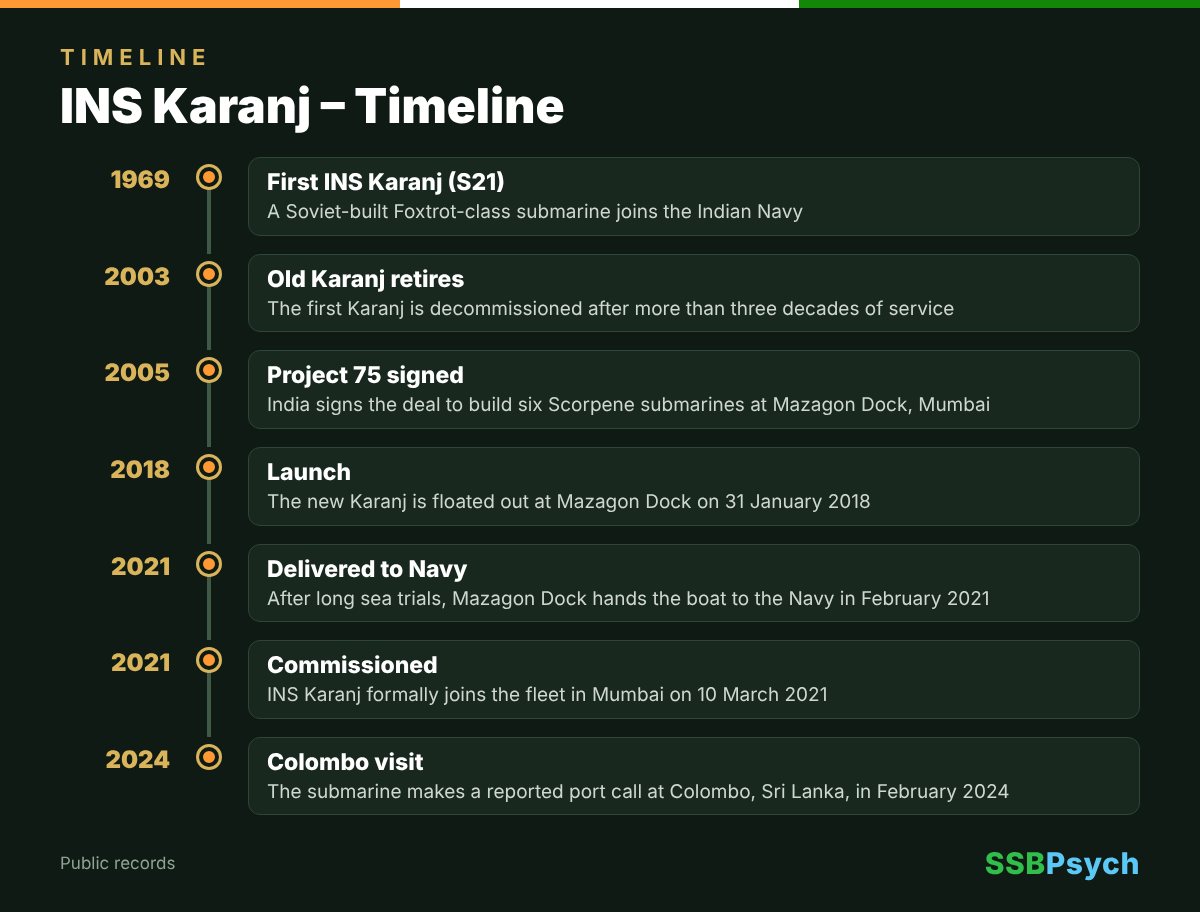
- 1969 – First INS Karanj (S21): A Soviet-built Foxtrot-class submarine joins the Indian Navy
- 2003 – Old Karanj retires: The first Karanj is decommissioned after more than three decades of service
- 2005 – Project 75 signed: India signs the deal to build six Scorpene submarines at Mazagon Dock, Mumbai
- 2018 – Launch: The new Karanj is floated out at Mazagon Dock on 31 January 2018
- 2021 – Delivered to Navy: After long sea trials, Mazagon Dock hands the boat to the Navy in February 2021
- 2021 – Commissioned: INS Karanj formally joins the fleet in Mumbai on 10 March 2021
- 2024 – Colombo visit: The submarine makes a reported port call at Colombo, Sri Lanka, in February 2024
Aircraft, Weapons and Sensors
- Six 533 mm torpedo tubes
- SUT heavyweight wire-guided torpedoes (about 18 weapons can be carried, as reported)
- SM.39 Exocet anti-ship missiles fired from the torpedo tubes
- Sea mines (reported about 30) in place of torpedoes
- C303/S anti-torpedo decoy system
- Hull-mounted and flank sonars for silent listening
- Periscopes, radar and electronic support measures for surface search
How the weapons work
All of Karanj’s punch comes out of six torpedo tubes at the front of the boat. The SUT torpedo is a heavyweight torpedo that stays connected to the submarine by a thin wire after launch, so the crew can steer it towards a target. The Exocet SM.39 is clever: it is fired underwater inside a capsule, the capsule rises to the surface, and the missile then flies low over the waves towards an enemy ship. The boat can also carry sea mines instead of torpedoes. For defence, a decoy system can confuse incoming enemy torpedoes.
Operations and Missions
- 1971 – Old Karanj in the 1971 war: The first submarine to carry the name served during the 1971 India-Pakistan war
- 2021 – Commissioning in Mumbai: Commissioned in the presence of the then Navy chief, Admiral Karambir Singh
- 2024 – Port call at Colombo: Reported goodwill visit to Sri Lanka in February 2024, building naval friendship

Why Does India Need INS Karanj?
India has a coastline of over 7,500 km, island chains on both sides, and most of its trade and oil arrives by sea. Through the 2000s and 2010s, the Navy’s older Russian and German-designed submarines were ageing fast, while other navies in the region were adding new boats. Project 75 was approved to fill that gap with modern, quiet submarines built at home.
Karanj and its sister boats also built something just as valuable as the submarines themselves: skill. Mazagon Dock’s engineers and workers learnt how to build a modern submarine hull, fit complex combat systems and run long sea trials. That knowledge feeds directly into future Indian submarine programmes.
INS Karanj Name Origin: A Name With History
Indian Navy submarines often carry forward the names of retired boats. The first INS Karanj (S21) was a Soviet-built Foxtrot-class submarine that joined the Navy in 1969 and served until 2003, including during the 1971 India-Pakistan war. The new Karanj proudly carries that legacy. The name is commonly linked to Karanja, an island near Uran on the Mumbai harbour side in Raigad district, Maharashtra.
At the 2021 commissioning, the then Chief of the Naval Staff, Admiral Karambir Singh, was present, along with Admiral V S Shekhawat (retd), a former Navy chief. It was a moving moment that linked the veterans of the old Karanj to the young crew of the new one.
Crew Size and Who Commands the Submarine
A Kalvari-class boat is reported to carry about 43 people: roughly 8 officers and 35 sailors. That is a small team for a warship, and everyone must know several jobs. Indian Navy submarines of this size are usually commanded by an officer of Commander rank, a senior officer who has passed tough submarine command training. Under the commanding officer come an executive officer (second in command) and specialist officers for weapons, engineering, electrical systems and navigation, supported by highly trained sailors.
Life on Board INS Karanj
Life inside a submarine is not for everyone. Space is so tight that many sailors share bunks in shifts, a practice called hot bunking, where one person sleeps while the other is on watch. There are no windows, no sunlight and no fresh air for days when the boat stays deep. Days are divided into watches, so the clock can feel strange after a while.
- Food is cooked in a tiny galley, and fresh vegetables run out within the first days of a patrol.
- Water is precious, so showers are short and rare.
- Silence rules: when the boat is hiding, even dropping a spanner can give away its position.
- There is no mobile signal underwater, so sailors are cut off from family for long stretches.
- Strong teamwork and calm minds matter more than physical strength.
This is exactly why the Navy looks for officers with emotional stability, quick thinking and team spirit, the same qualities SSB assessors test for in psychology, GTO and interview.
Diving Depth and Endurance
Open sources report a test depth of around 350 metres for the Scorpene design, which is deeper than the height of a 100-storey skyscraper turned upside down. The exact depths at which Indian boats operate are classified, and the Navy does not publish them. The boat is reported to stay at sea for about 50 days and cover about 6,500 nautical miles at an economical speed, while underwater on battery alone it can travel only a few hundred nautical miles at very slow speed before it must recharge.
What Did INS Karanj Cost?
The Navy does not publish a separate price for each submarine. What is publicly reported is the overall Project 75 deal signed in October 2005, valued at about Rs 23,562 crore for six boats, including technology transfer. Simple division gives a figure close to Rs 4,000 crore per boat, but that is only a rough average, because the total also paid for setting up production, training and transfer of know-how.
What drives the running cost?
No credible public figure exists for Karanj’s yearly running cost. In general, the main cost drivers for a submarine like this are:
- Diesel fuel and lubricants for charging the batteries.
- Battery replacement, since the huge battery bank wears out over the years.
- Regular maintenance and a major mid-life refit in a dockyard.
- Torpedoes, missiles and decoys, which are very expensive per piece.
- Training, salaries and special allowances for a highly skilled crew.
Dangers Submariners Face
Submarine service is one of the most demanding jobs in any navy. The crew lives surrounded by high-pressure seawater, high-voltage batteries, fuel and explosive weapons. Fire is especially feared in a sealed steel tube. Battery cells can release hydrogen gas if not handled correctly, and flooding at depth is always a risk. That is why submariners train endlessly on drills for fire, flooding and escape, and why safety rules on board are extremely strict. India has also built specialised submarine rescue systems so that help can reach a stricken boat.
Home Port and Operations
INS Karanj was built and commissioned in Mumbai, and the Kalvari boats are widely reported to operate under the Western Naval Command, with Mumbai as the main base. Day-to-day patrol areas and deployment patterns are not made public, which is normal for submarines. What has been publicly reported is a port call at Colombo, Sri Lanka, in February 2024, part of the Navy’s effort to build friendly ties with neighbouring countries.
Why INS Karanj Matters for Defence Aspirants
Questions on Project 75, Scorpene boats and the Navy’s submarine fleet appear regularly in current affairs sections of NDA, CDS and AFCAT exams, and in SSB interview discussions. Knowing that Karanj is the third Kalvari-class boat, built by Mazagon Dock and commissioned in March 2021, gives you a sharp, confident answer.
Did You Know?
- The Kalvari class is named after the tiger shark, and all six boats carry names of earlier Indian submarines.
- INS Karanj can fire anti-ship missiles while fully submerged.
- A Scorpene boat runs almost silently on batteries, quieter than many larger submarines.
- The first INS Karanj served the Navy for over 30 years.
- Karanj was launched in 2018 but took about three years of trials before joining the fleet.
- The Navy plans to add an Indian-made air independent propulsion system to Kalvari boats during later refits.
Quiz: Test Your Knowledge of INS Karanj
Click an option to see if you are right. Your score updates live.
INS Karanj: Frequently Asked Questions
INS Karanj is a diesel-electric attack submarine of the Kalvari class, India’s version of the French Scorpene design. It was built by Mazagon Dock in Mumbai under Project 75.
INS Karanj was commissioned into the Indian Navy on 10 March 2021 in Mumbai, about three years after it was launched in January 2018.
Open sources report a test depth of around 350 metres for the Scorpene design. The exact operating depth of Indian boats is classified.
It has six 533 mm torpedo tubes that can fire SUT heavyweight torpedoes and SM.39 Exocet anti-ship missiles, or lay sea mines, along with an anti-torpedo decoy system.
It carries forward the name of the first INS Karanj, a Foxtrot-class submarine that served from 1969 to 2003. The name is commonly linked to Karanja island near Mumbai.
This is part 11 of 21 in SSBPsych’s submarine series – a new post every morning at 10 AM.
Sources: en.wikipedia.org, en.wikipedia.org, pib.gov.in, indiannavy.nic.in.
Preparing for NDA, CDS, AFCAT or your SSB? Join SSBPsych’s online and offline batches – explore our courses or call +91 8076540582.