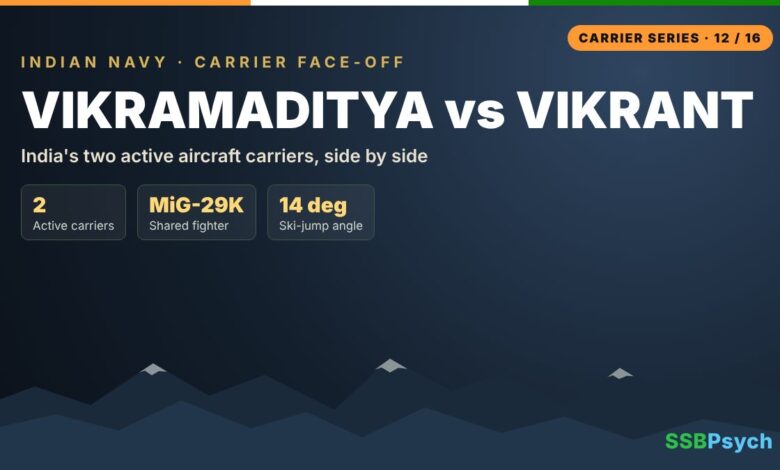
INS Vikramaditya vs INS Vikrant: India’s Two Carriers Compared
India is one of very few countries that can send two aircraft carriers to sea at the same time. Our two flat-tops are INS Vikramaditya and the home-built INS Vikrant (2022). So who wins in an INS Vikramaditya vs INS Vikrant battle? One is a Soviet-era ship rebuilt in Russia, the other was designed and built in India. In this guide we put them side by side, number by number, in plain language.
If you are preparing for NDA, CDS, AFCAT or the SSB interview, this is gold. Carrier questions pop up in GK papers, lecturettes and group discussions. By the end you will know their size, speed, aircraft, crew, cost and history, and you will be able to explain which carrier is better at what, and why.

INS Vikramaditya vs INS Vikrant: The Quick Answer
Both carriers are roughly the same weight class, around 45,000 tonnes when fully loaded. That is about as heavy as 30,000 family cars put together. Both launch MiG-29K fighters off a curved ramp at the bow called a ski-jump, and both catch landing jets with steel arrestor wires. So on paper they look like twins.
Look closer and the story changes. INS Vikramaditya is longer, a little faster and has very long range thanks to her big steam plant. INS Vikrant (2022) is wider, uses modern gas turbines, has newer systems everywhere and, most importantly, was built in India. One is a smart second-hand buy, the other is a national achievement.
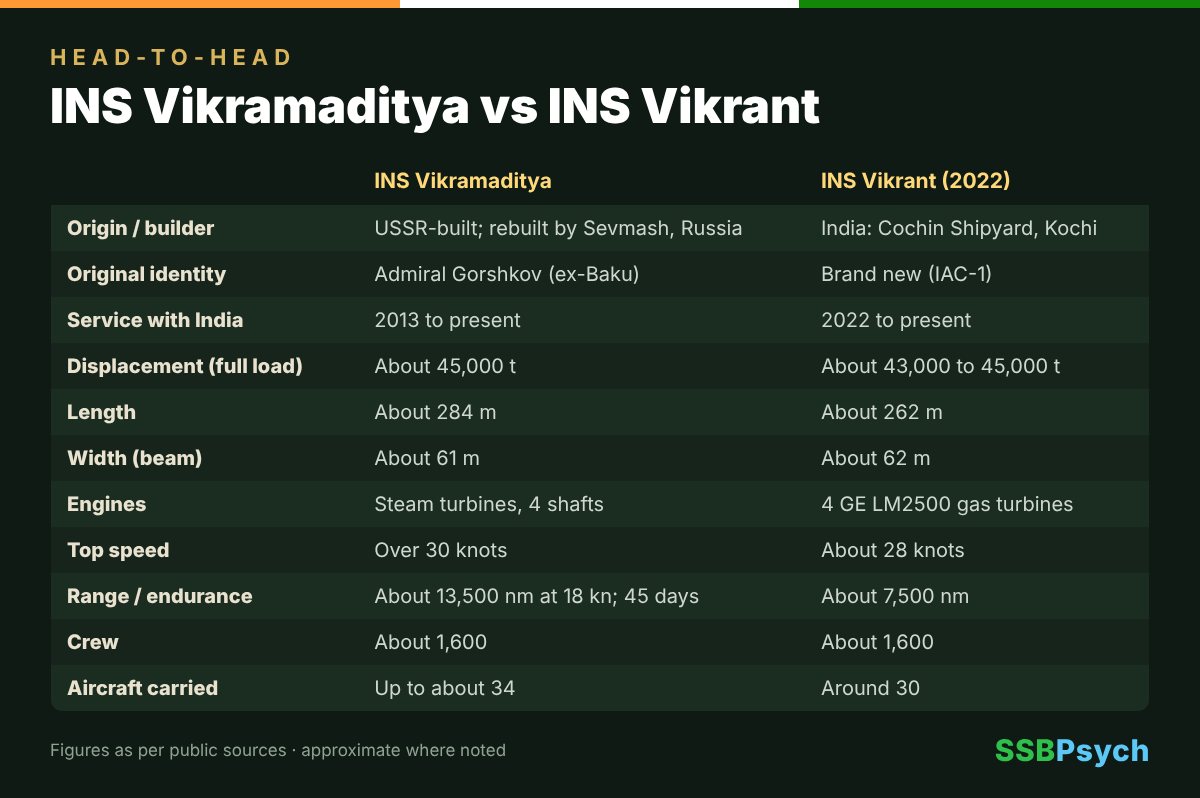
INS Vikramaditya vs INS Vikrant: Side-by-Side Comparison
| INS Vikramaditya | INS Vikrant (2022) | |
|---|---|---|
| Origin / builder | USSR-built; rebuilt by Sevmash, Russia | India: Cochin Shipyard, Kochi |
| Original identity | Admiral Gorshkov (ex-Baku) | Brand new (IAC-1) |
| Service with India | 2013 to present | 2022 to present |
| Displacement (full load) | About 45,000 t | About 43,000 to 45,000 t |
| Length | About 284 m | About 262 m |
| Width (beam) | About 61 m | About 62 m |
| Engines | Steam turbines, 4 shafts | 4 GE LM2500 gas turbines |
| Top speed | Over 30 knots | About 28 knots |
| Range / endurance | About 13,500 nm at 18 kn; 45 days | About 7,500 nm |
| Crew | About 1,600 | About 1,600 |
| Aircraft carried | Up to about 34 | Around 30 |
| Main fighter | MiG-29K | MiG-29K (Rafale M ordered) |
| Launch method | 14 deg ski-jump plus wires (STOBAR) | 14 deg ski-jump plus wires (STOBAR) |
| Reported cost | Refit about USD 2.35 bn (reported) | Nearly Rs 20,000 crore (2022) |
| Key operations | Fleet exercises; twin-carrier ops | Op Sindoor deployment 2025 |
| Fate / status | In service (Karwar) | In service |
Understanding the Numbers in Simple Words
Displacement: How Heavy Is a Carrier?
Displacement means the weight of water a ship pushes aside when it floats. It is the simplest way to say how heavy a ship is. Vikramaditya is reported at about 45,000 tonnes. For Vikrant (2022), published figures range from about 43,000 to 45,000 tonnes depending on the source and how much fuel and stores are counted. Either way, the two are in the same league.
Length and Width
Vikramaditya is about 284 metres long, nearly three football fields placed end to end. Vikrant (2022) is about 262 metres long. But Vikrant is slightly wider, about 62 metres against Vikramaditya’s 61 metres. Vikrant also has a flight deck of about 12,500 square metres, roughly the size of two football fields, which matters a lot because deck space is where jets park, get fuelled and take off.
Speed in Knots
Ships measure speed in knots. One knot is one nautical mile per hour, about 1.85 km per hour. Vikramaditya can do over 30 knots, roughly 55 km per hour. Vikrant (2022) has an official top speed of about 28 knots, about 52 km per hour. That may sound slow for a car, but for a floating city of steel it is very quick. Speed matters for a carrier because sailing into the wind helps heavy jets get airborne.
Range and Endurance
Range tells you how far a ship can travel before refuelling. Vikramaditya is reported to manage about 13,500 nautical miles (around 25,000 km) at a steady 18 knots and to stay at sea for about 45 days. Vikrant (2022) has a reported endurance of about 7,500 nautical miles. In simple words, Vikramaditya can go further without topping up, while Vikrant usually works with fleet tankers that refuel her at sea.
Engines: Steam Power vs Gas Turbines
This is the biggest hidden difference. Vikramaditya runs on steam. Eight boilers heat water into high-pressure steam, which spins turbines connected to four propeller shafts. It is powerful, but boilers are big, need many sailors to look after them and take time to heat up.
Vikrant (2022) uses four General Electric LM2500 gas turbines, close cousins of jet engines, together producing about 100 megawatts. Gas turbines start fast, need fewer people and are easier to maintain. Think of it as the difference between an old coal-fired steam engine and a modern diesel or electric train.
Aircraft: What Flies From Each Deck
Both carriers use the MiG-29K as their main fighter. This twin-engine Russian jet can hunt enemy aircraft and strike ships. Both also use helicopters for submarine hunting, early warning and rescue. Vikramaditya is reported to carry up to about 34 aircraft, including Kamov Ka-31 radar helicopters that act as flying lookout towers, and Ka-28 and Sea King submarine hunters.
Vikrant (2022) is designed for an air wing of around 30 aircraft. She operates MiG-29Ks, Ka-31s, Indian HAL Dhruv helicopters and the modern American MH-60R multi-role helicopter. India has also ordered 26 Rafale M naval fighters from France, reported in April 2025, which are meant to fly from Vikrant in the coming years.
STOBAR: How the Jets Take Off and Land
Both ships use a system called STOBAR, short for Short Take-Off But Arrested Recovery. To take off, a fighter runs its engines at full power while held by restraints, then rushes up a 14-degree ski-jump at the bow. The ramp throws the jet upward, a bit like a skier flying off a slope. To land, the pilot lowers a hook under the tail that grabs one of the steel arrestor wires stretched across the deck, stopping the jet within a short distance.
STOBAR is simpler and cheaper than the catapults used on big American carriers, but it limits how heavy a jet can be at take-off. That means slightly less fuel or fewer weapons on each sortie.
Aircraft, Weapons and Sensors
- MiG-29K and MiG-29KUB fighters (Vikramaditya)
- Kamov Ka-31 early-warning helicopters (Vikramaditya)
- Kamov Ka-28 and Sea King anti-submarine helicopters (Vikramaditya)
- MiG-29K fighters (Vikrant 2022)
- MH-60R multi-role helicopters (Vikrant 2022)
- Kamov Ka-31 early-warning helicopters (Vikrant 2022)
- HAL Dhruv utility helicopters (Vikrant 2022)
- 26 Rafale M fighters on order (Vikrant 2022)
Origin Story: Second-Hand Giant vs Home-Grown Hero
Vikramaditya began life as the Soviet ship Baku, later renamed Admiral Gorshkov. She was a hybrid, half cruiser and half carrier, armed with large missiles on her front deck. India signed a deal with Russia on 20 January 2004 to buy the ship and have her completely rebuilt at the Sevmash yard. The missile launchers were removed, the ski-jump was added and most of the inside was rebuilt with thousands of kilometres of new cable and pipe. The project faced long delays, and she was finally commissioned on 16 November 2013 at Severodvinsk in Russia.
Vikrant (2022), also called IAC-1 (Indigenous Aircraft Carrier 1), was designed by the Indian Navy’s own design team and built by Cochin Shipyard Limited in Kochi. Her keel was laid in 2009, she was floated out in 2013 and commissioned by the Prime Minister on 2 September 2022. With her, India joined a small group of nations that can design and build their own aircraft carrier. She carries the name of India’s first carrier, INS Vikrant (1961), which served from 1961 to 1997.

Cost: What Did Each Carrier Take?
Big warships come with big bills. The rebuild of Vikramaditya was reported at about USD 2.35 billion, and this does not include the fighters and helicopters bought separately. For Vikrant (2022), official statements at commissioning in 2022 put the cost at nearly Rs 20,000 crore; some later reports quote higher figures.
Running costs are not published in detail, but the main drivers are easy to understand: fuel for the engines, a crew of around 1,600 people, spare parts, aircraft maintenance and regular refits in dry dock. Vikrant’s money mostly stayed in India, supporting hundreds of Indian companies, while much of Vikramaditya’s refit money went abroad.
Who Leads a Carrier and Who Lives Aboard
Each carrier is commanded by an officer of Captain rank, a senior and experienced naval officer. Under the captain are departments for navigation, engineering, weapons, logistics and, of course, the air wing. Each ship carries about 1,600 people. They live, eat, sleep and work aboard for weeks at a time, with kitchens, a hospital, workshops and laundries. A carrier really is a floating town.
Operations and Missions
- 2016 – First foreign visits (Vikramaditya): Port calls at Colombo and Male.
- 2020 – Naval Tejas landing (Vikramaditya): Hosted the first deck landing of the naval LCA Tejas.
- 2023 – First fighter landings (Vikrant 2022): MiG-29K and naval LCA landed on deck in February.
- 2023-24 – Twin-carrier operations: Vikramaditya and Vikrant (2022) operated jets together at sea.
- 2024 – Exercise with Italy (Vikramaditya): Sailed with the Italian carrier Cavour in the Arabian Sea.
- 2025 – Operation Sindoor (Vikrant 2022): Carrier group forward-deployed in the Arabian Sea.
Which Is Better at What?
- Range: Vikramaditya wins. Her steam plant and fuel capacity let her travel further without refuelling.
- Top speed: Vikramaditya again, by a small margin, over 30 knots against about 28.
- Maintenance and modern engines: Vikrant (2022) wins. Gas turbines are quicker to start and simpler to keep running than old boilers.
- Deck size: Vikrant (2022) is shorter but wider, with a large modern flight deck.
- Aircraft numbers: Roughly equal, about 30 to 34 aircraft each.
- Future upgrades: Vikrant (2022) wins. India controls her design, so new systems and the Rafale M can be added more easily.
- Strategic value: Vikrant (2022) wins because she proves India can build carriers on its own.
How Carrier Technology Evolved Between Them
Even though both ships fly MiG-29Ks off a ski-jump, they show how carrier thinking moved forward. Vikramaditya’s hull was designed in the Soviet Union in the late 1970s and 1980s, built around steam boilers and heavy missiles. Turning her into a pure carrier was like turning an old bungalow into a modern apartment: possible, but full of surprises behind the walls.
Vikrant (2022) was designed from day one as a carrier for the 21st century. She has gas turbine propulsion, highly automated machinery control, modern sensors and space for a mix of Russian, American, French and Indian aircraft. Her hull uses special warship-grade steel developed in India. In short, Vikramaditya shows how India learned to operate a big carrier; Vikrant shows that India learned to build one.
INS Vikramaditya vs INS Vikrant Timeline
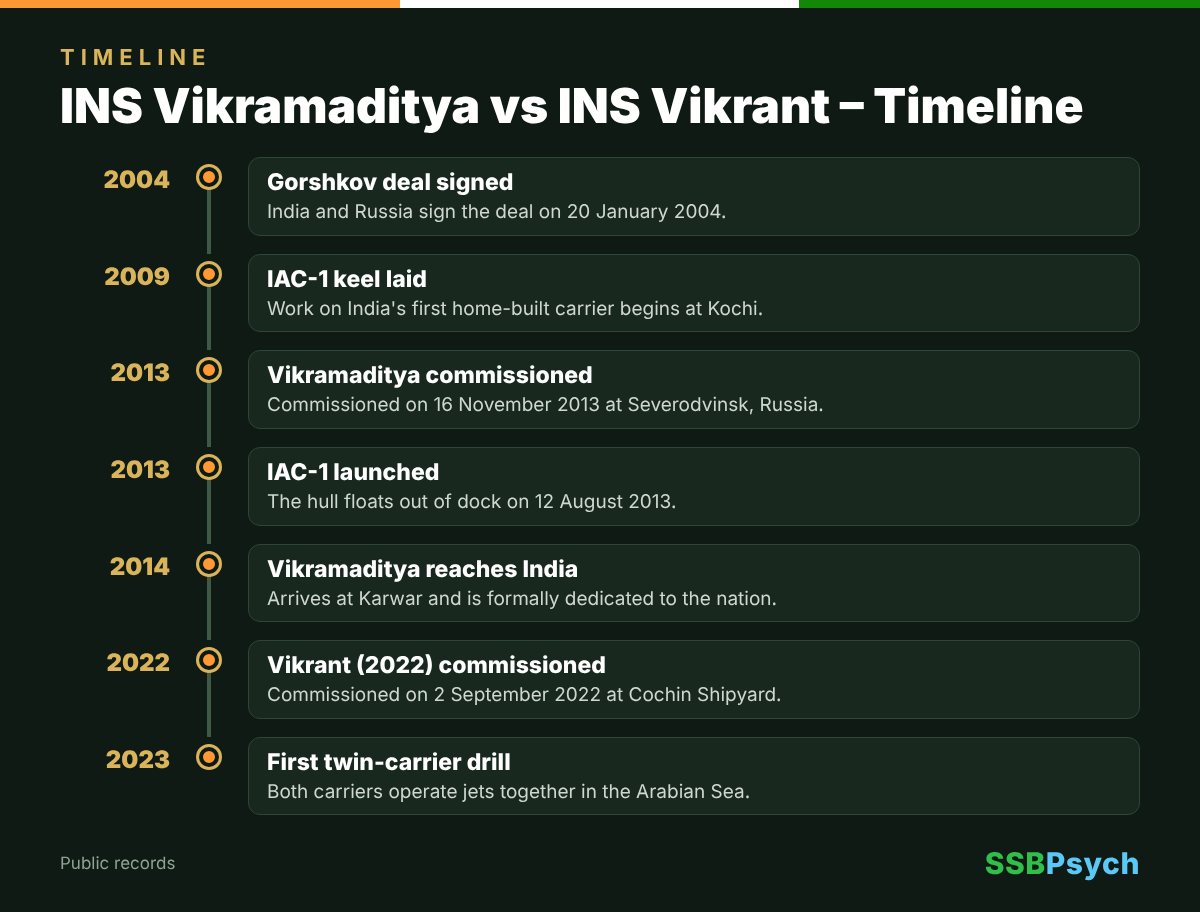
- 2004 – Gorshkov deal signed: India and Russia sign the deal on 20 January 2004.
- 2009 – IAC-1 keel laid: Work on India’s first home-built carrier begins at Kochi.
- 2013 – Vikramaditya commissioned: Commissioned on 16 November 2013 at Severodvinsk, Russia.
- 2013 – IAC-1 launched: The hull floats out of dock on 12 August 2013.
- 2014 – Vikramaditya reaches India: Arrives at Karwar and is formally dedicated to the nation.
- 2022 – Vikrant (2022) commissioned: Commissioned on 2 September 2022 at Cochin Shipyard.
- 2023 – First twin-carrier drill: Both carriers operate jets together in the Arabian Sea.
Why India Needs Both
A single carrier spends long periods in maintenance, so having two means at least one is usually ready. Navies often say that three carriers are ideal: one at sea, one training and one in refit. India operates on both its coasts, the Arabian Sea in the west and the Bay of Bengal in the east, so two carriers give real flexibility. In 2023 and 2024 the Navy showed this by operating both carriers together, launching MiG-29Ks from both decks in the same exercise.
A carrier with its escorts of destroyers, frigates, submarines and tankers is called a carrier battle group. It can protect sea lanes, show the flag in friendly ports and help in disasters by carrying helicopters, doctors and relief supplies.
The Verdict: INS Vikramaditya vs INS Vikrant
If this were a cricket match, Vikramaditya would be the experienced overseas pro who still hits big: long range, high speed and years of proven service. Vikrant (2022) would be the young home-grown star with modern skills and a long career ahead. For raw reach, Vikramaditya edges it. For modern technology, ease of upkeep and national pride, Vikrant (2022) takes the trophy. The real winner, though, is the Indian Navy, because together they give India a true two-carrier navy.
For your SSB lecturette, remember this simple line: Vikramaditya is a bought and rebuilt carrier, Vikrant (2022) is a designed and built-in-India carrier, and both use STOBAR with MiG-29K fighters.
Did You Know?
- Vikramaditya was originally a Soviet hybrid ship that carried large anti-ship missiles on her front deck.
- Vikramaditya has 22 decks, and during her rebuild about 1,750 of her 2,500 compartments were refabricated.
- Vikrant (2022) has about 2,300 compartments and is about 59 metres tall, close to the height of a 20-storey building.
- The first naval LCA Tejas deck landing happened on Vikramaditya in January 2020.
- Both carriers use a 14-degree ski-jump ramp at the bow.
- Vikrant (2022) is named after India’s first carrier, INS Vikrant (1961), a veteran of the 1971 war.
- Vikramaditya’s home port is Karwar in Karnataka.
Quiz: Test Your Knowledge of INS Vikramaditya vs INS Vikrant
Click an option to see if you are right. Your score updates live.
INS Vikramaditya vs INS Vikrant: Frequently Asked Questions
Both displace roughly 45,000 tonnes. Vikramaditya is longer at about 284 m, while Vikrant (2022) is about 262 m long but slightly wider.
Vikramaditya can exceed 30 knots, while Vikrant (2022) has an official top speed of about 28 knots.
She was designed by the Indian Navy and built by Cochin Shipyard, with a large share of Indian equipment, though some items such as her gas turbines and current fighters are foreign.
Vikramaditya is reported to carry up to about 34 aircraft and Vikrant (2022) around 30, a mix of fighters and helicopters.
Carriers need long maintenance breaks, and India has two long coastlines. Two carriers mean at least one is usually ready and both seas can be covered.
This is part 12 of 16 in SSBPsych’s Indian Navy aircraft carrier series – a new post every day at 2 PM.
Sources: en.wikipedia.org, en.wikipedia.org, en.wikipedia.org.
Preparing for NDA, CDS, AFCAT or your SSB? Join SSBPsych’s online and offline batches – explore our courses or call +91 8076540582.