Sikh Regiment: History, Motto, War Cry, Saragarhi and Heroes
On 12 September 1897, twenty-one Sikh soldiers in a small signal post called Saragarhi chose to fight to the last man rather than surrender to thousands of tribesmen. That spirit lives on in the Sikh Regiment, one of the most decorated infantry regiments of the Indian Army. From that frontier post to the first airlift into Srinagar in 1947 and the slopes of Tiger Hill in 1999, Sikh soldiers have shown again and again what determination means.
This guide is for NDA, CDS, AFCAT, TES and SSB aspirants. It covers the history and lineage of the regiment, a visual timeline, major operations and battle honours, the insignia, motto and war cry, its heroes, life in the regiment, what the regiment teaches SSB candidates, and a 10-question quiz at the end.
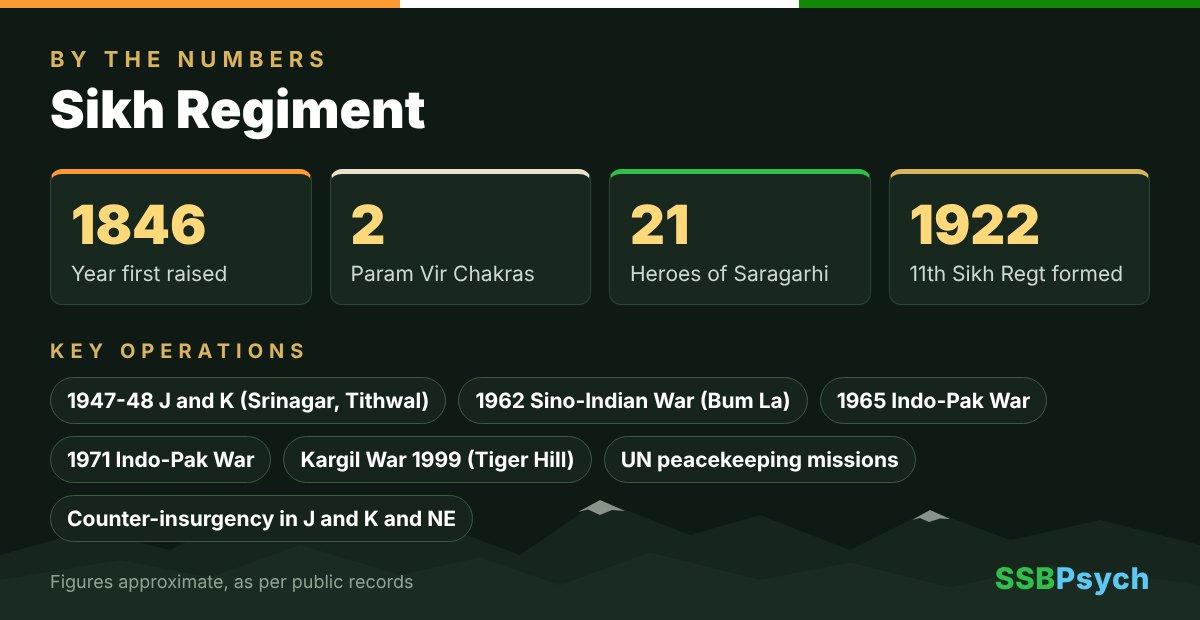
Sikh Regiment – Quick Facts
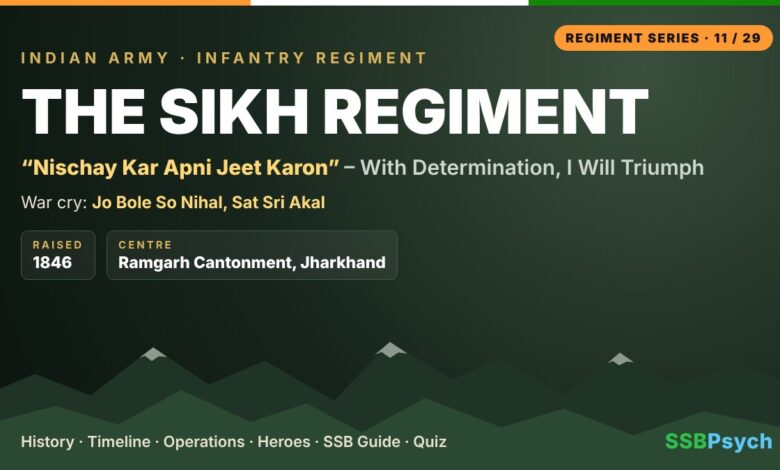
| Raised | 1846 (Regiments of Ferozepore and Ludhiana); grouped as 11th Sikh Regiment in 1922 |
| Regimental Centre | Ramgarh Cantonment, Jharkhand |
| Motto | Nischay Kar Apni Jeet Karon (With determination, I will triumph) |
| War Cry | Jo Bole So Nihal, Sat Sri Akal |
| Recruitment | Single class: Jat Sikhs, mainly from Punjab |
| Battalions | About 20 regular battalions, plus Territorial Army units |
| Notable gallantry | 2 Param Vir Chakras, several Victoria Crosses and Maha Vir Chakras |
| Famous battle | Saragarhi, 12 September 1897 |
| Insignia | A lion encircled by a chakra |
| Saragarhi Day | 12 September, observed every year |
History of the Sikh Regiment
The regiment was born at the end of the Sikh Empire. After the First Anglo-Sikh War of 1845 to 1846, the East India Company began recruiting Sikh soldiers into its Bengal Army. Its first battalion was raised on 1 August 1846. Among the earliest all-Sikh units were the Regiment of Ferozepore and the Regiment of Ludhiana, both raised in 1846, which later became the 14th King George’s Own Ferozepore Sikhs and the 15th Ludhiana Sikhs.
During the nineteenth century these regiments fought at Lucknow in 1857 to 1858, in China, in the Second Anglo-Afghan War and in the Tirah campaign on the North-West Frontier. More Sikh units were raised, including the 35th and 36th Sikhs in 1887 and the 45th Rattray’s Sikhs, which began as a military police battalion.
The Battle of Saragarhi
Saragarhi was a small signalling post between Fort Lockhart and Fort Gulistan in the Samana range of the North-West Frontier, now in Pakistan. On 12 September 1897 it was attacked by a huge force of Afghan tribesmen. The post was held by 21 soldiers of the 36th Sikhs led by Havildar Ishar Singh. They refused to surrender and fought for hours until every one of them was killed. All 21 were awarded the Indian Order of Merit posthumously, then the highest gallantry award an Indian soldier could receive. The 36th Sikhs is today the 4th Battalion of the Sikh Regiment, and 12 September is observed every year as Saragarhi Day.
Formation of the 11th Sikh Regiment
In 1922 the British grouped the 14th Ferozepore Sikhs, 15th Ludhiana Sikhs, 45th Rattray’s Sikhs, 36th Sikhs, 47th Sikhs and 35th Sikhs into the 11th Sikh Regiment. In both World Wars the Sikhs fought with great distinction, from France, Gallipoli and Mesopotamia in the first, to East Africa, North Africa, Malaya, Italy and Burma in the second, winning many Victoria Crosses along the way. At independence the regiment was allotted to India and the numeral 11 was dropped. Its centre was earlier at Meerut and is now at Ramgarh Cantonment in Jharkhand.
Sikh Regiment Timeline: From Raising to Today
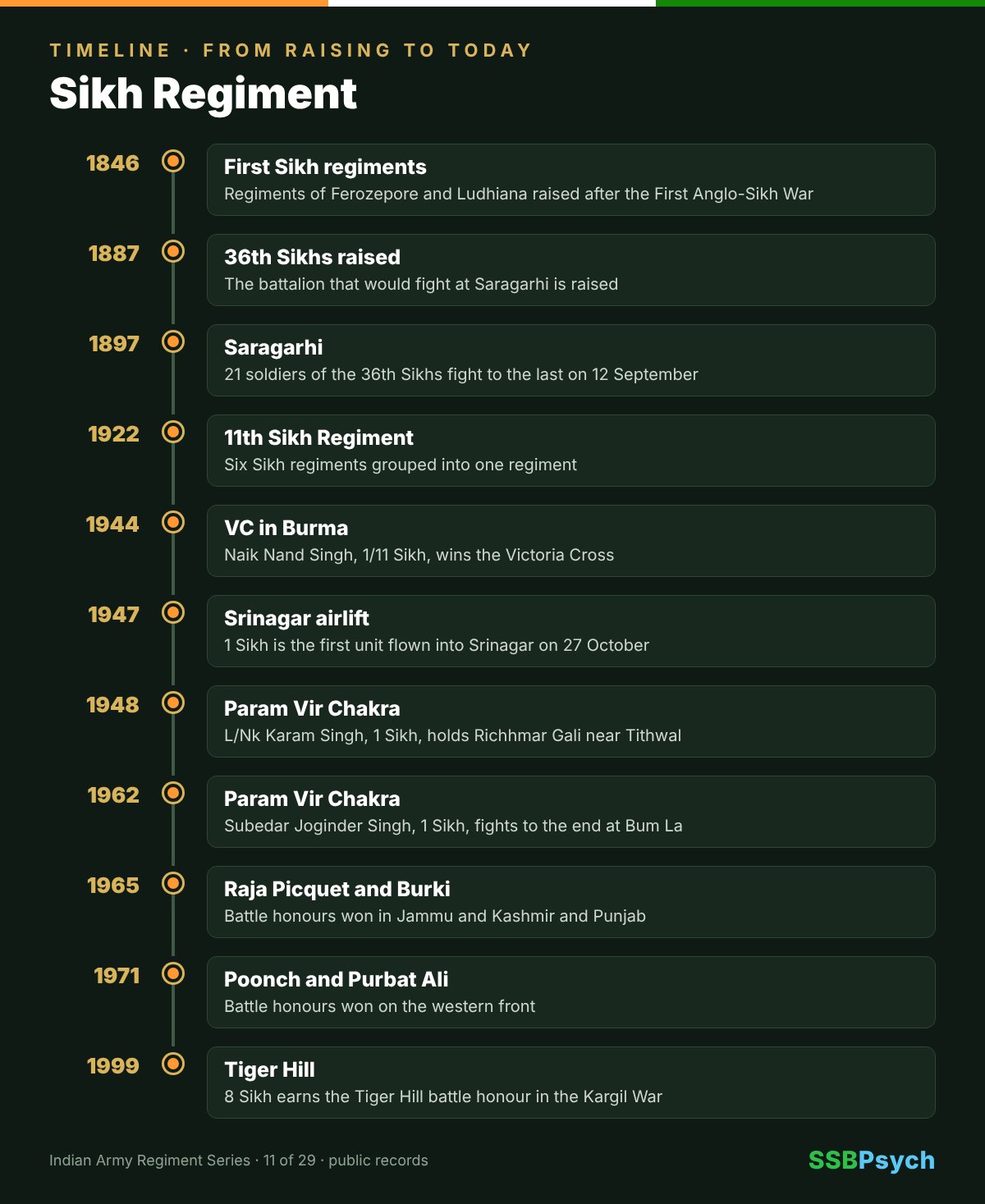
- 1846 – First Sikh regiments: Regiments of Ferozepore and Ludhiana raised after the First Anglo-Sikh War
- 1887 – 36th Sikhs raised: The battalion that would fight at Saragarhi is raised
- 1897 – Saragarhi: 21 soldiers of the 36th Sikhs fight to the last on 12 September
- 1922 – 11th Sikh Regiment: Six Sikh regiments grouped into one regiment
- 1944 – VC in Burma: Naik Nand Singh, 1/11 Sikh, wins the Victoria Cross
- 1947 – Srinagar airlift: 1 Sikh is the first unit flown into Srinagar on 27 October
- 1948 – Param Vir Chakra: L/Nk Karam Singh, 1 Sikh, holds Richhmar Gali near Tithwal
- 1962 – Param Vir Chakra: Subedar Joginder Singh, 1 Sikh, fights to the end at Bum La
- 1965 – Raja Picquet and Burki: Battle honours won in Jammu and Kashmir and Punjab
- 1971 – Poonch and Purbat Ali: Battle honours won on the western front
- 1999 – Tiger Hill: 8 Sikh earns the Tiger Hill battle honour in the Kargil War
Major Operations and Battle Honours
The Sikh Regiment has taken part in every war of independent India and in many peacekeeping and counter-insurgency operations.
1947-48: Saving Srinagar
When tribal raiders backed by Pakistan swept towards Srinagar in October 1947, 1 Sikh was the first Indian unit sent to Kashmir. It was flown from Gurgaon to Srinagar on 27 October 1947. Its Commanding Officer, Lieutenant Colonel Dewan Ranjit Rai, immediately led his men forward to block the raiders near Baramulla and Pattan and was killed the same day. His battalion’s stand bought precious time for more troops to arrive and helped save Srinagar. He was awarded the Maha Vir Chakra posthumously. The battalion earned the battle honours Srinagar and Tithwal.
The battalion kept fighting through the winter of 1947. Lieutenant Colonel Harbaksh Singh, who would later lead Western Command in 1965, took command of 1 Sikh at Uri in December 1947. In the same month Nand Singh, who had already won the Victoria Cross in Burma, was killed leading an attack in the hills near Uri and was awarded the Maha Vir Chakra posthumously, making him one of the rare soldiers to hold both honours.
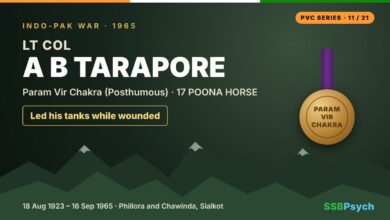
At Tithwal, on 13 October 1948, Lance Naik Karam Singh of 1 Sikh held his post at Richhmar Gali against repeated enemy attacks. Though wounded, he kept moving between trenches, encouraging his men and throwing grenades, and the post did not fall. He received the Param Vir Chakra and is one of the few recipients who survived to wear it.
1962: Bum La
During the Sino-Indian War, Subedar Joginder Singh of 1 Sikh commanded a platoon near Bum La in the Tawang sector. On 23 October 1962 his small force faced wave after wave of Chinese attacks. He was wounded, but he kept fighting and, when ammunition ran out, led his remaining men in a bayonet charge. He was captured and died in captivity, and was awarded the Param Vir Chakra posthumously.
1965 and 1971
In 1965 the regiment won the battle honours Raja Picquet (2 Sikh), Burki (4 Sikh) and OP Hill (7 Sikh). In 1971 it fought on the western front, winning honours including Poonch (6 Sikh) and Purbat Ali (10 Sikh), along with theatre honours in Jammu and Kashmir, Punjab, Sindh and East Pakistan. These wars also showed the value of junior leaders. In many of these actions, young officers and non-commissioned officers took decisions on the spot, led small teams under heavy fire and turned difficult situations into success. That tradition of leadership at every level is one of the regiment’s greatest strengths.
Kargil 1999: Tiger Hill
In the Kargil War, 8 Sikh fought in the battle for Tiger Hill, one of the most important heights in the Drass sector. After early attacks were stopped by heavy fire, the battalion surrounded the feature and held on. In the final assault in July 1999, a force from 8 Sikh climbed the Western Ridge and split the enemy defences, beating off several counter-attacks, while 18 Grenadiers captured the top. 8 Sikh earned the battle honour Tiger Hill.
Sikh Regiment and Sikh Light Infantry: Know the Difference
Aspirants often confuse the Sikh Regiment with the Sikh Light Infantry. They are separate regiments. The Sikh Regiment dates back to 1846, recruits Jat Sikhs and has its centre at Ramgarh in Jharkhand. The Sikh Light Infantry was raised in 1941, recruits Mazhabi and Ramdasia Sikhs and has its centre at Fatehgarh in Uttar Pradesh. Both share the war cry Jo Bole So Nihal, Sat Sri Akal, but they have different mottos, insignia and histories. Getting this right in an interview shows careful preparation.
Sikh Regiment Insignia, Motto and War Cry
The regimental insignia is a lion encircled by a chakra, the steel quoit carried by Sikh warriors. The lion stands for the name Singh, which every Sikh man carries, and for courage itself.
The motto is Nischay Kar Apni Jeet Karon, a line inspired by the writings of Guru Gobind Singh, which means with determination, I will be triumphant. The war cry is Jo Bole So Nihal, Sat Sri Akal, which can be understood as whoever says this shall be fulfilled, true is the Timeless Lord. It is one of the most famous war cries in the world and has echoed across battlefields for more than a century.
Heroes of the Sikh Regiment
The regiment’s list of heroes is long. Here are some of the best known.
- Havildar Ishar Singh, Indian Order of Merit (posthumous) – led the 21 men of the 36th Sikhs at Saragarhi on 12 September 1897.
- Naik Nand Singh, Victoria Cross and Maha Vir Chakra (posthumous) – won the VC in Burma in March 1944 with 1/11 Sikh, and the MVC near Uri in December 1947 with 1 Sikh.
- Lieutenant Colonel Dewan Ranjit Rai, Maha Vir Chakra (posthumous) – led 1 Sikh into Srinagar on 27 October 1947 and fell the same day.
- Lance Naik Karam Singh, Param Vir Chakra – 1 Sikh, defended Richhmar Gali near Tithwal on 13 October 1948.
- Subedar Joginder Singh, Param Vir Chakra (posthumous) – 1 Sikh, fought to the end at Bum La on 23 October 1962.
- Lieutenant General Harbaksh Singh – a Sikh Regiment officer who commanded 1 Sikh in 1947 and led Western Command in the 1965 war.
Role and Life in the Regiment
The Sikh Regiment is an infantry regiment whose battalions serve along the Line of Control, in high-altitude areas, in the deserts and plains of the west, in counter-insurgency areas and in peace stations. Its soldiers are known for their physical strength, cheerful spirit and fearlessness in close combat.
The regiment is a single class regiment, recruiting Jat Sikh soldiers mainly from Punjab. Faith is central to regimental life. Battalions have a gurdwara in their lines, soldiers observe the articles of the Sikh faith, and the turban is part of the uniform. The teachings of the Gurus about courage, service and standing up for the weak fit naturally with the life of a soldier.
The Regimental Centre at Ramgarh Cantonment in Jharkhand trains every recruit and keeps the traditions alive. Saragarhi Day on 12 September is the regiment’s most important commemoration, when battalions across India remember the 21 who stood firm. Sport is also strong, and Sikh soldiers have represented India in hockey, athletics and many other games.
Officers posted to a Sikh battalion learn quickly that their men expect them to lead from the front. In return, the troops give a loyalty that has become legendary. The story of 1 Sikh alone, which produced two Param Vir Chakras and the first unit into Srinagar, shows what that bond can achieve.
Lessons for SSB Aspirants
Saragarhi is often discussed in SSB interviews and lecturettes because it is a perfect example of duty under impossible odds. Havildar Ishar Singh had a choice, and he chose to stand and fight, holding up a far larger enemy force for as long as possible. Similarly, Lieutenant Colonel Dewan Ranjit Rai did not wait for perfect conditions when he landed at Srinagar; he understood the urgency and acted. Both stories show courage, initiative and sense of responsibility, which are key officer like qualities. When you narrate them, explain the decision each leader made and its impact.
Sikh Regiment for SSB Candidates: What You Should Know
How officers join
- Officers join the infantry through the National Defence Academy (after Class 12), the Indian Military Academy (via CDS or entries such as TES after Class 12 with PCM) or the Officers Training Academy, Chennai (Short Service Commission).
- Every entry requires clearing the five-day SSB interview and a medical board.
- Arm and regiment are allotted near the end of academy training based on the cadet’s preferences, order of merit and vacancies, so no regiment is guaranteed in advance.
- Officers of any background can be commissioned into the Sikh Regiment and are expected to learn and respect the customs of their troops.
How soldiers join
- The Sikh Regiment is a single class regiment that recruits Jat Sikh soldiers, mainly from Punjab, as per its recruitment pattern.
- Since 2022, soldiers join as Agniveers under the Agnipath scheme for four years, after which a portion (up to 25 percent as per the scheme) can be selected for regular service.
- Recruits are trained at the Sikh Regimental Centre, Ramgarh Cantonment, Jharkhand.
Questions you may face in the SSB interview, GD or lecturette
- Why do you want to join the Sikh Regiment or the infantry?
- What happened at Saragarhi and why is it remembered?
- Name the two Param Vir Chakra awardees of the Sikh Regiment.
- What role did 1 Sikh play in saving Srinagar in 1947?
- Lecturette topic: Courage under impossible odds, lessons from Saragarhi.
SSBPsych tip: Do not just recite that 21 soldiers died at Saragarhi; explain the decision they made and why it mattered, because SSB boards want to see that you understand leadership choices.
Read the stories of its Param Vir Chakra heroes: Lance Naik Karam Singh, Subedar Joginder Singh.
From Saragarhi to Tiger Hill, the Sikh Regiment has proved its motto in every generation. Read its history, remember its heroes and test your knowledge with the quiz below.
Quiz: How Well Do You Know the Sikh Regiment?
Test yourself! Click an option to see if you are right. Your score updates live.
Sikh Regiment: Frequently Asked Questions
The motto is Nischay Kar Apni Jeet Karon, which means with determination, I will be triumphant.
The Sikh Regimental Centre is at Ramgarh Cantonment in Jharkhand.
The war cry is Jo Bole So Nihal, Sat Sri Akal.
Two: Lance Naik Karam Singh (1948, Tithwal) and Subedar Joginder Singh (1962, Bum La), both of 1 Sikh.
Saragarhi Day, 12 September, honours the 21 soldiers of the 36th Sikhs who fought to the last at Saragarhi in 1897. The 36th Sikhs is today 4 Sikh.
Indian Army Regiments Series on SSBPsych
This is part 11 of 29 in our series on every infantry regiment of the Indian Army – a new regiment every day at 11 AM. Previous in the series: Jat Regiment. Also follow our Param Vir Chakra series.
Sources: en.wikipedia.org, en.wikipedia.org, en.wikipedia.org, en.wikipedia.org, en.wikipedia.org.
Preparing for NDA, CDS, AFCAT or your SSB? Join SSBPsych’s online and offline batches – explore our courses or call +91 8076540582.