INS Vela (S24): The Stingray Submarine of the Indian Navy
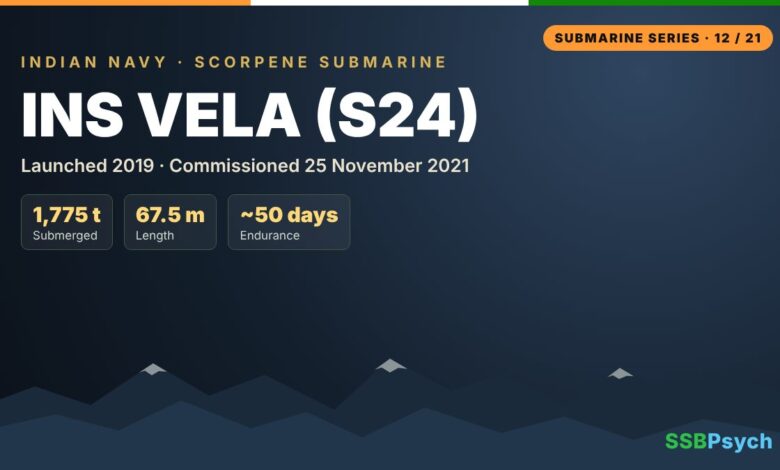
In the warm waters off India lives a flat, graceful fish that buries itself in the sand and strikes when least expected: the stingray. The Indian Navy named one of its most modern submarines after it. Meet INS Vela, pennant S24, the fourth Kalvari-class Scorpene submarine, commissioned on 25 November 2021 and built entirely at Mazagon Dock in Mumbai.
This easy guide explains what INS Vela is, how it works, its size and weapons, the people who live inside it, its cost, its dangers and why its name matters. If you are preparing for NDA, CDS, AFCAT or your SSB interview, these are the facts that help you speak with confidence about India’s submarine arm.

INS Vela at a Glance
INS Vela is a conventional attack submarine. Conventional here means it is not nuclear powered; it runs on diesel engines and batteries. Attack means its main job is to hunt ships and submarines rather than carry long-range nuclear missiles. It is the fourth of six boats built under Project 75, India’s Scorpene programme, with design and technology support from France’s Naval Group.
Work on Vela’s hull began in July 2009 when the first steel was cut. The boat was launched in May 2019, went through long harbour and sea trials, and was delivered to the Navy on 9 November 2021. Just over two weeks later it was commissioned, which means it formally became a ship of the Indian Navy, with its flag hoisted and a crew assigned.
INS Vela Specifications
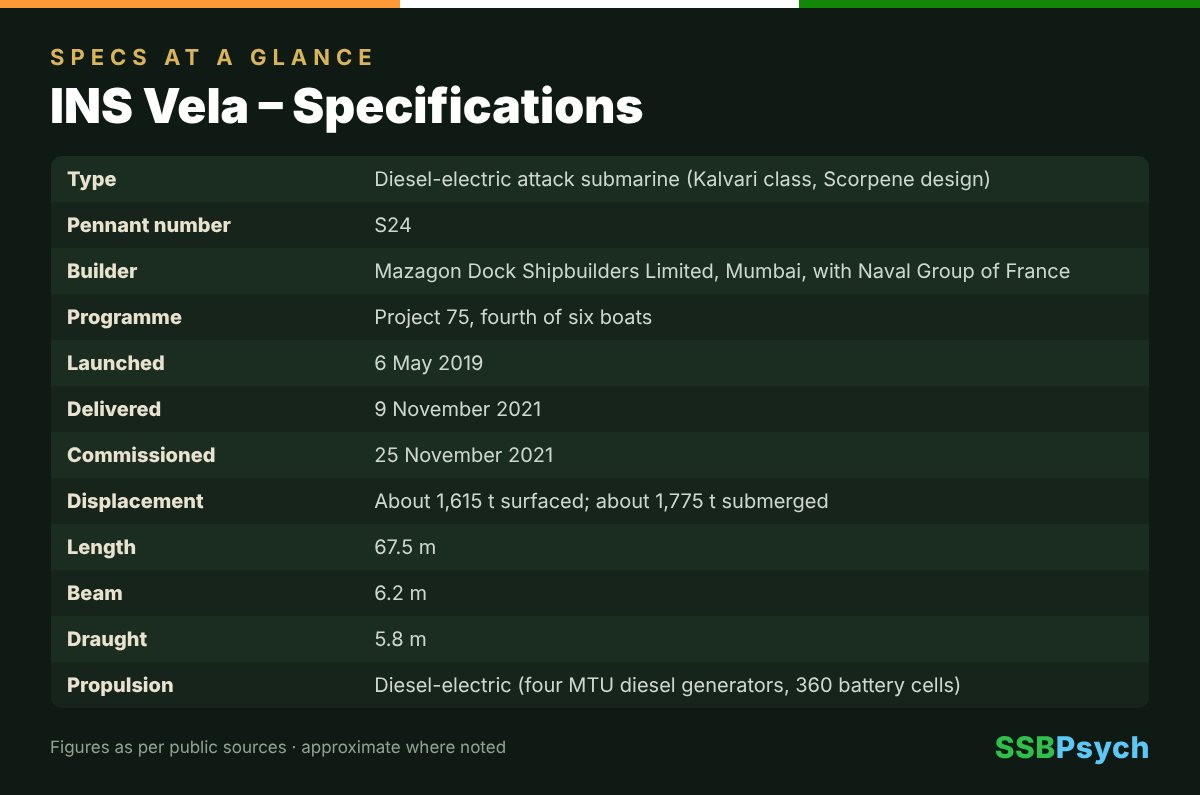
| Type | Diesel-electric attack submarine (Kalvari class, Scorpene design) |
| Pennant number | S24 |
| Builder | Mazagon Dock Shipbuilders Limited, Mumbai, with Naval Group of France |
| Programme | Project 75, fourth of six boats |
| Launched | 6 May 2019 |
| Delivered | 9 November 2021 |
| Commissioned | 25 November 2021 |
| Displacement | About 1,615 t surfaced; about 1,775 t submerged |
| Length | 67.5 m |
| Beam | 6.2 m |
| Draught | 5.8 m |
| Propulsion | Diesel-electric (four MTU diesel generators, 360 battery cells) |
| Speed | About 11 knots surfaced; about 20 knots submerged (reported) |
| Endurance | About 50 days; around 6,500 nautical miles at 8 knots (reported) |
| Crew | About 43 (8 officers, 35 sailors, as reported) |
| Status | In active service |
Size Explained in Simple Words
Vela is about 67.5 metres long, which is roughly two-thirds of a football pitch, and 6.2 metres wide, about the width of a two-lane road. Underwater it displaces about 1,775 tonnes. Displacement is the weight of water the submarine pushes aside when it floats, and that equals its own weight. Picture roughly 350 adult elephants on one scale, and you have a rough idea.
The hull is shaped like a smooth teardrop so that water flows past it quietly. Rubber-like coatings and carefully mounted machinery reduce the sounds that enemy sonars could pick up.
How Does a Submarine Dive and Surface?
A submarine dives using ballast tanks, large tanks between the inner and outer parts of the hull. When the crew opens vents and lets seawater flood these tanks, the boat becomes heavier and sinks. To surface, compressed air is blown into the tanks, pushing the water out so the boat becomes lighter and rises. Small fins called hydroplanes help steer it up or down, much like the wings of an aircraft.
Battery power: the secret of silence
On or near the surface, Vela’s diesel generators charge 360 battery cells. When it goes deep, the diesels stop and an electric motor runs on battery power. This is almost silent, but batteries drain, so the submarine must come back near the surface every so often to recharge using its snorkel mast. That moment, when the snorkel is up, is when a diesel-electric submarine is most at risk of being spotted.
INS Vela Timeline
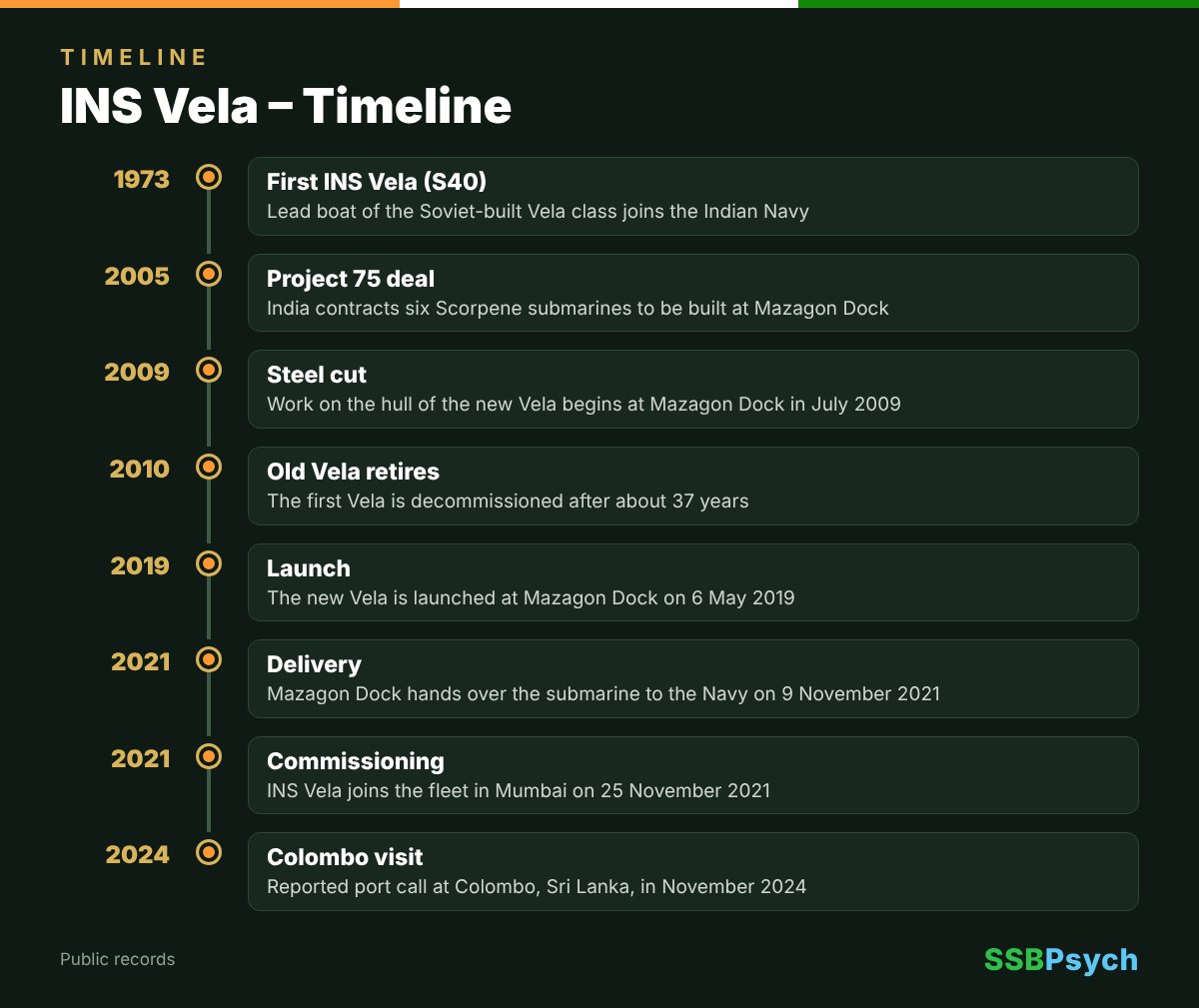
- 1973 – First INS Vela (S40): Lead boat of the Soviet-built Vela class joins the Indian Navy
- 2005 – Project 75 deal: India contracts six Scorpene submarines to be built at Mazagon Dock
- 2009 – Steel cut: Work on the hull of the new Vela begins at Mazagon Dock in July 2009
- 2010 – Old Vela retires: The first Vela is decommissioned after about 37 years
- 2019 – Launch: The new Vela is launched at Mazagon Dock on 6 May 2019
- 2021 – Delivery: Mazagon Dock hands over the submarine to the Navy on 9 November 2021
- 2021 – Commissioning: INS Vela joins the fleet in Mumbai on 25 November 2021
- 2024 – Colombo visit: Reported port call at Colombo, Sri Lanka, in November 2024
What Is the Role of INS Vela?
The Navy uses Kalvari-class boats for a wide set of tasks. INS Vela is designed to:
- Attack enemy surface warships with torpedoes and missiles.
- Hunt and track enemy submarines using its sensitive sonars.
- Collect intelligence by silently watching and listening at sea.
- Lay sea mines to block harbours or important sea routes.
- Patrol and guard India’s sea lanes and coastal waters.
A submarine does not need to fire a single shot to be useful. If an adversary believes an Indian submarine might be lurking, it must spend time, ships and money hunting for it. That pressure alone protects Indian interests.
Aircraft, Weapons and Sensors
- Six 533 mm bow torpedo tubes
- SUT wire-guided heavyweight torpedoes (about 18 weapons, as reported)
- SM.39 Exocet submarine-launched anti-ship missiles
- Sea mines (reported about 30) in place of torpedoes
- C303/S anti-torpedo countermeasure decoys
- Sonar suite for passive listening and active detection
- Search and attack periscopes
The torpedo tubes are Vela’s main teeth. The SUT torpedo is guided through a thin trailing wire so the crew can adjust its course after launch. The SM.39 Exocet anti-ship missile starts its journey in a protective capsule, breaks the surface, then skims just above the waves to its target. Sea mines can be laid quietly to deny an area to enemy shipping.
Operations and Missions
- 2021 – Commissioning ceremony: Commissioned in Mumbai by the then Navy chief Admiral Karambir Singh
- 2024 – Goodwill visit to Sri Lanka: Reported port call at Colombo from 11 to 13 November 2024

INS Vela Name Origin: Why a Stingray?
Vela is the name of a species of stingray found in Indian waters. The stingray is known for hiding on the seabed, staying calm and then striking fast, which is exactly how a submarine fights. The name also honours the first INS Vela (S40), the lead boat of the Soviet-built Vela class. It served the Indian Navy from 1973 to 2010. Members of the old boat’s crew were reported to be present at the 2021 commissioning, connecting two generations of submariners.
Why India Needed INS Vela
India sits in the middle of the Indian Ocean, a highway for global trade and energy shipping. Over the 2000s, the Navy’s submarine fleet was shrinking as older boats aged. Strategic experts often argued that India needed many more modern submarines to guard both its western and eastern seaboards. Project 75 was India’s answer, and Vela helped bring the fleet back to strength.
Equally important, Vela proved that Indian shipyards can build complex underwater warships. Thousands of workers, engineers and small suppliers gained experience that will matter for future projects.
Old Vela vs New Vela: How Far Technology Has Come
The first Vela of 1973 was a Soviet-designed boat built for the Cold War era. Its sensors and fire control relied heavily on older analogue equipment, and it was larger and noisier by modern standards. The new INS Vela packs a digital combat management system that brings together sonar, periscope and weapon data on screens, helping a small crew make fast decisions.
Automation is the big difference. Tasks that once needed many hands, such as controlling depth, trim and machinery, are now handled through computerised consoles. That is why a Kalvari boat can operate with a crew of around 43, while older submarines of similar role needed many more people. Quieter machinery, better hull shaping and modern sonar also mean the new Vela can hear an enemy before the enemy hears it, which is the golden rule of underwater warfare.
There is one more future upgrade on the Navy’s roadmap. India’s Defence Research and Development Organisation (DRDO) has developed an air independent propulsion (AIP) system, which lets a non-nuclear submarine stay submerged much longer without surfacing to charge batteries. Public reports say Kalvari boats are planned to receive it during later refits, starting with the earlier boats of the class.
The Crew and Command Structure
A Kalvari boat carries a small crew, reported at about 8 officers and 35 sailors. The commanding officer is usually of Commander rank, an experienced submariner who has completed demanding command qualifications. Specialist officers handle navigation, weapons, engineering and electrical systems. Sailors include sonar operators, who listen for faint sounds in the ocean, torpedo and missile specialists, engine room staff, electricians, cooks and medical assistants.
Life on Board INS Vela
Living inside Vela is like living inside a large metal pipe with 40-odd colleagues for weeks at a time. Personal space is a small bunk with a curtain. Watches run around the clock, so meals, sleep and duty rotate in fixed cycles. Air is cleaned and recycled by onboard systems. Fresh food runs out early, so the menu shifts to stored items as the patrol goes on.
- Strict silence routines during quiet running, even in the galley.
- No internet or phone contact with home while on patrol.
- Constant drills for fire, flooding and emergency surfacing.
- Humour and friendship become survival skills.
- Every sailor learns basic duties outside their own speciality.
Officer-like qualities such as cooperation, stamina, sense of responsibility and courage are tested at the SSB for exactly this reason: a submarine cannot afford a weak link.
How Deep and How Far?
Open-source references put the Scorpene design’s test depth at about 350 metres. The actual operating depth of Indian boats is classified and is not shared by the Navy. Reported figures suggest Vela can stay at sea for about 50 days and travel roughly 6,500 nautical miles (about 12,000 km) at an economical surface speed. Fully submerged on batteries, its range is far shorter, a few hundred nautical miles at very slow speed, before it must recharge.
Cost of INS Vela
There is no official per-boat price for Vela. The publicly reported figure is the total Project 75 programme, about Rs 23,562 crore for six submarines under contracts signed in 2005. That sum also covered technology transfer and building up production skills, so it is not a simple price tag for one submarine.
What makes a submarine expensive to run?
- Fuel for battery charging and port operations.
- Replacing large battery banks during the boat’s life.
- Planned refits in dockyards, where systems are overhauled.
- Costly weapons such as heavyweight torpedoes and missiles.
- Long, specialised training for every crew member.
No credible public figure for Vela’s yearly running cost has been reported, so the list above shows the general cost drivers rather than exact numbers.
Dangers of Submarine Life
A submarine works in one of the harshest places on Earth. Deep water presses on the hull from every side, so any leak at depth is serious. Batteries can release hydrogen gas, which can be dangerous if not ventilated, and fire in a closed hull is the nightmare every submariner trains for. To reduce these risks, the Indian Navy follows strict safety procedures and has invested in deep submergence rescue vehicles that can reach a stranded submarine.
Where Is INS Vela Based?
Vela was built and commissioned in Mumbai, and the Kalvari boats are reported to serve under the Western Naval Command, with Mumbai as their main base. Patrol areas are secret, as with all submarines. A publicly reported highlight is its visit to Colombo, Sri Lanka, in November 2024, where such port calls help build friendship and trust between navies.
Key Takeaways on INS Vela for Exams
Remember these points: INS Vela is S24, the fourth Kalvari-class boat, built by Mazagon Dock under Project 75, launched in May 2019 and commissioned on 25 November 2021. It is named after a stingray and after the earlier Vela-class submarine that served from 1973 to 2010.
Did You Know?
- The old INS Vela gave its name to an entire class of Indian submarines.
- The new Vela took more than 12 years from first steel cutting to commissioning.
- Its batteries are made up of 360 cells, each a heavy unit in its own right.
- Exocet missiles can be launched from Vela while it is fully underwater.
- Kalvari, the name of the class, refers to the tiger shark.
- Vela was commissioned in the same week that the destroyer INS Visakhapatnam joined the fleet in November 2021.
Quiz: Test Your Knowledge of INS Vela
Click an option to see if you are right. Your score updates live.
INS Vela: Frequently Asked Questions
INS Vela (S24) is the fourth Kalvari-class diesel-electric attack submarine of the Indian Navy, built by Mazagon Dock in Mumbai under Project 75 using the French Scorpene design.
INS Vela was commissioned on 25 November 2021 in Mumbai, after being launched on 6 May 2019 and delivered on 9 November 2021.
Vela is a species of stingray found in Indian waters. The name also honours the earlier INS Vela (S40), which served from 1973 to 2010.
A Kalvari-class submarine is reported to carry about 43 personnel, roughly 8 officers and 35 sailors, commanded usually by a Commander-rank officer.
The Scorpene design is reported to have a test depth of around 350 metres. Actual operating depths of Indian boats are classified.
This is part 12 of 21 in SSBPsych’s submarine series – a new post every morning at 10 AM.
Sources: en.wikipedia.org, thehindu.com, business-standard.com, economictimes.indiatimes.com, en.wikipedia.org.
Preparing for NDA, CDS, AFCAT or your SSB? Join SSBPsych’s online and offline batches – explore our courses or call +91 8076540582.