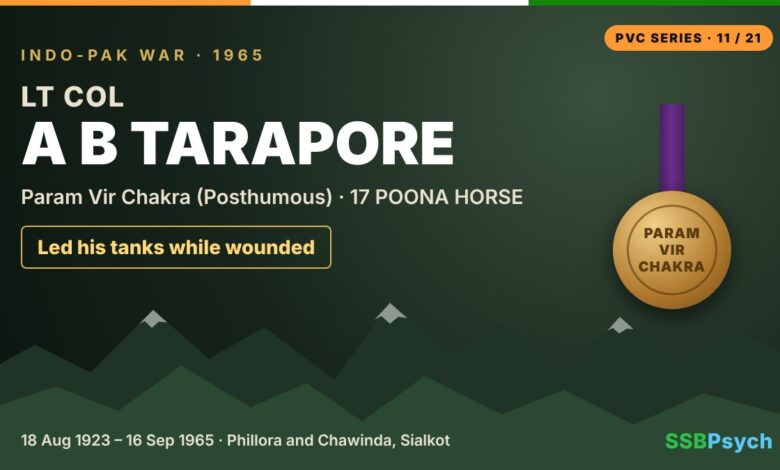
Lt Col Ardeshir Burzorji Tarapore, PVC: The Tank Commander of Phillora and Chawinda – Full Story (with Quiz)
In September 1965, the flat fields around Sialkot became the stage for one of the largest tank battles fought anywhere since the Second World War. At the head of one Indian armoured regiment stood a 42-year-old commanding officer who was wounded on the very first day of the fight and simply refused to go back. For six days, Lieutenant Colonel Ardeshir Burzorji Tarapore stayed in his tank, leading 17 Horse, The Poona Horse, from the front, until his tank was hit and he was killed at Butur-Dograndi on 16 September 1965.
For an SSB aspirant, the story of Lt Col Tarapore is a masterclass in what a commanding officer really is: the man whose calm keeps hundreds of others steady. In this post, the eleventh in our 21 Param Vir Chakra heroes series, you will read about his early life, his unusual path into the Indian Army, the battle of Phillora and Chawinda, his citation in simple words, his legacy, and the officer-like qualities you can learn from him. A 10-question quiz at the end will help you check what you remember.
Lt Col Ardeshir Burzorji Tarapore – Quick Facts
| Full name | Ardeshir Burzorji Tarapore |
| Popularly known as | Adi |
| Born | 18 August 1923, Bombay (now Mumbai) |
| Early service | Hyderabad State Forces, commissioned 1 January 1942 |
| Indian Army commission | 1 April 1951, The Poona Horse |
| Service number | IC-5565 |
| Unit | 17 Horse (The Poona Horse), Armoured Corps |
| War | Indo-Pakistan War of 1965 |
| Battles | Phillora, Wazirwali, Jassoran and Butur-Dograndi, Sialkot sector |
| Dates of action | 11 to 16 September 1965 |
| Died | 16 September 1965, in battle near Chawinda |
| Award | Param Vir Chakra (Posthumous) |
Early Life: A Boy Called Adi
Ardeshir Burzorji Tarapore was born on 18 August 1923 in Bombay, into a Parsi family. Friends and family called him Adi. His family traced its roots to an ancestor named Ratanjiba, a military leader in the service of Chhatrapati Shivaji, and the family name is linked to the village of Tarapur in Maharashtra. His grandfather had moved to Hyderabad and worked in the Nizam’s Customs and Excise Department, and his father, B. P. Tarapore, a scholar of Persian and Urdu, worked in the same department.
At the age of seven, Adi was sent to the Sardar Dastur Boys’ Boarding School in Pune. He was never a top student in the classroom, but he shone on the sports field. By the time he finished school in 1940, he had been made school captain, a sign that his teachers and classmates already saw a leader in him.
Joining the Forces: From Hyderabad to the Poona Horse
After school, Tarapore applied for a commission in the army of the princely state of Hyderabad and was selected. He trained at the Officers’ Training Schools at Golconda and Bangalore and was commissioned as a second lieutenant in the 7th Hyderabad Infantry on 1 January 1942.
His heart, however, was set on armour. An unusual incident changed his path. During an inspection by Major General El Edroos, the commander-in-chief of the Hyderabad forces, a live grenade landed where it should not have. Tarapore picked it up and threw it away; it exploded and wounded him in the chest. Impressed by his presence of mind, the general moved him to the 1st Hyderabad Imperial Service Lancers, an armoured unit that went on to serve in West Asia during the Second World War.
After Operation Polo in 1948, Hyderabad joined the Indian Union and its forces were merged into the Indian Army. Tarapore was selected for the Indian Army and was commissioned on 1 April 1951 into The Poona Horse, one of India’s most famous cavalry regiments. He served in its squadrons, became a squadron second-in-command, and was later sent to the United Kingdom for a course on the Centurion tank, which India was bringing into service. He was promoted to major in 1958 and took over as a lieutenant colonel in June 1965, only a few months before the war.
The 1965 War: Why Sialkot Mattered
Tension between India and Pakistan had been building through 1965. In August, Pakistan launched Operation Gibraltar, sending armed infiltrators into Jammu and Kashmir. When that failed, it followed with Operation Grand Slam on 1 September, a thrust aimed at the vital Akhnoor area. India responded by opening new fronts across the international border on 6 September.
India’s I Corps was given the Sialkot sector. The 1st Armoured Division, of which the Poona Horse was a part, was to drive deep into Pakistani territory and cut the link between Sialkot and Lahore. This was open, flat country, ideal for tanks, and Pakistan had strong armoured forces waiting there. The villages of Phillora and Chawinda soon became household names.
The Battle: Six Days of Iron and Fire
11 September: The Charge at Phillora
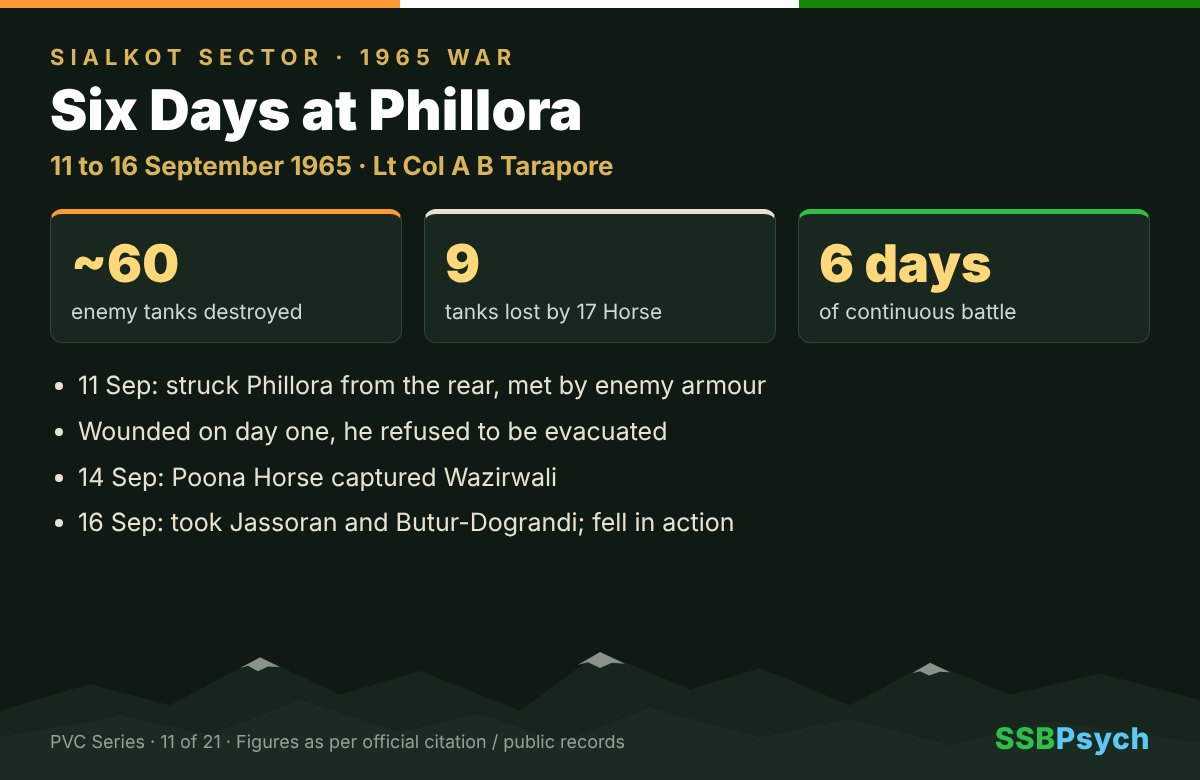
On 11 September 1965, the Poona Horse was given the main armoured thrust: capture Phillora. Instead of hitting the village head-on, Lt Col Tarapore planned to attack it from the rear. As his tanks moved between Phillora and Chawinda, enemy armour suddenly counter-attacked from the direction of Wazirwali (spelt Wazirali in the official citation).
A weaker commander might have pulled back to regroup. Tarapore did the opposite. He held his ground, fought off the enemy tanks, and pressed on with the attack on Phillora, all while his infantry support and his own regiment were under heavy tank and artillery fire. During this fighting he was wounded. He was offered evacuation and refused it. His place, he believed, was with his men.
14 September: Wazirwali Falls
Still carrying his wound, Tarapore continued to lead from his tank. On 14 September, the Poona Horse attacked and captured Wazirwali. Each success opened the way for the next push towards Chawinda, which Pakistan was defending with great determination.
16 September: Jassoran and Butur-Dograndi
On 16 September, the regiment advanced again, this time to capture Jassoran and Butur-Dograndi, with infantry support from 9 Dogra and 8 Garhwal Rifles. Both objectives were taken. Tarapore’s own tank was hit several times during the fighting, yet he held on to both positions so that the infantry could launch its attack on Chawinda from the rear.
It was here, at Butur-Dograndi, that his tank was struck and caught fire, and Lt Col Tarapore was mortally wounded. He had led the regiment through six days of almost non-stop combat.
The results of those six days were remarkable. Under his command, the Poona Horse destroyed roughly 60 enemy tanks while losing only 9 of its own. For an armoured regiment fighting a strong, well-equipped opponent on open ground, that ratio speaks volumes about the quality of its leadership.
The Param Vir Chakra Citation
Lt Col Tarapore was awarded the Param Vir Chakra posthumously, with effect from 11 September 1965, the day his ordeal began. In simple words, his citation says the following:
- His regiment was given the main armoured thrust to capture Phillora and was suddenly counter-attacked by heavy enemy armour from Wazirali.
- He did not give way. He held his ground and attacked Phillora, under continuous tank and artillery fire.
- He was wounded but declined to be evacuated, and stayed calm throughout the action.
- He went on to lead the regiment in capturing Wazirali, Jassoran and Butur-Dograndi, even though his own tank was hit several times.
- Inspired by him, the regiment destroyed about 60 enemy tanks for the loss of only 9 of its own.
- His leadership and sacrifice were judged to be in the highest traditions of the Indian Army.
His wife received the medal from the President of India. It was later handed over to the Poona Horse, and the regiment keeps it in its quarter guard as one of its proudest possessions.
Legacy: The Pride of the Poona Horse
The Poona Horse is a rare regiment in Indian military history: it has produced two Param Vir Chakra awardees. Lt Col Tarapore was the first. Just six years later, in December 1971, a 21-year-old officer of the same regiment, Second Lieutenant Arun Khetarpal, would earn the second, fighting in the very same broad region of Shakargarh and Sialkot. The regiment’s spirit of holding ground against tanks was built in large part on the example Tarapore set at Phillora.
In 2009, his name was inscribed at the Balidan Stambh, the war memorial in Jammu, among the martyrs of the 1965 war, and he appears on its mural of Param Vir Chakra heroes. His story was told in the 1988 Doordarshan series Param Vir Chakra and in an Amar Chitra Katha volume on Param Vir Chakra heroes, keeping his memory alive for new generations of Indians.
Perhaps his greatest legacy is a simple idea that every young officer learns: a commanding officer does not lead from a map in the rear. When the shells are falling, the men look for their CO, and Tarapore made sure they always found him in front.
What This Means for You as an Aspirant
Notice that Tarapore’s story starts with an ordinary student who was weaker in studies but strong in sport and leadership. The SSB does not look for toppers alone; it looks for people who take charge, stay calm and think of the team. His instinct to grab a live grenade and throw it away, his choice to attack Phillora from the rear, and his refusal to leave a fight while wounded all show the officer-like qualities that assessors look for in group tasks, interviews and psychology tests.
Lessons for SSB Aspirants: OLQs in Action
The SSB does not test whether you can recite history – it looks for the qualities of an officer. Here is how Lt Col Ardeshir Burzorji Tarapore showed them:
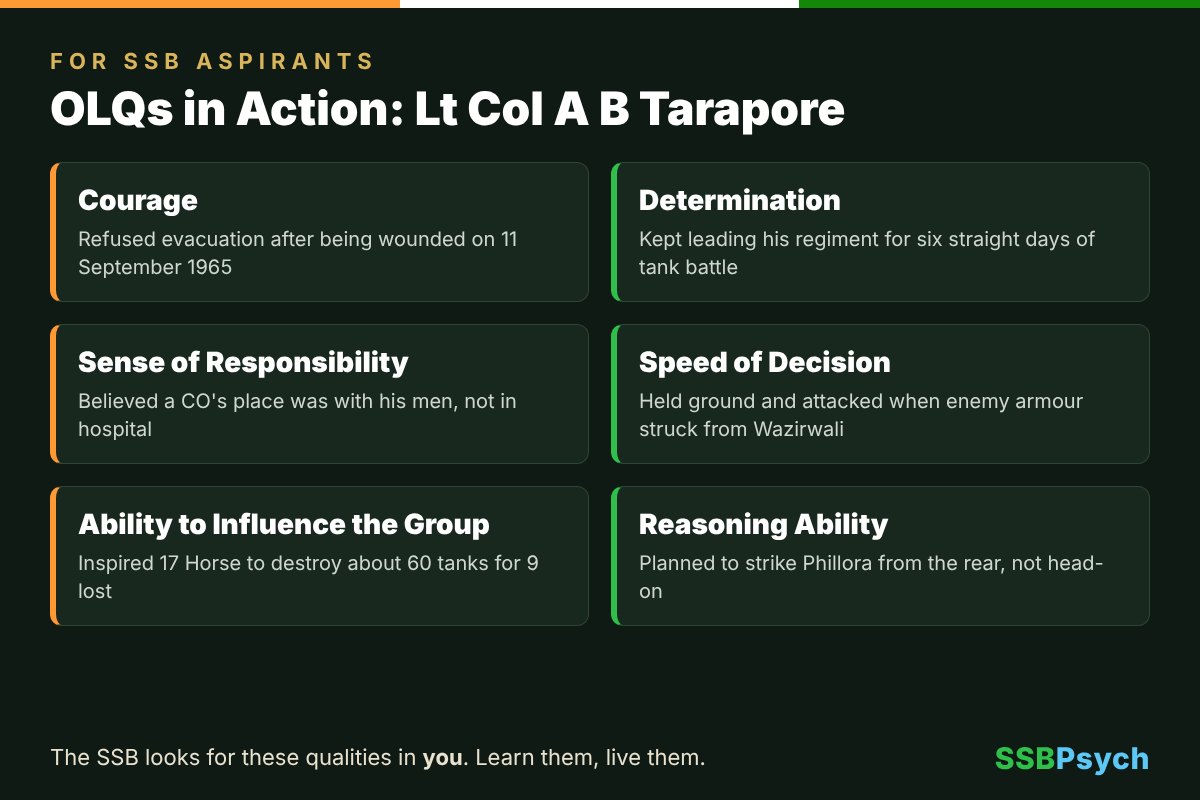
- Courage – Refused evacuation after being wounded on 11 September 1965
- Determination – Kept leading his regiment for six straight days of tank battle
- Sense of Responsibility – Believed a CO’s place was with his men, not in hospital
- Speed of Decision – Held ground and attacked when enemy armour struck from Wazirwali
- Ability to Influence the Group – Inspired 17 Horse to destroy about 60 tanks for 9 lost
- Reasoning Ability – Planned to strike Phillora from the rear, not head-on
Tip for your SSB interview: If the interviewing officer asks about a time you kept going despite a setback, give a real example where you stayed with your team after an injury, failure or loss, and explain what you did next, just as Tarapore stayed with his regiment after being wounded.
Practice Corner: WAT and SRT
Write your first spontaneous response to these before you scroll to the quiz. Keep WAT sentences short, positive and action-oriented.
WAT Words
- Wound
- Tank
- Regiment
- Ground
- Commander
SRTs
- He is leading a team in an inter-college competition and twists his ankle on the first day. The team depends on him. He…
- He is captain of a trekking group when a sudden storm splits the group and the junior members panic. He…
- He planned a project one way, but the situation changes suddenly and the original plan will not work. He…
Quiz: How Well Do You Know Lt Col Ardeshir Burzorji Tarapore?
Test yourself! Click an option to see if you are right. Your score updates live.
Frequently Asked Questions
Why was Lt Col Ardeshir Tarapore awarded the Param Vir Chakra?
For leading 17 Horse through six days of tank battles in the Sialkot sector in September 1965, refusing evacuation after being wounded, capturing several objectives and helping destroy about 60 enemy tanks before he was killed.
Where did Lt Col Tarapore die?
He was mortally wounded at Butur-Dograndi, near Chawinda in the Sialkot sector, on 16 September 1965 when his tank was hit.
Was Tarapore always in the Indian Army?
No. He was first commissioned in 1942 into the Hyderabad State Forces. After Hyderabad joined India, he was commissioned into the Indian Army’s Poona Horse on 1 April 1951.
Where is his Param Vir Chakra kept today?
His wife received the medal from the President of India, and it was later handed over to the Poona Horse, which keeps it in its quarter guard.
What can SSB aspirants learn from Lt Col Tarapore?
That leadership means staying with your team when things are hardest, keeping calm under pressure and making bold, sensible decisions, qualities that the SSB looks for in every test.
The Param Vir Chakra Series on SSBPsych
This is part 11 of 21 in our series on every Param Vir Chakra awardee. A new hero goes live every morning at 7:30 AM. Also read the story of Captain Vikram Batra, PVC – the Sher Shah of Kargil.
Sources: en.wikipedia.org, bharat-rakshak.com.
Preparing for your SSB? Join SSBPsych’s online and offline SSB batches and learn how to show your OLQs with confidence – explore our courses or call +91 8076540582.