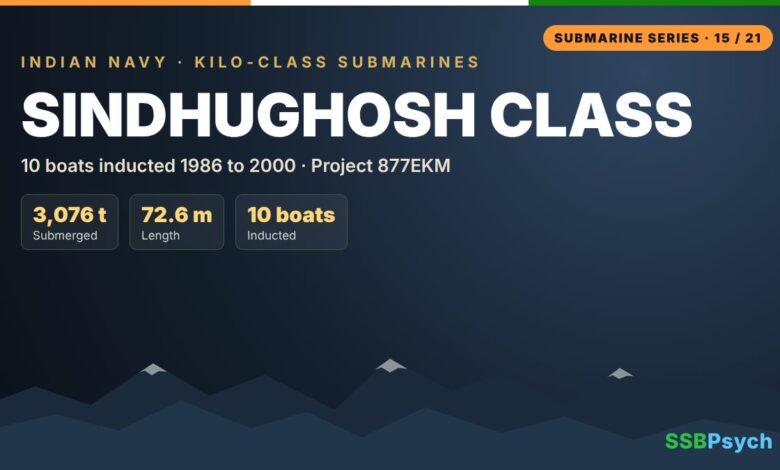
Sindhughosh class: All 10 of India’s Kilo Submarines Explained
Long before Scorpene boats were built in Mumbai, India’s underwater power rested on a family of tough Russian-built submarines. The Sindhughosh class is the Indian Navy’s version of the famous Soviet Kilo-class design, known as Project 877EKM. Between 1986 and 2000, ten of these boats joined the Navy, and for decades they formed the backbone of India’s conventional submarine fleet.
In this complete guide we cover every boat of the class, what they can do, how they were upgraded with long-range missiles, which were transferred or retired, and the hard lessons learnt from accidents. It is written in simple words for NDA, CDS, AFCAT and SSB aspirants and for anyone curious about India’s silent service.

What Is the Sindhughosh Class?
The Sindhughosh class is a group of diesel-electric attack submarines. Diesel-electric means the boats use diesel generators to charge large batteries, then run quietly on battery power underwater. Attack submarine means their main job is to hunt enemy ships and submarines. The design comes from the Soviet Union’s Kilo class, one of the most widely exported submarine types in the world. Kilo is the NATO reporting name; the export version India bought is called Project 877EKM.
Sindhu means the sea, and ghosh means a roar or loud sound, so the class name is often translated as the roar of the sea. Every boat in the class has a name beginning with Sindhu, such as Sindhuraj (king of the sea) or Sindhurakshak (protector of the sea).
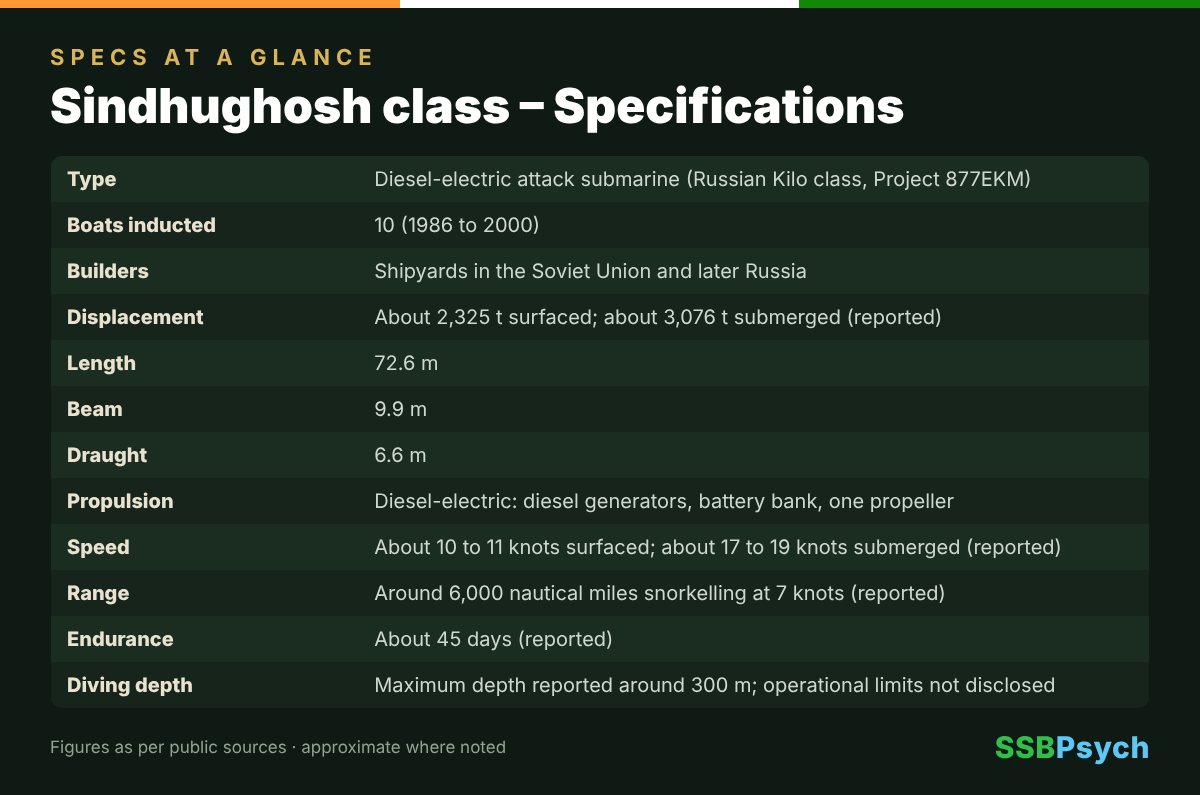
Sindhughosh class Specifications
| Type | Diesel-electric attack submarine (Russian Kilo class, Project 877EKM) |
| Boats inducted | 10 (1986 to 2000) |
| Builders | Shipyards in the Soviet Union and later Russia |
| Displacement | About 2,325 t surfaced; about 3,076 t submerged (reported) |
| Length | 72.6 m |
| Beam | 9.9 m |
| Draught | 6.6 m |
| Propulsion | Diesel-electric: diesel generators, battery bank, one propeller |
| Speed | About 10 to 11 knots surfaced; about 17 to 19 knots submerged (reported) |
| Range | Around 6,000 nautical miles snorkelling at 7 knots (reported) |
| Endurance | About 45 days (reported) |
| Diving depth | Maximum depth reported around 300 m; operational limits not disclosed |
| Crew | About 52 to 53, including around 13 officers (reported) |
| Weapons | Six 533 mm tubes: torpedoes, Klub-S anti-ship missiles (upgraded boats), mines |
| Status | Several boats still in service; others decommissioned, transferred or lost |
All Ten Boats of the Sindhughosh Class
Here is the full list of the ten submarines India received, with their pennant numbers and what is publicly known about their status:
- INS Sindhughosh (S55): commissioned 30 April 1986, the lead boat. Reported decommissioned in Mumbai in December 2025 after almost 40 years.
- INS Sindhudhvaj (S56): commissioned 1987. Decommissioned on 16 July 2022.
- INS Sindhuraj (S57): commissioned 1987. Refitted in Russia; reported in service.
- INS Sindhuvir (S58): commissioned 1988. Refitted at Hindustan Shipyard, Visakhapatnam, and transferred to the Myanmar Navy in 2020.
- INS Sindhuratna (S59): commissioned December 1988. Suffered a fatal fire in February 2014; refitted and reported in service.
- INS Sindhukesari (S60): commissioned 1988 to 1989 (sources differ). Upgraded in Russia; reported in service.
- INS Sindhukirti (S61): commissioned 1990. Long refit at Hindustan Shipyard, back in service in 2015.
- INS Sindhuvijay (S62): commissioned 1991. Refitted in Russia; reported in service.
- INS Sindhurakshak (S63): commissioned December 1997. Lost after an explosion in Mumbai on 14 August 2013.
- INS Sindhushastra (S65): commissioned July 2000, the last of the class and the first delivered with Klub missiles. Reported in service.
Based on public reports, around six of the original ten remain with the Indian Navy as of late 2025, though exact operational status of each boat at any moment is not published.
Sindhughosh class Timeline
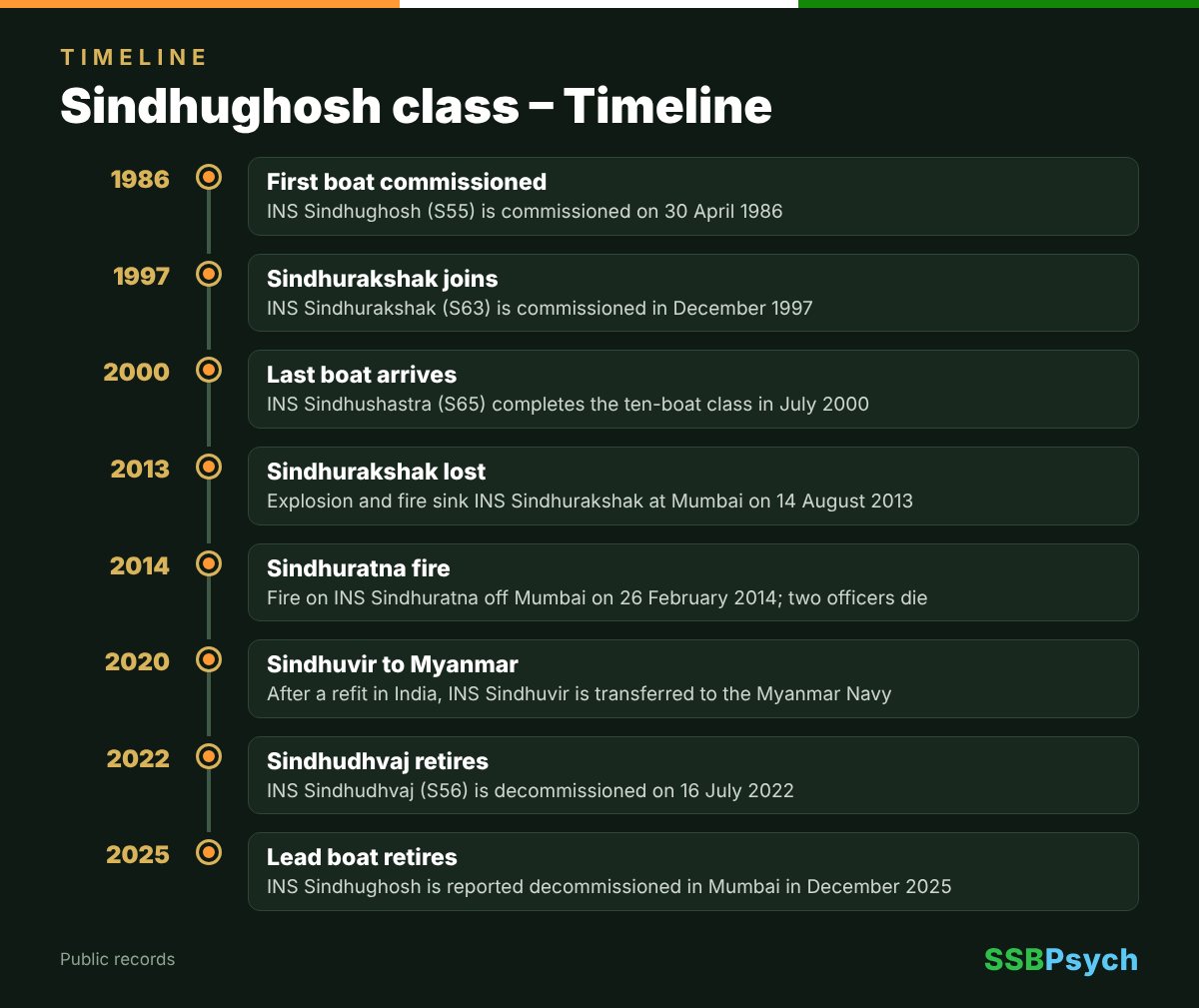
- 1986 – First boat commissioned: INS Sindhughosh (S55) is commissioned on 30 April 1986
- 1997 – Sindhurakshak joins: INS Sindhurakshak (S63) is commissioned in December 1997
- 2000 – Last boat arrives: INS Sindhushastra (S65) completes the ten-boat class in July 2000
- 2013 – Sindhurakshak lost: Explosion and fire sink INS Sindhurakshak at Mumbai on 14 August 2013
- 2014 – Sindhuratna fire: Fire on INS Sindhuratna off Mumbai on 26 February 2014; two officers die
- 2020 – Sindhuvir to Myanmar: After a refit in India, INS Sindhuvir is transferred to the Myanmar Navy
- 2022 – Sindhudhvaj retires: INS Sindhudhvaj (S56) is decommissioned on 16 July 2022
- 2025 – Lead boat retires: INS Sindhughosh is reported decommissioned in Mumbai in December 2025
How Big Is a Sindhughosh Class Submarine?
A Kilo-class boat is about 72.6 metres long and 9.9 metres wide, noticeably wider and heavier than the newer Kalvari class. Submerged, it displaces roughly 3,076 tonnes, about as much as 2,400 small cars. Its fat, rounded hull gives plenty of room inside for batteries, weapons and a crew of over 50, and helps it carry a big load of torpedoes and missiles.
It has a double hull: an inner pressure hull that keeps the crew safe from water pressure, and an outer hull that shapes the boat and holds ballast tanks. Ballast tanks are flooded with seawater to dive and emptied with compressed air to surface. The Kilo design is also known for being quiet for its time, thanks to rubber-like tiles on its outer skin that absorb sound.
Aircraft, Weapons and Sensors
- Six 533 mm bow torpedo tubes
- Type 53-series heavyweight torpedoes (reported)
- TEST-71/76 wire-guided anti-submarine torpedoes (reported)
- 3M-54 Klub-S (Club-S) anti-ship cruise missiles on upgraded boats
- Sea mines (reported up to 24) in place of torpedoes
- Sonar suites, with Indian-made USHUS sonar fitted on several boats during upgrades
- Periscopes, radar and electronic support measures
The Klub-S Upgrade: Giving Old Boats a Long Reach
The biggest change in the class’s life was the addition of the 3M-54 Klub-S (also written Club-S) anti-ship cruise missile. Fired from the torpedo tubes, it is reported to hit targets around 200 km away, far beyond torpedo range. Sindhushastra was delivered with this capability in 2000, and several older boats received it during major refits in Russia under an upgrade programme called Project 08773. These refits also brought new electronics, fire control systems and sonar improvements.
Later, several boats were fitted with Indian-made equipment such as the USHUS sonar developed by DRDO. Modernising old submarines this way is cheaper and faster than building new ones and keeps fleet numbers up while new boats are under construction.
Where the refits happened
- Zvezdochka shipyard, Severodvinsk (Russia): medium refits and upgrades for several boats, including Sindhuraj, Sindhuratna, Sindhukesari, Sindhuvijay and Sindhurakshak.
- Hindustan Shipyard Limited, Visakhapatnam: refit of Sindhukirti (2007 to 2015) and later Sindhuvir before its transfer.
- Indian partners with Russian support: public reports describe plans for further life-extension work on remaining boats with Indian shipyard involvement.
Operations and Missions
- 2006 – President on board: President A P J Abdul Kalam sailed on INS Sindhurakshak in February 2006
- 2015 – Sindhukirti returns: Sindhukirti rejoins the fleet in 2015 after a long refit at Hindustan Shipyard
- 2020 – Naval diplomacy: INS Sindhuvir handed to Myanmar, becoming that navy’s first submarine

Transfers and Decommissionings
INS Sindhuvir became a symbol of India’s neighbourhood diplomacy. After its refit at Hindustan Shipyard, it was handed to the Myanmar Navy in 2020, becoming Myanmar’s first submarine. It was reportedly renamed UMS Minye Theinkhathu in Myanmar service.
INS Sindhudhvaj was decommissioned on 16 July 2022 after about 35 years of service, and later reports said it was being dismantled. The lead boat, INS Sindhughosh, was reported decommissioned in December 2025 in Mumbai, closing a nearly 40-year career. Retiring submarines are usually stripped of sensitive equipment before being scrapped or otherwise disposed of.
Accidents and Lessons From the Sindhughosh Class
The class has also seen dark days. On 14 August 2013, INS Sindhurakshak was destroyed by explosions and fire while berthed at the naval dockyard in Mumbai. Eighteen naval personnel lost their lives. Months later, on 26 February 2014, a fire on INS Sindhuratna during a training sortie off Mumbai claimed the lives of two officers, and several sailors were affected by smoke. Following a series of mishaps, the then Navy chief, Admiral D K Joshi, resigned in February 2014, taking moral responsibility.
These tragedies led to tighter safety checks, more focus on ammunition handling and battery safety, and a push to speed up new submarine construction. Every submariner today learns from the sacrifices of those crews. Our separate post on INS Sindhurakshak covers that story in detail.
Why India Bought the Kilo Class
In the 1980s, India’s submarine arm relied on older Soviet Foxtrot-class boats. The Navy needed quieter, more capable submarines, and the Soviet Union, then India’s main defence partner, offered the Kilo. It was rugged, simple to maintain, well armed and suited to warm tropical waters. India also bought German-designed Type 209 boats around the same time, which became the Shishumar class, giving the Navy two different submarine families.
For over three decades, the Sindhughosh boats patrolled the Arabian Sea and Bay of Bengal, trained generations of submariners and gave India a credible underwater deterrent. Public reports say the class has been split between the Western Naval Command at Mumbai and the Eastern Naval Command at Visakhapatnam.
Sindhughosh Class vs Kalvari Class: Old Guard and New Generation
It helps to compare the Kilos with the newer Scorpene-based Kalvari boats built in Mumbai. The Sindhughosh boats are bigger, about 72.6 metres long and over 3,000 tonnes submerged, while a Kalvari boat is about 67.5 metres and around 1,775 tonnes. The Kilos carry a larger crew of over 50, while the more automated Kalvari boats need only about 43.
In weapons, upgraded Kilos have an edge in reach with Klub-S cruise missiles, while Kalvari boats carry Exocet missiles and modern wire-guided torpedoes. In stealth and electronics, the Kalvari class benefits from a newer design and digital combat systems. Together, the two classes, along with the German-designed Shishumar boats, make up India’s conventional submarine force today.
Why old submarines are hard to keep running
A submarine hull goes through a squeeze every time it dives and relaxes every time it surfaces. Over decades, this, along with seawater corrosion, slowly wears out the steel. Pipes, valves, batteries and cables also age. That is why the Navy sends old boats for long refits, checks hulls carefully and finally retires them when repairs no longer make sense. Getting spare parts for systems designed in the Soviet era adds another layer of difficulty and cost.
Crew, Command and Life on Board
A Sindhughosh class submarine is reported to carry around 52 to 53 crew, including about 13 officers. Indian submarines of this kind are commanded by an officer of Commander rank, supported by an executive officer and specialist heads for weapons, engineering, electrical and navigation duties. The boats are older and less automated than Scorpenes, so more hands are needed to run them.
Life on board an older Kilo is hot and cramped, especially in tropical waters. Sailors share tight bunk spaces, work in shifts around the clock and live without daylight while submerged. Reported endurance is around 45 days, and during that time fresh food runs out, water is rationed and the air smells of diesel and machinery. Teamwork, patience and humour carry the crew through.
Diving Depth, Dangers and Costs
Open sources report a maximum diving depth of about 300 metres for the Kilo design, with a shallower normal operating depth. The Indian Navy does not publish the operating limits of its boats. The biggest dangers on older submarines include fire, battery gases such as hydrogen, flooding and the handling of weapons, which is why strict procedures matter so much.
The original purchase cost of the boats in the 1980s and 1990s has not been clearly published in reliable public sources. What has been reported is the cost of upgrades: in 2010, a refit contract for Sindhurakshak at Zvezdochka was reported at about US$80 million, and in 2014 the Defence Acquisition Council was reported to have cleared about Rs 4,800 crore for mid-life upgrades of four Kilo-class boats. Running costs are driven by fuel, battery replacement, frequent refits as boats age, spare parts from Russia, weapons and crew training.
The Legacy of the Sindhughosh Class
The Sindhughosh class served India through the Cold War, the 1999 Kargil conflict period, and well into the age of Scorpene and nuclear submarines. As the newer Kalvari boats and future programmes take over, the remaining Kilos continue to serve after upgrades. For exam aspirants, remember: ten boats, inducted between 1986 and 2000, Russian Kilo design, Klub-S missile upgrade, Sindhuvir to Myanmar in 2020, Sindhurakshak lost in 2013.
Did You Know?
- All ten boat names start with Sindhu, meaning sea.
- There is no S64 in the class; the tenth boat is S65, Sindhushastra.
- INS Sindhuvir became the first submarine of the Myanmar Navy.
- President A P J Abdul Kalam sailed on INS Sindhurakshak in 2006.
- Klub-S missiles turned these older boats into long-range ship killers.
- The lead boat Sindhughosh served for close to 40 years.
Quiz: Test Your Knowledge of Sindhughosh class
Click an option to see if you are right. Your score updates live.
Sindhughosh class: Frequently Asked Questions
The Sindhughosh class is the Indian Navy’s version of the Russian Kilo-class diesel-electric attack submarine (Project 877EKM). Ten boats were inducted between 1986 and 2000.
Of the ten, Sindhurakshak was lost in 2013, Sindhuvir went to Myanmar in 2020, Sindhudhvaj retired in 2022 and Sindhughosh was reported retired in December 2025, leaving around six in service per public reports.
They have six 533 mm torpedo tubes for heavyweight torpedoes and mines, and upgraded boats can fire Klub-S anti-ship cruise missiles.
INS Sindhuvir was transferred to the Myanmar Navy in 2020 after a refit at Hindustan Shipyard, becoming Myanmar’s first submarine.
Sindhu means sea and ghosh means roar or sound, so the name is usually translated as the roar of the sea.
This is part 15 of 21 in SSBPsych’s submarine series – a new post every morning at 10 AM.
Sources: en.wikipedia.org, en.wikipedia.org, en.wikipedia.org, en.wikipedia.org, en.wikipedia.org.
Preparing for NDA, CDS, AFCAT or your SSB? Join SSBPsych’s online and offline batches – explore our courses or call +91 8076540582.