Mahar Regiment: History, Motto, War Cry, Battles and Heroes
Some regiments are famous for one great battle. The Mahar Regiment is famous for its journey. Its soldiers served in the armies of the 18th and 19th centuries, were shut out of the Army for decades, fought their way back in, and built a regiment that has given India a Param Vir Chakra and two Chiefs of the Army Staff. It is also the only Indian infantry regiment that spent its early years as a machine-gun regiment.
In this guide you will learn the history of the Mahar Regiment, follow a clear timeline, read about its major operations and battle honours, understand its motto, war cry and insignia, meet its heroes and see what life in the regiment is like today. At the end there is a section for NDA, CDS and SSB aspirants and a 10-question quiz.
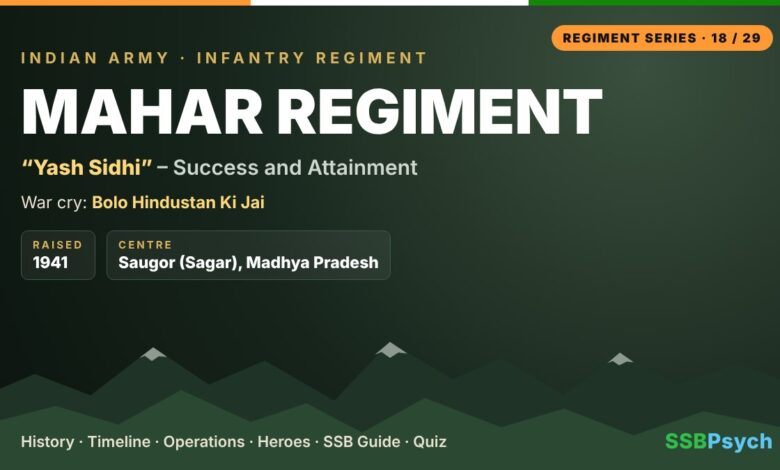
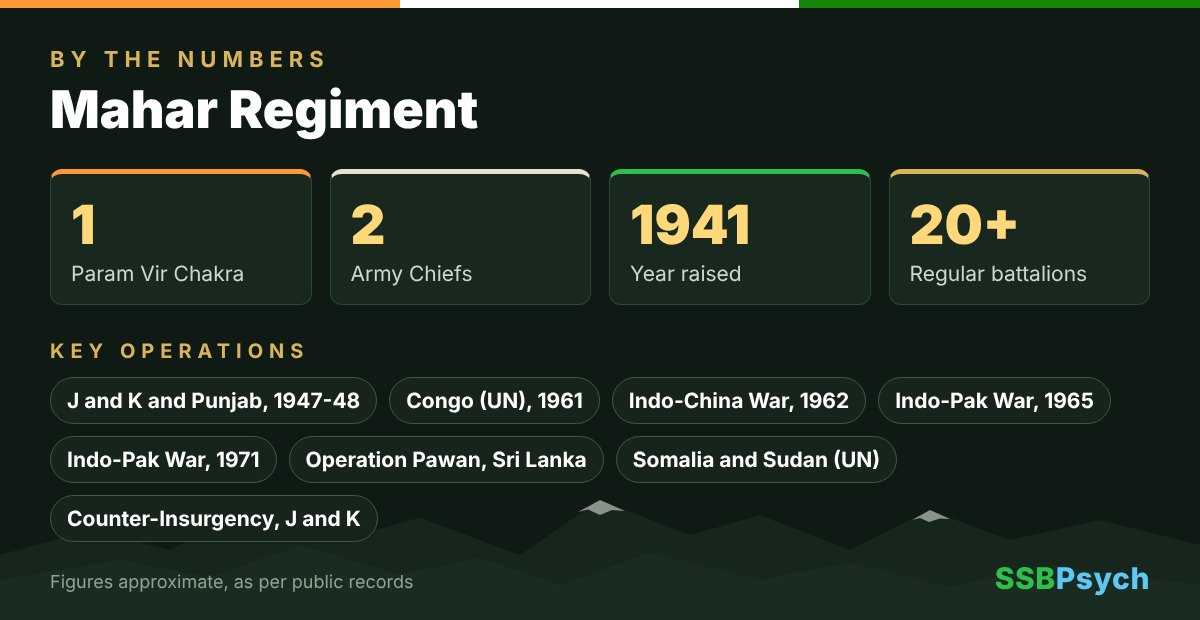
Mahar Regiment – Quick Facts
| Raised | 1 October 1941, 1st Battalion at Belgaum |
| Regimental Centre | Saugor (Sagar), Madhya Pradesh |
| Motto | Yash Sidhi (Success and Attainment) |
| War Cry | Bolo Hindustan Ki Jai (Say Victory to India) |
| Recruitment | Mahars of Maharashtra in some battalions; most others all-India, all-class |
| Special history | Served as a machine-gun regiment from 1946 to the early 1960s |
| Battalions | About 20 regular battalions, plus RR and TA units |
| Param Vir Chakra | 1 (Maj Ramaswamy Parameswaran, 8 Mahar, 1987) |
| Army Chiefs | 2 (Gen K V Krishna Rao and Gen K Sundarji) |
| Notable gallantry | Maha Vir Chakras including Naik Krishna Sonawane and Maj P S Ganapathi |
History of the Mahar Regiment
The Mahars are a community mainly from Maharashtra with a long tradition of military service. From around the middle of the 18th century they joined the East India Company’s Bombay Army in large numbers and formed a significant part of its strength. Many also served in the Company’s Marine Battalion.
After 1857, British recruitment policies changed. The authorities began to favour communities they called the martial classes, and in 1892 recruitment of Mahars was stopped altogether. Former soldiers and community leaders petitioned again and again for the decision to be reversed. During the First World War, when the Army needed more men, the 111th Mahars was raised in 1917. But it was merged and then disbanded by 1921, and the community was again left without a regiment.
Raising of the Regiment in 1941
The Second World War brought a new chance. As the Army expanded, the decision was taken to raise a Mahar Regiment. Dr B R Ambedkar, who was appointed to the Viceroy’s Defence Advisory Committee in 1941, strongly encouraged Mahar youth to join. On 1 October 1941, the 1st Battalion, Mahar Regiment, was raised at Belgaum (now Belagavi) in Karnataka. More battalions followed in 1942.
A training company was set up at Kamptee near Nagpur in 1942, which grew into the regimental centre. After moving for a short time, the centre settled at Saugor (Sagar) in Madhya Pradesh in 1948, where it remains today along with the Mahar Regimental Museum.
The Machine-Gun Years
In 1946 the regiment was converted into a machine-gun regiment. Its battalions were equipped with medium machine guns and were sent to support other infantry formations wherever heavy firepower was needed. In 1956, Border Scouts battalions raised after Partition were merged into the regiment as Mahar (Borders) battalions. For several years the Mahar Regiment was the only machine-gun regiment in the Indian Army. In 1963–64 it was converted back to a standard infantry regiment, though its machine-gun heritage is still visible on its badge.
Mahar Regiment Timeline: From Raising to Today
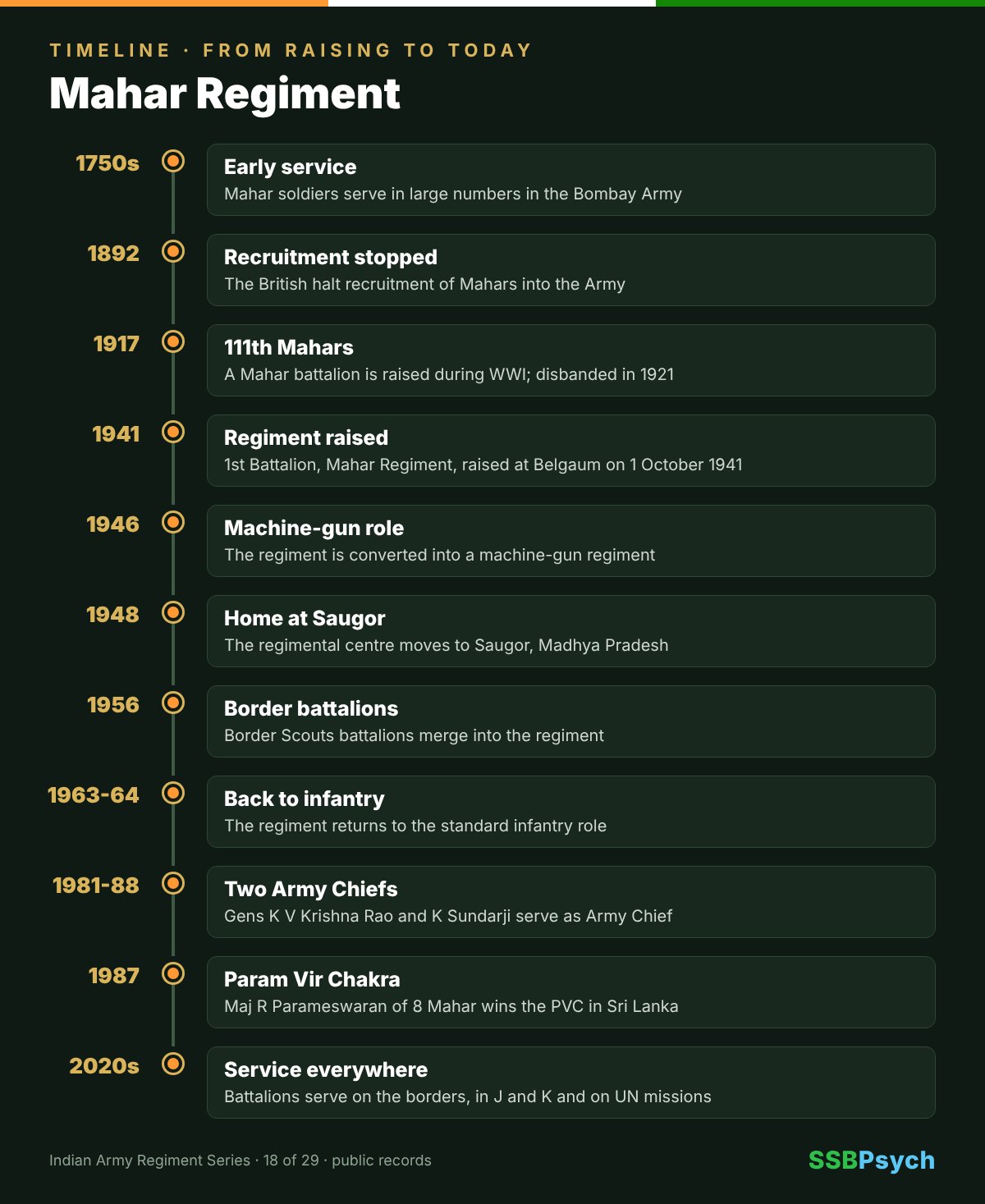
- 1750s – Early service: Mahar soldiers serve in large numbers in the Bombay Army
- 1892 – Recruitment stopped: The British halt recruitment of Mahars into the Army
- 1917 – 111th Mahars: A Mahar battalion is raised during WWI; disbanded in 1921
- 1941 – Regiment raised: 1st Battalion, Mahar Regiment, raised at Belgaum on 1 October 1941
- 1946 – Machine-gun role: The regiment is converted into a machine-gun regiment
- 1948 – Home at Saugor: The regimental centre moves to Saugor, Madhya Pradesh
- 1956 – Border battalions: Border Scouts battalions merge into the regiment
- 1963-64 – Back to infantry: The regiment returns to the standard infantry role
- 1981-88 – Two Army Chiefs: Gens K V Krishna Rao and K Sundarji serve as Army Chief
- 1987 – Param Vir Chakra: Maj R Parameswaran of 8 Mahar wins the PVC in Sri Lanka
- 2020s – Service everywhere: Battalions serve on the borders, in J and K and on UN missions
Major Operations and Battle Honours of the Mahar Regiment
Because Mahar machine-gun companies were spread across many formations, the regiment took part in almost every major action from 1947 onwards. It holds theatre honours for Jammu and Kashmir and Punjab in 1947–48, Ladakh in 1962, Punjab and Jammu and Kashmir in 1965, and several fronts in 1971, including East Pakistan.
1947-48 and 1962
In 1947–48 Mahar machine-gunners supported Indian troops in Jammu and Kashmir and Punjab, providing the heavy firepower that helped infantry battalions hold and capture key positions. In 1962, Mahar units fought in Ladakh during the war with China, holding positions in extreme cold at very high altitude.
1965 and 1971
During the wars with Pakistan in 1965 and 1971, Mahar battalions fought on several fronts. The regiment earned battle honours such as Asal Uttar, Kalidhar, Sehjra, Parbat Ali and Shamsher Nagar – names that cover battlefields from Punjab and Jammu to Rajasthan and East Pakistan.
Sri Lanka 1987: The Param Vir Chakra
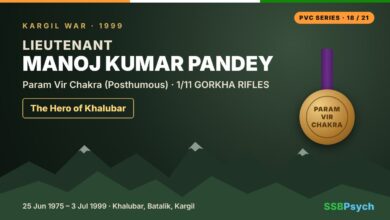
The regiment’s proudest moment came in Sri Lanka. On 25 November 1987, Major Ramaswamy Parameswaran of 8 Mahar was returning from a search operation with the Indian Peace Keeping Force when his column was ambushed by militants. Keeping calm, he moved his men to encircle the attackers from the rear. In close-quarter fighting he was shot in the chest, yet he kept directing his men until he died. The ambush was broken and the militants were driven off. He was awarded the Param Vir Chakra posthumously, the regiment’s highest honour.
UN Missions and Counter-Insurgency
Mahar soldiers have served the United Nations in the Congo in 1961, in Somalia in 1993 and in Sudan, among other missions. At home, Mahar battalions have spent many years on counter-insurgency duty in Jammu and Kashmir and the North-East, and continue to guard India’s borders today. Serving under the blue helmet in distant countries, they have helped protect civilians and keep fragile ceasefires, earning praise for their discipline and friendly conduct with local people.
Insignia, Motto and War Cry
The regiment’s badge has changed several times, telling its story. The early badge featured the Koregaon pillar. After the conversion to a machine-gun regiment, crossed Vickers machine guns were added. After Independence, the pillar was replaced by an upward-pointing katar, a traditional Indian dagger, and the motto was written in Devanagari. The crossed machine guns remain a reminder of the regiment’s unique past.
The motto is Yash Sidhi, meaning Success and Attainment. The war cry, Bolo Hindustan Ki Jai – Say Victory to India – is special because it is not linked to any single deity or community. It is a call to the nation itself, which suits a regiment that today draws soldiers from across India.
Heroes of the Mahar Regiment
- Major Ramaswamy Parameswaran, Param Vir Chakra (posthumous) – 8 Mahar, Sri Lanka, 25 November 1987.
- Naik Krishna Sonawane, Maha Vir Chakra (posthumous) – 1 Mahar.
- Sepoy Ansuya Prasad, Maha Vir Chakra (posthumous) – 10 Mahar.
- Major P S Ganapathi, Maha Vir Chakra – 8 Mahar.
- Lt Col Gurbans Singh Sangha, Maha Vir Chakra – Mahar Regiment officer.
- General K V Krishna Rao – Chief of the Army Staff from 1981 to 1983.
- General K Sundarji – Chief of the Army Staff from 1986 to 1988, known for his ideas on modernising the Army.
The Mahar Regiment and Its Leaders
Two officers from the Mahar Regiment rose to become Chief of the Army Staff, a remarkable record for a regiment raised only in 1941. General K V Krishna Rao led the Army from 1981 to 1983 and later served as Governor of several states, including Jammu and Kashmir. General K Sundarji, Chief from 1986 to 1988, was known as a thinker who pushed for mechanisation and new ideas in warfare. The regiment has also produced several Army Commanders, showing the depth of its leadership tradition.
For the regiment’s soldiers, these achievements carry special meaning. They show that a regiment whose community was once kept out of the Army can produce leaders at the very top. Young officers joining the regiment are often reminded that their predecessors earned this respect through performance, not privilege.
The Mahar (Borders) Battalions
After Partition, the new Indian Army needed units to watch the long and sensitive border with Pakistan. Scout units were raised in East Punjab and nearby areas from local men who knew the land well. In 1956 these Border Scouts battalions were merged into the Mahar Regiment, then a machine-gun regiment, and later became regular infantry battalions. Known as the Mahar (Borders) battalions, they brought soldiers from the border regions into the regiment’s family and further widened its all-India character.
Role and Life in the Mahar Regiment
Today the Mahar Regiment is a line infantry regiment trained for all terrain. Its class composition is one of the most varied in the Army. A few battalions are made up mainly of Mahar soldiers from Maharashtra, while most others are all-India, all-class units with soldiers from many states and communities. The Mahar (Borders) battalions trace their roots to soldiers from border areas of Punjab and Jammu and Kashmir.
This mix gives the regiment a strong sense of national unity. Soldiers from different regions, languages and religions train, live and fight together, and the regiment’s war cry reminds them that they all serve one country. The regiment also has Rashtriya Rifles and Territorial Army battalions.
Saugor, the regimental centre, is a historic cantonment in Madhya Pradesh. Recruits learn not only weapons and tactics but also the regiment’s long struggle for the right to serve, which gives them a deep sense of pride. The Mahar Regimental Museum preserves uniforms, badges, weapons and records from every stage of this journey.
Like every infantry regiment, the Mahar Regiment marks its raising day and remembers its fallen with dignity. Regimental reunions at Saugor bring together veterans, war widows and serving soldiers, keeping alive the bond between generations. The centre also supports the welfare of retired soldiers and their families, a reminder that in the Army, the regimental family never forgets its own.
What the Mahar Regiment Teaches Aspirants
The story of the Mahar Regiment is a story of perseverance. A community that was denied the chance to serve kept asking, kept proving itself and finally built a regiment that produced two Army Chiefs and a Param Vir Chakra winner. For an officer candidate, this is a lesson in resilience: setbacks are not the end of the road. The regiment’s change from infantry to machine guns and back again also shows adaptability, another quality the SSB values.
Major Parameswaran’s action teaches something more: in a sudden crisis, a leader must stay calm, think quickly and act decisively. He turned an ambush into a counter-attack within minutes. That kind of quick, sound judgment under pressure is exactly what assessors look for in the Group Testing tasks and the interview.
Mahar Regiment for SSB Candidates: What You Should Know
How officers join
- Officers from any part of India can be commissioned into the Mahar Regiment; there is no regional quota for officers.
- Entry routes include NDA after Class 12, IMA through CDS, TES, TGC or ACC, and OTA Chennai through Short Service Commission.
- Regiment allotment happens at the academy based on your choices, order of merit and vacancies.
- The regiment’s mixed class composition means young officers learn to lead soldiers from many backgrounds from day one.
How soldiers join
- Some battalions recruit mainly Mahars from Maharashtra, while most others are all-India, all-class.
- Since 2022, soldiers join as Agniveers under the Agnipath scheme through Army recruitment rallies; check joinindianarmy.nic.in for current rules.
Questions you may face in the SSB interview, GD or lecturette
- Who was Major Ramaswamy Parameswaran and what did he do?
- Why is the Mahar Regiment’s war cry special?
- Name the Army Chiefs who came from the Mahar Regiment.
- What role did the Indian Peace Keeping Force play in Sri Lanka?
- Give a short lecturette on the role of social inclusion in the armed forces.
SSBPsych tip: Use the Mahar Regiment’s story of perseverance as an example in your SSB interview when asked how you handle setbacks, but connect it honestly to a real experience of your own.
Read the stories of its Param Vir Chakra heroes: Major Ramaswamy Parameswaran.
Conclusion
From the Bombay Army of the 18th century to the battlefields of 1965 and 1971 and the jungles of Sri Lanka, the Mahar Regiment has earned success and attainment through sheer determination. Its soldiers have held machine-gun posts in the snow, fought through ambushes in the jungle and stood guard on the border with quiet pride. Its story belongs to every Indian who believes that courage and character matter more than birth, and that a nation is strongest when every community has a fair chance to serve it. Test yourself with the quiz below, and keep preparing with SSBPsych for your own journey to the Indian Army.
Quiz: How Well Do You Know the Mahar Regiment?
Test yourself! Click an option to see if you are right. Your score updates live.
Mahar Regiment: Frequently Asked Questions
The motto is Yash Sidhi, meaning Success and Attainment.
The war cry is Bolo Hindustan Ki Jai, meaning Say Victory to India.
The Mahar Regimental Centre is at Saugor (Sagar) in Madhya Pradesh.
Major Ramaswamy Parameswaran of 8 Mahar was awarded the Param Vir Chakra posthumously for his action in Sri Lanka on 25 November 1987.
General K V Krishna Rao (1981-83) and General K Sundarji (1986-88) both came from the Mahar Regiment.
Indian Army Regiments Series on SSBPsych
This is part 18 of 29 in our series on every infantry regiment of the Indian Army – a new regiment every day at 11 AM. Previous in the series: Bihar Regiment. Also follow our Param Vir Chakra series.
Sources: en.wikipedia.org, en.wikipedia.org, theprint.in, aviation-defence-universe.com.
Preparing for NDA, CDS, AFCAT or your SSB? Join SSBPsych’s online and offline batches – explore our courses or call +91 8076540582.