Bihar Regiment: History, Motto, War Cry, Battles and Heroes
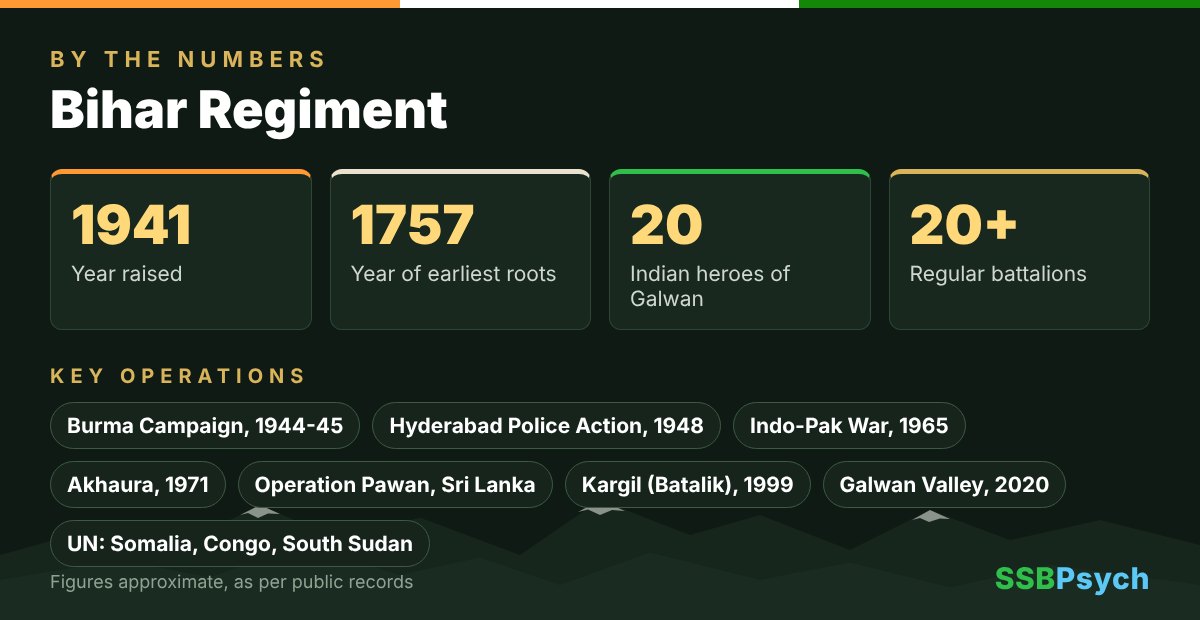
When news came from the Galwan Valley in June 2020 that a group of Indian soldiers had stood their ground against a much larger Chinese force, the whole nation learned the name of one battalion: 16 Bihar. But the courage of the Bihar Regiment did not begin at Galwan. From the jungles of Burma in the Second World War to Akhaura in 1971 and the heights of Batalik in 1999, the soldiers of Bihar and Jharkhand have earned a reputation for raw toughness and unshakeable spirit.
In this guide you will learn the history of the Bihar Regiment, follow a simple timeline, read about its key operations and battle honours, understand its motto, war cries and insignia, meet its heroes and get a feel for life in the regiment. At the end there is a section for NDA, CDS and SSB aspirants and a quiz to test yourself.
Bihar Regiment – Quick Facts
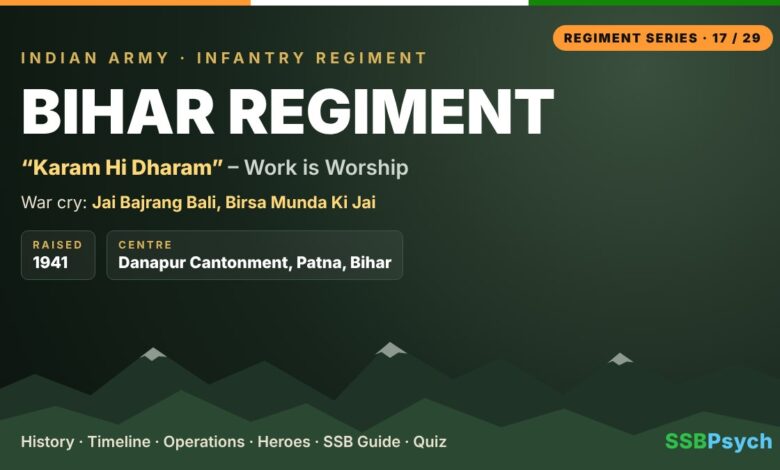
| Raised | 1941 (1st Battalion regularised at Danapur on 15 September 1941) |
| Regimental Centre | Danapur Cantonment, Patna, Bihar |
| Motto | Karam Hi Dharam (Work is Worship) |
| War Cries | Jai Bajrang Bali and Birsa Munda Ki Jai |
| Recruitment | Bihar, Jharkhand and nearby areas, including tribal communities; some all-India units |
| Battalions | Over 20 regular battalions, plus RR and TA units |
| Insignia | The Ashoka Lion |
| Battle honours | Haka, Gangaw, Akhaura, Batalik |
| Notable gallantry | Ashoka Chakras and Maha Vir Chakras, including Col B Santosh Babu |
| Famous recent action | Galwan Valley, June 2020 (16 Bihar) |
History of the Bihar Regiment
Soldiers from Bihar have a long military history. In the 18th century, men from the Bhojpur region around Arrah formed a large part of the East India Company’s early sepoy battalions, and a battalion was raised at Patna as early as 1757. These soldiers, often called Purbias (men from the east), served across India. After 1857, however, the British recruited far fewer men from the region, and for decades Bihar had no regiment of its own.
Things changed in the 20th century. A Territorial Force battalion, the 11th Battalion of the 19th Hyderabad Regiment, was based at Danapur from the 1920s. During the Second World War, as the Army expanded rapidly, this battalion was converted into a regular unit and became the 1st Battalion, Bihar Regiment on 15 September 1941. The 2nd Battalion followed in December 1942.
The regimental centre was first set up at Agra in 1945, moved through Ranchi and Gaya, and finally settled at Danapur Cantonment, near Patna, in 1949. It has remained there ever since, on the banks of the Ganga.
Burma, 1944-45
The young regiment’s first big test came in Burma. As part of the Lushai Brigade, 1 Bihar operated in the difficult hills along the Indo-Burmese border. It captured Haka in October 1944 and Gangaw in January 1945, earning the battle honours Haka and Gangaw and the theatre honour Burma 1942–45.
Bihar Regiment Timeline: From Raising to Today
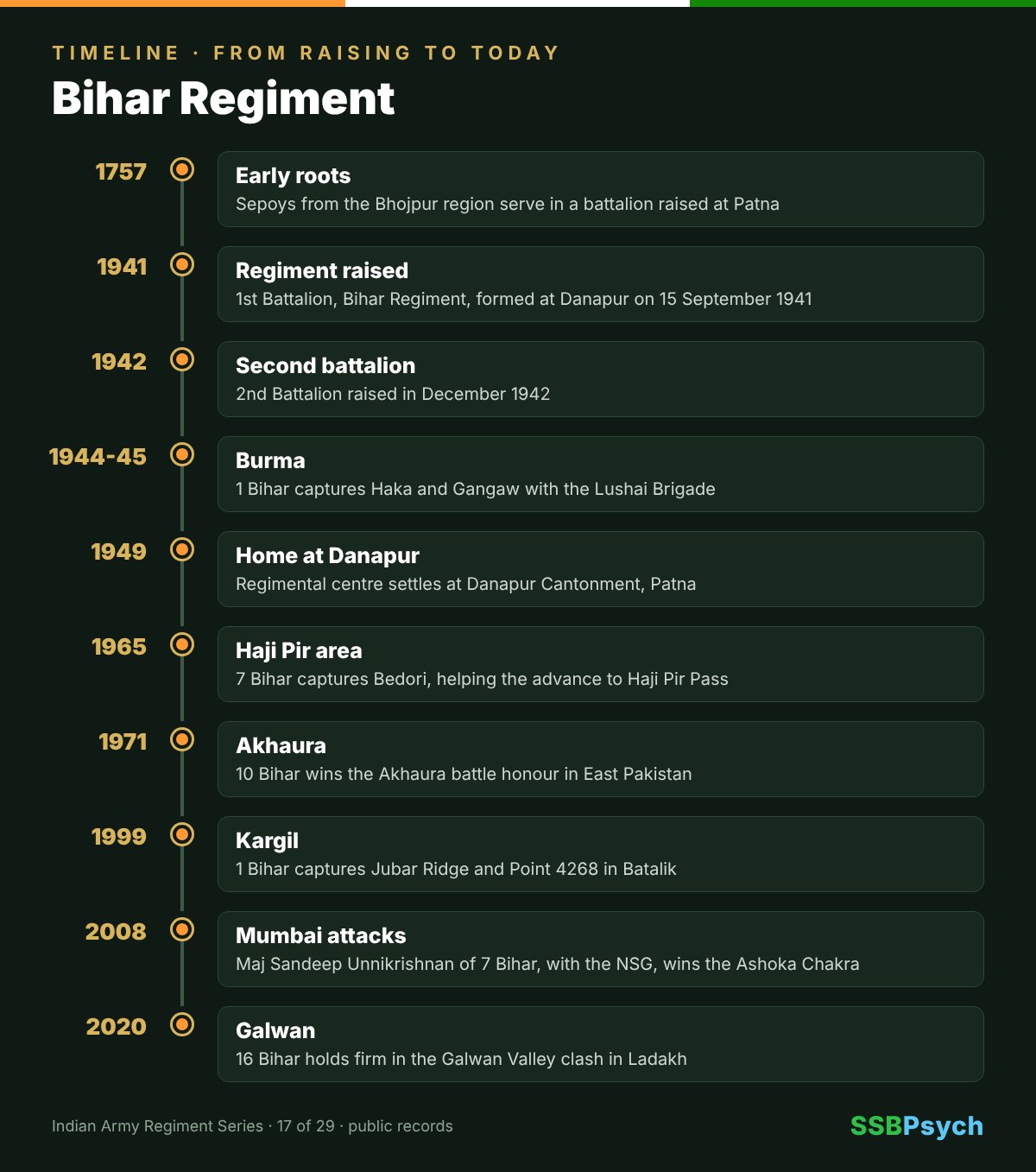
- 1757 – Early roots: Sepoys from the Bhojpur region serve in a battalion raised at Patna
- 1941 – Regiment raised: 1st Battalion, Bihar Regiment, formed at Danapur on 15 September 1941
- 1942 – Second battalion: 2nd Battalion raised in December 1942
- 1944-45 – Burma: 1 Bihar captures Haka and Gangaw with the Lushai Brigade
- 1949 – Home at Danapur: Regimental centre settles at Danapur Cantonment, Patna
- 1965 – Haji Pir area: 7 Bihar captures Bedori, helping the advance to Haji Pir Pass
- 1971 – Akhaura: 10 Bihar wins the Akhaura battle honour in East Pakistan
- 1999 – Kargil: 1 Bihar captures Jubar Ridge and Point 4268 in Batalik
- 2008 – Mumbai attacks: Maj Sandeep Unnikrishnan of 7 Bihar, with the NSG, wins the Ashoka Chakra
- 2020 – Galwan: 16 Bihar holds firm in the Galwan Valley clash in Ladakh
Major Operations and Battle Honours of the Bihar Regiment
1948 and 1965
After Independence, Bihar battalions took part in Operation Polo in 1948, which brought Hyderabad into the Indian Union. In the 1965 war, 7 Bihar captured Bedori, a key feature that helped Indian troops in the famous advance to the Haji Pir Pass in Jammu and Kashmir.
1971: Akhaura
In the 1971 war, 10 Bihar fought in the battle of Akhaura in eastern East Pakistan, an important rail and road junction on the way to Dhaka. The battalion earned the battle honour Akhaura and the theatre honour East Pakistan 1971. Other Bihar battalions also took part, including 11 Bihar, which formed part of an amphibious task force landed near Cox’s Bazar in December 1971, and 3 Bihar on the western front.
Sri Lanka
Several Bihar battalions served with the Indian Peace Keeping Force during Operation Pawan in Sri Lanka in the late 1980s, operating in thick jungle against a skilled guerrilla force.
Kargil 1999: Batalik
In May 1999, 1 Bihar was among the first units to face the intruders in the Batalik sector. On 29 May, Major M Saravanan led an attack on a heavily defended enemy position at very high altitude and was killed after fighting bravely; he was awarded the Vir Chakra posthumously. In early July, the battalion captured Point 4268 and Jubar Ridge, earning the battle honour Batalik and the theatre honour Kargil 1999.
2020: Galwan Valley
On the night of 15 June 2020, troops of 16 Bihar, led by their Commanding Officer Colonel B Santosh Babu, were involved in a violent clash with Chinese troops in the Galwan Valley of eastern Ladakh. The fighting was hand-to-hand, without firearms, in freezing conditions. Twenty Indian soldiers, including Colonel Babu, lost their lives. The Chinese side also suffered casualties. Colonel Babu was awarded the Maha Vir Chakra posthumously in 2021, and several of his men also received gallantry awards. Galwan has become a symbol of the Indian soldier’s resolve to defend every inch of the nation’s territory.
The Galwan clash was the first deadly confrontation on the India-China border in about 45 years, and it changed how India looks at its northern frontier. In the years since, the Army has strengthened its presence along the Line of Actual Control, built new roads and bridges, and kept large forces ready in Ladakh. For any defence aspirant, Galwan is now an essential topic for group discussions, lecturettes and interviews, and the story of 16 Bihar is at its heart.
UN Peacekeeping
Bihar battalions have also served with United Nations missions in Somalia, the Democratic Republic of the Congo and South Sudan, earning respect for their professionalism in difficult and dangerous conditions.
Insignia, Motto and War Cry
The insignia of the Bihar Regiment is the Ashoka Lion, a reminder of the great Mauryan empire whose capital, Pataliputra, stood where Patna stands today. The badge was adopted in the early years of the regiment, long before the Ashoka Lion became the national emblem of India.
The motto is Karam Hi Dharam, meaning Work is Worship. It tells soldiers that doing their duty honestly and completely is itself a sacred act. The regiment has two war cries: Jai Bajrang Bali, calling on Lord Hanuman, and Birsa Munda Ki Jai, honouring the great tribal hero of Jharkhand who fought against British rule. Together they reflect the mix of communities that make up the regiment.
Heroes of the Bihar Regiment
- Lt Col Harsh Uday Singh Gaur, Ashoka Chakra (posthumous) – Commanding Officer of 10 Bihar, killed while leading an operation against terrorists in Baramulla in 1994.
- Major Sandeep Unnikrishnan, Ashoka Chakra (posthumous) – officer of 7 Bihar serving with the NSG; fell fighting terrorists at the Taj Mahal Palace hotel during the 2008 Mumbai attacks.
- Major M Saravanan, Vir Chakra (posthumous) – 1 Bihar, Batalik, Kargil, 29 May 1999.
- Captain Gurjinder Singh Suri, Maha Vir Chakra (posthumous) – 12 Bihar, Uri sector, 9 November 1999.
- Colonel B Santosh Babu, Maha Vir Chakra (posthumous) – Commanding Officer of 16 Bihar, Galwan Valley, 2020.
These names stand for hundreds of other Bihar soldiers who have been decorated for courage in war, counter-insurgency and peacekeeping.
Who Was Birsa Munda?
Many aspirants know the war cry but not the man behind it. Birsa Munda was a young tribal leader from the Chotanagpur region of present-day Jharkhand. In the last years of the 19th century he led the Munda people in a powerful movement, known as the Ulgulan or Great Tumult, against British rule and the exploitation of tribal land by outsiders. He was captured and died in British custody in 1900 while still in his twenties.
Today he is honoured across India as a freedom fighter, and his birth anniversary on 15 November is celebrated as Janjatiya Gaurav Divas. By shouting his name before battle, tribal soldiers of the Bihar Regiment connect their own courage with the struggle of their ancestors for dignity and freedom. It is a powerful example of how regiments draw strength from local heroes and traditions.
Role and Life in the Bihar Regiment
The Bihar Regiment is a line infantry regiment trained for every type of terrain, from deserts and plains to high mountains. In most battalions, about half the soldiers come from Bihar and nearby areas of Uttar Pradesh, and the rest are tribal soldiers – such as Mundas, Santhals, Hos and Oraons – from Jharkhand and Odisha. Some newer battalions have an all-India, all-class composition.
This mix gives the regiment a unique culture. Soldiers celebrate Chhath, Holi, Sarhul and Karma together, and the regimental centre at Danapur hosts colourful events that bring all these traditions under one roof. Bihari and tribal soldiers are known for their endurance, simplicity and willingness to work hard in any condition – qualities that shine in tough places like Kargil and Ladakh.
The regiment also includes Rashtriya Rifles battalions for counter-terror work in Jammu and Kashmir and Territorial Army battalions. Danapur Cantonment, one of the oldest cantonments in India, has a regimental museum and war memorial that preserve the stories of the regiment’s heroes. Every year, veterans and serving soldiers gather to remember those who made the supreme sacrifice.
Training and Traditions at Danapur
Every Bihar soldier begins his journey at the regimental centre in Danapur. Recruits go through months of hard physical training, weapon handling, drill, fieldcraft and tactics. Just as importantly, they are taught the regiment’s history, the stories of its heroes and the values of loyalty, honesty and teamwork. By the time they pass out and march on the parade ground in front of their families, they have become part of a proud regimental family.
Regimental traditions continue in the battalions. Raising days are celebrated with sports, cultural programmes and a special meal shared by officers and men. Memorial services honour those who fell at Akhaura, Batalik and Galwan. Retired soldiers are invited back and treated with great respect, and the regiment helps the families of its fallen soldiers long after the battle is over.
Lessons for Aspirants from the Bihar Regiment
The Bihar Regiment’s story teaches three important lessons. First, leaders lead from the front: Lieutenant Colonel Gaur and Colonel Santosh Babu were Commanding Officers who stood with their men in the most dangerous moments. Second, discipline matters even under extreme provocation, as the Galwan clash, fought under strict rules, showed. Third, true professionals keep growing – Major Unnikrishnan joined the NSG and gave his life protecting civilians in Mumbai. These are the officer-like qualities the SSB looks for.
Bihar Regiment for SSB Candidates: What You Should Know
How officers join
- Officers from any state can be commissioned into the Bihar Regiment; officers are not selected by region or class.
- Entry routes include NDA after Class 12, IMA through CDS, TES, TGC or ACC, and OTA Chennai through Short Service Commission.
- Regiment allotment is done at the academy based on your choices, order of merit and vacancies.
- After commissioning, young officers learn their soldiers’ languages and festivals and build strong bonds with their companies.
How soldiers join
- Soldiers mainly come from Bihar, Jharkhand and nearby areas, including tribal communities; some battalions are all-India, all-class.
- Since 2022, soldiers join as Agniveers under the Agnipath scheme through Army recruitment rallies; see joinindianarmy.nic.in for the latest rules.
Questions you may face in the SSB interview, GD or lecturette
- What happened in the Galwan Valley in June 2020 and what does it tell you about leadership?
- What is the motto of the Bihar Regiment and how would you apply it in your life?
- Tell us about Major Sandeep Unnikrishnan.
- Who was Birsa Munda and why does a regiment honour him in its war cry?
- Give a short lecturette on India-China border relations.
SSBPsych tip: Be ready for current-affairs questions on Galwan and the LAC in your SSB; give balanced, factual answers and avoid emotional or exaggerated claims.
Conclusion
From Haka and Gangaw to Akhaura, Batalik and Galwan, the Bihar Regiment has lived up to its motto, Work is Worship. Its soldiers do their duty quietly and fight with fierce determination when the moment comes. Whether in the jungles of Burma, the plains of East Pakistan or the frozen heights of Ladakh, they have carried the spirit of Bihar and Jharkhand with pride. Try the quiz below to test what you have learned, and keep preparing with SSBPsych for your own future in uniform.
Quiz: How Well Do You Know the Bihar Regiment?
Test yourself! Click an option to see if you are right. Your score updates live.
Bihar Regiment: Frequently Asked Questions
The motto is Karam Hi Dharam, meaning Work is Worship.
The regiment has two war cries: Jai Bajrang Bali and Birsa Munda Ki Jai.
The Bihar Regimental Centre is at Danapur Cantonment, near Patna, Bihar.
16 Bihar, led by Colonel B Santosh Babu, fought in the Galwan Valley clash on 15 June 2020. Colonel Babu was awarded the Maha Vir Chakra posthumously.
The 1st Battalion of the Bihar Regiment was formed at Danapur on 15 September 1941, though soldiers from Bihar served in the Army much earlier.
Indian Army Regiments Series on SSBPsych
This is part 17 of 29 in our series on every infantry regiment of the Indian Army – a new regiment every day at 11 AM. Previous in the series: Assam Regiment. Also follow our Param Vir Chakra series.
Sources: en.wikipedia.org, en.wikipedia.org, en.wikipedia.org, en.wikipedia.org, bharat-rakshak.com.
Preparing for NDA, CDS, AFCAT or your SSB? Join SSBPsych’s online and offline batches – explore our courses or call +91 8076540582.