PHALCON AWACS in Indian Air Force: A-50EI Specs, Radar, History
Picture a huge four-engine aircraft with a giant saucer on its back, flying calmly far inside Indian airspace. Inside, a team of officers stares at screens showing every aircraft, drone and missile moving hundreds of kilometres away. They can warn fighters, guide them to targets and warn ground stations, all without firing a single shot. This is the PHALCON AWACS, officially the A-50EI, the Indian Air Force’s eye in the sky.
In this article you will learn what AWACS means, why India needed it, how the PHALCON radar works without spinning, its key specifications in simple words, the missions and exercises it has supported, where it is based, its strengths and weaknesses, and how India plans to grow its fleet of flying radars. A quick quiz at the end will help you lock in the facts for AFCAT, CDS and the SSB.

PHALCON AWACS Specifications
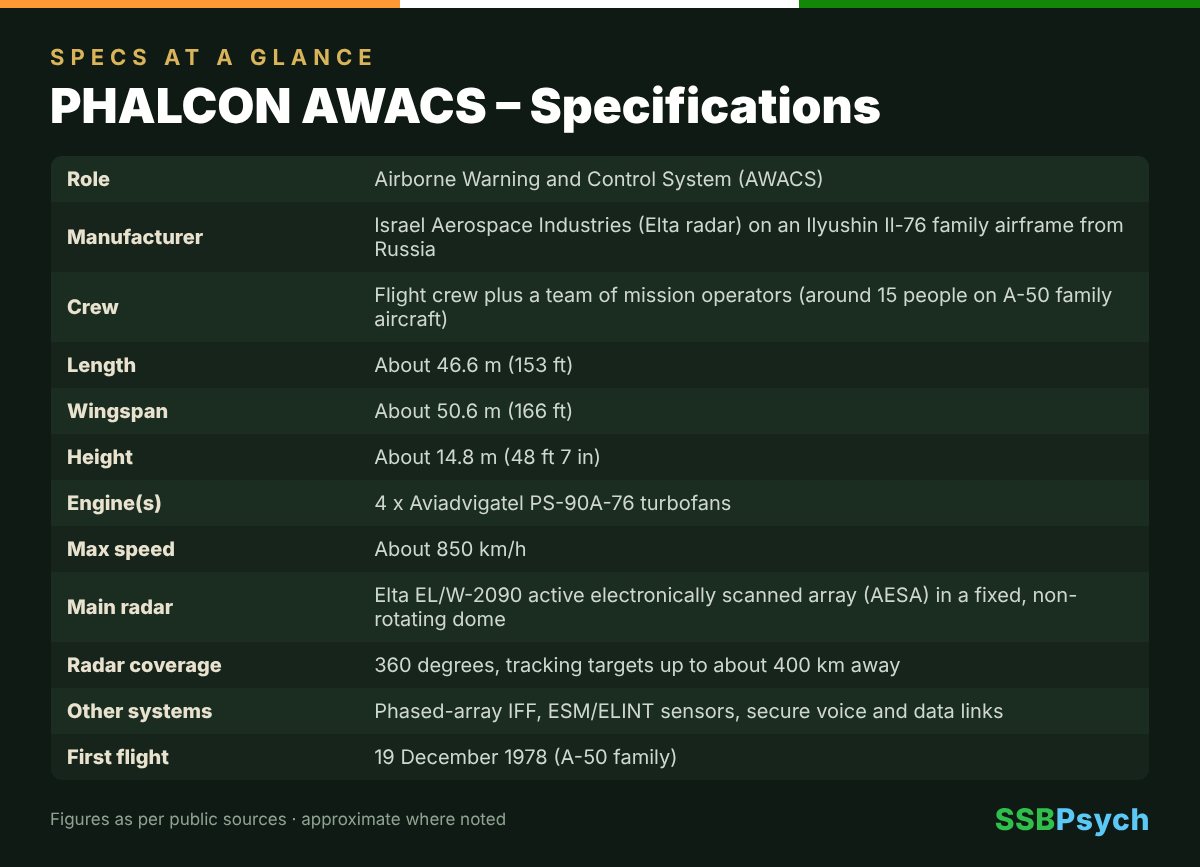
| Role | Airborne Warning and Control System (AWACS) |
| Manufacturer | Israel Aerospace Industries (Elta radar) on an Ilyushin Il-76 family airframe from Russia |
| Crew | Flight crew plus a team of mission operators (around 15 people on A-50 family aircraft) |
| Length | About 46.6 m (153 ft) |
| Wingspan | About 50.6 m (166 ft) |
| Height | About 14.8 m (48 ft 7 in) |
| Engine(s) | 4 x Aviadvigatel PS-90A-76 turbofans |
| Max speed | About 850 km/h |
| Main radar | Elta EL/W-2090 active electronically scanned array (AESA) in a fixed, non-rotating dome |
| Radar coverage | 360 degrees, tracking targets up to about 400 km away |
| Other systems | Phased-array IFF, ESM/ELINT sensors, secure voice and data links |
| First flight | 19 December 1978 (A-50 family) |
| Contract | Signed in March 2004, worth about US$1.1 billion for three systems |
| Inducted in IAF | 28 May 2009 |
| Number in IAF | 3 |
| Unit | No. 50 Squadron ‘Adwitiya’, Agra (publicly reported) |
What Is an AWACS and Why India Needed the PHALCON
AWACS stands for Airborne Warning and Control System. Ground radars are blocked by the curve of the Earth and by mountains, so a low-flying aircraft or cruise missile can sneak in close before a ground radar sees it. Put a powerful radar high in the sky, though, and it can look much farther, right over hills and deep into enemy territory. That is the core idea of AWACS.
The word Control matters too. An AWACS is not just a watchtower. Its crew can act like a flying air traffic control and battle command centre, directing friendly fighters, warning them of threats and helping commanders decide what to do next. In modern air war, the side that sees first often wins, and that is why AWACS aircraft are called force multipliers.
India’s neighbours were building or buying such capabilities, and the IAF needed its own. After years of effort, India decided to combine an Israeli radar system with a Russian heavy aircraft. The result became India’s first true AWACS.
History of the PHALCON AWACS in the IAF
In March 2004, India signed a deal worth about US$1.1 billion with Israel for three PHALCON radar systems. Separately, India arranged three Il-76 family aircraft from Russia to carry them. This was a true three-nation project: Russian aircraft, Israeli radar and an Indian customer.
The aircraft were flown to Israel, where engineers installed the radar and mission systems. The first completed A-50EI landed at Jamnagar on 25 May 2009, and it was formally inducted into the newly formed No. 50 Squadron on 28 May 2009. The second followed in 2010, and all three had been delivered by 2011.
No. 50 Squadron is nicknamed Adwitiya, meaning ‘peerless’ or ‘without equal’. It operates under Central Air Command and is publicly reported to be based at Agra. Since induction, the PHALCONs have supported IAF exercises such as Indradhanush with the Royal Air Force in 2010 and the huge Gagan Shakti exercise in 2018.
For years India also discussed buying two more PHALCON aircraft. Price talks dragged on, and as of the early 2020s that follow-on order had not moved ahead, so India continued to rely on the original three along with its smaller home-grown Netra aircraft.
How the PHALCON Radar Works
Older AWACS aircraft, such as the Russian A-50 and the American E-3, carry a radar dish inside a dome that physically rotates, sweeping the sky like a lighthouse. The PHALCON is different. Its Elta EL/W-2090 radar is an active electronically scanned array (AESA), and its dome on top of the aircraft does not rotate.
An AESA radar has hundreds of tiny transmit-and-receive modules. By controlling the timing of each module, the radar can point its beam in any direction electronically, in a tiny fraction of a second, without moving any part. Imagine a stadium crowd doing a ‘Mexican wave’: no person moves around the stadium, yet the wave travels. The radar beam is steered in a similar clever way.
Arrays are arranged inside the dome to give 360-degree coverage, so the aircraft can watch all around itself at the same time. The radar can track many fast, manoeuvring targets at ranges of up to about 400 km, and start a new track in a few seconds. For comparison, 400 km is a little more than the straight-line distance from Delhi to Lucknow.
Besides the main radar, the PHALCON carries an IFF system (Identification Friend or Foe) that sends coded questions to aircraft and recognises friendly replies. It also has ESM and ELINT sensors that silently listen for enemy radars and radio signals, and secure data links that share the air picture with fighters, ground control centres and even ships.
What Happens on a Typical AWACS Sortie
Before take-off, the crew is briefed on the area to watch, the friendly aircraft expected in the sky and the radio frequencies to use. Once airborne, the aircraft climbs to its working height and settles into a long oval orbit over friendly territory. The radar comes alive and the consoles fill with symbols: airliners on their routes, IAF fighters on patrol, helicopters near the border.
The mission crew sorts this picture. Known friendly aircraft are marked, airliners are checked against flight plans, and anything unknown is watched closely. If a suspicious track appears, a fighter controller can send patrolling fighters towards it, give them its height, speed and heading, and keep them updated until the pilots see it on their own radar. All of this information can also be shared with ground command centres in real time.
Such a sortie can last many hours. The crew must stay sharp the whole time, because a single missed blip could matter a great deal. It is teamwork in its purest form.
Engine and Performance Explained Simply
The A-50EI flies on four PS-90A-76 turbofan engines, a newer and more fuel-efficient engine than those on older Il-76s. A turbofan pushes a large amount of air around the engine core with a big front fan, which makes it quieter and more economical.
Its top speed is about 850 km/h, nearly three times as fast as a bullet train. But speed is not its main job. An AWACS usually flies slow, steady patterns for hours, high above friendly territory, like a guard walking a fixed route. Height matters most, because the higher the radar, the farther it can see over the horizon.
The aircraft is about 46.6 metres long, roughly the length of eleven cars in a line, and its wings span about 50.6 metres, around half the length of a football field. The big radome on its back makes it one of the most recognisable aircraft in the IAF.
What It Carries
- No guns or missiles: its weapon is information
- Elta EL/W-2090 AESA radar with 360-degree coverage
- Phased-array IFF (Identification Friend or Foe) to tell own aircraft from enemies
- ESM/ELINT sensors that listen for enemy radar and radio signals
- Secure long-range voice and data links to fighters, ground stations and ships
The PHALCON carries no weapons of its own. Its power lies in what it sees and shares. One AWACS can help dozens of fighters fight smarter, intercept intruders earlier and avoid surprises.
PHALCON AWACS Missions and Operations
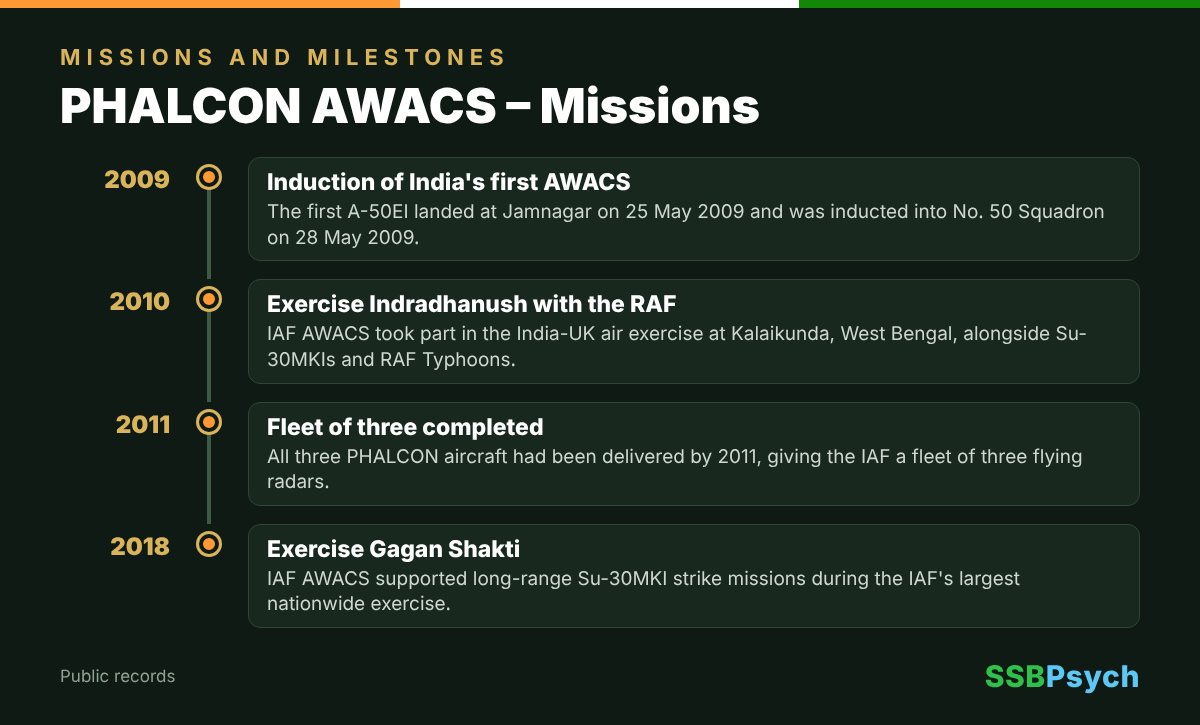
- 2009 – Induction of India’s first AWACS: The first A-50EI landed at Jamnagar on 25 May 2009 and was inducted into No. 50 Squadron on 28 May 2009.
- 2010 – Exercise Indradhanush with the RAF: IAF AWACS took part in the India-UK air exercise at Kalaikunda, West Bengal, alongside Su-30MKIs and RAF Typhoons.
- 2011 – Fleet of three completed: All three PHALCON aircraft had been delivered by 2011, giving the IAF a fleet of three flying radars.
- 2018 – Exercise Gagan Shakti: IAF AWACS supported long-range Su-30MKI strike missions during the IAF’s largest nationwide exercise.
Where It Is Based and Who Flies It
The PHALCON fleet is publicly reported to be based at Air Force Station Agra with No. 50 Squadron. From there it can deploy to forward areas as needed.
The crew has two parts. The flight crew, including pilots and other aircrew, flies the aircraft. The mission crew sits in the cabin at consoles, watching the radar picture, identifying aircraft and directing fighters. Mission crews typically include fighter controllers, who come from the IAF’s Administration branch, along with specialists in communications and electronic warfare.
Like other IAF squadrons, the unit is usually led by a Wing Commander, with Squadron Leaders and junior officers under command. Pilots come from the transport stream: after basic training at the Air Force Academy, Dundigal, they learn multi-engine flying and then convert to heavy aircraft over several years.
Strengths and Limitations of the PHALCON AWACS
- Strength: 360-degree radar coverage, unlike smaller systems that see only part of the sky.
- Strength: AESA radar can steer its beam instantly and track many targets at once.
- Strength: Can see low-flying aircraft and missiles that ground radars miss.
- Strength: Acts as a flying command post, guiding fighters in real time.
- Limitation: Only three aircraft, so keeping one airborne at all times is very demanding.
- Limitation: Large and unarmed, so it must stay well away from enemy fighters and long-range missiles.
- Limitation: Follow-on orders for more PHALCONs have been delayed for years.
- Limitation: Depends on foreign suppliers for the airframe and radar support.
Future of India’s AWACS Fleet
India knows three PHALCONs are not enough for a long, two-front border. It also operates the DRDO-developed Netra AEW and C aircraft on smaller Embraer jets, whose radar sees over a narrower arc than PHALCON’s full circle. India has been working on more Netra aircraft and a larger future version, so that the IAF can keep a constant watch over more areas.
PHALCON vs Netra at a Glance
- Aircraft: PHALCON uses a large four-engine Il-76 family jet; Netra uses a smaller twin-engine Embraer jet.
- Radar view: PHALCON sees a full circle; Netra covers a narrower arc on each side.
- Origin: PHALCON’s radar is Israeli; Netra’s radar was developed in India by DRDO.
- Role: Both spot threats early and help guide fighters, so they work best together.
Until those arrive, the three PHALCONs remain the IAF’s most powerful flying radars. They are likely to keep receiving upgrades to stay useful for many years.
Why PHALCON Matters for SSB and AFCAT Aspirants
AWACS, AEW and C and Netra are favourite topics in AFCAT and CDS general awareness. In the SSB interview, explaining how an AWACS works, or how AESA radar differs from a rotating dish, shows clear technical understanding. In group discussions on modern warfare, you can use PHALCON to show that information and networking are as important as missiles and bombs.
If you are heading for the Administration branch, note that fighter controllers play a key role on AWACS missions. It is a great example to share when an interviewer asks why you chose a ground duty branch.
Did You Know?
- PHALCON’s radar dome does not rotate; the beam is steered electronically.
- The A-50EI combined a Russian airframe with an Israeli radar for India.
- The first IAF PHALCON landed at Jamnagar on 25 May 2009.
- No. 50 Squadron, which flies PHALCON, is nicknamed Adwitiya (peerless).
- The radar can track targets up to about 400 km away.
- IFF stands for Identification Friend or Foe.
- India’s smaller Netra AEW and C aircraft complement the three PHALCONs.
Quiz: Test Your Knowledge of PHALCON AWACS
Click an option to see if you are right. Your score updates live.
PHALCON AWACS: Frequently Asked Questions
PHALCON AWACS, or A-50EI, is the Indian Air Force’s airborne warning and control aircraft. It carries an Israeli radar on a Russian Il-76 family aircraft to watch the skies and guide fighters.
India operates three PHALCON AWACS aircraft, all delivered between 2009 and 2011.
Its EL/W-2090 radar can track targets up to about 400 km away and covers all 360 degrees around the aircraft.
It is publicly reported to be based at Air Force Station Agra with No. 50 Squadron.
PHALCON is a large AWACS with 360-degree coverage on a four-engine Il-76 family aircraft, while Netra is a smaller DRDO-developed AEW and C on an Embraer jet with a narrower radar arc.
This is part 18 of 50 in SSBPsych’s Indian Air Force aircraft series – a new aircraft every evening at 6 PM.
Sources: en.wikipedia.org, en.wikipedia.org, airforce-technology.com, indiandefencereview.com, globalsecurity.org.
Preparing for NDA, CDS, AFCAT or your SSB? Join SSBPsych’s online and offline batches – explore our courses or call +91 8076540582.