Il-78MKI Tanker in Indian Air Force: Specs, Role, History, Quiz
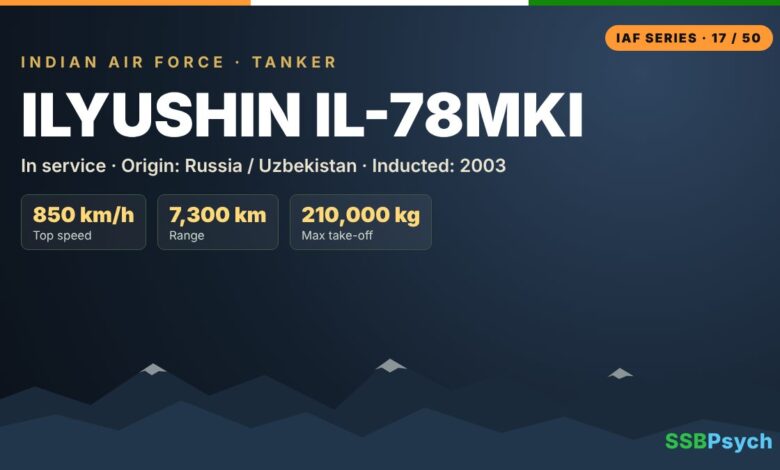
What if a petrol pump could fly at 600 km/h, find a fighter jet in the dark sky, and fill its tanks while both aircraft are moving? That is exactly what the Il-78MKI does for the Indian Air Force. It is the IAF’s flying fuel station, an air-to-air refuelling tanker that lets fighters fly much farther and stay in the air much longer than their own fuel tanks allow.
In this guide you will discover why India bought this giant tanker, how mid-air refuelling actually works, its specifications in plain language, the important missions and exercises where it played a quiet but vital role, where it is based, its strengths and weak points, and what the future holds for India’s tanker fleet. A 10-question quiz at the end will test what you have learnt.

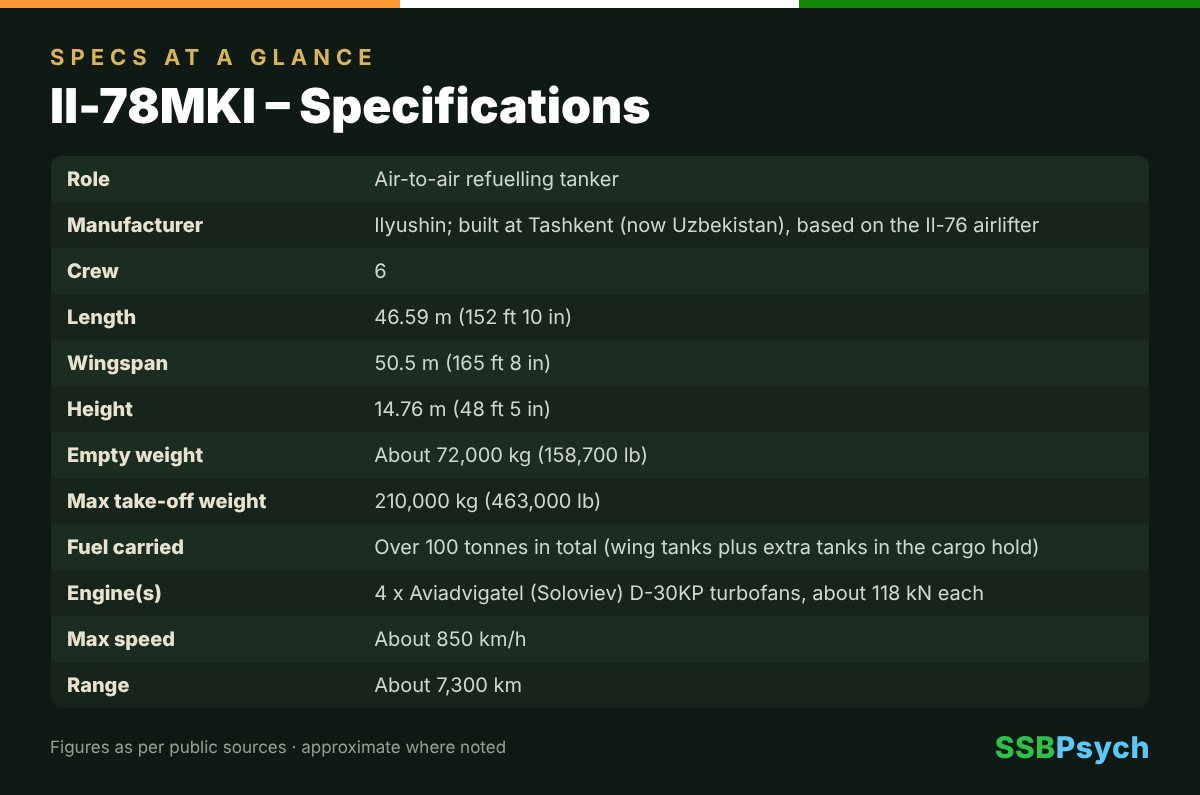
Il-78MKI Specifications
| Role | Air-to-air refuelling tanker |
| Manufacturer | Ilyushin; built at Tashkent (now Uzbekistan), based on the Il-76 airlifter |
| Crew | 6 |
| Length | 46.59 m (152 ft 10 in) |
| Wingspan | 50.5 m (165 ft 8 in) |
| Height | 14.76 m (48 ft 5 in) |
| Empty weight | About 72,000 kg (158,700 lb) |
| Max take-off weight | 210,000 kg (463,000 lb) |
| Fuel carried | Over 100 tonnes in total (wing tanks plus extra tanks in the cargo hold) |
| Engine(s) | 4 x Aviadvigatel (Soloviev) D-30KP turbofans, about 118 kN each |
| Max speed | About 850 km/h |
| Range | About 7,300 km |
| Service ceiling | About 12,000 m (39,000 ft) |
| Refuelling points | 3 hose-and-drogue points, so it can refuel 3 aircraft at once |
| First flight | 26 June 1983 (Il-78 type); IAF version first flew in January 2003 |
| Inducted in IAF | 2003 (deliveries completed in 2004) |
| Number in IAF | 6 |
Why India Needed the Il-78MKI
A fighter jet burns fuel very quickly, especially when it uses its afterburner. Even a long-range fighter like the Su-30MKI can only go so far before it must turn back. India has a long border, a huge ocean area to watch over, and interests stretching from the Gulf to the Malacca Strait. To reach far-off targets, patrol for long hours, or fly fighters across the world for exercises, the IAF needed a way to refuel jets in the air.
One fighter can carry a refuelling pod and pass a little fuel to another, called ‘buddy refuelling’, but a small fighter cannot carry much spare fuel. A dedicated tanker carries tens of tonnes of fuel and can serve many jets in one mission. That is a force multiplier: it makes every fighter in the fleet more useful.
History of the Il-78MKI in the IAF
India ordered six tankers in the early 2000s. They were based on the Il-78M, itself a tanker version of the famous Il-76 heavy transport, and were built at the aircraft factory in Tashkent, Uzbekistan. The Indian version was named Il-78MKI and was tailored for the IAF, with refuelling pods that can serve both Russian-built and Western-built fighters.
The first aircraft arrived in March 2003, and all six had been delivered by 2004. They were given to a newly raised unit, No. 78 Squadron, at Agra. The squadron is often called MARS, short for Mid Air Refuelling Squadron, and it serves under the IAF’s Central Air Command.
Since then the tankers have become a regular part of big IAF missions. In 2008 two of them helped eight Su-30MKIs cross the globe for Exercise Red Flag in the United States. In 2018 an Il-78MKI carried out the first ever ‘wet’ refuelling of the home-grown Tejas, which means real fuel was transferred, not just a practice hook-up. The same year, during the huge Exercise Gagan Shakti, the tankers helped Su-30MKIs fly a strike mission of about 4,000 km.
During the Balakot air strike of February 2019, reports said IAF Il-78 tankers were airborne while the Mirage 2000s went in, and in the following days they refuelled MiG-29s and Su-30MKIs that were flying long patrols along the border.
How Mid-Air Refuelling Works
The Il-78MKI uses the hose-and-drogue method. The tanker reels out a long flexible hose with a cone-shaped basket at the end, called a drogue. It looks a bit like a giant shuttlecock. The fighter has a fixed or retractable tube near its nose called a probe. The fighter pilot flies carefully behind the tanker and pushes the probe into the basket. Once it locks in, fuel flows from the tanker to the fighter.
Doing this at several hundred kilometres per hour, sometimes at night or in bumpy air, needs great skill and calm nerves. The fighter pilot must hold position just a few metres behind a huge aircraft while both are moving fast. The tanker crew watches closely and controls the flow of fuel.
The Il-78MKI has three refuelling points: one pod under each wing and one on the fuselage. This means it can refuel up to three fighters at the same time. A single tanker can support a whole formation of jets in one sortie.
A Typical Refuelling Mission, Step by Step
First, planners decide where the fighters will need fuel. The tanker takes off early and flies to a pre-decided area, often called a refuelling track, where it flies a steady racetrack pattern. Next, the fighters arrive and join up in formation slightly behind and to the side of the tanker. They talk to the tanker crew by radio, or use light signals when radio silence is needed.
When cleared, each fighter moves in behind a drogue, matches the tanker’s speed exactly and gently pushes its probe into the basket. Lights on the pod tell the pilot when fuel is flowing and when to back off. After filling up, the fighter slides away and the next one moves in. Once everyone has taken fuel, the fighters head off for their mission, and the tanker either waits for them to return for a second top-up or flies back to base.
The whole dance needs careful timing. If the tanker is late or in the wrong place, fighters may have to abort their mission. That is why tanker crews are trained to be extremely precise about time, place and height.
Engine and Performance Explained Simply
The Il-78MKI is powered by four D-30KP turbofan engines, each producing about 118 kilonewtons of thrust. A turbofan is a jet engine with a big fan at the front that pushes a lot of air around the core, making it more fuel-efficient than older turbojets. Four engines also give safety: if one fails, the aircraft can still fly home.
Its top speed is about 850 km/h, nearly three times faster than a bullet train running at about 320 km/h. Its range is about 7,300 km, farther than the straight-line distance from Delhi to Paris. The service ceiling, the highest height at which it can still usefully climb, is about 12,000 metres, which is higher than Mount Everest.
Size-wise, this is a giant. The Il-78MKI is about 46.6 metres long, as long as about eleven cars parked in a row. Its wings stretch about 50.5 metres from tip to tip, roughly half the length of a football field. At take-off it can weigh up to 210 tonnes, as much as about 150 family cars.
Most of that weight is fuel. The IAF tanker carries over 100 tonnes of fuel in its wing tanks and in extra tanks fitted inside the cargo hold. That is enough to fill the tanks of thousands of cars. Part of this fuel is used by the tanker itself to fly, and the rest is passed on to thirsty fighters.
What It Carries
- No guns or missiles: its ‘weapon’ is fuel
- Two wing-mounted hose-and-drogue refuelling pods (Western-made Cobham Mk 32B type)
- A third refuelling point on the fuselage, allowing three receivers at once
- Over 100 tonnes of fuel in wing and cargo-hold tanks
- Receivers include Su-30MKI, Mirage 2000, MiG-29 and Tejas
Unlike fighters, the Il-78MKI carries no bombs, missiles or guns. Its real weapon is fuel, and its power lies in letting other aircraft carry more weapons and fly farther. A fighter that takes off with a heavy bomb load and less fuel can top up from the tanker after take-off, then continue to a distant target.
Il-78MKI Missions and Operations
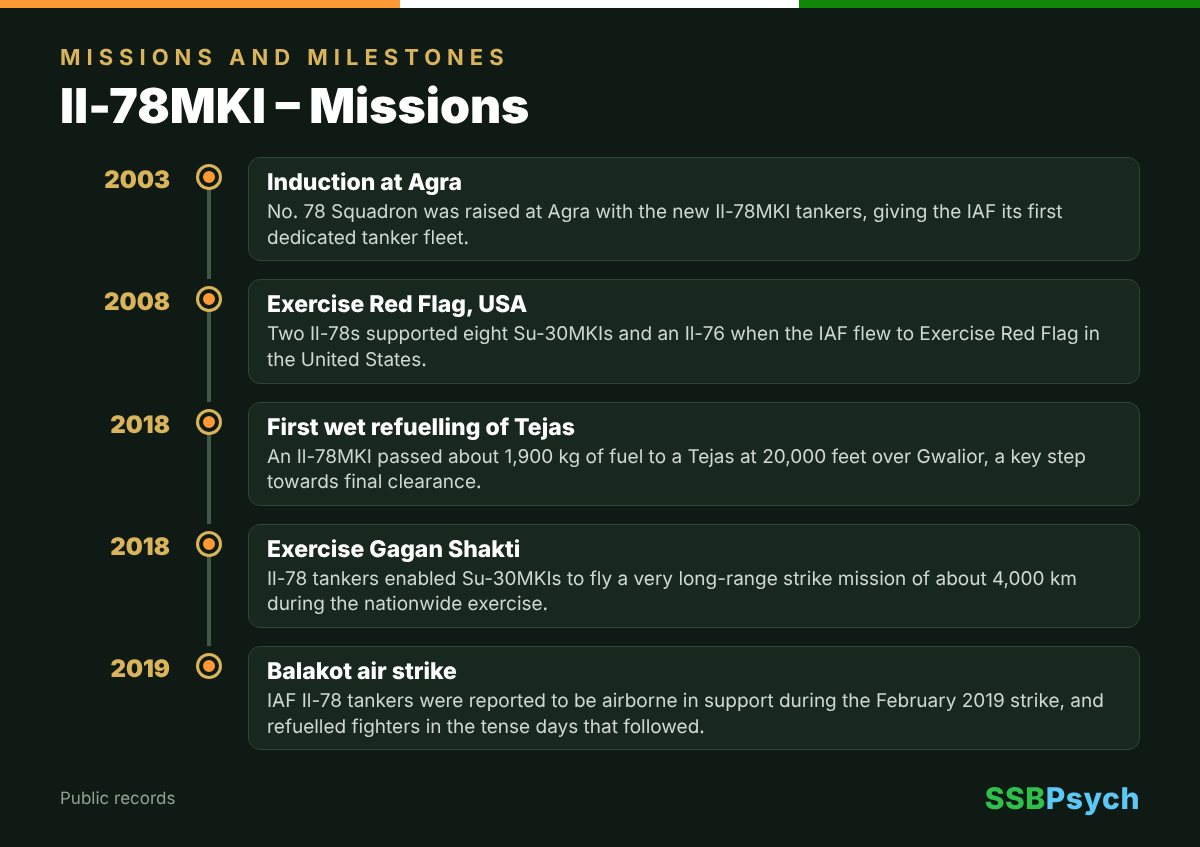
- 2003 – Induction at Agra: No. 78 Squadron was raised at Agra with the new Il-78MKI tankers, giving the IAF its first dedicated tanker fleet.
- 2008 – Exercise Red Flag, USA: Two Il-78s supported eight Su-30MKIs and an Il-76 when the IAF flew to Exercise Red Flag in the United States.
- 2018 – First wet refuelling of Tejas: An Il-78MKI passed about 1,900 kg of fuel to a Tejas at 20,000 feet over Gwalior, a key step towards final clearance.
- 2018 – Exercise Gagan Shakti: Il-78 tankers enabled Su-30MKIs to fly a very long-range strike mission of about 4,000 km during the nationwide exercise.
- 2019 – Balakot air strike: IAF Il-78 tankers were reported to be airborne in support during the February 2019 strike, and refuelled fighters in the tense days that followed.

Where It Is Based and Who Flies It
All six Il-78MKIs are publicly reported to be based at Air Force Station Agra in Uttar Pradesh, with No. 78 Squadron. Agra’s central location lets the tankers reach both the western and northern borders, as well as the seas, within a few hours.
A tanker crew is a team. The crew of about six includes pilots and specialist aircrew who handle navigation, the aircraft systems and the refuelling equipment. Like other IAF squadrons, the unit is usually commanded by a Wing Commander, supported by Squadron Leaders and younger Flight Lieutenants and Flying Officers.
Pilots who fly big aircraft like the Il-78 belong to the transport stream. After basic training at the Air Force Academy, Dundigal, they move to multi-engine training on smaller twin-engine aircraft, and then convert to heavy aircraft in their squadron. Becoming a captain of a four-engine tanker takes several years and many hundreds of flying hours.
Strengths and Limitations of the Il-78MKI
- Strength: Carries over 100 tonnes of fuel, enough to support many fighters in one mission.
- Strength: Three refuelling points let it fuel three jets at once.
- Strength: Pods work with both Russian and Western fighters in IAF service.
- Strength: Four engines for safety and long range.
- Limitation: Only six aircraft, which is a small fleet for an air force of India’s size.
- Limitation: The fleet has faced maintenance and serviceability problems, as widely reported in the media.
- Limitation: Older engines are thirsty compared with modern tankers.
- Limitation: Large, unarmed aircraft must be protected and kept away from enemy fighters.
Future of the IAF Tanker Fleet
The IAF has wanted more and newer tankers for many years. Plans to buy modern tankers have been discussed several times, but have faced delays over cost and other issues. Meanwhile, the IAF has also looked at options such as leasing tanker aircraft and converting used airliners into tankers.
Until new tankers arrive, the six Il-78MKIs remain the backbone of India’s mid-air refuelling. They will keep supporting long-range missions, overseas exercises and ferry flights. Every new fighter the IAF inducts, whether the Rafale or the Tejas Mk1A, makes the need for good tankers even greater.
Why the Il-78MKI Matters for SSB and AFCAT Aspirants
Questions about force multipliers such as tankers and AWACS are common in AFCAT and CDS general awareness. In the SSB interview, explaining how mid-air refuelling extends a fighter’s reach shows that you think beyond just fast jets. In a group discussion on air power, you can point out that winning a war is not only about fighters, but also about the support aircraft that keep them flying.
If you are applying for the flying branch, remember that transport and tanker pilots are just as respected as fighter pilots. Their missions demand precision, teamwork and long hours of concentration, all qualities the SSB looks for.
Did You Know?
- The Il-78MKI is based on the Il-76 heavy transport aircraft.
- India’s six tankers were built in Tashkent, Uzbekistan.
- No. 78 Squadron, which flies the tankers, is nicknamed MARS (Mid Air Refuelling Squadron).
- It can refuel three fighters at the same time.
- In 2018 an Il-78MKI carried out the first wet refuelling of the Tejas over Gwalior.
- Two Il-78s helped Su-30MKIs travel to Exercise Red Flag in the USA in 2008.
- The drogue at the end of the refuelling hose looks like a giant shuttlecock.
Quiz: Test Your Knowledge of Il-78MKI
Click an option to see if you are right. Your score updates live.
Il-78MKI: Frequently Asked Questions
The Il-78MKI is the Indian Air Force’s air-to-air refuelling tanker. It carries a large amount of fuel and passes it to fighters in flight so they can fly farther and longer.
The IAF operates six Il-78MKI tankers, delivered in 2003 and 2004 and flown by No. 78 Squadron.
The tankers are publicly reported to be based at Air Force Station Agra in Uttar Pradesh.
Its top speed is about 850 km/h, and it has a range of about 7,300 km.
It can refuel probe-equipped IAF jets such as the Su-30MKI, Mirage 2000, MiG-29 and Tejas, and its pods can serve both Russian and Western designs.
This is part 17 of 50 in SSBPsych’s Indian Air Force aircraft series – a new aircraft every evening at 6 PM.
Sources: en.wikipedia.org, en.wikipedia.org, airforce-technology.com, globalsecurity.org, gktoday.in.
Preparing for NDA, CDS, AFCAT or your SSB? Join SSBPsych’s online and offline batches – explore our courses or call +91 8076540582.