
Shishumar class submarine: India’s Type 209 Hunter-Killers
Imagine a hunter that waits in total silence under the waves, listening for the faintest sound of a ship far away. That is the job of the Shishumar class submarine, a group of four German-designed boats that have guarded India’s western sea for close to four decades. They are older than many of the sailors who serve in them today, yet they still go to sea, still train, and still keep enemy planners guessing.
In this guide we explain what the Shishumar class is, why India bought it, how big it is, who sails in it, what weapons it carries, what it costs to keep running, the dangers its crew face, and what daily life is like in a steel tube smaller than a train coach. If you are preparing for NDA, CDS, AFCAT or your SSB interview, these are exactly the facts that make you sound well-read in a group discussion.

What Is the Shishumar Class Submarine?
The Shishumar class is a set of four diesel-electric attack submarines. Navies call such a boat an SSK: a conventional submarine whose main job is to hunt enemy ships and submarines. The design is the famous German Type 209, made by the shipyard HDW in Kiel. India’s version is a bigger variant called the Type 209/1500, the number roughly pointing to its size in tonnes.
The four boats are INS Shishumar (S44), INS Shankush (S45), INS Shalki (S46) and INS Shankul (S47). The class takes its name from the first boat. Shishumar is a Sanskrit-origin word linked with the dolphin or porpoise, a fitting name for a sea creature that moves quietly and smartly underwater.
Two built in Germany, two built in Mumbai
Here is what makes this class historic. Under the 1981 deal, the first two boats were built in Kiel, Germany, while the next two were put together at Mazagon Dock Shipbuilders (MDL) in Mumbai with German technology and training. INS Shalki, commissioned in 1992, became the first submarine ever built in India. Every Indian-built submarine since then, from the Scorpene-based Kalvari class to future projects, stands on the lessons learned while building Shalki and Shankul.
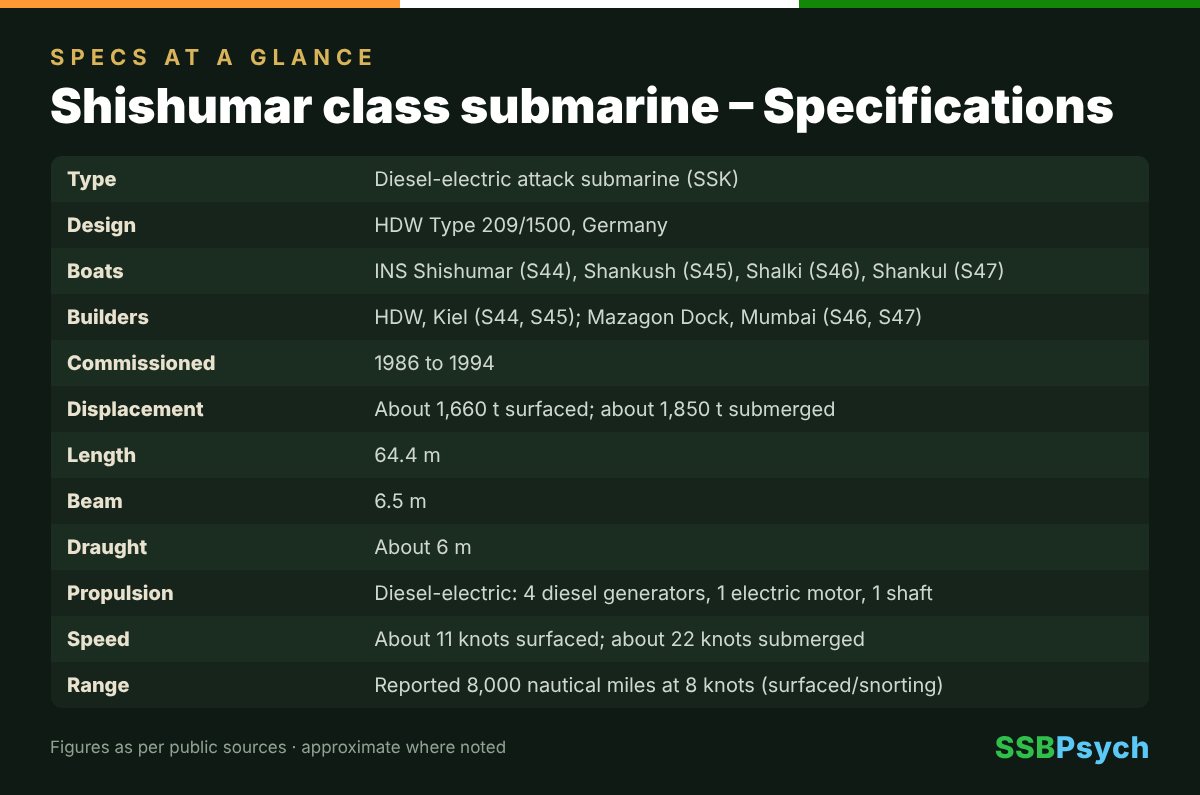
Shishumar class submarine Specifications
| Type | Diesel-electric attack submarine (SSK) |
| Design | HDW Type 209/1500, Germany |
| Boats | INS Shishumar (S44), Shankush (S45), Shalki (S46), Shankul (S47) |
| Builders | HDW, Kiel (S44, S45); Mazagon Dock, Mumbai (S46, S47) |
| Commissioned | 1986 to 1994 |
| Displacement | About 1,660 t surfaced; about 1,850 t submerged |
| Length | 64.4 m |
| Beam | 6.5 m |
| Draught | About 6 m |
| Propulsion | Diesel-electric: 4 diesel generators, 1 electric motor, 1 shaft |
| Speed | About 11 knots surfaced; about 22 knots submerged |
| Range | Reported 8,000 nautical miles at 8 knots (surfaced/snorting) |
| Crew | About 40, including about 8 officers (reported) |
| Diving depth | Not officially disclosed |
| Home port | Mumbai (Western Naval Command) |
| Status | All four in service; boats going through mid-life refits |
Size of the Shishumar Class Submarine Explained Simply
Each boat is about 64.4 metres long. Picture roughly three cricket pitches placed end to end, or a 20-storey building lying on its side. The hull is only about 6.5 metres wide, about the width of a two-lane road, and all the machinery, weapons and people have to fit inside that narrow space.
Submerged, the boat displaces about 1,850 tonnes. Displacement simply means the weight of water the vessel pushes aside, which equals the vessel’s own weight. So a Shishumar class boat underwater weighs about as much as 1,500 family cars. When it surfaces it is a little lighter, because some of the water in its ballast tanks is blown out with compressed air.
How does a diesel-electric submarine move?
Think of a hybrid car. Diesel engines run generators that charge huge banks of batteries. Underwater, the boat runs quietly on battery power through one electric motor driving a single propeller. To recharge, it comes up to periscope depth and raises a pipe called a snorkel to suck in air for the diesels. This is the most dangerous moment, because a raised mast can be spotted by radar. The reported top speed is about 22 knots (around 40 km/h) underwater, but at that speed the battery drains very quickly, so on patrol the boat creeps along slowly and silently.
Duty and Role: Why India Needs These Boats
A submarine is the navy’s invisible weapon. A surface warship can be seen by satellites and aircraft. A submarine sitting quietly in the deep cannot easily be found, so an enemy must assume it could be anywhere. This fear alone forces an enemy navy to slow down, escort its ships and spend huge effort on anti-submarine work. Strategists call this sea denial.
- Anti-ship strike: attacking enemy warships and supply vessels with torpedoes and, on upgraded boats, missiles.
- Anti-submarine warfare: hunting hostile submarines near Indian waters.
- Intelligence and surveillance: secretly watching ports, shipping lanes and naval movements.
- Mine laying: placing sea mines quietly in chosen areas during war.
- Training: acting as the target submarine so Indian ships, helicopters and P-8I aircraft can practise anti-submarine skills.
India has a coastline of over 7,500 km and most of its trade moves by sea. With China expanding in the Indian Ocean and Pakistan adding new submarines, the Navy needs enough boats at sea at all times. The Shishumar class, though old, helps fill gaps while newer submarines arrive.
Home Port and Command
The Shishumar class boats are publicly reported to be based in Mumbai under the Western Naval Command, and they mostly operate in the Arabian Sea. A submarine in the Indian Navy is commanded by an officer usually of Commander rank, supported by an executive officer, engineering, weapons and electrical officers, and a team of highly trained sailors. Submarines are grouped into squadrons, and a senior officer looks after the overall readiness of each squadron.
Shishumar class submarine Timeline
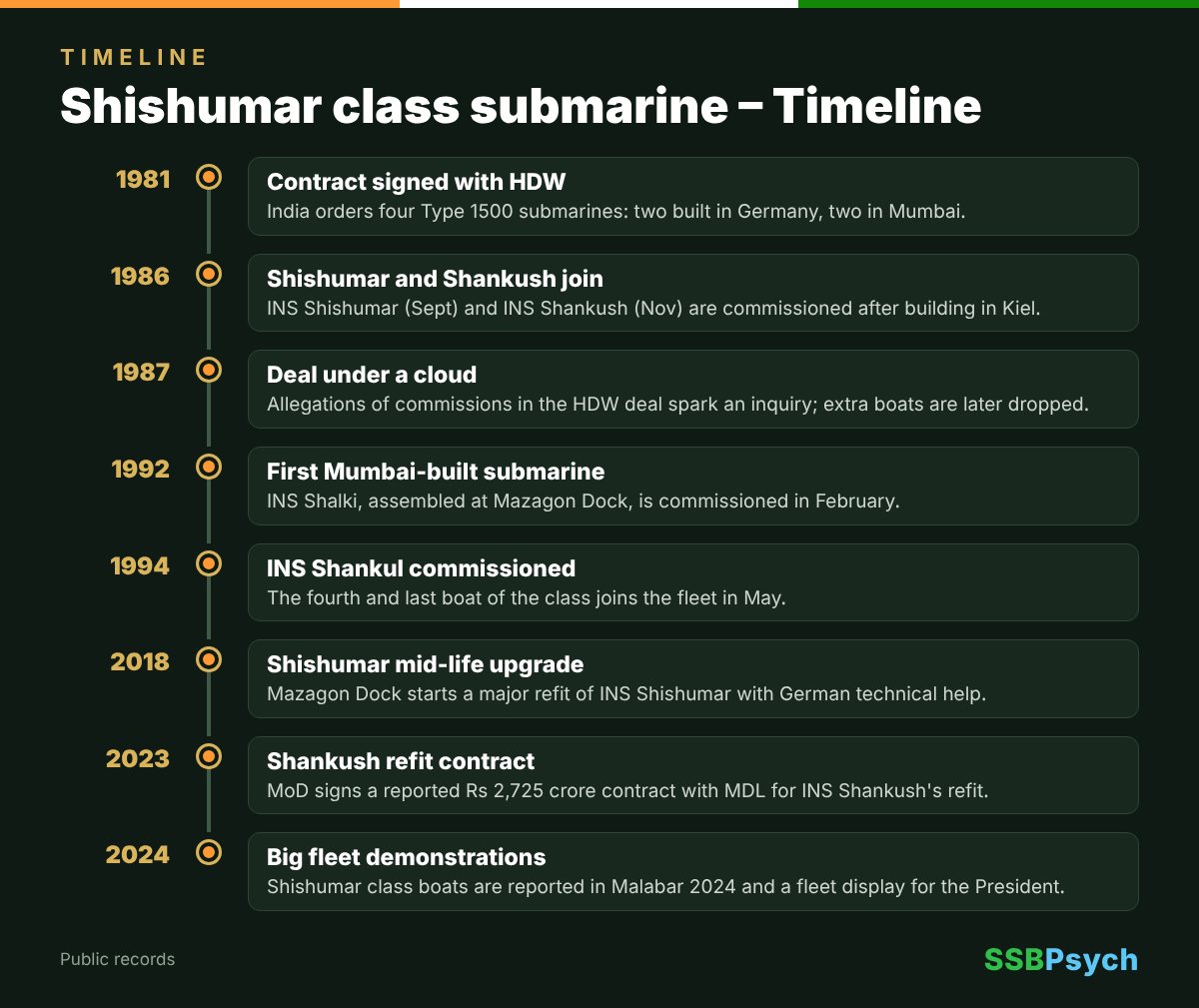
- 1981 – Contract signed with HDW: India orders four Type 1500 submarines: two built in Germany, two in Mumbai.
- 1986 – Shishumar and Shankush join: INS Shishumar (Sept) and INS Shankush (Nov) are commissioned after building in Kiel.
- 1987 – Deal under a cloud: Allegations of commissions in the HDW deal spark an inquiry; extra boats are later dropped.
- 1992 – First Mumbai-built submarine: INS Shalki, assembled at Mazagon Dock, is commissioned in February.
- 1994 – INS Shankul commissioned: The fourth and last boat of the class joins the fleet in May.
- 2018 – Shishumar mid-life upgrade: Mazagon Dock starts a major refit of INS Shishumar with German technical help.
- 2023 – Shankush refit contract: MoD signs a reported Rs 2,725 crore contract with MDL for INS Shankush’s refit.
- 2024 – Big fleet demonstrations: Shishumar class boats are reported in Malabar 2024 and a fleet display for the President.
Aircraft, Weapons and Sensors
- Eight 533 mm bow torpedo tubes (as reported for the Type 209/1500 design)
- Heavyweight torpedoes, about 14 carried (reported)
- Sea mines can be carried in place of some torpedoes, plus external strap-on mine belts (reported)
- Harpoon anti-ship missiles fired from torpedo tubes, reported on some boats after upgrades
- Active and passive sonar suites for hunting ships and submarines
- Surface search radar and electronic support (ESM) equipment
- Periscopes for attack and search
- Integrated escape sphere for the crew, a special Indian feature (reported)
Crew and Life on Board
A Shishumar class boat is reported to carry about 40 people, including around 8 officers. Now imagine 40 people living, working and sleeping inside a space the size of a few railway coaches for weeks, with no windows and no daylight.
- Hot bunking: in many submarines sailors share bunks in shifts, so when one wakes up for duty another climbs into the same bed.
- Watches: the crew works in rotating shifts round the clock. Day and night lose meaning; clocks and meal times keep the routine.
- Water is precious: fresh water is made on board, so quick baths and careful use are the rule.
- Silence is survival: during quiet running, even dropping a spanner can give away the boat’s position to an enemy sonar.
- Food and smells: cooks work miracles in a tiny galley, but the air soon carries a mix of diesel, cooking and machinery smells.
That is why the Navy selects submariners carefully and gives them extra pay and special training. They must be calm, technically sharp and able to get along with others in very close quarters, qualities an SSB board also looks for.
The escape sphere
One unusual feature of India’s Type 1500 boats is a reported integrated escape sphere, a capsule designed to carry the entire crew to the surface if the submarine is disabled. Reports say it can hold the whole crew with several hours of air. This was a special Indian requirement and is not found on most other Type 209 boats.
Operations and Missions
- 1986 onwards – Western Fleet patrols: Long patrols in the Arabian Sea guarding sea lanes and the approaches to Mumbai.
- Regular – Anti-submarine training: Act as the ‘enemy’ submarine so ships and aircraft can practise hunting.
- 2024 – Exercise Malabar 2024: A Shishumar class boat was reported taking part in Malabar 2024 with partner navies.
- Nov 2024 – Fleet demonstration: Two boats were reported in a sea display for President Droupadi Murmu alongside INS Vikrant.

Diving Depth: What Is Known
The exact diving depth of the Shishumar class has not been officially published, and like most submarine performance details it is treated as sensitive. What we can say is that a submarine’s hull is a pressure vessel: every 10 metres of depth adds about one more atmosphere of pressure. A few hundred metres down, each square metre of the hull is being squeezed by hundreds of tonnes of water. Designers build in a large safety margin, and captains never casually push close to the limit.
Cost and What Drives the Running Cost
The original 1981 contract for the four boats, including torpedoes, was reported at about Rs 465 crore, a huge sum at the time. The deal later became controversial after allegations that commissions had been paid, which led to an official inquiry and the cancellation of plans for more boats.
Today, the big cost is keeping these veterans alive. In June 2023 the Ministry of Defence signed a contract with MDL, reported at about Rs 2,725 crore, for the medium refit and life certification of INS Shankush. Earlier, INS Shishumar went through a mid-life upgrade at MDL. Running costs are not publicly reported in detail, but they are driven by:
- Long refits in dry dock, where the hull is checked, pipes and cables are replaced, and sensors are upgraded.
- Batteries, which are very large and must be replaced every few years.
- Diesel fuel, spare parts and imported components from original makers.
- Torpedoes and missiles, which are expensive and need regular maintenance.
- Training and allowances for a highly skilled crew.
Dangers of Serving on a Submarine
Submarine service is among the riskiest jobs in any navy. Fire and flooding are the two biggest fears because there is nowhere to run. Batteries can release hydrogen gas, which can explode if not ventilated. Old hulls need constant checks for fatigue and corrosion. Snorkelling near the surface exposes the boat to collisions with merchant ships and to enemy detection. The crew trains again and again with damage-control drills, escape drills and firefighting so that every reaction becomes automatic.
The Future of the Shishumar Class Submarine Fleet
The Navy has chosen to refit these boats and extend their lives rather than retire them early, because new submarines take many years to build. Reports suggest that mid-life refits can add 10 to 15 years of service. Over time they will be replaced by newer submarines such as the Kalvari class already in service and the planned Project-75I boats with air-independent propulsion, which we cover in a separate post in this series.
Why This Matters for Defence Aspirants
Questions on Indian submarines appear in NDA and CDS general knowledge papers, and naval topics often come up in SSB lecturettes and group discussions. Knowing that the Shishumar class gave India its first home-built submarine shows you understand the bigger story of self-reliance in defence, or Aatmanirbhar Bharat. You can link it to the Kalvari class, built at the same Mumbai yard decades later, and to the push for more Indian-made content in every new warship. Interviewers value candidates who can connect a fact to a trend, not just repeat a number.
Did You Know?
- INS Shalki was the first submarine built in India, commissioned in 1992 at Mumbai.
- The name Shishumar is linked with the dolphin, a smart and agile sea animal.
- Type 209 is one of the most widely exported submarine designs in the world, used by many navies.
- INS Shishumar has served for close to four decades, longer than many of its crew have been alive.
- A submarine on battery power can be quieter than the natural noise of the sea around it.
- The class is reported to be fitted with a full-crew escape sphere, rare among Type 209 boats.
Quiz: Test Your Knowledge of Shishumar class submarine
Click an option to see if you are right. Your score updates live.
Shishumar class submarine: Frequently Asked Questions
It is a class of four diesel-electric attack submarines of the Indian Navy, based on Germany’s Type 209/1500 design. The boats are INS Shishumar, Shankush, Shalki and Shankul.
Yes. All four remain in service, and the Navy has been putting them through mid-life refits at Mazagon Dock to extend their working life.
It is reported to carry about 40 personnel, including around 8 officers.
INS Shalki and INS Shankul were built at Mazagon Dock Shipbuilders in Mumbai. The first two boats were built by HDW in Kiel, Germany.
The Navy has not officially published the diving depth. Such performance details are treated as sensitive.
This is part 17 of 21 in SSBPsych’s submarine series – a new post every morning at 10 AM.
Sources: en.wikipedia.org, indiannavy.nic.in, pib.gov.in.
Preparing for NDA, CDS, AFCAT or your SSB? Join SSBPsych’s online and offline batches – explore our courses or call +91 8076540582.