Naib Subedar Bana Singh, PVC: The Hero of Siachen and Bana Top – Full Story (with Quiz)
Imagine fighting a battle where the enemy is not the only thing trying to kill you. The air holds less than half the oxygen you are used to, the temperature can fall far below minus 30 degrees, your rifle can jam in the cold, and a single wrong step sends you down a crevasse. This is the Siachen Glacier, the highest battlefield in the world. In June 1987, on its most dominating peak, a soft-spoken JCO from Jammu named Naib Subedar Bana Singh did something many experienced soldiers believed was impossible.
For NDA, CDS, AFCAT and SSB aspirants, Bana Singh’s story is a lesson in volunteering for the hardest job, planning smartly instead of rushing, and leading from the front with a tiny team. In this post we cover his early life, the background of the Siachen conflict, a detailed account of Operation Rajiv, his Param Vir Chakra citation in simple words, his legacy, and the Officer Like Qualities you can learn from him. A 10-question quiz at the end will help you revise.
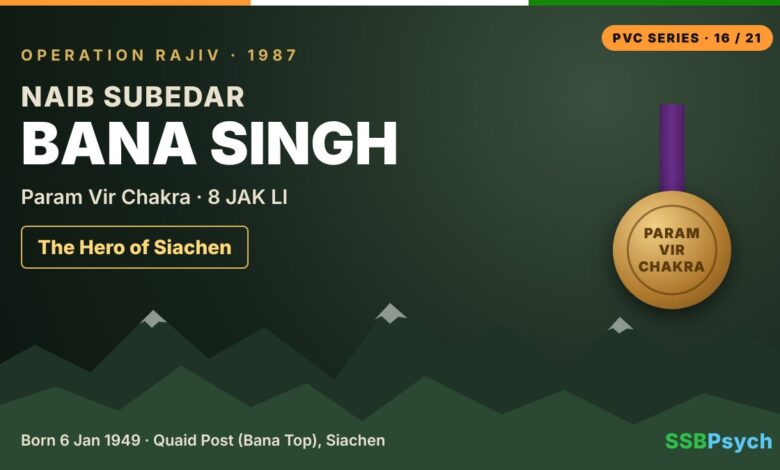
Naib Subedar Bana Singh – Quick Facts
| Full name | Bana Singh |
| Born | 6 January 1949, Kadyal village, R.S. Pura, Jammu (J and K) |
| Enrolled | 6 January 1969 |
| Unit | 8th Battalion, Jammu and Kashmir Light Infantry (8 JAK LI) |
| Rank at the time | Naib Subedar |
| Operation | Operation Rajiv, Siachen Glacier |
| Objective | Quaid Post, now called Bana Top |
| Date of action | 26 June 1987 |
| Award | Param Vir Chakra (announced 26 January 1988) |
| Retired | 31 October 2000 as Honorary Captain |
| Honours | Peak renamed Bana Top; Bana Island in Andaman and Nicobar (2023) |
Early Life: A Farmer’s Son From Kadyal
Bana Singh was born on 6 January 1949 in Kadyal, a village in the R.S. Pura area of Jammu district, close to the international border. He came from a Sikh farming family, and soldiering was already part of the household; several of his uncles had served in the Army. Growing up near the border, he heard stories of duty and sacrifice from an early age, and the uniform felt like a natural path rather than a distant dream.
Life in a farming village built in him the qualities that later mattered on the glacier: patience, physical toughness and the habit of working hard without complaint. There was nothing glamorous about his background. That is exactly why his story connects so well with young aspirants from small towns and villages across India.
Joining the Army
Bana Singh enrolled in the Indian Army on 6 January 1969 and joined the 8th Battalion of the Jammu and Kashmir Light Infantry (8 JAK LI). Over the next eighteen years he rose steadily through the ranks, earning a reputation as a dependable, fit and calm soldier. He received training in high-altitude and snow warfare, including at the High Altitude Warfare School in Gulmarg, which would prove vital later.
By October 1985 he had been promoted from Havildar to Naib Subedar, making him a Junior Commissioned Officer. JCOs are the backbone of an infantry battalion; they connect officers with the men, know every soldier personally and often lead small teams in the most dangerous tasks. Bana Singh would soon prove how important that role can be.
The Background: Why Siachen Mattered
The Siachen Glacier lies in the far north of Ladakh, between the Saltoro Ridge and the Karakoram. After India’s Operation Meghdoot in April 1984, Indian troops occupied the key passes on the Saltoro Ridge. Pakistan tried to gain a foothold on the heights, and in 1987 it held a position on a towering peak that overlooked the Bilafond La area and Indian posts below.
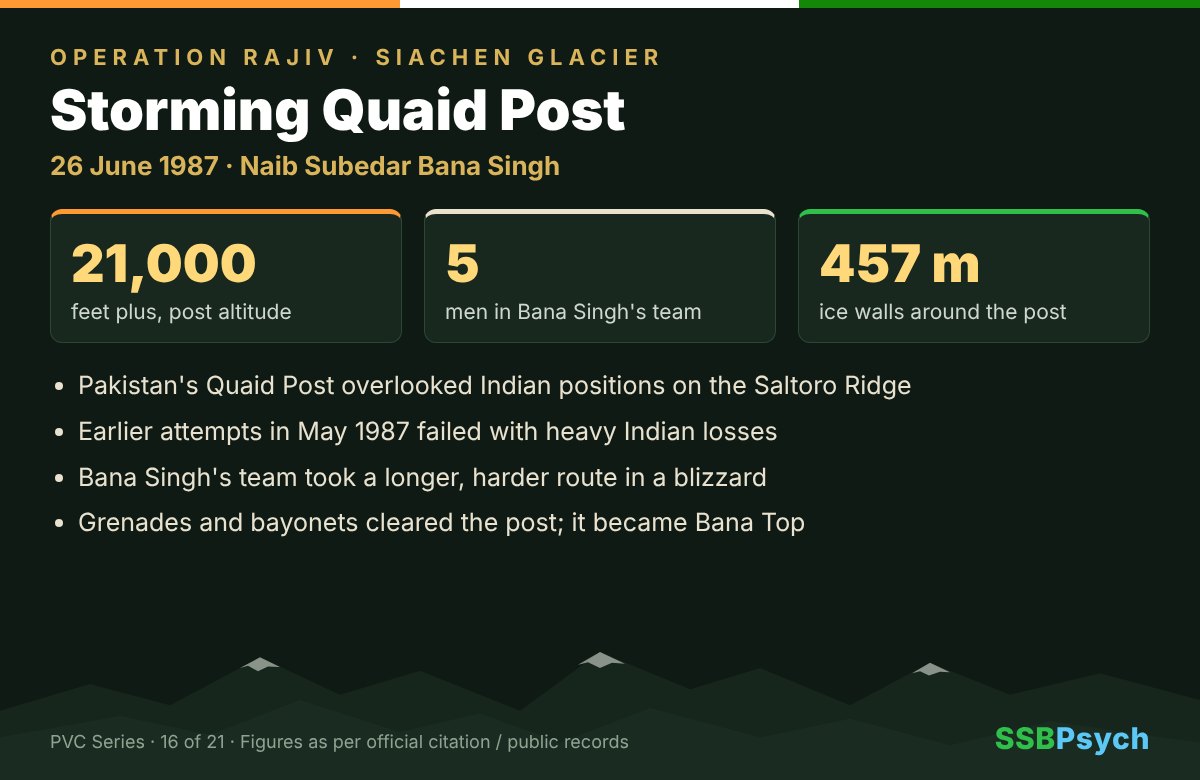
Pakistan called this position Quaid Post, after Muhammad Ali Jinnah. Sitting at more than 21,000 feet, it was an ice fortress protected on its sides by near-vertical ice walls roughly 457 metres (about 1,500 feet) high. From there, the enemy could watch and fire on Indian movement. In April 1987, fire from the post killed two Indian soldiers at a nearby Indian position, and it was clear the threat had to be removed.
On 29 May 1987 a patrol led by Second Lieutenant Rajiv Pande of 8 JAK LI tried to establish a route towards the post. The patrol was caught in the open and about ten Indian soldiers, including the young officer, were killed. When the battalion planned the next attempt, it was named Operation Rajiv in his honour.
Operation Rajiv: The Battle for Quaid Post
A Task Force of Volunteers
A special task force of about sixty soldiers from 8 JAK LI was put together under Major Varinder Singh. Bana Singh volunteered to be part of it. The plan was to approach the post from more than one direction, using the ropes and routes that earlier parties had fixed on the ice. Between 23 and 25 June, several attempts were made. The cold was brutal, visibility was poor, men suffered frostbite, and weapons sometimes refused to fire. Each attempt brought the troops closer, but the post still stood.
The Unexpected Route
For the final assault on 26 June 1987, Bana Singh led a team of five: himself and four riflemen: Chuni Lal, Laxman Das, Om Raj and Kashmir Chand. Instead of the obvious approach that the enemy was watching, he chose a longer and far more difficult route up the ice. It was a calculated risk. The defenders would not expect anyone to come that way, precisely because it looked almost impossible to climb.
A blizzard was blowing as the team moved. The storm hid them from enemy eyes but made every metre exhausting. The five men climbed the ice wall, cut steps, used ropes and, near the top, crawled forward on their stomachs to stay out of sight. Every move had to be silent. At that altitude even a short burst of effort leaves a soldier gasping, and they were carrying weapons, ammunition and grenades.
Trench to Trench
When the team reached the top, Bana Singh found an enemy bunker. He lobbed a grenade into it, silencing the soldiers sheltering inside. The team then went from trench to trench, using grenades, rifles and finally bayonets in close-quarter fighting. The defenders belonged to Pakistan’s Special Services Group, trained commandos, yet they were taken completely by surprise. Some were killed in the fighting and others jumped off the peak to escape. Indian troops later found six enemy bodies at the post.
Within a short time the highest point in the area was in Indian hands. The position that had dominated the Saltoro heights was cleared of intruders, and the sacrifice of Rajiv Pande’s patrol had been honoured. Major Varinder Singh, who led the overall operation, was badly wounded by artillery fire and was later awarded the Vir Chakra. Rifleman Chuni Lal, one of the five, would go on to a long and decorated career of his own.
Bana Singh chose the route the enemy believed no one could climb, and that choice won the battle before the first grenade was thrown.
– SSBPsych on Operation Rajiv
The Param Vir Chakra Citation (In Simple Words)
Bana Singh’s Param Vir Chakra was announced on 26 January 1988. In plain language, his citation says that when Pakistani intruders occupied a post at about 21,000 feet in the Siachen area, a special task force was raised to throw them out, and Naib Subedar Bana Singh volunteered to join it. The post was a glacier fortress guarded by ice walls around 457 metres high. Bana Singh led his men along an extremely difficult and dangerous route, inspired them through his own example, and crawled forward with them to close in on the enemy. Moving from trench to trench and using grenades and bayonet charges, they cleared the post of all intruders. The citation praises his most conspicuous gallantry and leadership under the most adverse conditions.
Legacy of the Hero of Siachen
After the battle the captured peak was renamed Bana Top in his honour, a rare tribute for a living soldier. Bana Singh continued to serve with his battalion, became Subedar in 1992 and Subedar Major in 1996, and retired on 31 October 2000 with the honorary rank of Captain. He was widely noted as the only Param Vir Chakra awardee still in uniform when the Kargil War was fought in 1999.
His later years also showed his quiet dignity. He spoke up about the very small monthly allowance that Jammu and Kashmir paid to gallantry award winners compared with other states. When Punjab offered him a large grant, a monthly allowance and land if he moved there, he declined, choosing to stay rooted in his home state. A stadium in R.S. Pura was named after him, his son Rajinder Singh later joined the Army, and in January 2023 one of 21 previously unnamed islands in the Andaman and Nicobar group was named Bana Island. His statue also stands among the Param Vir Chakra awardees at the Param Yodha Sthal of the National War Memorial in New Delhi.
- Bana Top: the Siachen peak he captured carries his name
- Bana Island: named in January 2023 along with 20 other islands for PVC awardees
- Param Yodha Sthal, National War Memorial: statue among India’s 21 PVC heroes
- A sports stadium in R.S. Pura, Jammu, named in his honour
For aspirants, the biggest takeaway is that he was not an officer, yet he showed every quality an officer must have. He volunteered, he thought differently, he took responsibility for a small team and he brought them through. Leadership is about behaviour, not rank.
Lessons for SSB Aspirants: OLQs in Action
The SSB does not test whether you can recite history – it looks for the qualities of an officer. Here is how Naib Subedar Bana Singh showed them:
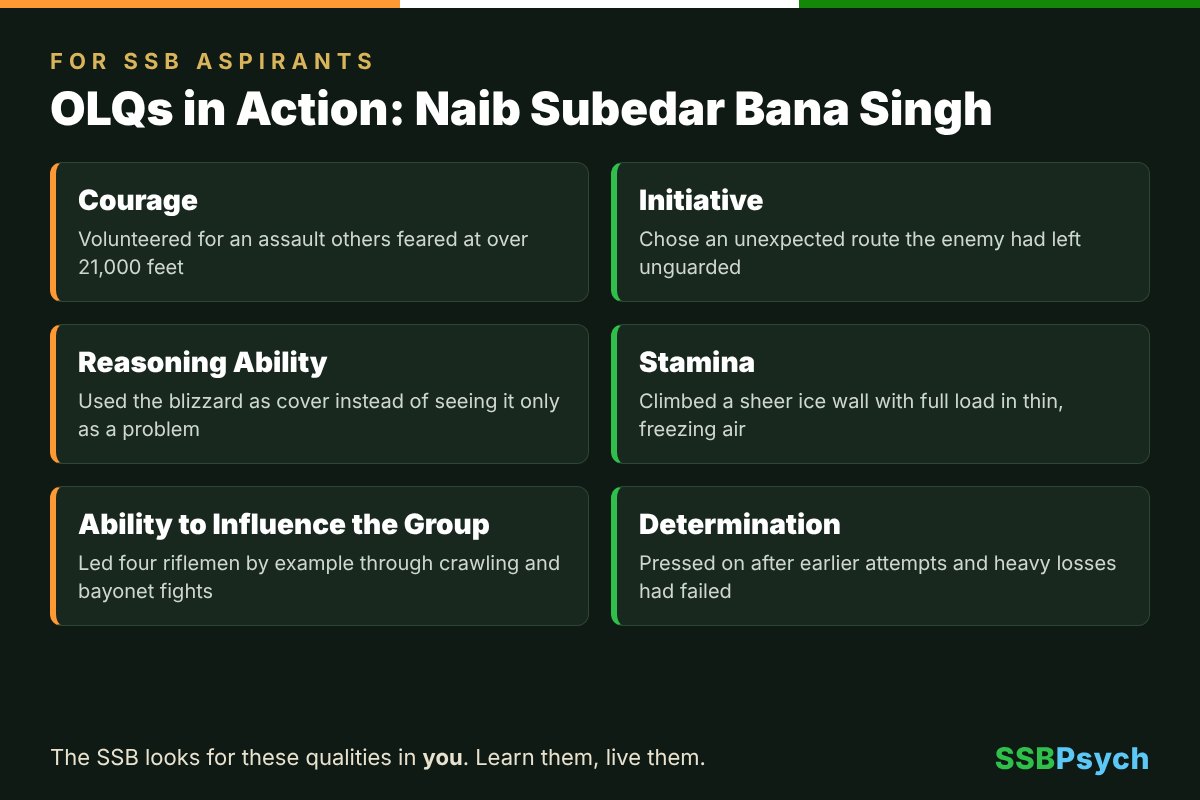
- Courage – Volunteered for an assault others feared at over 21,000 feet
- Initiative – Chose an unexpected route the enemy had left unguarded
- Reasoning Ability – Used the blizzard as cover instead of seeing it only as a problem
- Stamina – Climbed a sheer ice wall with full load in thin, freezing air
- Ability to Influence the Group – Led four riflemen by example through crawling and bayonet fights
- Determination – Pressed on after earlier attempts and heavy losses had failed
Tip for your SSB interview: If the IO asks about a difficult task you volunteered for, describe how you chose your approach, like Bana Singh choosing the harder but unexpected route, not just how hard you worked.
Practice Corner: WAT and SRT
Write your first spontaneous response to these before you scroll to the quiz. Keep WAT sentences short, positive and action-oriented.
WAT Words
- Glacier
- Volunteer
- Route
- Blizzard
- Summit
SRTs
- He is leading a small team to a hilltop and finds the main path is watched by a rival group. He…
- His team has failed twice in a tough task and morale is low before the final attempt. He…
- During a trek a sudden snowstorm reduces visibility and one member wants to turn back. He…
Quiz: How Well Do You Know Naib Subedar Bana Singh?
Test yourself! Click an option to see if you are right. Your score updates live.
Frequently Asked Questions
Why is Bana Singh called the Hero of Siachen?
Because he led the five-man team that captured Pakistan’s Quaid Post, the dominant peak in the Siachen area, on 26 June 1987 during Operation Rajiv.
What is Bana Top?
Bana Top is the new name of Quaid Post, the Siachen peak above 21,000 feet that Bana Singh’s team captured. It was renamed in his honour.
Why was the operation called Operation Rajiv?
It honoured Second Lieutenant Rajiv Pande of 8 JAK LI, who was killed with his patrol in May 1987 while trying to approach the same post.
Was Bana Singh’s Param Vir Chakra posthumous?
No. He survived the battle, received the Param Vir Chakra in 1988 and retired from the Army in 2000 as an Honorary Captain.
Which island is named after Bana Singh?
In January 2023 one of 21 unnamed islands in the Andaman and Nicobar group was named Bana Island after him.
The Param Vir Chakra Series on SSBPsych
This is part 16 of 21 in our series on every Param Vir Chakra awardee. A new hero goes live every morning at 7:30 AM. Also read the story of Captain Vikram Batra, PVC – the Sher Shah of Kargil.
Sources: en.wikipedia.org, en.wikipedia.org, www.bharat-rakshak.com, thehitavada.com.
Preparing for your SSB? Join SSBPsych’s online and offline SSB batches and learn how to show your OLQs with confidence – explore our courses or call +91 8076540582.