Assam Regiment: History, Motto, War Cry, Battles and Heroes
Born in the dark days of the Second World War, when Japanese forces were advancing towards India’s eastern borders, the Assam Regiment was tested in battle within three years of being raised – and passed with flying colours at Jessami and Kohima. Today its soldiers, proudly called the Rhinos, come from all eight states of the North-East and guard India’s borders from Arunachal Pradesh to Ladakh.
In this article you will learn the history of the Assam Regiment, follow a simple timeline, read about its major operations and battle honours, understand its motto, war cry and insignia, meet its heroes and discover what life in the regiment is like. There is a special section for NDA, CDS and SSB aspirants and a quiz at the end.
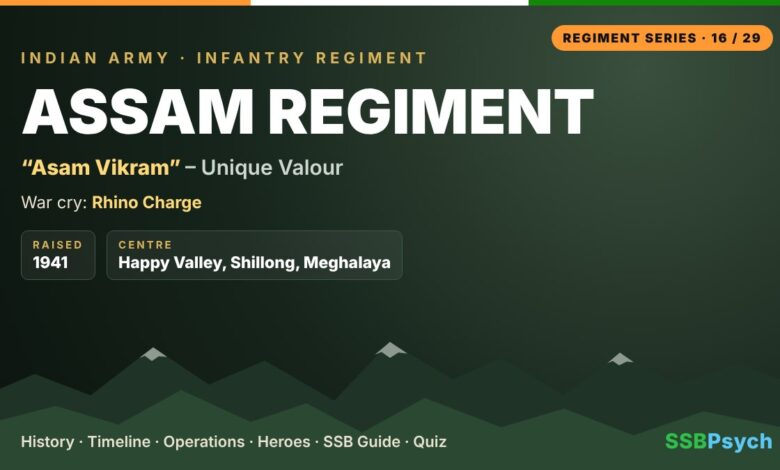
Assam Regiment – Quick Facts
| Raised | 15 June 1941, at Shillong |
| Raised by | Maj (later Brig) Ross Howman |
| Regimental Centre | Happy Valley, Shillong, Meghalaya |
| Motto | Asam Vikram (Unique Valour) |
| War Cry | Rhino Charge |
| Nickname | The Rhinos |
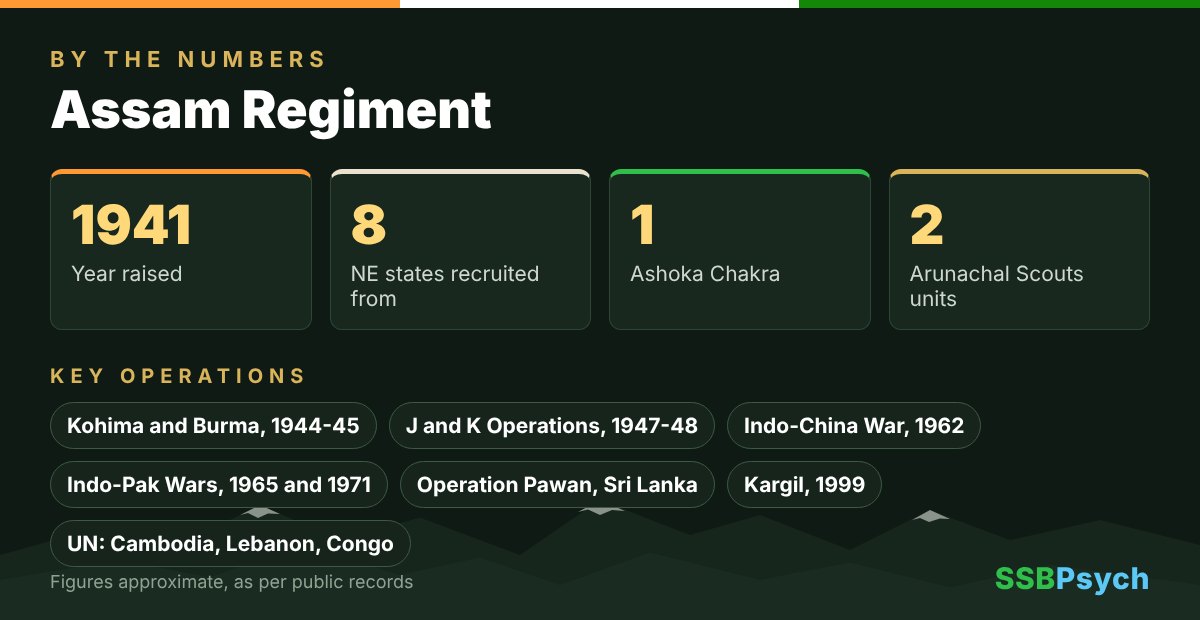
| Recruitment | All eight North-Eastern states |
| Battalions | Over 15 regular battalions, plus RR, TA and 2 Arunachal Scouts |
| Regimental song | Badluram Ka Badan |
| Notable gallantry | Ashoka Chakra (Hav Hangpan Dada) and Maha Vir Chakras |
History of the Assam Regiment
Before 1941, the people of the North-East had served in units such as the Assam Rifles, but there was no regular Indian Army infantry regiment for the region. As the threat of a Japanese invasion grew, the demand for a regiment of Assam’s own gained support. On 15 June 1941, the 1st Battalion of the Assam Regiment was raised at Shillong under Major Ross Howman, who later rose to the rank of Brigadier.
The young battalion did not have long to settle in. Within months it was sent to protect the vital oil fields at Digboi. In 1942 it moved to Ledo and helped survey the route for what became the Stilwell Road, the famous supply road built to link India with China through Burma. The regimental centre was set up in Shillong, and it remains in the beautiful Happy Valley area of the city today.
Baptism of Fire: Jessami and Kohima, 1944
In March 1944 the Japanese launched a major offensive towards Kohima and Imphal. The 1st Battalion, Assam Regiment, under Lieutenant Colonel William Felix Brown, was rushed to the remote posts of Jessami and Kharasom in the Naga Hills. Its task was to delay a whole Japanese division. The young soldiers held their positions for several days against overwhelming numbers, buying precious time for the defenders of Kohima.
The battalion then fought in the defence of Kohima itself, one of the most intense battles of the Second World War in Asia, and later in the capture of Aradura. The regiment won battle honours such as Jessami, Kohima, Aradura, Toungoo, Kyaukmyaung Bridgehead and Mawlaik, and the theatre honour Burma 1942–45. It also received a large number of gallantry awards for such a new unit.
Historians often describe the battles of Kohima and Imphal as a turning point of the war in Asia. The Japanese 31st Division had hoped to capture Kohima quickly and cut the road to Dimapur, a major supply base. The delay imposed at Jessami and Kharasom, followed by the stubborn defence of Kohima, helped wreck that plan. For a battalion raised less than three years earlier, it was an extraordinary achievement, and the Rhinos still remember it with great pride.
Assam Regiment Timeline: From Raising to Today
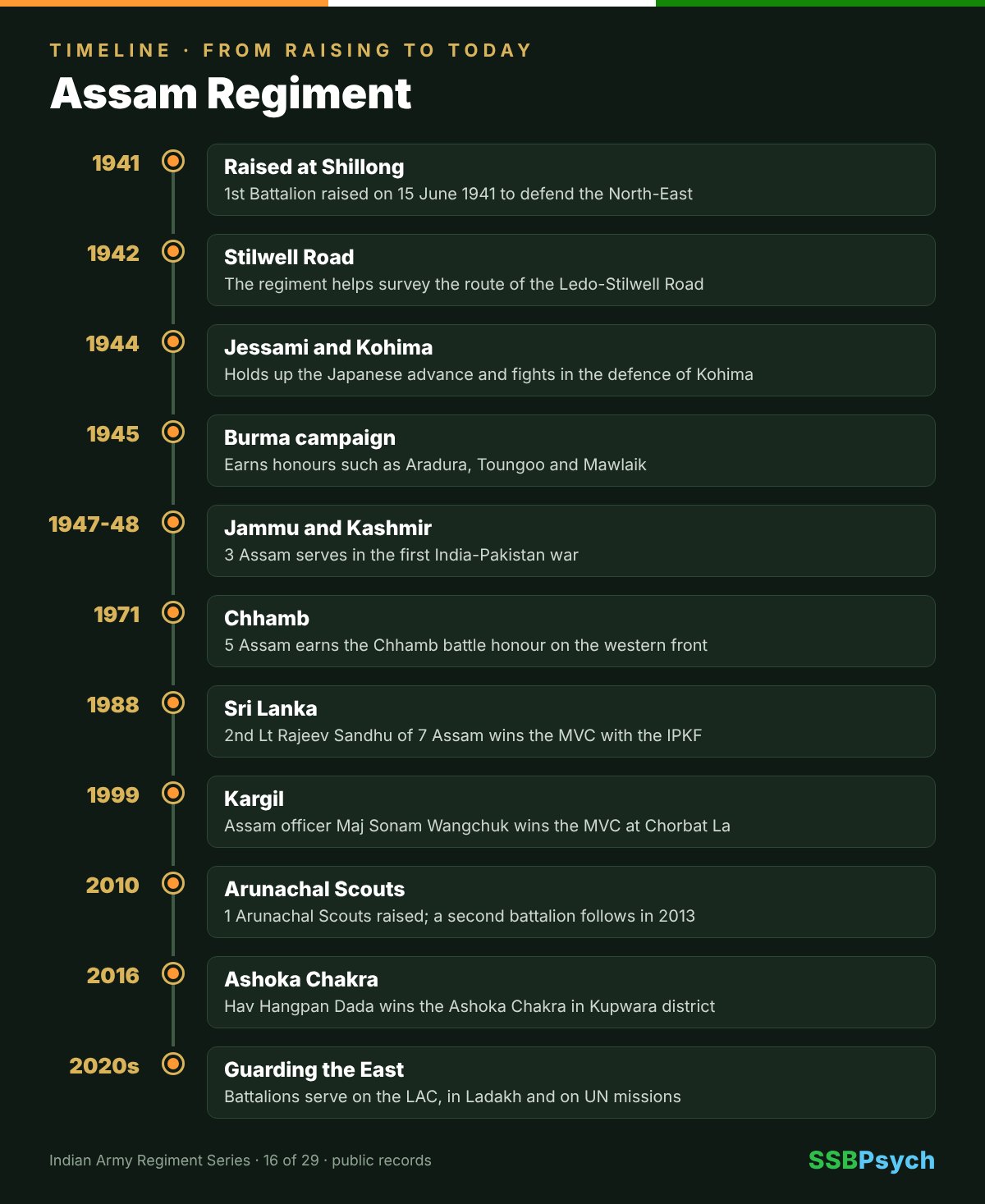
- 1941 – Raised at Shillong: 1st Battalion raised on 15 June 1941 to defend the North-East
- 1942 – Stilwell Road: The regiment helps survey the route of the Ledo-Stilwell Road
- 1944 – Jessami and Kohima: Holds up the Japanese advance and fights in the defence of Kohima
- 1945 – Burma campaign: Earns honours such as Aradura, Toungoo and Mawlaik
- 1947-48 – Jammu and Kashmir: 3 Assam serves in the first India-Pakistan war
- 1971 – Chhamb: 5 Assam earns the Chhamb battle honour on the western front
- 1988 – Sri Lanka: 2nd Lt Rajeev Sandhu of 7 Assam wins the MVC with the IPKF
- 1999 – Kargil: Assam officer Maj Sonam Wangchuk wins the MVC at Chorbat La
- 2010 – Arunachal Scouts: 1 Arunachal Scouts raised; a second battalion follows in 2013
- 2016 – Ashoka Chakra: Hav Hangpan Dada wins the Ashoka Chakra in Kupwara district
- 2020s – Guarding the East: Battalions serve on the LAC, in Ladakh and on UN missions
Major Operations of the Assam Regiment After 1947
Wars with Pakistan and China
After Independence, 3 Assam served in Jammu and Kashmir during the 1947–48 war. In 1962, 4 Assam fought in the war with China. During the 1965 and 1971 wars, several battalions served on both the western and eastern fronts. In 1971, 5 Assam fought in the Chhamb sector and earned the Chhamb battle honour, one of the toughest battlefields of that war.
Sumdorong Chu and Siachen
Because so many of its soldiers come from Arunachal Pradesh and other border states, the regiment has a special connection with the eastern frontier. During the Sumdorong Chu standoff with China in 1986–87, Assam battalions were deployed in the area. Since 1984 Assam units have also served on the Siachen Glacier, showing that the Rhinos are equally at home in the jungles of the East and the ice of the North.
Sri Lanka 1988
With the Indian Peace Keeping Force in Sri Lanka, 4 and 7 Assam took part in Operation Pawan. On 19 July 1988, Second Lieutenant Rajeev Sandhu of 7 Assam was leading troops in a convoy when it was ambushed. He fought back bravely and was killed in the action. He was awarded the Maha Vir Chakra posthumously.
Kargil 1999
Several Assam battalions took part in Operation Vijay. One of the war’s earliest heroes was Major Sonam Wangchuk, an officer of the Assam Regiment serving with the Ladakh Scouts. At the end of May 1999 he led his men to stop intruders near Chorbat La in the Batalik sector at very high altitude, and was awarded the Maha Vir Chakra. He became known as the Lion of Ladakh.
Counter-Terrorism and UN Missions
Assam battalions have served long tours in Jammu and Kashmir through the Rashtriya Rifles and in counter-insurgency operations. Abroad, the regiment has served the United Nations in Cambodia, Lebanon and the Democratic Republic of the Congo. Its battalions have also trained with the US Army in the Yudh Abhyas exercises.
Insignia, Motto and War Cry
The insignia of the Assam Regiment is the one-horned rhinoceros, the proud symbol of Assam and its Kaziranga forests. That is why the regiment’s soldiers call themselves the Rhinos. The rhino stands for strength, toughness and the courage to charge straight at danger.
The motto is Asam Vikram, meaning Unique Valour, and the war cry is Rhino Charge. The regiment also has a unique greeting, Tagra Raho, meaning stay strong and fit, which was introduced in the 1960s and is used by Rhinos everywhere.
The regimental song, Badluram Ka Badan, is one of the most famous marching songs in the Indian Army. It has a cheerful tune and a humorous story from the Second World War about a soldier named Badluram, and it is sung with great energy at parades and functions.
Heroes of the Assam Regiment
- Brigadier Ross Howman – raised the 1st Battalion at Shillong in 1941.
- Lt Col William Felix Brown, DSO – commanded the battalion at Jessami and Kohima in 1944.
- 2nd Lt Rajeev Sandhu, Maha Vir Chakra (posthumous) – 7 Assam, Sri Lanka, 1988.
- Major Sonam Wangchuk, Maha Vir Chakra – Assam Regiment officer with the Ladakh Scouts, Batalik sector, Kargil, 1999.
- Havildar Hangpan Dada, Ashoka Chakra (posthumous) – of 4 Assam, serving with 35 Rashtriya Rifles; killed fighting infiltrating terrorists at Naugam, Kupwara district, in May 2016.
- Major General S C Barbora – a senior Rhino remembered for introducing the Tagra Raho greeting.
Role and Life in the Assam Regiment
The Assam Regiment is an infantry regiment trained for all terrain, but its soldiers are especially skilled in jungle and mountain warfare. Recruits come from Assam, Arunachal Pradesh, Manipur, Meghalaya, Mizoram, Nagaland, Tripura and Sikkim. Within a single company you may find soldiers from many tribes and communities, speaking different languages but united by one regimental identity.
This diversity is one of the regiment’s greatest strengths. Soldiers learn to respect each other’s customs, festivals and food, and the regimental family becomes a bridge between the North-East and the rest of India. Officers who serve with the Rhinos often say their men are cheerful, physically tough and fiercely loyal.
The regiment also includes two battalions of Arunachal Scouts, raised in 2010 and 2013. These units recruit local men who know the high mountains of Arunachal Pradesh intimately, making them ideal for guarding the Line of Actual Control. The regiment also has Rashtriya Rifles and Territorial Army battalions, including ecological battalions that help with forestry and environmental work in the North-East.
Happy Valley in Shillong is the regiment’s home. Recruits train there in a cool, green setting, and the regimental museum preserves the memories of Jessami, Kohima and later battles. In 2011 the Assam Regimental Centre became the first regimental centre in the Army to receive a GOC-in-C Unit Citation.
The Assam Regiment Today
Today’s Rhinos are a modern, well-equipped force. Battalions rotate between peace stations and demanding field areas, including the Line of Actual Control in the eastern sector, the high-altitude areas of Ladakh, and counter-terror zones in Jammu and Kashmir. In 2020, Assam battalions were among the units deployed along the northern borders during the standoff with China.
The regiment also builds bridges with friendly armies and other services. Its battalions have represented India in the Yudh Abhyas exercises with the United States Army, and in 2021 the Indian Air Force’s 106 Squadron was formally affiliated with the Assam Regiment and the Arunachal Scouts at Tezpur. Such links help soldiers understand how different forces work together in modern operations.
Sport is another passion. Many soldiers from the North-East love football and other games, and regimental teams take part in Army competitions with great enthusiasm. A fit soldier is a confident soldier, which is exactly what the greeting Tagra Raho is meant to encourage.
Why the Assam Regiment Matters for the Nation
The Assam Regiment is more than a fighting force. It gives young people from the North-East a respected path into national service, and it carries the region’s courage to every corner of India. When a Rhino stands guard in Ladakh or on a UN mission in Africa, he represents both his home state and the whole country. For aspirants, the regiment is a powerful example of unity in diversity – a value that SSB assessors look for in every Group Discussion and interview.
The regiment’s story also shows how quickly a new unit can build a proud tradition. In less than three years after its raising, a battalion of young recruits stood firm against a battle-hardened enemy at Jessami. Good training, trust in leaders and belief in a shared cause made that possible – the same ingredients that make any team succeed.
Assam Regiment for SSB Candidates: What You Should Know
How officers join
- Officers from any part of India can be commissioned into the Assam Regiment; officers are not recruited by region.
- Entry routes include NDA after Class 12, IMA through CDS, TES, TGC or ACC, and OTA Chennai through Short Service Commission.
- Regiment allotment happens at the academy based on your choices, order of merit and vacancies.
- Officers who join learn about the cultures of the North-East and often pick up words from several regional languages.
How soldiers join
- Soldiers are recruited from all eight North-Eastern states; the Arunachal Scouts recruit mainly from Arunachal Pradesh.
- Since 2022, soldiers join as Agniveers under the Agnipath scheme through Army recruitment rallies; check joinindianarmy.nic.in for current rules.
Questions you may face in the SSB interview, GD or lecturette
- Why are soldiers of the Assam Regiment called the Rhinos?
- What was the importance of the battle of Kohima in 1944?
- How does the Army help integrate the North-East with the rest of India?
- What do you know about Havildar Hangpan Dada?
- Give a lecturette on the strategic importance of Arunachal Pradesh.
SSBPsych tip: In the Group Discussion, topics on the North-East come up often; use the Assam Regiment as a factual example of how national service builds unity in diversity.
Conclusion
From the hills of Jessami in 1944 to the heights of Kargil and the forests of Kupwara, the Rhinos of the Assam Regiment have shown unique valour wherever they have served. Their story is one of courage, unity and pride in the North-East. It reminds every young Indian that bravery has no single home state, and that soldiers from every corner of the country stand shoulder to shoulder when the nation calls. The rhino on their badge may be a symbol of Assam, but the spirit behind it belongs to all of India. Test your knowledge with the quiz below and keep preparing with SSBPsych for your own journey to the Indian Army.
Quiz: How Well Do You Know the Assam Regiment?
Test yourself! Click an option to see if you are right. Your score updates live.
Assam Regiment: Frequently Asked Questions
The motto is Asam Vikram, meaning Unique Valour.
The war cry is Rhino Charge.
The Assam Regimental Centre is at Happy Valley, Shillong, in Meghalaya.
Soldiers are recruited from all eight North-Eastern states. Officers from anywhere in India can be commissioned into the regiment after training at NDA, IMA or OTA.
Because the regiment’s insignia is the one-horned rhinoceros, a symbol of Assam, standing for strength and courage.
Indian Army Regiments Series on SSBPsych
This is part 16 of 29 in our series on every infantry regiment of the Indian Army – a new regiment every day at 11 AM. Previous in the series: Kumaon Regiment. Also follow our Param Vir Chakra series.
Sources: en.wikipedia.org, en.wikipedia.org, en.wikipedia.org, salute.co.in, aviation-defence-universe.com.
Preparing for NDA, CDS, AFCAT or your SSB? Join SSBPsych’s online and offline batches – explore our courses or call +91 8076540582.