Major Ramaswamy Parameswaran, PVC: IPKF Hero of Operation Pawan, Sri Lanka – Full Story (with Quiz)
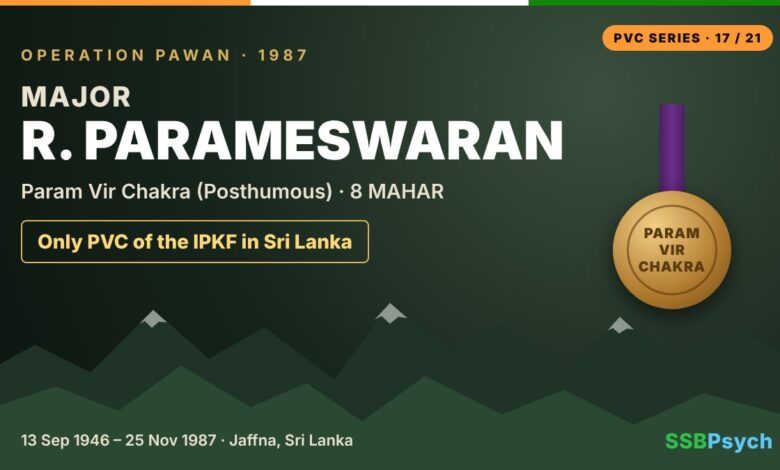
Most Param Vir Chakra stories come from wars against Pakistan or China. One of them comes from a very different battlefield: the coconut groves and narrow village lanes of the Jaffna peninsula in Sri Lanka. There, on a dark night in November 1987, an Indian officer whose column had been caught in a deadly ambush refused to simply take cover. Major Ramaswamy Parameswaran of 8 Mahar turned the trap around, charged the attackers and kept commanding his men even after being shot in the chest.
He remains the only soldier of the Indian Peace Keeping Force (IPKF) to receive the Param Vir Chakra. For SSB aspirants, his life shows that an officer’s real test is how fast and how clearly he thinks when everything goes wrong. Below we cover his early life, his long road into the Army, the background of Operation Pawan, the ambush in detail, his citation in simple words, his legacy, the OLQs he displayed, and a 10-question quiz.
Major Ramaswamy Parameswaran – Quick Facts
| Full name | Ramaswamy Parameswaran (also spelt Parameshwaran) |
| Born | 13 September 1946, Bombay (now Mumbai) |
| Education | SIES High School and SIES College, Mumbai (science graduate) |
| Commissioned | 1972, Mahar Regiment, through Officers Training Academy, Madras |
| Unit at the time | 8th Battalion, The Mahar Regiment (8 MAHAR) |
| Operation | Operation Pawan, Indian Peace Keeping Force (IPKF) |
| Place | Jaffna peninsula, Sri Lanka |
| Date of action | 25 November 1987 |
| Award | Param Vir Chakra (Posthumous) |
| Nickname | Parry Sahib, as his men called him |
| Honours | Ramaswamy Island (Andaman and Nicobar, 2023); Parameshwaran Vihar, Chennai |
Early Life in Bombay
Ramaswamy Parameswaran was born on 13 September 1946 in Bombay, now Mumbai, to K. S. Ramaswamy and Janaki. He grew up in a Tamil family in the city and studied at the South Indian Education Society (SIES) High School, finishing school in 1963. He then went on to SIES College and graduated in science in 1968.
His story is a useful reminder that there is no single “right” background for an officer. He was a city boy and a science graduate, not someone who went to a military school or the NDA. What he carried into the Army was a disciplined mind and a strong sense of purpose, and those turned out to matter far more than where he started.
Joining the Army and Early Career
Parameswaran joined the Officers Training Academy (OTA) in Madras, now Chennai, and was commissioned into the Mahar Regiment in 1972 with a short service commission, which was later converted into a regular commission. He served first with 15 Mahar for several years and later moved to 5 Mahar.
With his battalions he gained experience of counter-insurgency operations in the North East, the kind of work where small patrols, careful intelligence and quick reactions decide outcomes. He rose to the rank of Major in 1984. His soldiers fondly called him “Parry Sahib”, a sign of the affection and respect he earned from the men he led. When India sent troops to Sri Lanka in 1987, he was posted to 8 Mahar, one of the battalions sent to the island.
The Background: Operation Pawan and the IPKF
In July 1987 India and Sri Lanka signed the Indo-Sri Lanka Accord to try to end the conflict between the Sri Lankan government and Tamil militant groups in the north and east of the island. Under the accord, the Indian Peace Keeping Force was sent to Sri Lanka. The idea was that militant groups would hand over their weapons and a political settlement would follow.
The largest militant group, the Liberation Tigers of Tamil Eelam (LTTE), did not lay down its arms, and by October 1987 the IPKF found itself fighting them. The Indian operation to take control of the Jaffna peninsula was called Operation Pawan. It was a tough campaign. The LTTE knew every lane and field, blended into the civilian population, used mines and booby traps, and specialised in ambushes. Indian soldiers had to search villages for weapons while avoiding harm to civilians, which made every patrol slow and risky.
The Ambush Near Kantharodai, 25 November 1987
A Search Operation at Night
On 25 November 1987, Major Parameswaran’s company received information about a cache of arms and ammunition in a village in the Jaffna peninsula, widely reported to be near Kantharodai, close to Uduvil. He led a column of troops on a search operation to recover the weapons. The area was an LTTE stronghold, and the ground was dotted with coconut groves and thick vegetation that offered ideal cover for anyone lying in wait.
Late that night, as the column was returning from the search, it was suddenly hit by fire from a group of militants who had laid an ambush. In such moments most units instinctively drop to the ground and fire back from where they are. That keeps them pinned down, which is exactly what the ambushers want.
Turning the Tables
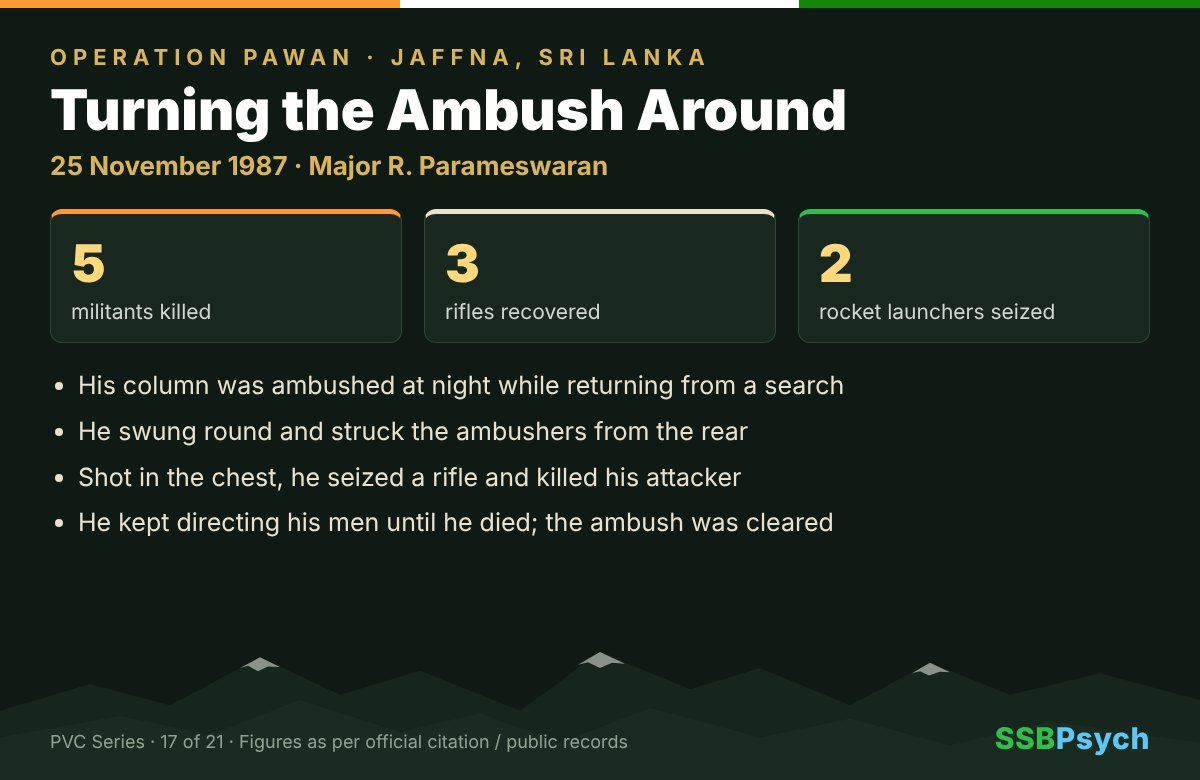
Parameswaran read the situation quickly. Instead of staying in the killing zone, he took a group of his men and moved around the ambush so that he could strike the militants from behind. It was a bold decision, taken under fire and in darkness. When his party hit the attackers from the rear, the militants were taken completely by surprise.
The fighting turned into close combat. During this hand-to-hand struggle a militant shot Parameswaran in the chest. Gravely wounded, he still had the strength and presence of mind to snatch the rifle from his attacker and shoot him dead. Then, though he was bleeding heavily, he continued to give orders and urge his men forward. He kept commanding them until he died.
The Result
Inspired by their commander, his soldiers pressed home the counter-attack. The ambush was cleared. Five militants were killed, and the troops recovered three rifles and two rocket launchers. A situation that could easily have ended with many Indian soldiers dead was turned into a clear success, at the cost of the life of the officer who made it possible.
When caught in an ambush, he did not ask how to survive it. He asked how to defeat it.
– SSBPsych on Major Parameswaran’s leadership
The Param Vir Chakra Citation (In Simple Words)
Major Parameswaran’s citation explains that he was serving with the IPKF in Sri Lanka. On 25 November 1987, while his column was coming back from a search operation late at night, militants ambushed it. Keeping a cool head, he moved round to encircle the militants from the rear and charged them, catching them off guard. In the close-quarter fight that followed, he was shot in the chest by a militant. Undeterred, he grabbed the man’s rifle and killed him. Though critically wounded, he went on issuing orders and inspiring his troops until his last breath. Five militants were killed, three rifles and two rocket launchers were recovered, and the ambush was cleared. The citation honours his most conspicuous courage, fighting spirit and supreme sacrifice with a posthumous Param Vir Chakra.
Legacy of Parry Sahib
Major Parameswaran is remembered as the only Param Vir Chakra awardee of the IPKF and the first officer from the Officers Training Academy, Chennai, to win the nation’s highest wartime gallantry award. For OTA, which trains short service commission officers, he became a lasting symbol that a graduate entry officer can rise to the very highest standards of courage and leadership.
- Parameshwaran Vihar: an Army Welfare Housing Organisation colony on Arcot Road, Chennai, built in 1998 and named after him
- Ramaswamy Island: one of 21 Andaman and Nicobar islands named after PVC awardees in January 2023
- Param Yodha Sthal, National War Memorial, New Delhi: his statue stands with the other PVC heroes
- The Mahar Regiment honours him as one of its greatest sons
His story also widened the meaning of the Param Vir Chakra. It showed that gallantry of the highest order is not limited to large conventional wars. In peacekeeping and counter-insurgency, where the enemy hides among villages and strikes from cover, an officer’s split-second judgement can save an entire column. That is a lesson today’s young officers serving in insurgency-hit areas still carry with them.
For aspirants preparing for SSB through the CDS or OTA routes, he is especially relevant. You do not need a military school background or the NDA badge to become an exceptional officer. You need clarity of thought, the will to take charge, and the character to put your men first.
What the Ambush Teaches a Young Leader
Military trainers often describe an ambush as the moment when the enemy has already made all the choices: the time, the place and the angle of fire. The side that is ambushed starts at a disadvantage, and the natural human reaction is to freeze or hide. Major Parameswaran’s response shows three habits that every future officer can practise long before wearing a uniform.
- Read the situation, then act. He did not waste time wondering why it had happened; he worked out where the enemy was weakest.
- Take a calculated risk. Moving around an ambush at night is dangerous, but staying in the line of fire was more dangerous for everyone.
- Lead until the job is done. Even with a fatal wound, his attention stayed on his men and the mission, not on himself.
In SSB tasks such as the Group Planning Exercise, Situation Reaction Test and outdoor tasks, assessors look for exactly this pattern: a quick, realistic grasp of the problem, a practical plan, and the willingness to carry the group with you when things get hard.
Lessons for SSB Aspirants: OLQs in Action
The SSB does not test whether you can recite history – it looks for the qualities of an officer. Here is how Major Ramaswamy Parameswaran showed them:
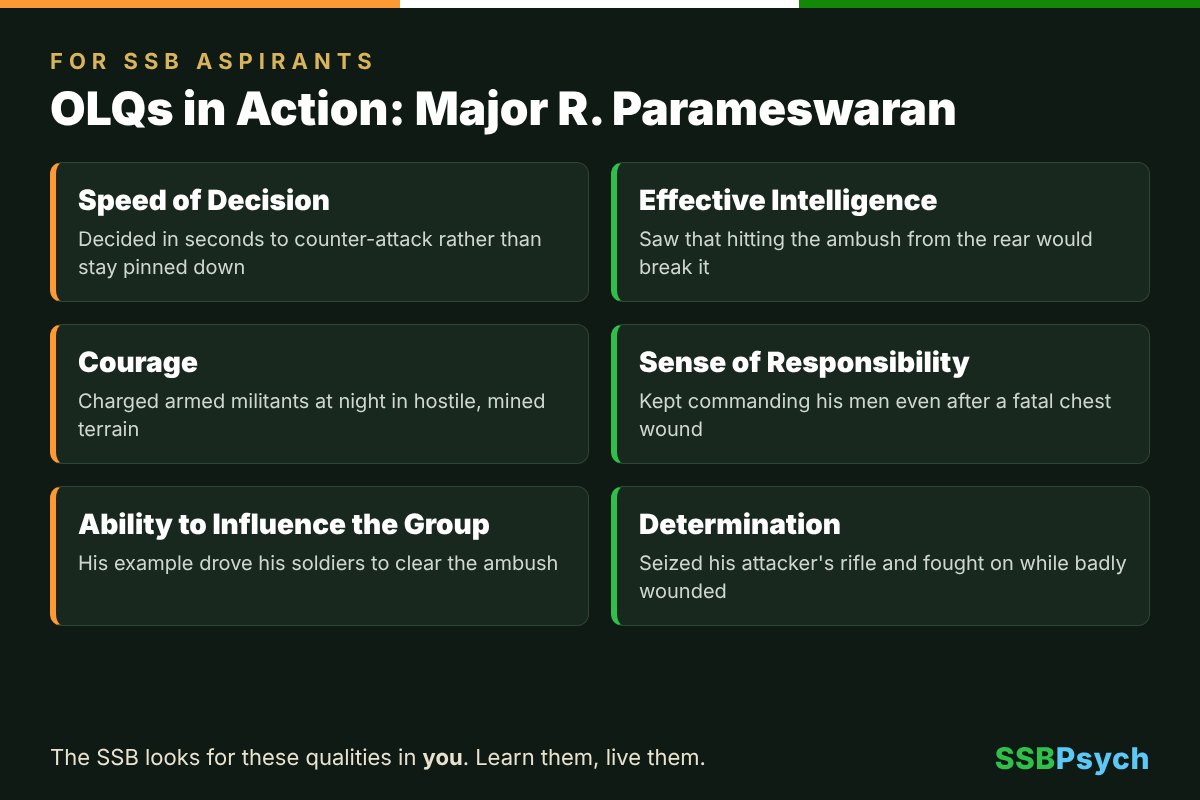
- Speed of Decision – Decided in seconds to counter-attack rather than stay pinned down
- Effective Intelligence – Saw that hitting the ambush from the rear would break it
- Courage – Charged armed militants at night in hostile, mined terrain
- Sense of Responsibility – Kept commanding his men even after a fatal chest wound
- Ability to Influence the Group – His example drove his soldiers to clear the ambush
- Determination – Seized his attacker’s rifle and fought on while badly wounded
Tip for your SSB interview: If you are a graduate aiming for CDS or OTA, be ready to explain why you chose the Army later in life; Major Parameswaran, a science graduate from OTA, is a strong example to quote.
Practice Corner: WAT and SRT
Write your first spontaneous response to these before you scroll to the quiz. Keep WAT sentences short, positive and action-oriented.
WAT Words
- Ambush
- Peace
- Jaffna
- Counter
- Command
SRTs
- He is returning from a trek at night with his group when they are suddenly surrounded by a hostile crowd. He…
- His team is stuck in a situation where staying put will only make things worse. He…
- He is badly hurt during a group task that is not yet complete. He…
Quiz: How Well Do You Know Major Ramaswamy Parameswaran?
Test yourself! Click an option to see if you are right. Your score updates live.
Frequently Asked Questions
Who is the only IPKF soldier to receive the Param Vir Chakra?
Major Ramaswamy Parameswaran of 8 Mahar, honoured posthumously for his action in Sri Lanka on 25 November 1987.
What happened on 25 November 1987?
While returning from a search operation at night in the Jaffna peninsula, his column was ambushed by militants. He attacked them from the rear, was shot in the chest, killed his attacker with the man’s own rifle and kept commanding until he died. Five militants were killed.
Was Major Parameswaran an NDA officer?
No. He was a science graduate from SIES College, Mumbai, and was commissioned in 1972 from the Officers Training Academy, Madras.
What was Operation Pawan?
It was the Indian Peace Keeping Force’s 1987 operation to take control of the Jaffna peninsula from the LTTE after the militants refused to disarm under the Indo-Sri Lanka Accord.
How is Major Parameswaran remembered today?
Through Ramaswamy Island in the Andaman and Nicobar group, the AWHO Parameshwaran Vihar colony in Chennai, and his statue at the Param Yodha Sthal of the National War Memorial.
The Param Vir Chakra Series on SSBPsych
This is part 17 of 21 in our series on every Param Vir Chakra awardee. A new hero goes live every morning at 7:30 AM. Also read the story of Captain Vikram Batra, PVC – the Sher Shah of Kargil.
Sources: en.wikipedia.org, bharat-rakshak.com, www.aviation-defence-universe.com, thehitavada.com.
Preparing for your SSB? Join SSBPsych’s online and offline SSB batches and learn how to show your OLQs with confidence – explore our courses or call +91 8076540582.