INS Kursura submarine museum and India’s Foxtrot Class Story
Most people will never set foot inside a real submarine. But on Visakhapatnam’s RK Beach, you can. The INS Kursura submarine museum lets you climb into a boat that once hunted in the Arabian Sea during the 1971 war, squeeze through its round hatches, and see the bunks where 70-plus sailors lived for weeks underwater.
Kursura belonged to the Foxtrot class, the Soviet-built submarines that started India’s entire submarine arm. In this guide we cover where these boats came from, why India needed them, their size, crew and weapons, their role in war, the dangers and daily routine of their crews, and what you can expect when you visit the museum today.

The Foxtrot Class: Where India’s Submarine Story Begins
In the 1960s India had no submarines at all. Pakistan, on the other hand, had received an American submarine, PNS Ghazi. India turned to the Soviet Union, which offered its proven Project 641 design. NATO gave this design the code name Foxtrot, and that is the name most people know.
India eventually received eight Foxtrot-type boats. The first four formed the Kalvari class: INS Kalvari, INS Khanderi, INS Karanj and INS Kursura. Four more, with some changes, arrived in 1973 and 1974 and were called the Vela class: INS Vela, INS Vagir, INS Vagli and INS Vagsheer. The very first, INS Kalvari, was commissioned on 8 December 1967. That is why the Indian Navy celebrates Submarine Day on 8 December every year.
Old names, new boats
The Navy honoured these pioneers by reusing their names. The modern Scorpene-based Kalvari class submarines built at Mazagon Dock, Mumbai, carry the same names: Kalvari, Khanderi, Karanj, Vela, Vagir and Vagsheer. So when you read about INS Vagsheer today, remember there was an older Vagsheer that sailed in the 1970s.
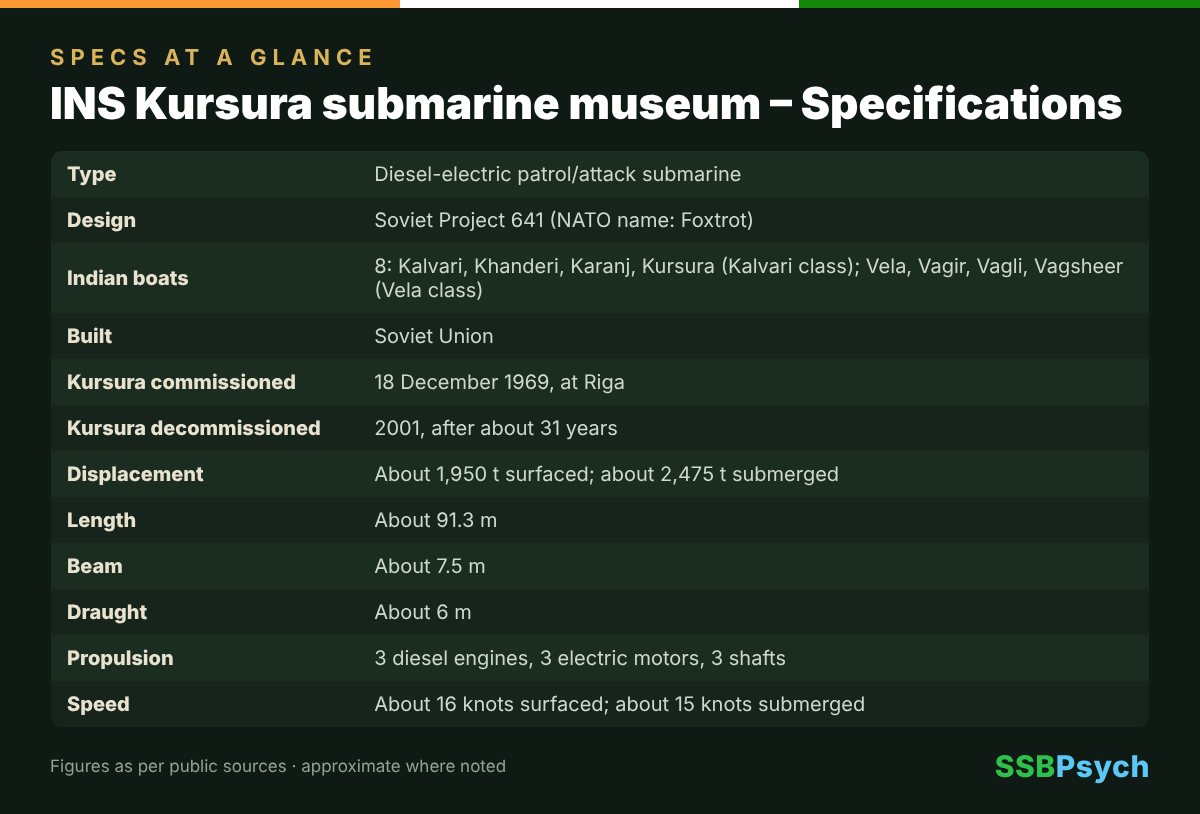
INS Kursura submarine museum Specifications
| Type | Diesel-electric patrol/attack submarine |
| Design | Soviet Project 641 (NATO name: Foxtrot) |
| Indian boats | 8: Kalvari, Khanderi, Karanj, Kursura (Kalvari class); Vela, Vagir, Vagli, Vagsheer (Vela class) |
| Built | Soviet Union |
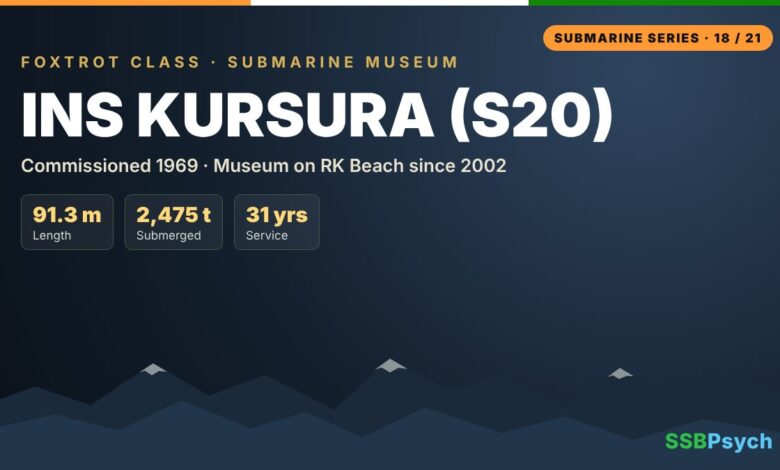
| Kursura commissioned | 18 December 1969, at Riga |
| Kursura decommissioned | 2001, after about 31 years |
| Displacement | About 1,950 t surfaced; about 2,475 t submerged |
| Length | About 91.3 m |
| Beam | About 7.5 m |
| Draught | About 6 m |
| Propulsion | 3 diesel engines, 3 electric motors, 3 shafts |
| Speed | About 16 knots surfaced; about 15 knots submerged |
| Crew | About 75, including about 8 officers (reported) |
| Torpedo tubes | 10 x 533 mm (6 bow, 4 stern) |
| Status | Class retired by 2010; Kursura is a museum at RK Beach, Visakhapatnam |
How Big Was a Foxtrot Submarine?
At about 91 metres, a Foxtrot was a long boat for its time, nearly as long as a football field. Underwater it weighed about 2,475 tonnes. Displacement is the weight of water a vessel pushes aside, which equals its own weight, so think of about 2,000 cars squeezed into one steel tube.
Unlike most submarines, which have one propeller, the Foxtrot had three shafts, driven by three diesel engines and three electric motors. On the surface the diesels pushed the boat and charged its batteries. Underwater it ran silently on batteries. Its reported speed was about 16 knots on the surface and about 15 knots submerged, though under the sea it usually crept along much slower to save battery power and stay quiet.
Ballast tanks made simple
How does a submarine dive and surface? It has ballast tanks, large spaces that can be filled with sea water or air. Let water in and the boat gets heavier and sinks. Blow the water out with compressed air and it becomes lighter and rises. Small trim tanks fine-tune the balance, a bit like a swimmer adjusting their breath to float at the right level. You can see parts of this machinery inside Kursura.
Duty and Role: Why India Needed the Foxtrots
The Foxtrots were India’s first true underwater weapon. Their jobs were to:
- Hunt and attack enemy warships and supply ships with torpedoes.
- Patrol sea lanes and watch enemy ports quietly.
- Lay sea mines when ordered.
- Act as practice targets so Indian ships and aircraft could learn anti-submarine warfare.
- Most importantly, train the first generation of Indian submariners, engineers and commanders.
That last role may be the biggest legacy. Every Indian submarine programme that followed, from the German-designed Shishumar class to the nuclear-powered Arihant class, was built on skills first learned in these Soviet boats.
INS Kursura submarine museum Timeline
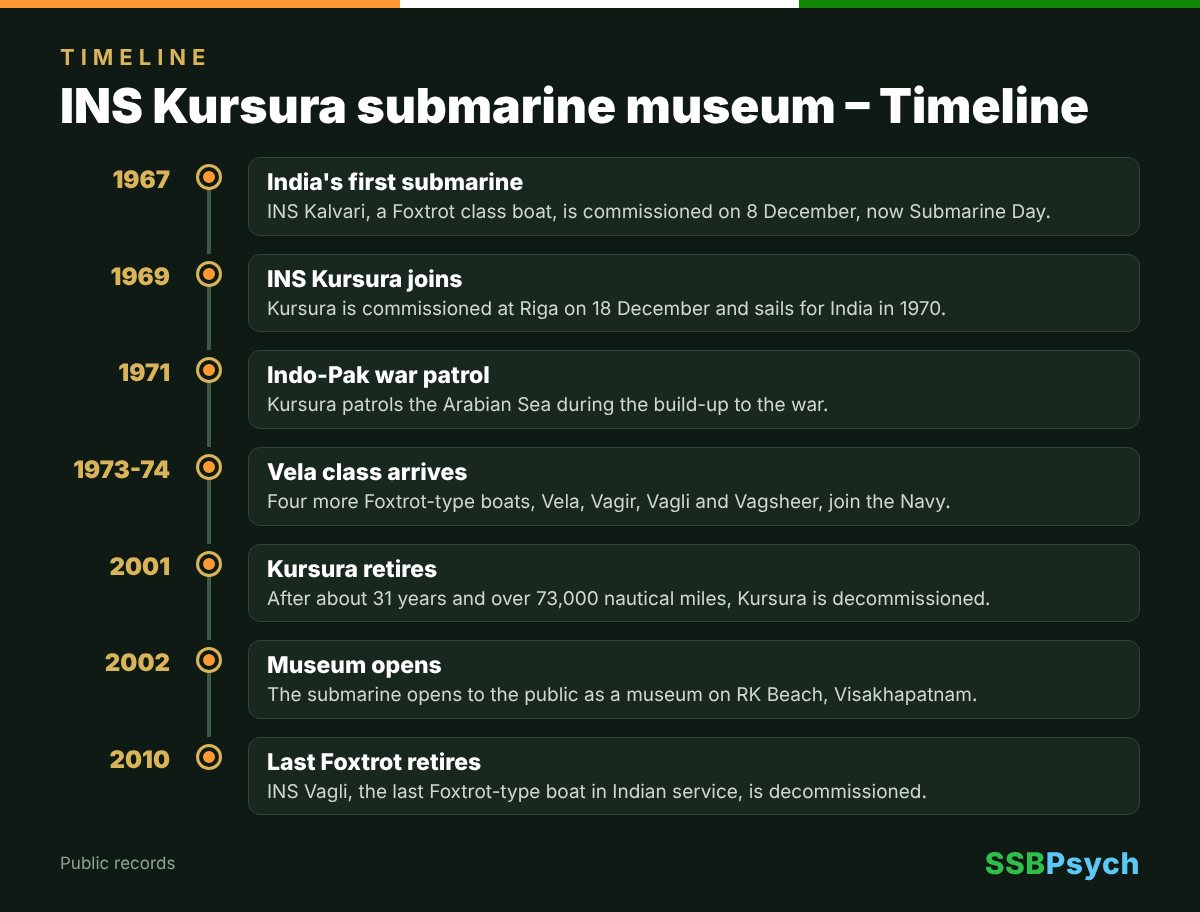
- 1967 – India’s first submarine: INS Kalvari, a Foxtrot class boat, is commissioned on 8 December, now Submarine Day.
- 1969 – INS Kursura joins: Kursura is commissioned at Riga on 18 December and sails for India in 1970.
- 1971 – Indo-Pak war patrol: Kursura patrols the Arabian Sea during the build-up to the war.
- 1973-74 – Vela class arrives: Four more Foxtrot-type boats, Vela, Vagir, Vagli and Vagsheer, join the Navy.
- 2001 – Kursura retires: After about 31 years and over 73,000 nautical miles, Kursura is decommissioned.
- 2002 – Museum opens: The submarine opens to the public as a museum on RK Beach, Visakhapatnam.
- 2010 – Last Foxtrot retires: INS Vagli, the last Foxtrot-type boat in Indian service, is decommissioned.
INS Kursura in the 1971 War
When tension with Pakistan rose in late 1971, Kursura left its home port in mid-November and took up patrol in the Arabian Sea. Its orders were strict: avoid demarcated shipping lanes, identify a target positively before attacking, and focus on enemy warships rather than merchant ships unless ordered. The boat shifted patrol areas, met its sister boat INS Karanj at sea, and was back in Bombay by early December as the war began.
The 1971 war showed how dangerous submarines can be. Pakistan’s submarine PNS Ghazi sank off Visakhapatnam in the opening days of the war, and India lost the frigate INS Khukri to a Pakistani submarine in the Arabian Sea. Both events made it clear that the side with stronger submarine and anti-submarine skills holds a big advantage at sea.
Aircraft, Weapons and Sensors
- Ten 533 mm torpedo tubes: six in the bow and four in the stern
- About 22 Soviet Type 53 family torpedoes carried (reported)
- Sea mines could be carried instead of torpedoes
- Passive and active sonar for detecting ships and submarines
- Surface search radar and periscopes
Operations and Missions
- 1971 – Arabian Sea war patrol: Kursura sailed in November 1971 to patrol assigned areas in the Arabian Sea.
- 1970s-1990s – Training the fleet: Foxtrot boats trained a whole generation of Indian submariners and anti-submarine crews.
- 1994 – Singapore and Jakarta: Kursura took part in anti-submarine exercises with Singapore and made goodwill visits.
- 2002 onwards – Museum duty: Kursura now teaches lakhs of visitors what life inside a submarine is like.
Crew and Life Inside a Foxtrot
Kursura is reported to have carried about 75 people, including roughly 8 officers. Walking through the museum, you quickly realise how little room each person had.
- Bunks were stacked tightly, sometimes right next to torpedoes in the torpedo rooms.
- Sailors moved between compartments through small round hatches, which also sealed each section in an emergency.
- There was no air conditioning comfort as we know it; in tropical waters the boat could get hot and humid.
- The galley (kitchen) was tiny, yet it fed the whole crew several times a day.
- Fresh water was limited, so bathing was rare during patrols.
- Silence was a rule. Noise could reveal the boat to enemy sonar.
Submariners call this life ‘silent service’. It demands patience, teamwork and calm nerves, the same qualities SSB assessors look for in officer candidates.
Who commands a submarine?
An Indian Navy submarine is usually commanded by an officer of Commander rank, helped by a second-in-command and specialist officers for engineering, weapons, electrical systems and navigation. Senior sailors, called chief petty officers and petty officers, run each compartment and train the younger crew.

Dangers the Foxtrot Crews Faced
Early submarine service was risky. Battery compartments could build up hydrogen gas, a serious fire and explosion risk. Flooding or fire in one compartment could threaten everyone. Collisions near the surface were another danger; Kursura’s sister INS Karanj was badly damaged in a collision with a destroyer in 1970. Diving depth figures for the Foxtrot design vary between published sources, so we leave out an exact number here. What matters is that every few metres deeper the water pressure rises, and the hull must withstand enormous squeezing force.
Cost and Running Cost Drivers
The purchase price of India’s Foxtrots was never published in detail. For the museum, moving Kursura from the sea onto the beach was a big engineering job that took about 18 months and is reported to have cost around Rs 5.5 crore. Running a working submarine is costly because of fuel, large battery banks that need replacement, spare parts from the original maker, long refits and specialist training. Today, the museum’s ticket income helps pay for its upkeep, including repairs against salt-air corrosion.
Visiting the INS Kursura Submarine Museum
Kursura was decommissioned in 2001 after about 31 years of service. It opened to the public as a museum on RK Beach, Visakhapatnam, in August 2002, and is widely described as one of the first submarine museums in South Asia. Retired naval personnel have served as guides, explaining each compartment.
- You enter through a hatch and walk the length of the boat, compartment by compartment.
- You see torpedo tubes, the control room with its gauges and periscope area, the engine room and crew bunks.
- Displays use mannequins to show sailors at work.
- The TU-142 maritime patrol aircraft museum is nearby on the same beach road, so you can see both in one trip.
- Timings and ticket prices change, so check locally before you go.
For any defence aspirant visiting Vizag, the INS Kursura submarine museum is a must. Few things explain submarine life better than standing in that narrow passage and imagining it moving deep underwater, sealed off from the sun for weeks.
What You Learn at the INS Kursura Submarine Museum
A visit is more than a photo opportunity. Inside, you understand three big ideas that textbooks struggle to explain. First, space: every pipe, valve and cable has a purpose, and humans fit around the machines, not the other way round. Second, teamwork: the control room shows how one order from the captain passes to the planesmen who steer the boat up or down, the helmsman, the engine room and the sonar operator, all within seconds. Third, discipline: watertight hatches, emergency valves and alarm systems remind you that one careless mistake can endanger every person on board.
Guides often explain how sailors communicated, how the periscope was used for a quick look at the surface, and how torpedoes were loaded by hand in the cramped torpedo room. Children enjoy it as an adventure, while aspirants can treat it as a live classroom on naval life.
Foxtrots Compared With Today’s Submarines
Technology has moved a long way since the 1960s. Modern conventional submarines are far quieter, thanks to better hull shapes, rubber-like coatings and machinery mounted on shock absorbers. Their batteries and computers are much more advanced, and many can fire anti-ship missiles from their torpedo tubes. Some newer designs also use air-independent propulsion (AIP), which lets them stay underwater for much longer without surfacing to charge batteries. Yet the basic ideas of diving, trimming, hunting by sound and surviving in a sealed hull have not changed. That is why a Foxtrot like Kursura is still a good teacher.
Lessons for Defence Aspirants
For NDA, CDS and AFCAT general knowledge, remember the key facts: India’s first submarine was INS Kalvari (1967), Submarine Day is 8 December, India operated eight Foxtrot-type boats, and Kursura became a museum at Visakhapatnam in 2002. In an SSB group discussion on self-reliance or maritime security, you can mention how India went from buying its first submarines to building its own in Mumbai and designing nuclear-powered boats. That journey began with the Foxtrots, and the INS Kursura submarine museum keeps that story alive.
Did You Know?
- Indian Navy Submarine Day, 8 December, marks the commissioning of the first INS Kalvari in 1967.
- Kursura still receives the Navy’s ‘dressing ship’ honour on special occasions, even as a museum.
- Kursura travelled over 73,000 nautical miles in service, more than three times around the Earth.
- INS Vagli, the last Foxtrot-type boat in Indian service, retired in 2010.
- Foxtrot boats had three propellers, unusual for a submarine.
- Several names from the Foxtrot era now sail again on modern Kalvari class submarines.
Quiz: Test Your Knowledge of INS Kursura submarine museum
Click an option to see if you are right. Your score updates live.
INS Kursura submarine museum: Frequently Asked Questions
It is a retired Indian Navy Foxtrot class submarine turned into a walk-through museum on RK Beach, Visakhapatnam. It opened to the public in 2002.
INS Kursura was commissioned on 18 December 1969 and decommissioned in 2001 after about 31 years of service.
It patrolled assigned areas in the Arabian Sea in November 1971, under strict rules of engagement, before returning to Bombay in early December.
India operated eight Foxtrot-type boats: four of the Kalvari class and four of the Vela class. The last, INS Vagli, retired in 2010.
Yes. Visitors walk through the submarine’s compartments, including the torpedo room, control room and crew quarters. Check local timings before visiting.
This is part 18 of 21 in SSBPsych’s submarine series – a new post every morning at 10 AM.
Sources: en.wikipedia.org, en.wikipedia.org, en.wikipedia.org, indiannavy.nic.in.
Preparing for NDA, CDS, AFCAT or your SSB? Join SSBPsych’s online and offline batches – explore our courses or call +91 8076540582.