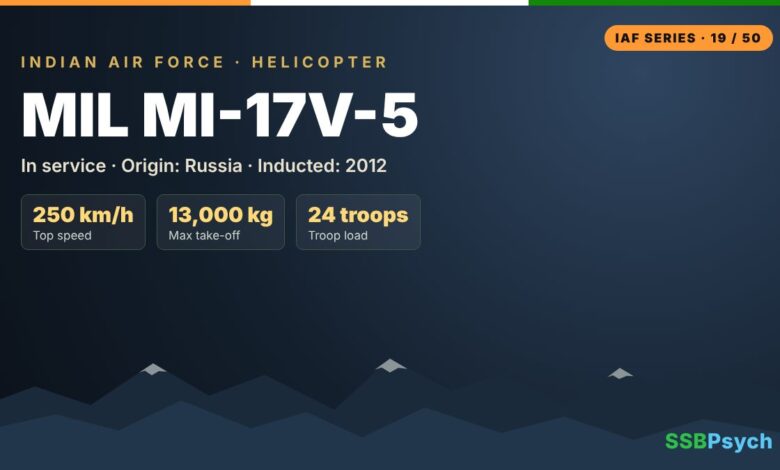
Mi-17V-5 Helicopter in Indian Air Force: Specs, Role, Rescues
When a flood traps families on rooftops, when an earthquake cuts off a mountain village, or when soldiers need supplies on a snowy post, one helicopter usually arrives first: the Mi-17V-5. This tough Russian-built machine is the Indian Air Force’s workhorse helicopter. It carries troops, cargo, injured people and even firefighting water, and it has saved thousands of lives across India and beyond.
In this guide you will learn how the Mi-17 family came to the IAF, what makes the V-5 version special, its specifications in plain language, its role in wars and rescues, where and how its crews train, its strengths and weaknesses, and what will replace it in the future. A 10-question quiz at the end will help you revise for AFCAT, CDS and the SSB interview.

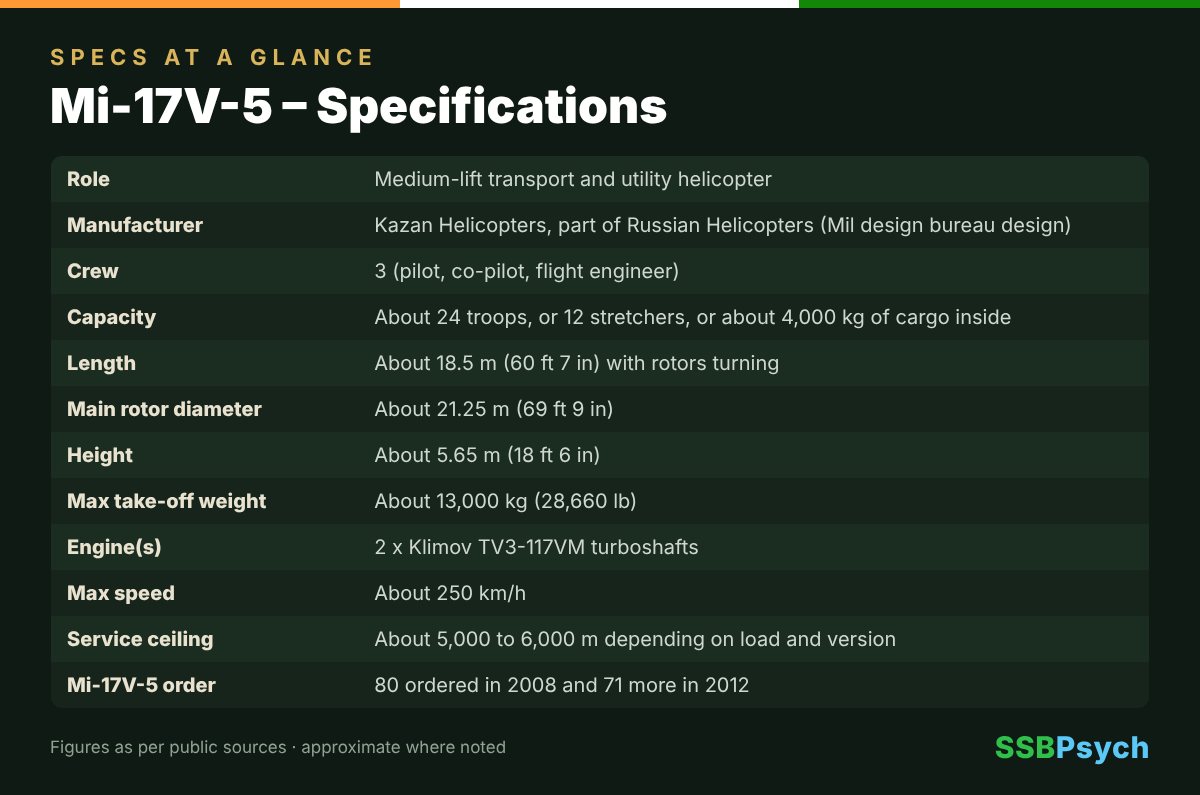
Mi-17V-5 Specifications
| Role | Medium-lift transport and utility helicopter |
| Manufacturer | Kazan Helicopters, part of Russian Helicopters (Mil design bureau design) |
| Crew | 3 (pilot, co-pilot, flight engineer) |
| Capacity | About 24 troops, or 12 stretchers, or about 4,000 kg of cargo inside |
| Length | About 18.5 m (60 ft 7 in) with rotors turning |
| Main rotor diameter | About 21.25 m (69 ft 9 in) |
| Height | About 5.65 m (18 ft 6 in) |
| Max take-off weight | About 13,000 kg (28,660 lb) |
| Engine(s) | 2 x Klimov TV3-117VM turboshafts |
| Max speed | About 250 km/h |
| Service ceiling | About 5,000 to 6,000 m depending on load and version |
| Mi-17V-5 order | 80 ordered in 2008 and 71 more in 2012 |
| Inducted in IAF | Mi-17V-5 from February 2012; older Mi-17s served well before 1999 |
| Number in IAF | 151 Mi-17V-5 delivered by February 2016, plus older Mi-17 versions |
Why India Needed the Mi-17V-5
India is a country of extremes. It has the high Himalayas, thick jungles in the Northeast, hot deserts in Rajasthan and a long coastline that faces cyclones. Roads are often blocked by snow, landslides or floods. In such places, a helicopter that can land almost anywhere is priceless.
The IAF first flew the older Mi-8 from the 1970s and then the more powerful Mi-17, which had already been in service well before the 1999 Kargil War. By the 2000s, the old Mi-8s needed replacing and the IAF wanted many more modern medium helicopters. The answer was the Mi-17V-5, a newer member of the same family with better engines, modern cockpit equipment and improved performance in hot and high conditions.
History of the Mi-17 Family in the IAF
In December 2008 India ordered 80 Mi-17V-5 helicopters, worth about US$1.375 billion, to replace ageing Mi-8s. In December 2012 a second contract for 71 more was signed. The first Mi-17V-5s entered IAF service in February 2012, and by February 2016 all 151 had been delivered. Together with the older Mi-17 versions, this makes the Mi-17 family the backbone of the IAF’s helicopter fleet.
The family has a proud record in war. During the 1999 Kargil War, armed IAF Mi-17s attacked intruders on high ridges in the early air phase of Operation Safed Sagar. One Mi-17 was shot down by an enemy shoulder-fired missile, and its crew lost their lives. After this, armed helicopters were pulled out of that area and fighter jets took over the attacks. The sacrifice of that crew is still remembered with great respect.
In peacetime, the Mi-17V-5 has become famous as a lifesaver. In June 2013, flash floods devastated Uttarakhand. Under Operation Rahat, IAF helicopters flew round the clock to rescue stranded pilgrims from Kedarnath and nearby valleys. Tragically, one Mi-17V-5 crashed during this operation with 20 IAF, ITBP and NDRF personnel on board, a reminder of how risky rescue flying in the mountains can be.
In 2015, after a massive earthquake struck Nepal, IAF Mi-17V-5s joined Operation Maitri, carrying relief material and rescuing people from remote areas. In 2018 they helped during the Kerala floods, lifting people off rooftops. More recently, IAF Mi-17s flew flood relief in 2025 and fought forest fires in Arunachal Pradesh and Nagaland in early 2026 using Bambi Buckets.
The fleet has also seen sad days. On 27 February 2019 a Mi-17 crashed at Budgam in Jammu and Kashmir, killing six on board and one person on the ground; it was later found to have been hit by India’s own air defence missile, and the IAF publicly accepted it as a mistake. On 8 December 2021, a Mi-17V-5 carrying Chief of Defence Staff General Bipin Rawat crashed near Coonoor in Tamil Nadu. General Rawat, his wife and others on board were killed. The lone survivor, Group Captain Varun Singh, later died of his injuries.
Engine and Performance Explained Simply
The Mi-17V-5 is powered by two Klimov TV3-117VM turboshaft engines. A turboshaft is a jet engine whose power turns a shaft instead of pushing out a jet of hot gas. That shaft, through a gearbox, spins the huge main rotor on top and the small tail rotor at the back. Having two engines means that if one fails, the helicopter still has power to land safely in many situations.
Its main rotor is about 21 metres across, roughly as wide as five cars parked end to end. Its top speed is about 250 km/h. That is slower than a bullet train, but nearly twice as fast as a Rajdhani Express, and of course it does not need tracks or roads.
The maximum take-off weight is about 13,000 kg, about as heavy as nine family cars. Of this, a good part can be useful load. Inside, it can carry about 24 soldiers with their gear, or 12 stretcher patients, or about 4,000 kg of cargo. It can also hang heavy loads below on a cargo hook, which is handy for lifting things like small vehicles, building material or water buckets.
Its service ceiling, the highest height at which it can still usefully climb, is about 5,000 to 6,000 metres depending on load and conditions. Thin air at height reduces both engine power and rotor lift, so in the Himalayas pilots must carefully calculate how much they can carry. That is why the V-5’s improved hot-and-high performance matters so much for India.
How a Helicopter Flies, in Simple Words
Each blade of the main rotor is shaped like a long, thin wing. As the rotor spins, the blades push air downwards and the helicopter is lifted upwards. By tilting the spinning rotor slightly, the pilot makes the helicopter move forward, backward or sideways. The small tail rotor stops the body from spinning in the opposite direction to the main rotor, and also lets the pilot turn the nose left or right. This is why a helicopter can hover in one spot, something no ordinary aeroplane can do.
What It Carries
- About 24 fully equipped troops or 12 stretchers for casualties
- Up to about 4,000 kg of cargo inside the cabin
- Heavy loads carried slung underneath on a cargo hook
- Bambi Bucket for scooping water to fight forest fires
- Unguided rocket pods on armed Mi-17s (used in the 1999 Kargil War)
- Reported plans to fit Spike missiles to some Mi-17V-5s
The Mi-17V-5 is mainly a transport helicopter, so its most important ‘payload’ is people and supplies. Armed versions of the Mi-17 carried rocket pods in Kargil, and reports have said the IAF plans to fit Spike missiles to some Mi-17V-5s, but its daily work is carrying troops, cargo and rescued civilians.
Mi-17V-5 Missions and Operations
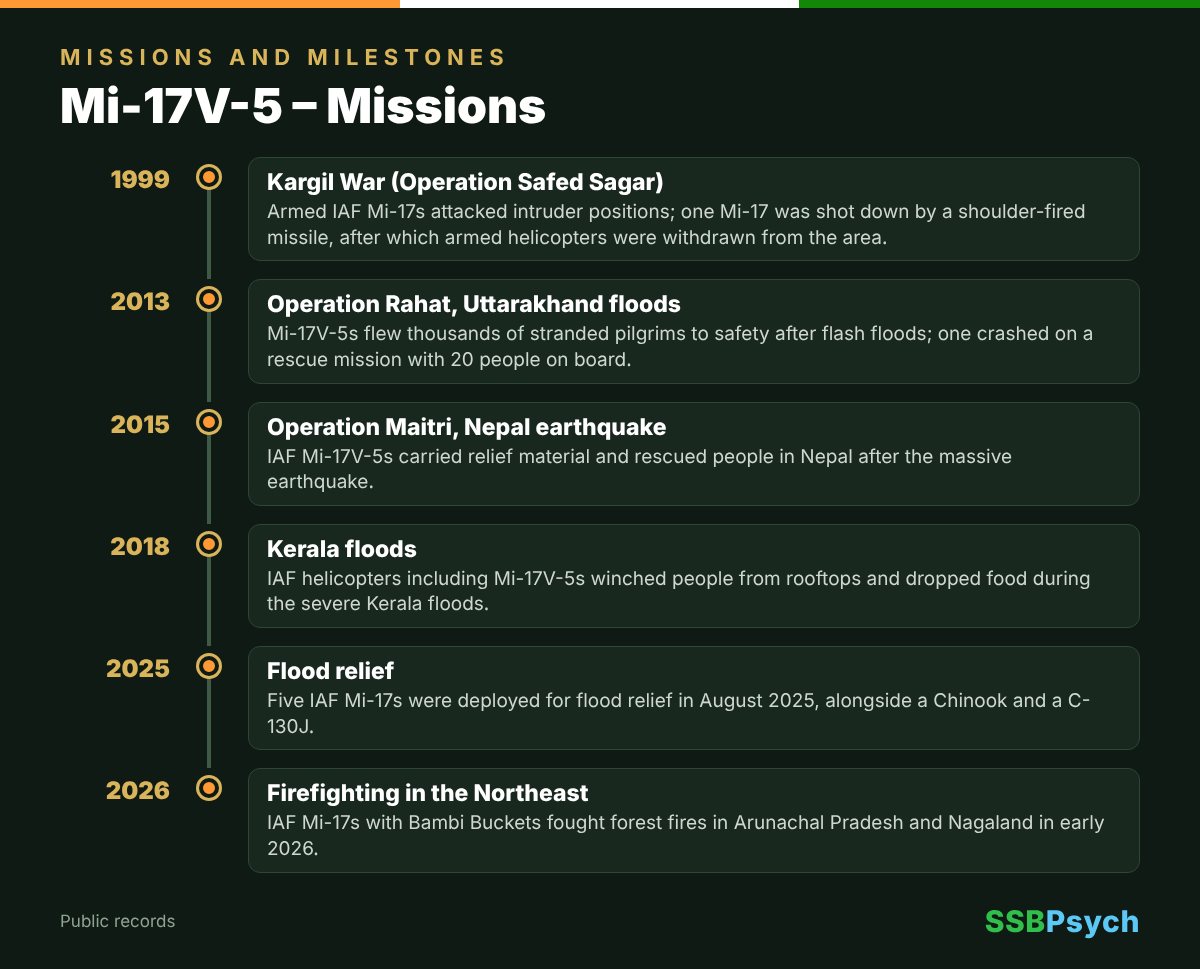
- 1999 – Kargil War (Operation Safed Sagar): Armed IAF Mi-17s attacked intruder positions; one Mi-17 was shot down by a shoulder-fired missile, after which armed helicopters were withdrawn from the area.
- 2013 – Operation Rahat, Uttarakhand floods: Mi-17V-5s flew thousands of stranded pilgrims to safety after flash floods; one crashed on a rescue mission with 20 people on board.
- 2015 – Operation Maitri, Nepal earthquake: IAF Mi-17V-5s carried relief material and rescued people in Nepal after the massive earthquake.
- 2018 – Kerala floods: IAF helicopters including Mi-17V-5s winched people from rooftops and dropped food during the severe Kerala floods.
- 2025 – Flood relief: Five IAF Mi-17s were deployed for flood relief in August 2025, alongside a Chinook and a C-130J.
- 2026 – Firefighting in the Northeast: IAF Mi-17s with Bambi Buckets fought forest fires in Arunachal Pradesh and Nagaland in early 2026.

How a Mi-17V-5 Rescue Mission Works
When a disaster strikes, the state government asks for help and the IAF moves helicopters to a nearby base or helipad. Crews first fly survey sorties to find people in trouble and safe places to land. Where landing is possible, the helicopter touches down for a few minutes, loads people and lifts off again. Where it is not, the crew hovers above a rooftop or ledge and uses a winch to lift people one by one.
Each sortie is planned around weather, fuel and how much the helicopter can lift at that height and temperature. In the mountains, clouds can close a valley within minutes, so pilots must decide quickly whether to press on or turn back. That mix of courage and judgement is what makes helicopter pilots so respected.
Where It Is Based and Who Flies It
Mi-17 family helicopters are spread across many IAF helicopter units, from the plains of the north to the mountains of Jammu and Kashmir, Ladakh and the Northeast, so that help is never too far away. Exact unit locations change over time, so we will stick to the general picture.
A helicopter unit is usually commanded by a Wing Commander. Under him or her are Squadron Leaders as flight commanders and younger Flight Lieutenants and Flying Officers. Each crew normally has a pilot, a co-pilot and a flight engineer, and on rescue missions they may be joined by winch operators and medical staff.
Officers chosen for the helicopter stream first complete basic flying training at the Air Force Academy, Dundigal. They then learn to fly helicopters at the Helicopter Training School in Hakimpet, before converting to the Mi-17 in an operational unit. Becoming a captain who can fly in the high Himalayas or at night takes several years and hundreds of flying hours.
Strengths and Limitations of the Mi-17V-5
- Strength: Very rugged and reliable in harsh weather and rough landing zones.
- Strength: Large cabin with a rear ramp for quick loading of troops and cargo.
- Strength: Twin engines give extra safety and better hot-and-high performance than older versions.
- Strength: Huge fleet size, so it is available almost everywhere in India.
- Limitation: Load drops sharply at very high altitudes, as with all helicopters.
- Limitation: Spares and support depend on Russia, which can be affected by global events.
- Limitation: Slower and shorter-ranged than fixed-wing transport aircraft.
- Limitation: Not heavily armoured, so it is vulnerable to shoulder-fired missiles in combat zones.
Future of the Mi-17V-5 and Its Replacement
The Mi-17V-5 fleet is relatively young and should serve for many more years, especially in disaster relief and mountain logistics. For the long term, HAL is developing the Indian Multi Role Helicopter (IMRH), a medium-lift helicopter in the 13-tonne class that is meant to eventually replace the Mi-17 family in Indian service. If it succeeds, India will be able to build its own workhorse helicopters instead of importing them.
Until then, the Mi-17V-5 will continue to be the first helicopter many Indians see when disaster strikes.
Why the Mi-17V-5 Matters for SSB and AFCAT Aspirants
Disaster relief operations like Operation Rahat and Operation Maitri are common topics in AFCAT and CDS papers, and they make excellent examples in the SSB interview and group discussions. You can talk about how the armed forces help civilians in times of crisis, or about the risks crews take to save lives.
The Coonoor crash of 2021 and the Budgam incident of 2019 are also important current-affairs lessons on safety, training and air defence coordination. Speaking about them with respect and balance shows maturity, which is exactly what assessors look for.
Did You Know?
- India received 151 Mi-17V-5 helicopters between 2012 and 2016.
- The Mi-17 is a more powerful development of the Mi-8, which the IAF flew earlier.
- Operation Rahat in 2013 was one of the largest helicopter rescue efforts in India’s history.
- A Mi-17 was lost to a shoulder-fired missile in the 1999 Kargil War.
- Mi-17s can carry a Bambi Bucket to scoop up and drop water on forest fires.
- A Mi-17V-5 has a rear ramp so troops and cargo can be loaded quickly.
- IAF helicopter pilots learn rotary flying at the Helicopter Training School, Hakimpet.
Quiz: Test Your Knowledge of Mi-17V-5
Click an option to see if you are right. Your score updates live.
Mi-17V-5: Frequently Asked Questions
It carries troops, cargo and casualties, supports Army posts in the mountains and is widely used for rescue, disaster relief and firefighting.
India received 151 Mi-17V-5 helicopters between 2012 and 2016, in addition to older Mi-17 versions.
Its top speed is about 250 km/h, and it can carry around 24 troops or about 4,000 kg of cargo inside.
It is built in Russia by Kazan Helicopters, part of Russian Helicopters, based on a Mil design.
HAL is developing the Indian Multi Role Helicopter (IMRH), a 13-tonne class helicopter intended to eventually replace the Mi-17 family.
This is part 19 of 50 in SSBPsych’s Indian Air Force aircraft series – a new aircraft every evening at 6 PM.
Sources: en.wikipedia.org, en.wikipedia.org, en.wikipedia.org.
Preparing for NDA, CDS, AFCAT or your SSB? Join SSBPsych’s online and offline batches – explore our courses or call +91 8076540582.