Lt Manoj Kumar Pandey, PVC: Hero of Khalubar, Kargil War – Full Story (with Quiz)
At his Services Selection Board interview, a young candidate from Lucknow was asked why he wanted to join the Army. As widely recounted, he answered that he wanted to win the Param Vir Chakra. Some might have taken it as overconfidence. A few years later, on a frozen ridge in Kargil, Lieutenant Manoj Kumar Pandey of 1/11 Gorkha Rifles kept that promise in the hardest way possible, earning the award posthumously at just 24.
Manoj Pandey is one of the most loved heroes among defence aspirants, partly because his journey runs through the same steps you are taking now: Sainik School, the SSB, the NDA and a commission. This post covers his early life, his time at the academy, the background of the Batalik fighting, a detailed account of the battle for Khalubar, his citation in simple words, his legacy, the OLQs he displayed and a 10-question quiz.
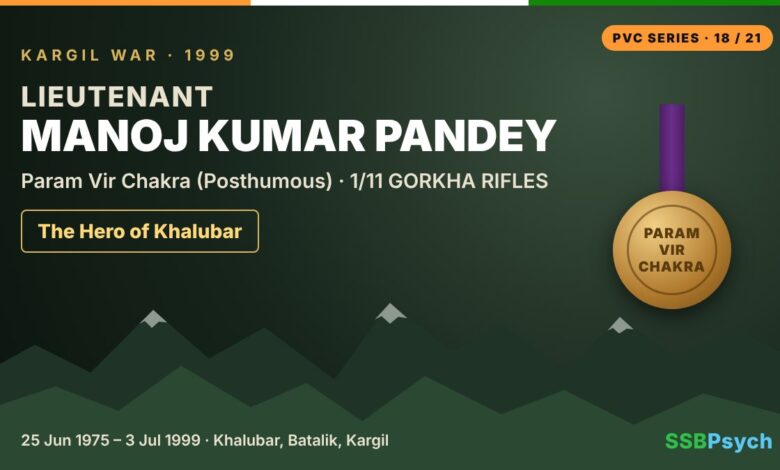
Lt Manoj Kumar Pandey – Quick Facts
| Full name | Manoj Kumar Pandey |
| Born | 25 June 1975, Rudha village, Sitapur district, Uttar Pradesh |
| Parents | Gopi Chand Pandey and Mohini Pandey |
| Schooling | Uttar Pradesh Sainik School, Lucknow |
| Training | National Defence Academy, Khadakwasla |
| Commissioned | 7 June 1997, 1st Battalion, 11 Gorkha Rifles (1/11 GR) |
| Operation | Operation Vijay (Kargil War), Batalik sector |
| Objective | Khalubar ridge |
| Date of action | Night of 2/3 July 1999 |
| Award | Param Vir Chakra (Posthumous) |
| Age at death | 24 years |
Early Life: A Boy From Sitapur
Manoj Kumar Pandey was born on 25 June 1975 in Rudha village in the Sitapur district of Uttar Pradesh. He was the eldest child of Gopi Chand Pandey, a small businessman who later settled in Lucknow, and his wife Mohini. Like many families in small-town Uttar Pradesh, his parents placed great value on education and discipline.
He studied at the Uttar Pradesh Sainik School in Lucknow and also attended Rani Laxmi Bai Memorial Senior Secondary School. He was keen on boxing and bodybuilding and was active in the NCC, where he was adjudged the best junior division cadet of the Uttar Pradesh directorate in 1990. Sainik School gave him the structure, sport and sense of purpose that pointed him firmly towards the armed forces.
NDA, Commission and the Gorkhas
Manoj cleared the NDA entrance and the SSB and joined the National Defence Academy, followed by the Indian Military Academy. He was commissioned on 7 June 1997 into the 1st Battalion of the 11th Gorkha Rifles (1/11 GR). Officers of Gorkha battalions often speak of the special bond with their men, who are known for their loyalty, toughness and battle cry, “Jai Mahakali, Ayo Gorkhali”.
His early service was demanding. The battalion completed a tenure on the Siachen Glacier, the world’s highest battlefield, where Manoj learned to operate in extreme cold and thin air. In his personal diary he wrote lines that have since become famous, including one that says some goals are so worthy that it is glorious even to fail in pursuing them.
The Background: Intrusion in Batalik
In May 1999 India discovered that Pakistani troops and irregulars had secretly crossed the Line of Control and occupied heights in the Kargil, Dras, Mushkoh and Batalik sectors of Ladakh. From these peaks they could fire on the Srinagar-Leh highway and threaten Indian positions. India launched Operation Vijay to throw them out.
1/11 GR, which had just finished its Siachen tenure and was preparing to move to a peace station, was instead sent to the Batalik sector. Under its Commanding Officer, Colonel Lalit Rai, the battalion was made responsible for clearing the enemy from features such as Jubar and Khalubar. The enemy held strong bunkers on ridges with commanding views, and every attack had to be made uphill, mostly at night, over rock, snow and scree.
Manoj took part in a series of attacks in the sector, including the operation that captured Jubar Top. Each success brought the battalion closer to Khalubar, one of the key enemy strongholds in Batalik.
The Battle of Khalubar, 2/3 July 1999
Racing Against Daylight
In early July, the battalion’s advance towards Khalubar was being held up by enemy soldiers entrenched on the heights. If the troops were still on the exposed slopes when the sun rose, they would be easy targets. Manoj’s platoon from B Company was given the task of clearing the enemy positions that were blocking the way. The only approach was a narrow, dangerous ridge.
Charging Ahead
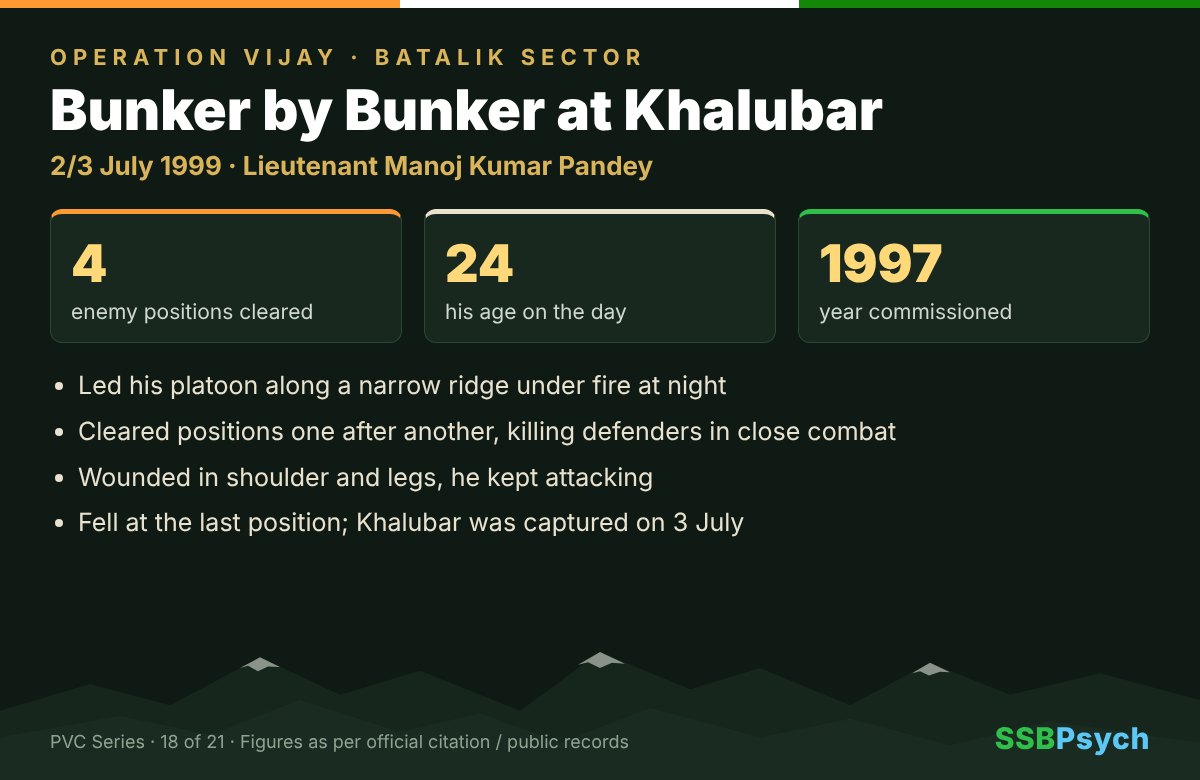
On the night of 2/3 July 1999, Manoj led his men along that ridge. As they came close to the objective, heavy fire from enemy positions stopped the attack. Instead of waiting for the fire to ease, he organised his men to deal with the positions in front of them and himself went after the enemy positions on the left. He rushed the first position and killed two enemy soldiers, then moved to the second and killed two more.
While attacking the third position he was hit in the shoulder and legs. Badly wounded, he refused to stop. Shouting encouragement to his Gorkhas, he pushed on to the next position and destroyed it with a grenade. As he did so, a burst of machine-gun fire struck him in the head. As widely recounted, his final words to his men were “Na Chhodnu”, Nepali for “don’t leave them”, urging his soldiers to finish the job.
Khalubar Falls
Inspired by their young officer, the Gorkhas overran the remaining positions. His action gave the attacking companies a firm base, and Khalubar was captured in the early hours of 3 July 1999. The capture was an important step in clearing the Batalik sector. Manoj Pandey had kept his word, but he did not live to see the dawn.
If death strikes before I prove my blood, I promise, I will kill death.
– A line widely attributed to Manoj Pandey’s diary
The Param Vir Chakra Citation (In Simple Words)
His citation records that on the night of 2/3 July 1999, during Operation Vijay in the Batalik sector, the battalion’s advance was stalled by a determined enemy holding commanding heights, and the troops risked being caught in the open at daybreak. Lieutenant Manoj Kumar Pandey volunteered to clear the opposition and led his platoon along a narrow and dangerous ridge. When enemy fire stopped the attack, he charged ahead, cleared the first position and killed enemy soldiers in hand-to-hand combat. Wounded in the shoulder and leg, he continued moving from bunker to bunker, urging his men on, until he fell grievously wounded at the last position after it had been cleared. The citation honours his most conspicuous bravery, leadership and supreme sacrifice with a posthumous Param Vir Chakra. His father received the award from the President at the Republic Day Parade on 26 January 2000.
Legacy of the Hero of Khalubar
Manoj Pandey’s name now lives on in many places that aspirants pass through. His old school in Lucknow was renamed Captain Manoj Kumar Pandey Uttar Pradesh Sainik School. At the NDA, a building is named the Manoj Pandey Block, and the SSB centre at Allahabad (Prayagraj) also has a block named after him. Many people refer to him as Captain, a rank by which he is widely remembered.
- Statue at the Param Yodha Sthal, National War Memorial, New Delhi
- Pandey Island: one of 21 Andaman and Nicobar islands named after PVC awardees in January 2023
- A gallery in the Kargil War Memorial museum at Dras
- Roads, chowks and housing complexes named after him in Lucknow, Sitapur and elsewhere
- Portrayed by Ajay Devgn in the 2003 film LOC Kargil
His life also inspires through its simplicity. He did not come from a powerful family. He studied hard, played hard, stated his ambition honestly at the SSB, and then backed his words with action. For Gorkha soldiers, he remains the young sahib who never asked them to go where he himself would not go first.
What Aspirants Can Learn From His Journey
Manoj Pandey’s story is not only about one night of extraordinary bravery. It is also about the years of preparation that made that night possible. Several patterns stand out for anyone preparing for the NDA, CDS or SSB today.
- He prepared early. Sainik School, NCC and sport built his fitness, discipline and confidence long before the SSB.
- He knew his why. His answer at the interview was bold, but it was sincere, and assessors value honesty and clarity of motivation.
- He wrote down his goals. His diary entries show a young man who thought deeply about duty and the kind of life he wanted to live.
- He led from the front. In the attack, he took on the most dangerous positions himself instead of only giving orders.
None of these habits needs a battlefield. You can practise them now: keep a simple diary of goals and progress, stay fit, take responsibility in group activities at college, and be ready to explain clearly why you want to wear the uniform. The SSB does not look for ready-made heroes. It looks for young people whose character shows the potential that Manoj Pandey turned into reality.
Lessons for SSB Aspirants: OLQs in Action
The SSB does not test whether you can recite history – it looks for the qualities of an officer. Here is how Lt Manoj Kumar Pandey showed them:
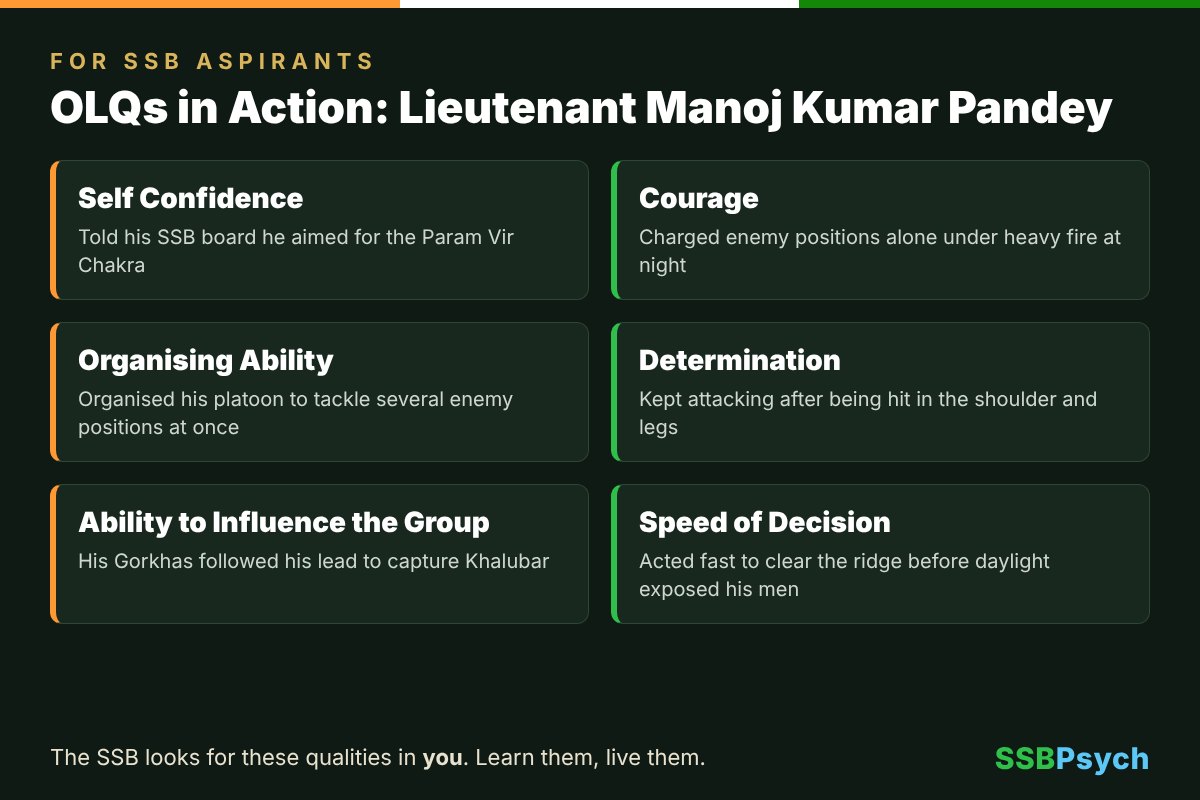
- Self Confidence – Told his SSB board he aimed for the Param Vir Chakra
- Courage – Charged enemy positions alone under heavy fire at night
- Organising Ability – Organised his platoon to tackle several enemy positions at once
- Determination – Kept attacking after being hit in the shoulder and legs
- Ability to Influence the Group – His Gorkhas followed his lead to capture Khalubar
- Speed of Decision – Acted fast to clear the ridge before daylight exposed his men
Tip for your SSB interview: Like Manoj Pandey, answer “Why the Army?” honestly and with conviction, but be ready to back your words with real examples of effort from your own life.
Practice Corner: WAT and SRT
Write your first spontaneous response to these before you scroll to the quiz. Keep WAT sentences short, positive and action-oriented.
WAT Words
- Diary
- Gorkha
- Ridge
- Promise
- Dawn
SRTs
- He is leading a team that must finish a task before sunrise, but progress is blocked. He…
- He is injured midway through an important inter-college competition. He…
- His friends laugh when he shares his ambition to become an officer. He…
Quiz: How Well Do You Know Lt Manoj Kumar Pandey?
Test yourself! Click an option to see if you are right. Your score updates live.
Frequently Asked Questions
Why is Manoj Kumar Pandey called the Hero of Khalubar?
Because his assault on the night of 2/3 July 1999 cleared the enemy positions that blocked his battalion, leading to the capture of Khalubar in the Batalik sector.
Did Manoj Pandey really say he wanted the Param Vir Chakra at his SSB?
Yes, this is widely recounted. When asked why he wanted to join the Army, he replied that he wanted to win the Param Vir Chakra, which he later received posthumously.
Was he a Lieutenant or a Captain?
His Param Vir Chakra citation names him as Lieutenant. He is also widely remembered as Captain Manoj Kumar Pandey, and his old school carries that title.
What does “Na Chhodnu” mean?
It is Nepali for “don’t leave them”, the words he is widely reported to have shouted to his Gorkha soldiers as he fell.
Which film shows his story?
Ajay Devgn played him in the 2003 Hindi film LOC Kargil.
The Param Vir Chakra Series on SSBPsych
This is part 18 of 21 in our series on every Param Vir Chakra awardee. A new hero goes live every morning at 7:30 AM. Also read the story of Captain Vikram Batra, PVC – the Sher Shah of Kargil.
Sources: en.wikipedia.org, bharat-rakshak.com, thehitavada.com.
Preparing for your SSB? Join SSBPsych’s online and offline SSB batches and learn how to show your OLQs with confidence – explore our courses or call +91 8076540582.