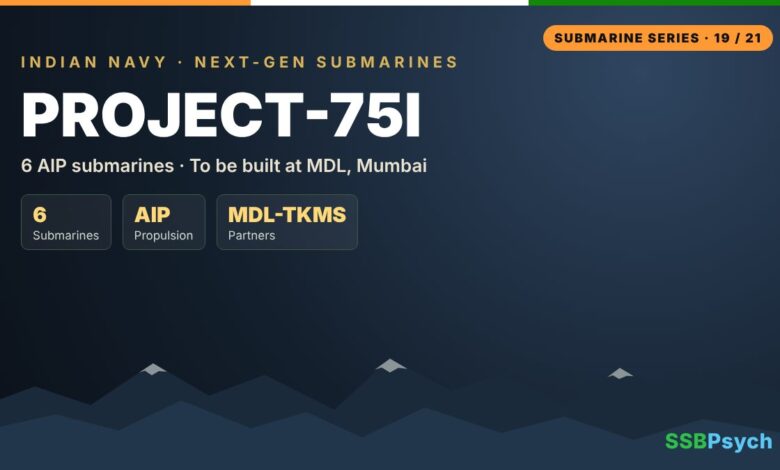
Project-75I submarine: India’s Next AIP Boats Explained
A submarine is only truly dangerous while it stays hidden. The problem for diesel-electric boats is that they must come up close to the surface every few days to breathe air for their engines, and that is exactly when they are most likely to be spotted. The Project-75I submarine programme is India’s answer: six new conventional submarines fitted with air-independent propulsion (AIP), so they can stay submerged much longer.
In this explainer we break down what Project-75I is, how AIP works in plain words, why the Indian Navy needs these boats, who is expected to build them, what has been reported about the cost, the long timeline of the deal and the dangers and daily life submariners can expect. Some details are still not public, and we say so clearly where that is the case.

What Is the Project-75I Submarine Programme?
In 1999 India approved a 30-year submarine building plan. It had two production lines. The first, Project-75, produced six Scorpene-based submarines of the Kalvari class at Mazagon Dock Shipbuilders (MDL), Mumbai. The second line was named Project-75 (India), or P-75I, for six more advanced submarines with AIP and stronger weapons.
The letter ‘I’ stands for India. The idea is that a foreign submarine designer partners with an Indian shipyard, shares technology, and the boats are built in India with a large share of Indian-made parts. This follows the government’s Strategic Partnership model, meant to build long-term defence manufacturing skills at home.
What Is AIP? Air-Independent Propulsion Made Simple
Think of a normal diesel-electric submarine like a mobile phone. It runs on batteries underwater, and when the battery gets low it must ‘plug in’. For a submarine, plugging in means rising to periscope depth and raising a snorkel pipe to suck in air so its diesel generators can recharge the batteries. A raised snorkel and the noise of diesels can give the boat away to enemy radar, aircraft and sonar.
AIP is like carrying a power bank that does not need outside air. It produces electricity underwater using oxygen carried on board. The boat can then crawl along quietly for far longer before it needs to snorkel. Nuclear submarines can stay down almost indefinitely, but AIP gives a conventional boat a big part of that stealth at a much lower cost.
Types of AIP
- Fuel cells: hydrogen and oxygen combine to produce electricity, with water as the by-product. Germany’s Type 214 family uses this kind of system.
- Stirling engines: a heat engine that burns fuel with stored liquid oxygen, used on some Swedish and Japanese boats.
- Closed-cycle steam (MESMA): a French system that burns fuel with oxygen to make steam.
- India’s own AIP: DRDO has developed a phosphoric acid fuel cell AIP that generates hydrogen on board. It has been reported for fitting on Kalvari class boats during refits.
Why India Needs the Project-75I Submarine Fleet
India’s submarine fleet has been under pressure for years. Several boats from the Sindhughosh (Kilo) and Shishumar classes are more than 30 years old. New submarines take close to a decade from contract to commissioning, so delays add up quickly.
- Ageing fleet: older boats need long refits and will retire over the coming years.
- China’s growing navy: Chinese submarines and survey ships are now regularly reported in the Indian Ocean.
- Pakistan’s new boats: Pakistan is acquiring Chinese-designed submarines reported to have AIP.
- Long coastline and island territories: India must guard over 7,500 km of coast, the Andaman and Nicobar Islands and Lakshadweep, plus vital sea lanes.
- Self-reliance: building advanced boats at home creates jobs, skills and a supply chain for future designs.
An AIP submarine sitting silently near a chokepoint or an enemy harbour is a nightmare for any opponent. It forces them to spend huge effort searching for it. This is called sea denial, and it is one of the main reasons navies invest in submarines.
Project-75I submarine Timeline
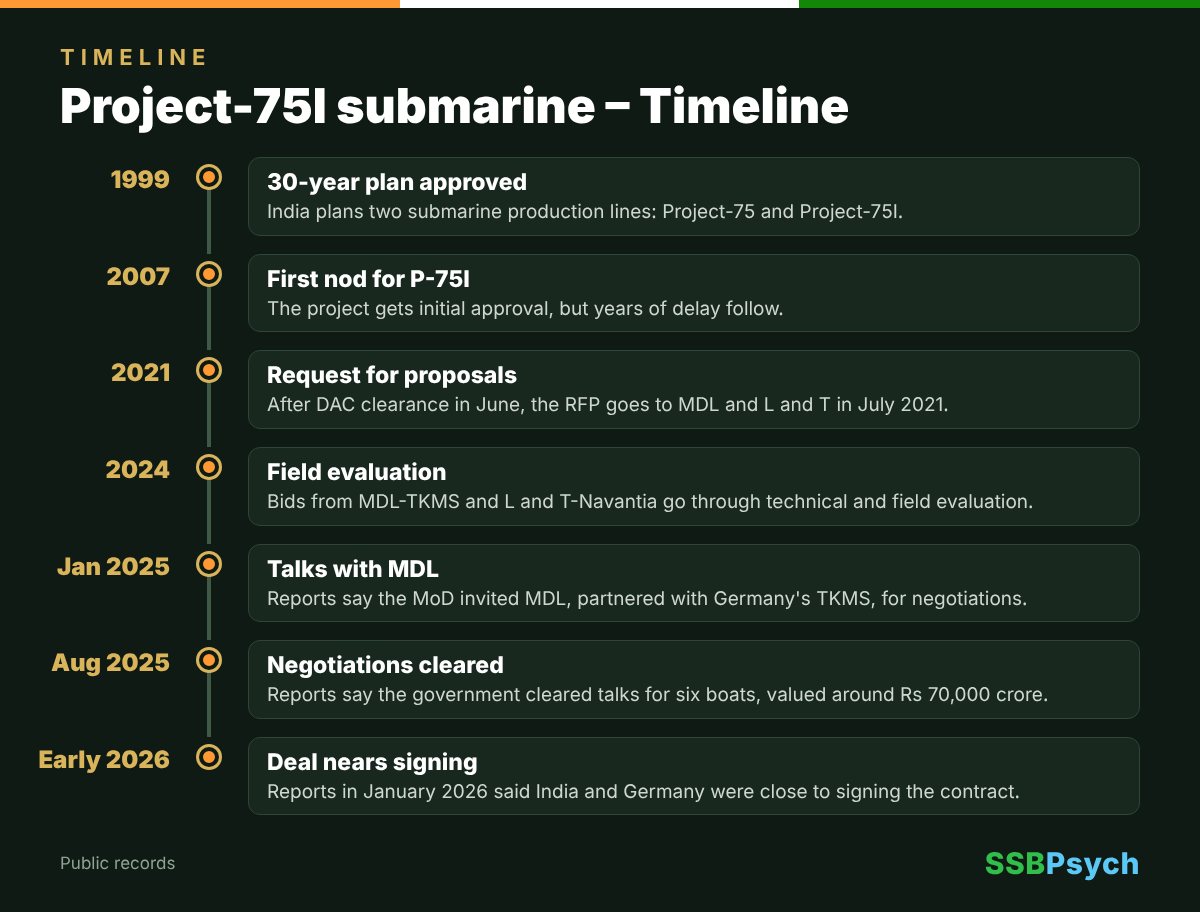
- 1999 – 30-year plan approved: India plans two submarine production lines: Project-75 and Project-75I.
- 2007 – First nod for P-75I: The project gets initial approval, but years of delay follow.
- 2021 – Request for proposals: After DAC clearance in June, the RFP goes to MDL and L and T in July 2021.
- 2024 – Field evaluation: Bids from MDL-TKMS and L and T-Navantia go through technical and field evaluation.
- Jan 2025 – Talks with MDL: Reports say the MoD invited MDL, partnered with Germany’s TKMS, for negotiations.
- Aug 2025 – Negotiations cleared: Reports say the government cleared talks for six boats, valued around Rs 70,000 crore.
- Early 2026 – Deal nears signing: Reports in January 2026 said India and Germany were close to signing the contract.
Who Will Build the Boats?
The request for proposals, issued in July 2021, went to two Indian shipyards: Mazagon Dock Shipbuilders (MDL) and Larsen and Toubro (L and T). Each tied up with a foreign designer. MDL partnered with Germany’s thyssenkrupp Marine Systems (TKMS), offering a larger variant of the Type 214 design. L and T partnered with Spain’s Navantia, offering a version of the S-80 class.
After evaluation, reports in 2025 said the MDL-TKMS offer had been chosen for negotiations. By early 2026, reports said India and Germany were close to finalising the contract. When the deal is signed it will be announced officially by the Ministry of Defence, so readers should check PIB or the Navy’s website for the latest confirmed status. The boats are expected to be built at MDL in Mumbai, the same yard that built the Kalvari class.
Size, Crew and Weapons: What We Know
Final specifications have not been officially released. Reports describe the offered design as an enlarged Type 214, which means bigger than India’s Kalvari class. A bigger hull gives room for the AIP section, more weapons and better living space.
Requirements reported in the media include AIP for long submerged endurance, heavyweight torpedoes, anti-ship missiles and the ability to strike land targets with cruise missiles. The exact crew size, diving depth, speed and weapon load have not been made public. Diving depth figures in particular are usually kept secret by every navy, because they tell an enemy how deep a submarine can hide.
Who commands such a submarine?
Like other Indian submarines, a P-75I boat would be commanded by a senior officer, typically of Commander rank, with a small team of officers in charge of engineering, weapons, electrical systems and navigation, supported by experienced sailors.

How Much Will Project-75I Cost?
Cost figures have changed over the years and are only reported, not officially final:
- In 2021, when the Defence Acquisition Council cleared the RFP, the project was reported at about Rs 43,000 crore.
- In August 2025, reports put the deal at around Rs 70,000 crore for six submarines.
- In January 2026, reports described the contract as worth about 8 billion US dollars.
The final value will be known only when the contract is signed and announced. The rise reflects inflation over the years, the larger design, AIP systems, weapons, technology transfer and long-term support.
What drives running costs?
Running costs for these boats have not been reported. In general, a submarine’s lifetime cost is driven by fuel and AIP consumables such as hydrogen and liquid oxygen, large battery banks, regular refits in dry dock, spare parts and support from the original designer, expensive torpedoes and missiles, and the training of specialised crews. Over a 30-year life, these costs can add up to more than the purchase price.
Dangers and Life on Board
Even the most modern submarine is a sealed steel tube under enormous water pressure. Fire, flooding and toxic gases remain the biggest risks. AIP systems add new safety work, because they store oxygen and hydrogen-based fuel, which must be handled with great care. Crews train constantly with damage-control and escape drills.
Life on board will likely be a little more comfortable than on older boats, thanks to modern design, but space will still be tight. Long AIP patrols mean the crew could stay submerged for a longer stretch, with no daylight, limited fresh water and strict silence. Submariners must be mentally tough, patient and good at teamwork, qualities that SSB boards specifically look for.
Why Did the Deal Take So Long?
P-75I first received approval in 2007, yet the request for proposals went out only in 2021. Several reasons have been reported over the years. The rules for choosing an Indian partner and a foreign designer changed more than once. Requirements were revised as technology moved on. Some foreign designers pulled out because they could not meet conditions such as a sea-proven AIP system. Field trials, technical evaluation and price negotiations each take many months on a deal of this size.
Meanwhile, the Navy kept older boats running through refits, and Project-75 delivered its six Kalvari class submarines, the last of which, INS Vagsheer, was commissioned in January 2025. Defence experts often point out that every year of delay in a submarine programme is a year in which the fleet gets older.
How an AIP Patrol Changes the Game
Imagine a submarine ordered to watch a busy shipping lane far from home. A regular diesel-electric boat would have to come up to snorkel every couple of days, each time risking detection by a patrol aircraft. An AIP boat can switch to its fuel cells, slow down to a quiet crawl, and stay deep for a much longer stretch, coming up only when needed. For the enemy, the search area grows and the chances of catching the boat near the surface shrink.
AIP is usually used at low speed. When the submarine has to sprint, for example to chase a target or escape a threat, it still uses its batteries, which drain quickly. So AIP is best thought of as a stealth tool for long, quiet patrols, not a way to go faster.
How P-75I Fits Into India’s Submarine Plans
India’s underwater fleet is built on three pillars. Conventional submarines such as the Kalvari class and the future P-75I boats handle patrol, sea denial and attack missions closer to home. Nuclear-powered attack submarines, planned under a separate programme, are meant for long-range hunting across the ocean. Nuclear ballistic missile submarines of the Arihant class carry India’s sea-based nuclear deterrent. P-75I sits in the first pillar, but with AIP it brings conventional boats a step closer to the endurance of nuclear ones at a far lower cost.
Project-75I Submarine: Key Points for Aspirants
- P-75I is the second line of India’s 30-year submarine plan approved in 1999.
- It aims for six conventional submarines with air-independent propulsion.
- The main contenders were MDL-TKMS (Germany) and L and T-Navantia (Spain).
- Reports in 2025 and 2026 said MDL-TKMS was selected for negotiations.
- The boats are to be built in India under the Strategic Partnership model.
Did You Know?
- A fuel cell AIP produces pure water as its waste product.
- AIP boats are among the quietest machines at sea, because fuel cells have almost no moving parts.
- India’s 1999 submarine plan is widely reported to have aimed for 24 new submarines over 30 years.
- DRDO’s Naval Materials Research Laboratory developed India’s own fuel cell AIP technology.
- Even with AIP, a conventional submarine still uses batteries and diesels for high-speed runs.
Quiz: Test Your Knowledge of Project-75I submarine
Click an option to see if you are right. Your score updates live.
Project-75I submarine: Frequently Asked Questions
It is the Indian Navy’s plan to build six conventional submarines with air-independent propulsion in India, in partnership with a foreign designer.
Reports in 2025 and 2026 said Mazagon Dock Shipbuilders, partnered with Germany’s TKMS, was chosen for negotiations. The final contract is confirmed only through an official Ministry of Defence announcement.
Reported figures have risen from about Rs 43,000 crore in 2021 to around Rs 70,000 crore in 2025 and about 8 billion US dollars in early 2026 reports. The final contract value is announced on signing.
AIP lets a conventional submarine stay submerged much longer without surfacing to snorkel, making it far harder for enemies to detect.
Project-75 built six Scorpene-based Kalvari class boats. P-75I aims for six larger, more advanced boats with AIP and stronger weapons.
This is part 19 of 21 in SSBPsych’s submarine series – a new post every morning at 10 AM.
Sources: en.wikipedia.org, en.wikipedia.org, en.wikipedia.org, pib.gov.in.
Preparing for NDA, CDS, AFCAT or your SSB? Join SSBPsych’s online and offline batches – explore our courses or call +91 8076540582.