Jammu and Kashmir Light Infantry: History, Motto and Heroes
Most regiments of the Indian Army were raised by kings or by the British. The Jammu and Kashmir Light Infantry was raised by its own people. In 1947, when raiders swept into Jammu and Kashmir, ordinary villagers, students and shopkeepers picked up whatever weapons they could find and stood beside the Army to defend their homes. From those volunteer bands grew a regiment that today holds a Param Vir Chakra won on the highest battlefield in the world.
In this guide for NDA, CDS, AFCAT and SSB aspirants, you will learn how JAK LI was born, see a simple timeline, read about its operations and battle honours, understand its motto and war cry, meet its greatest heroes, see what life in the regiment is like, and find interview questions and a quiz to test yourself.
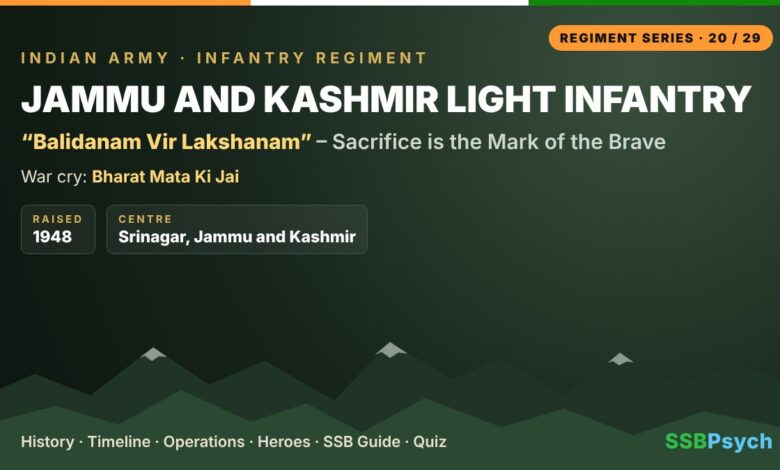
Jammu and Kashmir Light Infantry – Quick Facts
| Origins | Local volunteer groups who fought the 1947-48 invasion |
| Raised | 15 April 1948, as the Jammu and Kashmir Militia |
| Regular regiment | 1972, under the Ministry of Defence |
| Present name | Jammu and Kashmir Light Infantry (JAK LI), since 1976 |
| Regimental Centre | Rangreth, Srinagar, Jammu and Kashmir |
| Motto | Balidanam Vir Lakshanam (Sacrifice is the Mark of the Brave) |
| War Cry | Bharat Mata Ki Jai (Victory to Mother India) |
| Recruitment | Local youth from across Jammu, Kashmir and Ladakh |
| Battalions | Over 15 regular battalions, plus Territorial Army units |
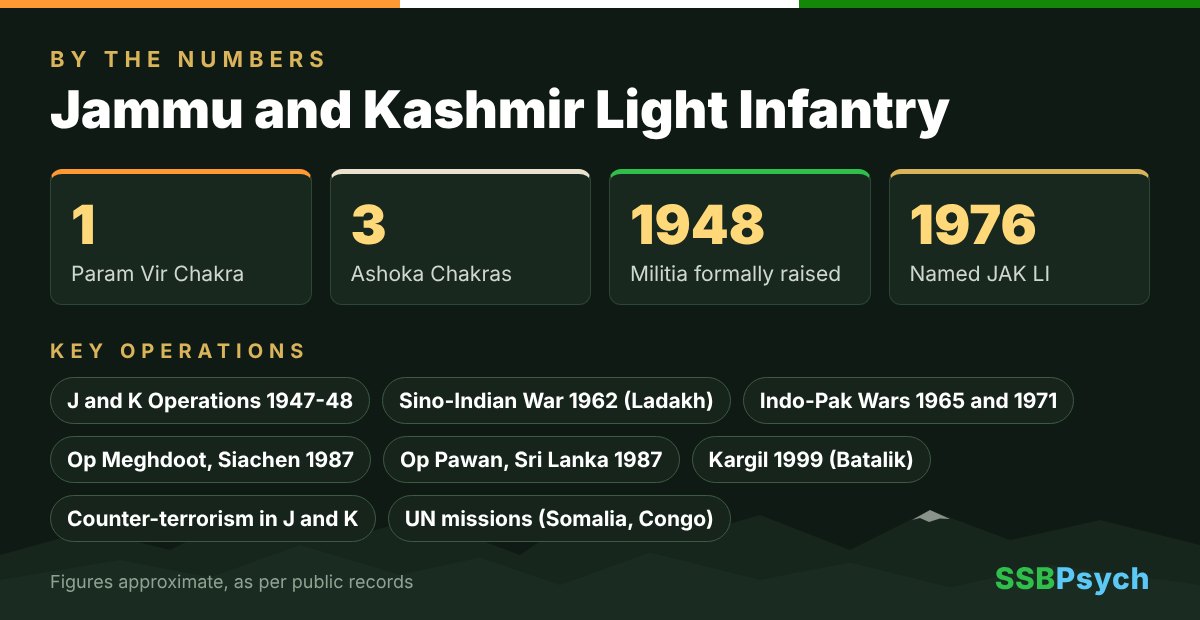
| Notable gallantry | 1 Param Vir Chakra, 3 Ashoka Chakras |
| Famous son | Hony Capt Bana Singh, PVC, hero of Siachen 1987 |
History of the Jammu and Kashmir Light Infantry
In October 1947 Pakistan sent tribal raiders and soldiers into Jammu and Kashmir. While Indian Army units were being rushed in, local people across the state formed their own defence groups. In the Kashmir Valley there were the National Home Guards. In Ladakh there were the Leh Scouts and the Nubra Guards. In the Jammu region and around Poonch and Naushera, groups such as the Border Defence Scouts and Poonch Scouts took shape. They knew every path and ridge, and they fought with great courage.
On 15 April 1948 these scattered volunteer bodies were organised into regular battalions of the Jammu and Kashmir Militia, with Indian Army officers posted to lead them. Their headquarters was at Haft Chinar in Srinagar. This date is still celebrated as the regiment’s raising day. For many years the militia worked as a paramilitary force, guarding the Line of Control and the mountain passes of the state.
From Militia to Regular Regiment
The militia’s performance in battle steadily earned it greater status. In 1963 two of its battalions were converted to form the Ladakh Scouts, which today is a separate regiment known for high-altitude warfare. In 1972 the militia became a full regiment of the Indian Army under the Ministry of Defence, and in 1976 it was renamed the Jammu and Kashmir Light Infantry. The regimental centre moved in 1993 from Haft Chinar to its present home at Damodar Karewa, Rangreth, on the edge of Srinagar.
What makes JAK LI unique is its recruitment. Its soldiers come from all parts of Jammu and Kashmir and Ladakh and from all of its communities. They know the land, the languages and the people, and this local knowledge has proved invaluable in both war and counter-terrorism. The regiment is a living example of the people of the region choosing to defend India.
This journey from volunteers to regulars took almost three decades. Through all those years the militia soldiers did the same dangerous work as regular troops, often with older weapons and fewer comforts. Their patience and steady performance are why the regiment today treats 1947-48 not just as history but as a source of pride and identity.
Jammu and Kashmir Light Infantry Timeline: From Raising to Today
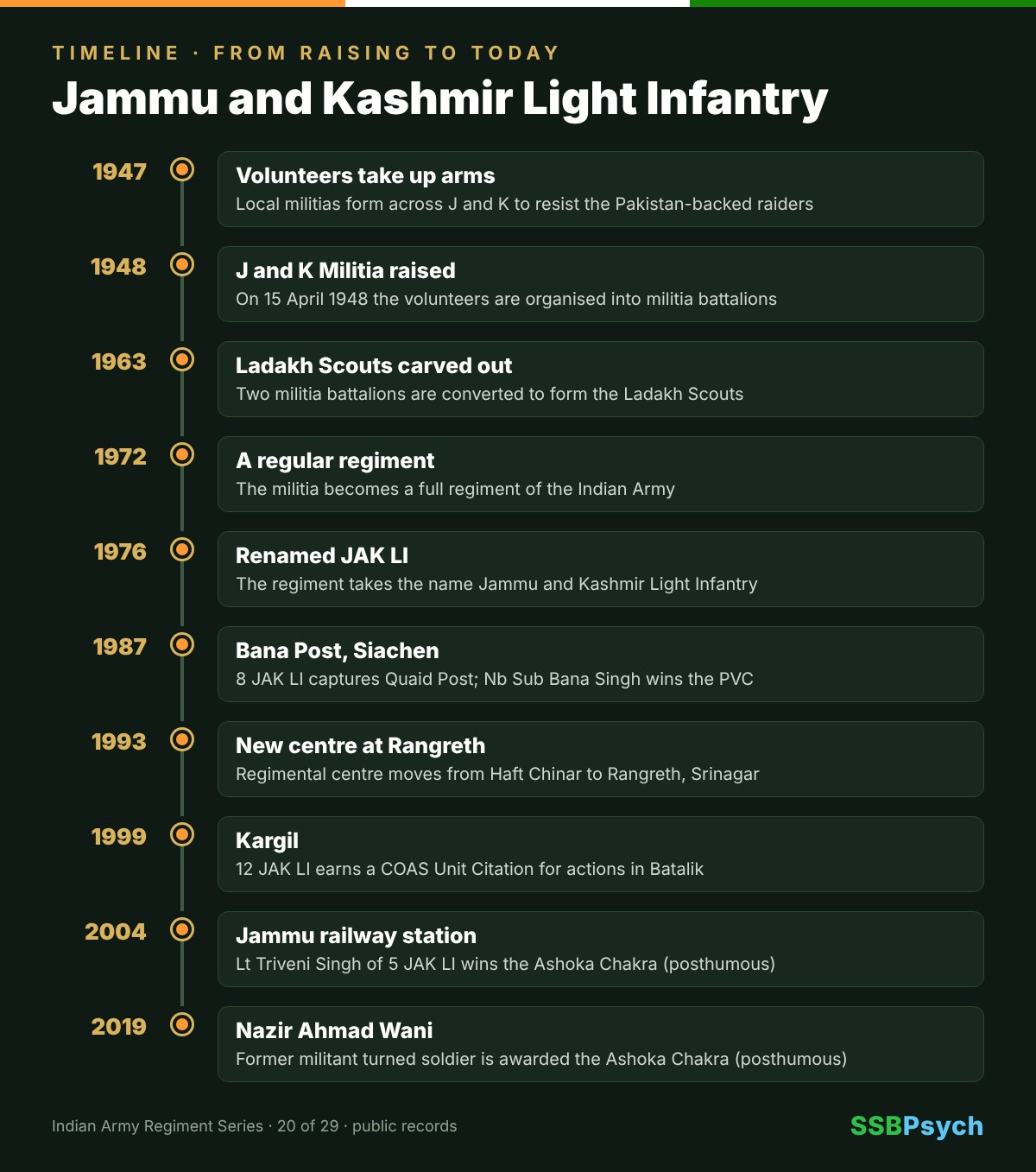
- 1947 – Volunteers take up arms: Local militias form across J and K to resist the Pakistan-backed raiders
- 1948 – J and K Militia raised: On 15 April 1948 the volunteers are organised into militia battalions
- 1963 – Ladakh Scouts carved out: Two militia battalions are converted to form the Ladakh Scouts
- 1972 – A regular regiment: The militia becomes a full regiment of the Indian Army
- 1976 – Renamed JAK LI: The regiment takes the name Jammu and Kashmir Light Infantry
- 1987 – Bana Post, Siachen: 8 JAK LI captures Quaid Post; Nb Sub Bana Singh wins the PVC
- 1993 – New centre at Rangreth: Regimental centre moves from Haft Chinar to Rangreth, Srinagar
- 1999 – Kargil: 12 JAK LI earns a COAS Unit Citation for actions in Batalik
- 2004 – Jammu railway station: Lt Triveni Singh of 5 JAK LI wins the Ashoka Chakra (posthumous)
- 2019 – Nazir Ahmad Wani: Former militant turned soldier is awarded the Ashoka Chakra (posthumous)
Major Operations and Battle Honours of JAK LI
1947-48 and 1962
In the first Kashmir war the volunteer battalions fought alongside Indian Army brigades at Srinagar, in the Poonch sector, around Chhamb and in the defence of Leh. In 1962 two militia battalions served in Ladakh during the war with China, facing the Chinese offensive in very harsh conditions.
1965 and 1971
In the wars with Pakistan the militia battalions again proved their worth in the mountains of Jammu and Kashmir. The regiment’s battle honours include Laleali, Picquet 707, Shingo River Valley and Gutrian, all won in the hard fighting of these wars. Several battalions also carry the theatre honour Jammu and Kashmir 1971.
1987: Siachen and Bana Post
The most famous action in JAK LI history took place on the Siachen Glacier. Pakistan had set up a post, called Quaid Post, at a height of about 21,000 feet that overlooked Indian positions. Earlier attempts to capture it had failed, and a young officer, Second Lieutenant Rajiv Pande, was among those killed. The next attack was named Operation Rajiv in his honour.
In June 1987 a small team from 8 JAK LI led by Naib Subedar Bana Singh climbed a sheer ice wall in a blizzard, crawled up to the enemy bunkers and cleared them with grenades and bayonets. The post was captured and renamed Bana Post. Bana Singh was awarded the Param Vir Chakra, the regiment’s first and only PVC so far. The same year 1 and 11 JAK LI served in Sri Lanka with the Indian Peace Keeping Force under Operation Pawan.
To understand how hard this was, remember what Siachen means. At over 20,000 feet the air holds far less oxygen, temperatures fall well below minus 30 degrees Celsius, and frostbite and avalanches can kill as surely as enemy fire. Every movement is slow and exhausting. Fighting and winning a close-quarter battle in such conditions required extraordinary fitness, willpower and leadership from every man in Bana Singh’s team.
1999: Kargil
In the Kargil conflict 12 JAK LI fought in the Batalik sector. It captured Point 5203 in June 1999 and Point 4812 at the start of July, actions for which the Chief of the Army Staff awarded the battalion a special Unit Citation.
Counter-Terrorism and UN Service
Since the 1990s JAK LI soldiers have been at the front of the fight against terrorism in their own home state. They also serve in Rashtriya Rifles battalions. Abroad, battalions of the regiment have served in UN missions in Somalia, Sudan, the Democratic Republic of the Congo and South Sudan.
Insignia, Motto and War Cry
The motto of the regiment is Balidanam Vir Lakshanam, a Sanskrit phrase meaning Sacrifice is the Mark of the Brave. It is a fitting motto for a regiment born from volunteers who risked everything for their homeland. The war cry is Bharat Mata Ki Jai, or Victory to Mother India, a cry shared by soldiers of every faith in the regiment.
The regimental insignia shows a pair of crossed muskets with a scroll carrying the regiment’s name. The earlier militia badge also carried a plough, a reminder that its first soldiers were farmers and villagers. Soldiers wear a black lanyard, and the regiment’s colours are red and black.
Heroes of the Jammu and Kashmir Light Infantry
- Naib Subedar (later Honorary Captain) Bana Singh, Param Vir Chakra – 8 JAK LI; led the capture of Quaid Post on the Siachen Glacier in 1987.
- Second Lieutenant Rajiv Pande, Vir Chakra (posthumous) – 8 JAK LI; killed in an earlier attempt on Quaid Post; Operation Rajiv was named after him.
- Lieutenant Triveni Singh, Ashoka Chakra (posthumous) – 5 JAK LI; fought terrorists at Jammu railway station in January 2004.
- Naib Subedar Chuni Lal, Ashoka Chakra (posthumous) – 8 JAK LI; one of the most decorated soldiers of his time, who also held the Vir Chakra and Sena Medal.
- Lance Naik Nazir Ahmad Wani, Ashoka Chakra (posthumous) – Territorial Army battalion of JAK LI; a former militant who joined the Army and fell fighting terrorists in 2018.
- 12 JAK LI – the battalion earned a COAS Unit Citation for its Kargil actions at Points 5203 and 4812.
The story of Lance Naik Nazir Ahmad Wani is especially moving. Once part of the militancy, he turned away from it, joined the Territorial Army and earned the Sena Medal twice before he was killed in action. He was awarded the Ashoka Chakra in 2019. His life shows the power of choice, a theme many SSB candidates find meaningful in group discussions.
Bana Singh, who comes from the Jammu region, is equally inspiring. After the war he became one of the most respected living Param Vir Chakra holders, and his story is told to every recruit who passes through the regimental centre. The post he captured still carries his name, a rare honour for any soldier.
Role and Life in the Regiment
JAK LI is a light infantry regiment, which means its soldiers are trained to move fast and light across difficult terrain. Its natural home is the mountains, and its battalions have served repeatedly on the Siachen Glacier, along the Line of Control and in counter-terrorism grids. Like all infantry regiments, its battalions also rotate to peace stations across India.
Because the soldiers come from the region, a JAK LI officer gets a rich education in the cultures of Kashmir, Jammu and Ladakh. Soldiers may speak Kashmiri, Dogri, Ladakhi, Gojri or other languages of the region. Officers must build trust across these communities and lead by example, often in operations among the very people their soldiers grew up with.
Officers who serve with JAK LI often say that the regiment teaches them the real meaning of the phrase unity in diversity. In a mixed regiment like this, soldiers of different faiths and regions train, live and fight side by side, sharing the same bunkers on the glacier and the same risks on patrol. For a young lieutenant, learning to lead such a team with fairness and respect is one of the best lessons in leadership the Army can offer.
The regimental centre at Rangreth trains recruits, including Agniveers, and its celebrations, such as the raising day, include an interfaith prayer that reflects the regiment’s mixed character. For young officers, the centre is where they learn the regiment’s customs and meet its veterans.
Why JAK LI Matters for SSB Aspirants
The Jammu and Kashmir Light Infantry is a powerful topic for group discussions and lecturettes on national integration, the role of local people in national security, and high-altitude warfare. Knowing about Bana Singh and Operation Rajiv also helps you answer questions on Siachen, one of the most common current-affairs areas in SSB interviews. Show the board that you understand not just the battles, but the human story behind the regiment. A candidate who can explain why local soldiers from Kashmir, Jammu and Ladakh chose to defend India, and what that means for national unity, will stand out from someone who only remembers dates.
Jammu and Kashmir Light Infantry for SSB Candidates: What You Should Know
How officers join
- Officers reach the infantry through NDA (after Class 12) or the CDS exam (IMA for graduates), followed by training at IMA Dehradun.
- Short Service Commission officers train at OTA Chennai through CDS (OTA), NCC Special Entry and similar entries.
- Arm and regiment allotment is done during academy training based on your preference, order of merit and vacancies; nobody applies directly to JAK LI.
- Officers of JAK LI are not required to be from Jammu and Kashmir; they come from all over India.
How soldiers join
- Soldiers are recruited from the youth of Jammu and Kashmir and Ladakh through Army recruitment rallies.
- Since 2022, soldiers join as Agniveers under the Agnipath scheme for four years, with up to 25 percent selected for regular service after that.
- Recruits train at the JAK LI Regimental Centre at Rangreth, Srinagar.
Questions you may face in the SSB interview, GD or lecturette
- What do you know about the Jammu and Kashmir Light Infantry and how it was raised?
- Tell us about Bana Singh and the capture of Quaid Post on Siachen.
- Why is Siachen important for India’s security?
- How can local recruitment help the Army in counter-terrorism operations?
- What role can youth play in bringing peace to Jammu and Kashmir?
SSBPsych tip: Prepare a two-minute lecturette on Siachen using the Bana Post story. A real example with dates and names makes your talk confident and memorable.
Read the stories of its Param Vir Chakra heroes: Naib Subedar Bana Singh.
From a band of volunteers in 1947 to a regular regiment with a Param Vir Chakra, the Jammu and Kashmir Light Infantry proves that the strongest defence of a land comes from its own people. Carry its motto into your preparation: sacrifice is the mark of the brave. Now test yourself with the quiz below.
Quiz: How Well Do You Know the Jammu and Kashmir Light Infantry?
Test yourself! Click an option to see if you are right. Your score updates live.
Jammu and Kashmir Light Infantry: Frequently Asked Questions
The motto is Balidanam Vir Lakshanam, which means Sacrifice is the Mark of the Brave.
The Jammu and Kashmir Light Infantry Regimental Centre is at Damodar Karewa, Rangreth, on the outskirts of Srinagar.
The war cry is Bharat Mata Ki Jai, meaning Victory to Mother India.
Naib Subedar Bana Singh of 8 JAK LI won the Param Vir Chakra for capturing Quaid Post on the Siachen Glacier in 1987. The post was renamed Bana Post.
JAK LI grew out of local volunteer militias formed in 1947-48 and recruits from across Jammu, Kashmir and Ladakh. JAK RIF descends from the Dogra state forces raised in 1821.
Indian Army Regiments Series on SSBPsych
This is part 20 of 29 in our series on every infantry regiment of the Indian Army – a new regiment every day at 11 AM. Previous in the series: Jammu and Kashmir Rifles. Also follow our Param Vir Chakra series.
Sources: en.wikipedia.org, bharat-rakshak.com, kashmirdespatch.com, etvbharat.com.
Preparing for NDA, CDS, AFCAT or your SSB? Join SSBPsych’s online and offline batches – explore our courses or call +91 8076540582.