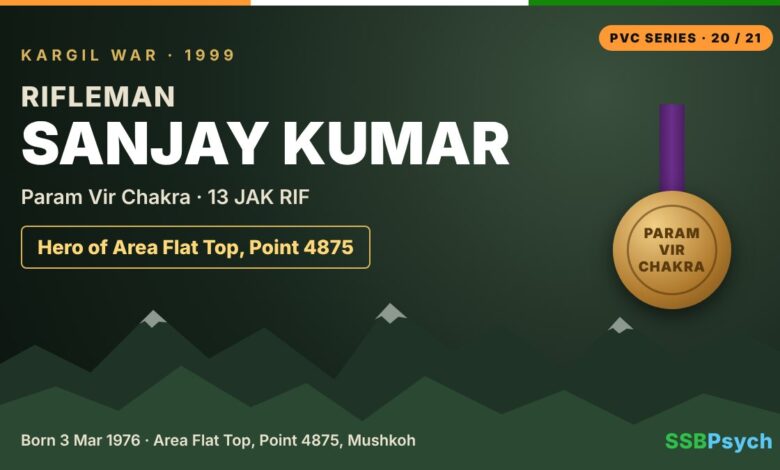
Rifleman Sanjay Kumar, PVC: From Delhi Taxi Driver to Kargil Hero of Point 4875 – Full Story (with Quiz)
Before he was a war hero, Sanjay Kumar drove a taxi on the busy streets of Delhi. He had applied to join the Army and been turned down, not once but three times. Many young men would have given up. He kept trying. A few years later, on a snow-covered ridge in Kargil, Rifleman Sanjay Kumar of 13 JAK RIF crawled towards an enemy machine gun, took two bullets, and still charged. His courage earned him the Param Vir Chakra.
If you have ever been screened out at the SSB or failed a written exam, Sanjay Kumar is the hero you need to know. His story proves that rejection is not the end. In this post we cover his early life, his long struggle to get into the Army, the background of the Mushkoh Valley fighting, a detailed account of the battle for Area Flat Top, his citation in simple words, his later career and legacy, the OLQs he displayed, and a 10-question quiz.
Rifleman Sanjay Kumar – Quick Facts
| Full name | Sanjay Kumar |
| Born | 3 March 1976, Kalol Bakain village, Bilaspur district, Himachal Pradesh |
| Parents | Durga Ram and Bhag Devi |
| Enrolled | 26 June 1996, after three rejections |
| Unit | 13th Battalion, The Jammu and Kashmir Rifles (13 JAK RIF) |
| Rank at the time | Rifleman |
| Operation | Operation Vijay (Kargil War), Mushkoh Valley |
| Objective | Area Flat Top, Point 4875 |
| Date of action | 4 July 1999 |
| Award | Param Vir Chakra |
| Later service | Subedar Major, instructor at NDA; Honorary Captain (26 January 2026) |
| Honours | Sanjay Island (Andaman and Nicobar, 2023) |
Early Life in the Hills of Bilaspur
Sanjay Kumar was born on 3 March 1976 in Kalol Bakain, a village in the Bilaspur district of Himachal Pradesh, to Durga Ram and Bhag Devi. Himachal is often called a land of soldiers, and his family was no exception; an uncle had served in the Indian Army, and military service was respected and admired at home.
He studied at the Government Senior Secondary School in Kalol. Life in the hills meant long walks, physical work and a habit of making do with little, all of which quietly built the stamina he would later need at high altitude.
Three Rejections and a Taxi in Delhi
Sanjay wanted to join the Army, but his first attempts did not succeed. He was rejected three times. To support himself, he moved to Delhi and worked as a taxi driver. It was an ordinary job, with long hours and little glamour, but he never let go of his goal of wearing the uniform.
His persistence finally paid off. On 26 June 1996 he was enrolled as a Rifleman in the 13th Battalion of the Jammu and Kashmir Rifles (13 JAK RIF). Exactly three years later, his battalion would be fighting one of the toughest battles of the Kargil War.
The Background: 13 JAK RIF in the Kargil War
When Pakistani intrusions were discovered in May 1999, 13 JAK RIF was among the battalions sent to fight in Operation Vijay. Under its Commanding Officer, Colonel Y. K. Joshi, the battalion first captured Point 5140 in the Dras sector in June 1999. That attack made one of its young officers, Captain Vikram Batra, famous for his radio message “Yeh Dil Maange More”.
The battalion then moved to the Mushkoh Valley, where the enemy held Point 4875, a large feature with steep cliffs that overlooked the National Highway and the Indian positions below. Clearing Point 4875 needed several attacks on different parts of the feature. One of these was a spur known as Area Flat Top, where Sanjay Kumar’s platoon was sent.
The Battle for Area Flat Top, 4 July 1999
Volunteering as Leading Scout
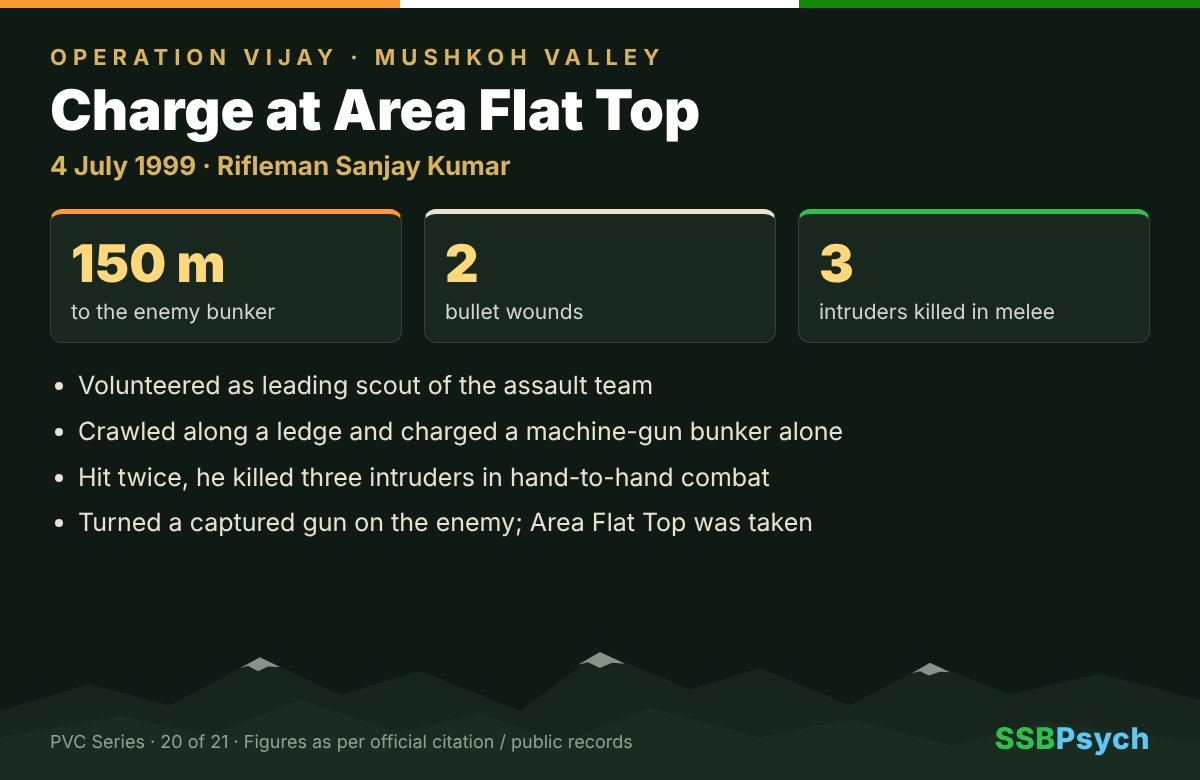
On 4 July 1999, Sanjay Kumar volunteered to be the leading scout of the team tasked to capture Area Flat Top. The leading scout moves ahead of everyone else and is usually the first to meet the enemy. It is one of the most dangerous positions in any attack. The team climbed the cliff to reach the objective, moving in the thin, cold air of the high Himalaya.
Pinned Down
As the team neared the top, an enemy machine gun firing from a bunker about 150 metres away opened up and pinned them down. The ground was open, and anyone who stood up risked being cut down. The attack was stuck, and every minute of delay gave the enemy time to bring more fire onto the Indian soldiers.
Charging the Bunker
Sanjay decided to deal with the machine gun himself. He crawled forward alone along a ledge, closing the distance under heavy fire. Then he charged at the bunker. On the way he was hit by two bullets, one in the chest and one in the forearm, and he began bleeding heavily. He did not stop. Reaching the bunker, he fought the enemy soldiers hand to hand and killed three of them.
He was not finished. Picking up an enemy machine gun from the position, he moved on towards a second bunker. Surprised by this attack, the enemy soldiers there began to abandon their position, and Sanjay fired at them as they fled. Throughout this, he refused to be evacuated in spite of his wounds.
Flat Top Captured
Seeing one wounded rifleman clear the way, the rest of his platoon charged with fresh energy and captured Area Flat Top. The capture was an important part of the effort to clear Point 4875. In the days that followed, the battalion continued the fight on the feature, and it was there, on 7 July 1999, that Captain Vikram Batra made the supreme sacrifice. Point 4875 is today known as Batra Top, and 13 JAK RIF has the rare honour of two Param Vir Chakra awardees from the same war.
Three rejections could not stop him from joining the Army, and two bullets could not stop him from reaching the enemy bunker.
– SSBPsych on Rifleman Sanjay Kumar
The Param Vir Chakra Citation (In Simple Words)
His citation records that on 4 July 1999, Rifleman Sanjay Kumar volunteered to be the leading scout of a team assigned to capture Area Flat Top in the Mushkoh Valley, held by Pakistani troops. After the team scaled the cliff, it was pinned down by machine-gun fire from an enemy bunker about 150 metres away. Realising the danger, he crawled along the ledge and charged the bunker on his own despite intense fire. Wounded twice and bleeding badly, he closed in, killed three intruders in hand-to-hand fighting, then took an enemy machine gun and used it against enemy soldiers fleeing from the next bunker. He refused to be evacuated, and his daring motivated his comrades to capture the objective. The citation honours his most conspicuous gallantry, cool courage and devotion to duty of an exceptionally high order with the Param Vir Chakra.
Later Career and Legacy
After the award, Sanjay Kumar was promoted directly to Havildar in January 2000. He continued to serve with the Jammu and Kashmir Rifles for more than two decades and also served with a United Nations mission abroad. He became a Naib Subedar in 2014 and later a Subedar. In February 2022 he was promoted to Subedar Major and posted to the National Defence Academy at Khadakwasla, where future officers trained in the presence of a living Param Vir Chakra hero.
He received the honorary rank of Lieutenant on 15 August 2025 and of Captain on Republic Day, 26 January 2026, and retired soon afterwards. He was widely described as the last Param Vir Chakra awardee of the Kargil War still serving in uniform.
- Sanjay Island: one of 21 Andaman and Nicobar islands named after PVC awardees in January 2023
- Statue at the Param Yodha Sthal, National War Memorial, New Delhi
- Portrayed by Sunil Shetty in the 2003 film LOC Kargil
- Instructor at the NDA, inspiring cadets who will lead the Army of tomorrow
Above all, his journey shows that the path to the uniform is not always straight. Some candidates clear the SSB on their first attempt. Others, like Sanjay Kumar, face repeated rejections and take ordinary jobs while they keep trying. What matters is refusing to quit, and being ready when your moment finally comes.
What Rejected Candidates Can Learn From Him
Every year thousands of aspirants get screened out at the SSB, miss the cut-off in a written exam or fail a medical. Many feel that the door has closed for good. Sanjay Kumar’s life is a direct answer to that feeling.
- Rejection is information, not a verdict. Each failed attempt is a chance to find out what was missing and work on it.
- Keep your goal alive while you earn a living. Driving a taxi did not make him less of a future soldier; it kept him going until his chance came.
- Be ready for the moment. When the time came on Area Flat Top, he did not wait to be ordered. He volunteered to lead.
- Small steps add up. From Rifleman to Subedar Major and Honorary Captain, his career was built one promotion at a time.
At the SSB, assessors are not looking for candidates who have never failed. They are looking for those who show they can learn, adapt and come back stronger. If you carry that spirit into your next attempt, you are already walking the path that Sanjay Kumar took.
Lessons for SSB Aspirants: OLQs in Action
The SSB does not test whether you can recite history – it looks for the qualities of an officer. Here is how Rifleman Sanjay Kumar showed them:
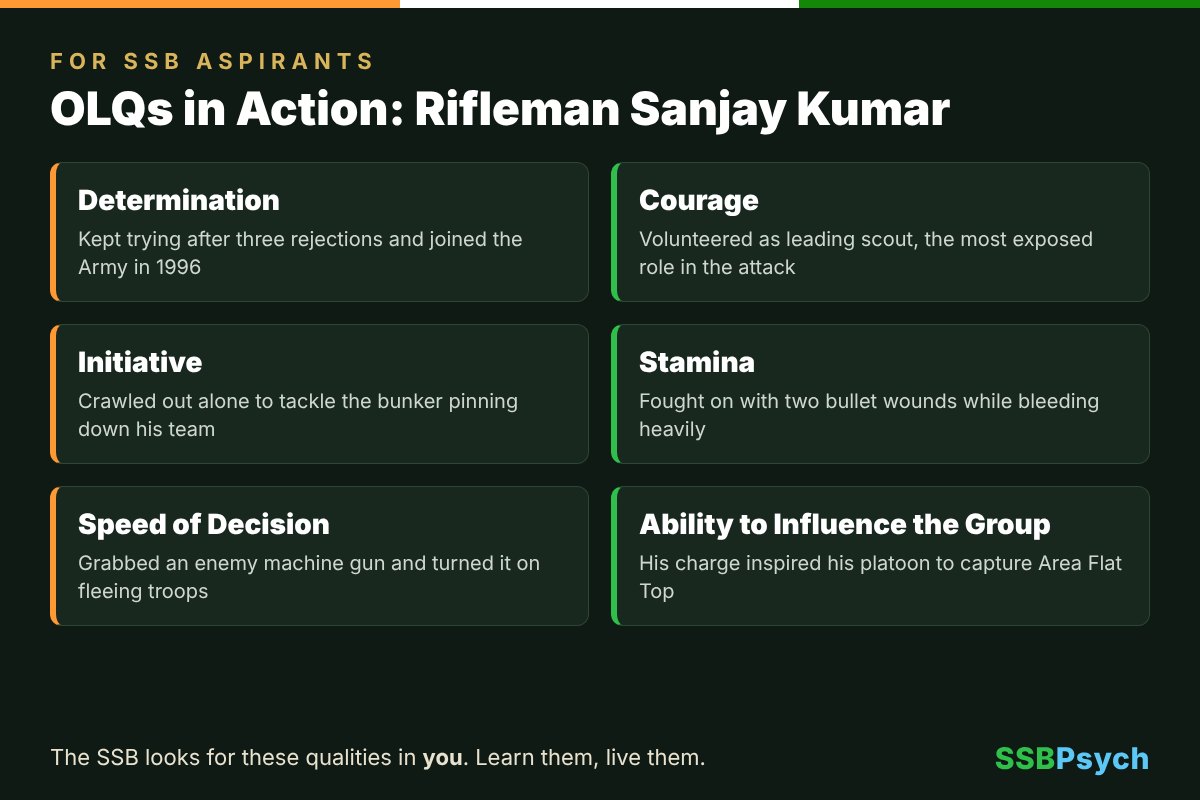
- Determination – Kept trying after three rejections and joined the Army in 1996
- Courage – Volunteered as leading scout, the most exposed role in the attack
- Initiative – Crawled out alone to tackle the bunker pinning down his team
- Stamina – Fought on with two bullet wounds while bleeding heavily
- Speed of Decision – Grabbed an enemy machine gun and turned it on fleeing troops
- Ability to Influence the Group – His charge inspired his platoon to capture Area Flat Top
Tip for your SSB interview: If you have been rejected before, do not hide it at the SSB; like Sanjay Kumar, show what you learned and how you kept working towards the uniform.
Practice Corner: WAT and SRT
Write your first spontaneous response to these before you scroll to the quiz. Keep WAT sentences short, positive and action-oriented.
WAT Words
- Rejection
- Scout
- Bunker
- Persist
- Taxi
SRTs
- He has failed the same selection test three times and his family suggests he find another career. He…
- His team is pinned down during a task and no one is willing to move first. He…
- He gets hurt early in a long and important event that his team depends on him for. He…
Quiz: How Well Do You Know Rifleman Sanjay Kumar?
Test yourself! Click an option to see if you are right. Your score updates live.
Frequently Asked Questions
What did Rifleman Sanjay Kumar do in the Kargil War?
On 4 July 1999, as leading scout, he charged an enemy machine-gun bunker on Area Flat Top, Point 4875, despite two bullet wounds, killed three intruders in close combat and used a captured gun against fleeing enemy soldiers.
Was Sanjay Kumar in the same battalion as Captain Vikram Batra?
Yes. Both served in 13 JAK RIF, which has two Param Vir Chakra awardees from the Kargil War.
Is it true he was rejected three times by the Army?
Yes. He was turned down three times and worked as a taxi driver in Delhi before being enrolled on 26 June 1996.
What rank did Sanjay Kumar reach?
He rose to Subedar Major, served at the NDA, received the honorary rank of Captain on 26 January 2026 and retired soon after.
Which island is named after him?
Sanjay Island in the Andaman and Nicobar group, named in January 2023 along with 20 other islands for PVC awardees.
The Param Vir Chakra Series on SSBPsych
This is part 20 of 21 in our series on every Param Vir Chakra awardee. A new hero goes live every morning at 7:30 AM. Also read the story of Captain Vikram Batra, PVC – the Sher Shah of Kargil.
Sources: en.wikipedia.org, www.ssbcrack.com, ssbcrackexams.com, thehitavada.com, www.ssbpsych.com.
Preparing for your SSB? Join SSBPsych’s online and offline SSB batches and learn how to show your OLQs with confidence – explore our courses or call +91 8076540582.