Jammu and Kashmir Rifles: History, Motto, Battles and Heroes
Few regiments can say that their history is older than the modern Indian Army itself. The Jammu and Kashmir Rifles, known in the Army simply as JAK RIF, can. Its roots go back to the Dogra soldiers raised in Jammu in 1821, and its most famous modern chapter was written on the icy peaks of Kargil in 1999, where one battalion won two Param Vir Chakras in a single campaign. If you have ever heard the words Yeh Dil Maange More, you already know a little of this regiment’s spirit.
This guide is written for NDA, CDS, AFCAT and SSB aspirants. It covers the regiment’s history, a clear timeline, its major operations and battle honours, the motto and war cry, its greatest heroes, life inside the regiment, what it means for you as a future officer, and a short quiz to test what you have learnt.
Jammu and Kashmir Rifles – Quick Facts
| Raised | 1821, by Gulab Singh in Jammu (as the Dogra state force) |
| Joined Indian Army | 15 January 1957, as the Jammu and Kashmir Regiment |
| Present name | Jammu and Kashmir Rifles (JAK RIF), since 1963 |
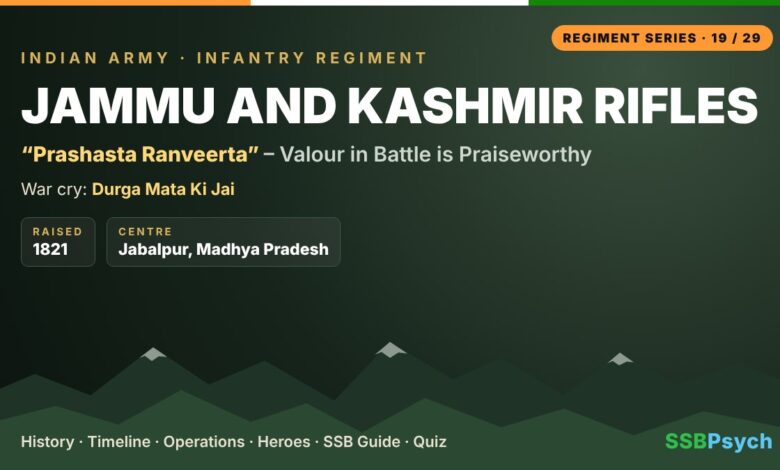
| Regimental Centre | Jabalpur, Madhya Pradesh |
| Motto | Prashasta Ranveerta (Valour in Battle is Praiseworthy) |
| War Cry | Durga Mata Ki Jai (Victory to Mother Durga) |
| Recruitment | Mainly Dogras, along with Gorkhas, Sikhs and Muslims |
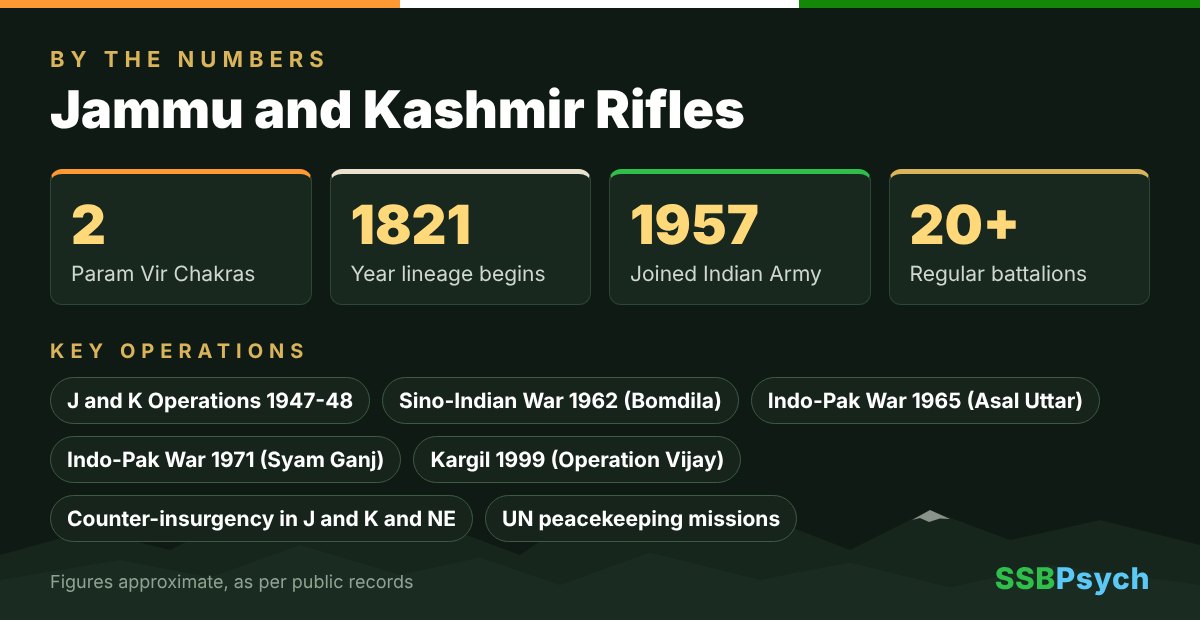
| Battalions | Over 20 regular battalions, plus Rashtriya Rifles and Territorial Army units |
| Notable gallantry | 2 Param Vir Chakras (Kargil 1999), 2 Ashoka Chakras |
| Famous sons | Capt Vikram Batra, Rfn Sanjay Kumar, Gen Upendra Dwivedi |
History of the Jammu and Kashmir Rifles
The story begins in the Dogra kingdom of Jammu. Gulab Singh, who later became the first Maharaja of Jammu and Kashmir, raised a fighting force in Jammu around 1820-21. This was not a British creation. It was the army of a princely state, built by a ruler who wanted strong, loyal troops of his own. Over the next decades these soldiers would carry the Dogra flag across some of the highest and harshest terrain on earth.
The most celebrated commander of that era was General Zorawar Singh. From the 1830s his columns marched into Ladakh and Baltistan, adding vast mountain regions to the Dogra domain. Later expeditions went towards Gilgit, Hunza, Chilas and Chitral. These campaigns gave the force a lasting reputation as hardy mountain fighters, a reputation the regiment still carries with pride.
During the First World War the state forces of Jammu and Kashmir served alongside British Indian troops. Infantry battalions and a mountain battery fought in East Africa, Palestine and Mesopotamia and earned many decorations. In the Second World War the Jammu and Kashmir troops served in Burma, where they won the battle honours Kennedy Peak and Meiktila.
1947: Buying Time for Kashmir
The regiment’s finest hour as a state force came in October 1947, when tribal raiders backed by Pakistan poured into Jammu and Kashmir. The state’s battalions were thinly spread over a huge front, from Kathua to Leh. Even so, they fought a series of delaying actions that slowed the invaders before Indian Army troops could be flown into Srinagar.
The most famous of these actions was led by Brigadier Rajinder Singh, the Chief of Staff of the state forces. With a small force he held back the raiders on the Uri road, blowing up a bridge and fighting until he was killed. He was awarded the Maha Vir Chakra posthumously and is remembered as one of the first MVC awardees of independent India. In Ladakh and Baltistan, Lieutenant Colonel Sher Jung Thapa led a long and stubborn defence of Skardu in 1948, also earning the Maha Vir Chakra. The cost of 1947-48 was heavy, with well over a thousand of the regiment’s soldiers killed.
Joining the Indian Army
After the state acceded to India in October 1947, its forces came under the command of the Indian Army. On 15 January 1957 they were formally absorbed as the Jammu and Kashmir Regiment. In 1963 the regiment was renamed the Jammu and Kashmir Rifles, the name it carries today. The regimental centre, once in Jammu, later moved and is now at Jabalpur in Madhya Pradesh.
For many years the regiment also looked after the Ladakh Scouts, the famous high-altitude unit made up largely of men from Ladakh. The Ladakh Scouts served under the regiment’s umbrella until 2002, when they became a separate regiment of their own. This link is one more reason why JAK RIF is so closely tied to the mountains of the north.
Jammu and Kashmir Rifles Timeline: From Raising to Today
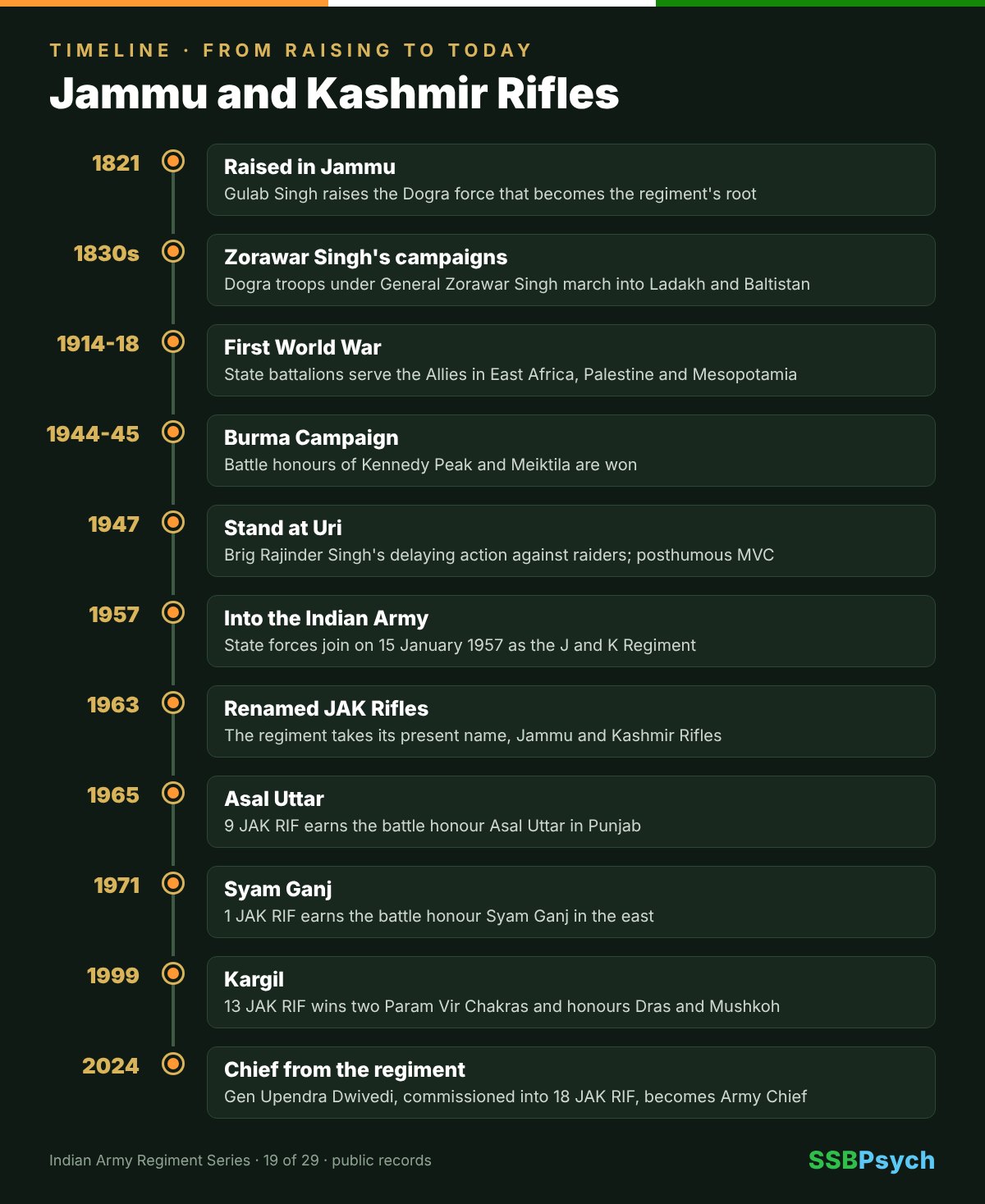
- 1821 – Raised in Jammu: Gulab Singh raises the Dogra force that becomes the regiment’s root
- 1830s – Zorawar Singh’s campaigns: Dogra troops under General Zorawar Singh march into Ladakh and Baltistan
- 1914-18 – First World War: State battalions serve the Allies in East Africa, Palestine and Mesopotamia
- 1944-45 – Burma Campaign: Battle honours of Kennedy Peak and Meiktila are won
- 1947 – Stand at Uri: Brig Rajinder Singh’s delaying action against raiders; posthumous MVC
- 1957 – Into the Indian Army: State forces join on 15 January 1957 as the J and K Regiment
- 1963 – Renamed JAK Rifles: The regiment takes its present name, Jammu and Kashmir Rifles
- 1965 – Asal Uttar: 9 JAK RIF earns the battle honour Asal Uttar in Punjab
- 1971 – Syam Ganj: 1 JAK RIF earns the battle honour Syam Ganj in the east
- 1999 – Kargil: 13 JAK RIF wins two Param Vir Chakras and honours Dras and Mushkoh
- 2024 – Chief from the regiment: Gen Upendra Dwivedi, commissioned into 18 JAK RIF, becomes Army Chief
Major Operations and Battle Honours of JAK RIF
Since independence, battalions of the regiment have fought in every major war India has faced, and they have spent long years on counter-insurgency duty in Jammu and Kashmir and the North East.
1962: Sino-Indian War
In 1962 the 2nd and 3rd battalions fought in the Bomdila area of what is now Arunachal Pradesh. Like many units in that war, they faced a much stronger enemy with limited support and lost a number of officers and men in hard fighting.
1965: Asal Uttar
Several battalions took part in the 1965 war with Pakistan. The 9th battalion fought in the Khem Karan sector of Punjab and earned the battle honour Asal Uttar, linked to one of the biggest tank battles of that war, where Pakistan’s armoured thrust was stopped.
1971: Syam Ganj
In the 1971 war the regiment’s battalions served on both the western and eastern fronts. The 1st battalion fought in East Pakistan and won the battle honour Syam Ganj, helping in the campaign that led to the liberation of Bangladesh.
1999: Kargil and the Bravest of the Brave
Kargil is where the Jammu and Kashmir Rifles became a household name. The 13th battalion (13 JAK RIF), commanded by Lieutenant Colonel Y.K. Joshi, was given some of the toughest tasks in the Dras and Mushkoh sectors. It captured Point 5140 and then fought for Point 4875, attacking up steep slopes against well-dug-in enemy positions.
Two soldiers of this one battalion won the Param Vir Chakra, India’s highest wartime gallantry award. 13 JAK RIF received the battle honours Dras and Mushkoh along with the theatre honour Kargil. Other battalions of the regiment also fought in the conflict, and the regiment’s total awards from Kargil were among the highest of any regiment.
Counter-Insurgency and Peacekeeping
Away from conventional wars, JAK RIF battalions have served long tenures fighting militancy in Jammu and Kashmir and insurgency in the North East. The regiment also supports Rashtriya Rifles battalions and has sent troops on United Nations peacekeeping missions abroad.
These quieter duties rarely make headlines, but they demand just as much from young officers. Patrolling a village at night, earning the trust of local people and making split-second decisions under fire are tests of character as much as skill. Several of the regiment’s peacetime gallantry awards have come from exactly this kind of work, far from the big battles that fill history books.
Insignia, Motto and War Cry
The regimental motto is Prashasta Ranveerta, which means Valour in Battle is Praiseworthy. The war cry is Durga Mata Ki Jai, or Victory to Mother Durga, a call that has echoed across the mountains of Kashmir and the peaks of Kargil.
The regimental crest shows a radiant sun inside an oval band carrying the motto, topped by the Lion Capital of Ashoka, with a scroll bearing the regiment’s name. The sun is a nod to the Suryavanshi heritage claimed by the Dogra rulers who first raised the force. Like other rifle regiments, JAK RIF wears black buttons and black rank badges, a tradition that comes from the rifleman’s need to stay hidden in the field.
Heroes of the Jammu and Kashmir Rifles
The regiment’s roll of honour is long. Here are some of the names every SSB aspirant should know.
- Captain Vikram Batra, Param Vir Chakra (posthumous) – 13 JAK RIF, Kargil 1999; captured Point 5140 and fell leading the fight on Point 4875.
- Rifleman Sanjay Kumar, Param Vir Chakra – 13 JAK RIF, Kargil 1999; charged enemy bunkers on Point 4875 despite serious wounds.
- Brigadier Rajinder Singh, Maha Vir Chakra (posthumous) – led the 1947 delaying action at Uri against the raiders.
- Lieutenant Colonel Sher Jung Thapa, Maha Vir Chakra – led the long defence of Skardu in 1948.
- Lance Naik Sundar Singh, Ashoka Chakra – 4th battalion, Jammu and Kashmir, 1956.
- Second Lieutenant Cyrus Addie Pithawalla, Ashoka Chakra – 17 JAK RIF, counter-insurgency in Manipur, 1981.
- Lieutenant Colonel (later Lieutenant General) Y.K. Joshi, Vir Chakra – commanded 13 JAK RIF in Kargil and later led Northern Command.
- General Upendra Dwivedi – commissioned into 18 JAK RIF in 1984 and later commanded it; became Chief of the Army Staff on 30 June 2024.
Captain Vikram Batra’s story deserves a special mention. His radio message after capturing Point 5140, Yeh Dil Maange More, became the most famous line of the war. He was later killed while rescuing a wounded soldier on Point 4875, which is now known as Batra Top. Rifleman Sanjay Kumar, from Himachal Pradesh, survived his wounds and continued to serve, rising in rank. Together they are a lesson that courage has no rank.
Role and Life in the Regiment
The Jammu and Kashmir Rifles is an infantry regiment. Its battalions are trained to fight in every kind of terrain, but mountain warfare and counter-insurgency are where they have built their deepest experience. A young officer joining JAK RIF can expect high-altitude postings, tours along the Line of Control, and tenures in Rashtriya Rifles units, as well as peace stations in the plains.
Life in the regiment is built on close bonds between officers and men. Many of the soldiers are Dogras from the hills of Jammu and Himachal Pradesh, known for their discipline and toughness, and the regiment also includes Gorkhas, Sikhs and Muslims. Officers are expected to learn their men’s language and customs, share their hardships and lead from the front, which is exactly what Captain Batra did.
The regimental centre at Jabalpur trains new recruits, now including Agniveers, and keeps the regiment’s history alive through its museum, traditions and ceremonies. For an officer, the centre is the home of the regimental family.
What the Jammu and Kashmir Rifles Means for SSB Aspirants
Knowing the history of a regiment like JAK RIF does more than help you answer one interview question. It shows the Interviewing Officer that you understand what the Army really asks of its young leaders: courage, care for your men, and the willingness to go first. The stories of Batra and Sanjay Kumar are also excellent material for lecturettes, group discussions and the Situation Reaction and Thematic Apperception tests, where real examples of leadership can make your thinking sharper.
Jammu and Kashmir Rifles for SSB Candidates: What You Should Know
How officers join
- Officers join the infantry after training at the Indian Military Academy (IMA) Dehradun, reached through NDA (after Class 12) or the CDS exam (for graduates).
- Short Service Commission officers train at the Officers Training Academy (OTA), Chennai, through CDS (OTA), NCC Special Entry and other entries.
- Arm and regiment allotment happens towards the end of academy training, based on your choice, your order of merit and the vacancies available.
- You cannot apply directly to JAK RIF; you can list it as a preference and work hard to earn a high merit position.
How soldiers join
- Soldiers are recruited mainly from the Dogra regions of Jammu and Himachal Pradesh, with other classes as per the regiment’s composition.
- Since 2022, soldiers join through the Agnipath scheme as Agniveers for four years, after which up to 25 percent can be selected for regular service.
- Recruits train at the Jammu and Kashmir Rifles Regimental Centre, Jabalpur, before joining a battalion.
Questions you may face in the SSB interview, GD or lecturette
- Why do you want to join the infantry, and would you like to serve in the Jammu and Kashmir Rifles?
- What do you know about Captain Vikram Batra and what can a young officer learn from him?
- The Jammu and Kashmir Rifles began as a princely state force. How did it become part of the Indian Army?
- What were the main lessons of the Kargil conflict of 1999?
- How would you lead soldiers in high-altitude counter-insurgency operations?
SSBPsych tip: If you mention Captain Vikram Batra in your interview, go beyond the famous line: talk about how he went back for an injured soldier. Interviewers want to see that you value your men, not just glory.
Read the stories of its Param Vir Chakra heroes: Captain Vikram Batra.
The Jammu and Kashmir Rifles began as a mountain army of the Dogras and grew into one of the most decorated regiments of the Indian Army. Read its story, remember its heroes, and carry its motto with you into the SSB: valour in battle is praiseworthy, but so is the quiet courage of preparing well every single day. Now try the quiz below and see how much you remember.
Quiz: How Well Do You Know the Jammu and Kashmir Rifles?
Test yourself! Click an option to see if you are right. Your score updates live.
Jammu and Kashmir Rifles: Frequently Asked Questions
The motto is Prashasta Ranveerta, which means Valour in Battle is Praiseworthy.
The JAK RIF Regimental Centre is at Jabalpur in Madhya Pradesh.
The war cry is Durga Mata Ki Jai, meaning Victory to Mother Durga.
The regiment has two Param Vir Chakras, both won by 13 JAK RIF in Kargil in 1999: Captain Vikram Batra (posthumous) and Rifleman Sanjay Kumar.
The Jammu and Kashmir state forces came under Indian Army command after 1947 and were formally absorbed on 15 January 1957. The regiment got its present name in 1963.
Indian Army Regiments Series on SSBPsych
This is part 19 of 29 in our series on every infantry regiment of the Indian Army – a new regiment every day at 11 AM. Previous in the series: Mahar Regiment. Also follow our Param Vir Chakra series.
Sources: en.wikipedia.org, bharat-rakshak.com, businesstoday.in.
Preparing for NDA, CDS, AFCAT or your SSB? Join SSBPsych’s online and offline batches – explore our courses or call +91 8076540582.