Grenadier Yogendra Singh Yadav, PVC: Youngest Param Vir Chakra, Hero of Tiger Hill – Full Story (with Quiz)
Most of us at 19 are worrying about exams, college admissions or our first job. At that age, Grenadier Yogendra Singh Yadav was hanging from a rope on an icy cliff on Tiger Hill, with enemy machine guns firing down at him. He was wounded, his comrades around him had been hit, and the top was still sixty feet away. He kept climbing. That climb made him the youngest soldier ever to receive the Param Vir Chakra.
Yogendra Singh Yadav’s story speaks directly to young NDA and SSB aspirants, because he did something historic at an age close to yours. In this post we cover his family background, how he joined the Army as a teenager, the importance of Tiger Hill in the Kargil War, a detailed account of the assault, his citation in simple words, his later life and legacy, the OLQs he showed and a 10-question quiz to test yourself.
Grenadier Yogendra Singh Yadav – Quick Facts
| Full name | Yogendra Singh Yadav |
| Born | 10 May 1980, Aurangabad Ahir village, Bulandshahr district, Uttar Pradesh |
| Enrolled | 27 December 1996, aged about 16 |
| Unit | 18th Battalion, The Grenadiers (18 Grenadiers), Ghatak Platoon |
| Rank at the time | Grenadier |
| Operation | Operation Vijay (Kargil War), Dras sector |
| Objective | Bunkers on Tiger Hill |
| Date of action | Night of 3/4 July 1999 |
| Award | Param Vir Chakra, at age 19 |
| Retired | 31 December 2021 as Subedar Major (Honorary Captain) |
| Honours | Yogender Island (Andaman and Nicobar, 2023); Yash Bharati (UP, 2015) |
Early Life: A Soldier’s Son From Bulandshahr
Yogendra Singh Yadav was born on 10 May 1980 in Aurangabad Ahir, a village in the Bulandshahr district of western Uttar Pradesh. The Army was part of his family story from the start. His father had served in the Kumaon Regiment and fought in the 1965 and 1971 wars with Pakistan, and young Yogendra grew up listening to his accounts of soldiering. An elder brother also joined the Army and served in the Regiment of Artillery.
Growing up in a rural home with a veteran father gave him a simple, firm idea of what life should be about: serving the country with honour. He did not wait long to act on it.
Joining the Grenadiers at Sixteen
On 27 December 1996, at only about sixteen and a half years of age, Yogendra enrolled in the Indian Army as a soldier of The Grenadiers, one of the oldest infantry regiments of the Army. Soldiers of the regiment hold the rank of Grenadier rather than Sepoy. After his training he joined the 18th Battalion (18 Grenadiers).
Within the battalion he became part of the Ghatak Platoon. Every infantry battalion has a Ghatak platoon, a group of its fittest and most aggressive soldiers who are trained to spearhead attacks, raid enemy positions and tackle the hardest tasks. Being picked for it at such a young age said a lot about his fitness and spirit.
The Background: Why Tiger Hill Mattered
In May 1999 Pakistani troops were found occupying heights along the Line of Control in Kargil, Dras, Mushkoh and Batalik. In the Dras sector, the enemy positions on peaks such as Tololing and Tiger Hill directly overlooked National Highway 1, the vital road linking Srinagar with Leh. Indian convoys moving along the highway were being shelled, so these heights had to be retaken.
18 Grenadiers had already fought hard in the battle for Tololing in June 1999, losing officers including its Second-in-Command and several brave men before the feature was taken. Next came Tiger Hill, the highest and most famous peak in the area at well over 16,000 feet. Its slopes were steep, rocky and covered in snow, and the enemy held bunkers on the heights. The battalion was tasked with capturing it, attacking from more than one direction.
The Assault on Tiger Hill, 3/4 July 1999
Volunteering for the Lead
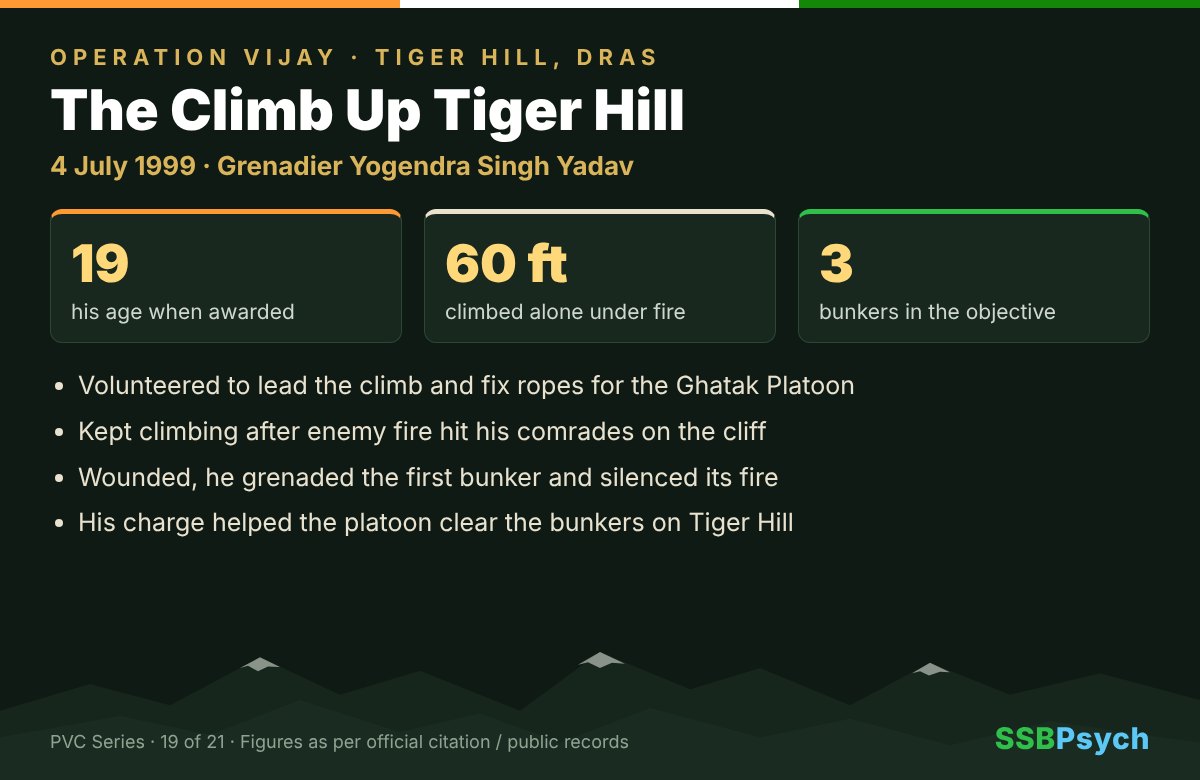
The Ghatak Platoon of 18 Grenadiers was given the task of capturing three strategic bunkers on a near-vertical, snow-covered cliff face on Tiger Hill. The approach was so steep that ropes had to be fixed for the rest of the team to follow. Yogendra volunteered to be the lead climber, the man at the very front who would go up first and fix the ropes. The climb began on the evening of 3 July and continued through a freezing night.
Under Fire on the Cliff
Partway up the cliff, the enemy spotted the climbers and opened fire with machine guns and rockets. The platoon commander and two other soldiers were hit. The team was stuck on an exposed rock face with almost nowhere to take cover. Yogendra himself was struck by bullets in the groin and shoulder. A wounded man on a cliff has every reason to stop. Instead, he climbed the remaining sixty feet or so to the top on his own.
Silencing the Bunkers
Once he reached the top, despite his wounds, he crawled towards the first enemy bunker and threw a grenade into it. The blast killed four enemy soldiers and stopped the fire that had been pinning down his comrades. This gave the rest of the platoon a chance to climb up. Then, with two fellow soldiers, he charged the second bunker and fought the defenders hand to hand, clearing it as well.
Badly hurt and bleeding, he refused to be taken back for treatment and continued to fight. Inspired by his courage, the platoon pressed on, and the enemy positions in their objective were captured. Tiger Hill was recaptured by Indian troops on 4 July 1999, one of the most celebrated victories of the Kargil War.
He was nineteen, wounded and alone at the top of a cliff, and he still chose to attack.
– SSBPsych on the Tiger Hill assault
The Param Vir Chakra Citation (In Simple Words)
His citation describes how, in the early morning of 4 July 1999, the Ghatak Platoon of 18 Grenadiers was tasked to capture three strategic bunkers on a vertical, snow-covered cliff on Tiger Hill. Grenadier Yogendra Singh Yadav volunteered to lead the assault and fix the ropes. When enemy fire hit the platoon commander and two other soldiers and halted the climb, he kept going and climbed the last stretch to the top in spite of bullet wounds to his groin and shoulder. He crawled to the first bunker and lobbed a grenade, killing enemy soldiers and stopping their fire. With two comrades, he then cleared the second bunker in close combat. The citation praises his most conspicuous courage, gallantry and determination under extremely adverse conditions with the Param Vir Chakra.
There is also a remarkable twist in his story. When the award was first announced, it was listed as posthumous, because it was believed he had been killed. It soon emerged that a soldier with the same name had died, while Yogendra was alive and recovering in hospital. He received the medal in person.
Later Life and Legacy
After the award he was promoted to Havildar in January 2000. Over the next two decades he continued to serve with his regiment, rising through the JCO ranks to Subedar Major. He was made an Honorary Lieutenant in January 2021 and an Honorary Captain in August 2021, and he retired from the Army at the end of December 2021.
He has remained an active voice for the armed forces. He received Uttar Pradesh’s Yash Bharati award in 2015, and when he won prize money on a popular television quiz show in 2020, he donated it to the Army welfare fund.
- Youngest recipient of the Param Vir Chakra, at age 19
- Yogender Island: one of 21 Andaman and Nicobar islands named after PVC awardees in January 2023
- Statue at the Param Yodha Sthal, National War Memorial, New Delhi
- Portrayed by Manoj Bajpayee in the 2003 film LOC Kargil
His life tells young aspirants that age is not a barrier to greatness. He was a teenager with no rank, no medals and no special background except a father’s example and a strong will. What set him apart was the decision to keep going when stopping would have been completely understandable.
Lessons From a Teenage Hero
It is easy to admire Yogendra Singh Yadav from a distance and think his courage belongs to another world. But the qualities behind his action are the same ones that SSB assessors look for in candidates of your age, and they can be built step by step.
- Volunteer for the front. He asked to be the lead climber. In group tasks, offering to take the toughest part shows initiative and responsibility.
- Fitness is a foundation. Being selected for the Ghatak Platoon came from hard physical training. Daily running, push-ups and endurance work prepare you for both the SSB outdoor tasks and the academy.
- Do not stop at the first setback. He was wounded before he reached the top. Many candidates give up after one failed attempt; recommended candidates usually treat failure as feedback.
- Think about the team. His grenade on the first bunker was not about personal glory; it gave his pinned-down comrades a chance to climb.
Remember, his greatest strength was not that he felt no fear. It was that he acted in spite of it. That is the essence of courage, and it is a quality you can show in small ways every day.
Lessons for SSB Aspirants: OLQs in Action
The SSB does not test whether you can recite history – it looks for the qualities of an officer. Here is how Grenadier Yogendra Singh Yadav showed them:
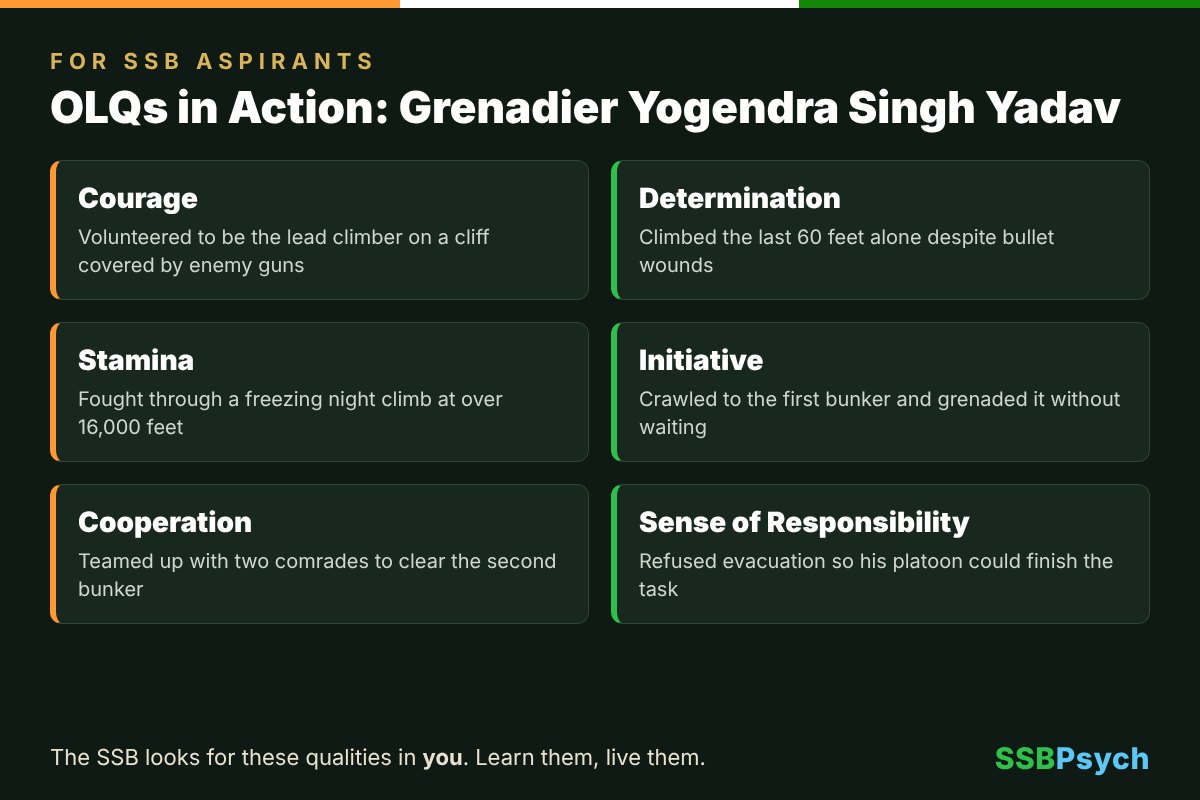
- Courage – Volunteered to be the lead climber on a cliff covered by enemy guns
- Determination – Climbed the last 60 feet alone despite bullet wounds
- Stamina – Fought through a freezing night climb at over 16,000 feet
- Initiative – Crawled to the first bunker and grenaded it without waiting
- Cooperation – Teamed up with two comrades to clear the second bunker
- Sense of Responsibility – Refused evacuation so his platoon could finish the task
Tip for your SSB interview: If asked about family influence, speak honestly about a role model, as Yogendra did about his veteran father, but show what you have done yourself to act on that inspiration.
Practice Corner: WAT and SRT
Write your first spontaneous response to these before you scroll to the quiz. Keep WAT sentences short, positive and action-oriented.
WAT Words
- Cliff
- Rope
- Young
- Wound
- Victory
SRTs
- He is leading a climb with friends when two of them get hurt halfway up. He…
- He is injured during a team sports final and the coach offers to substitute him. He…
- People tell him he is too young to take on a leadership role in his college fest. He…
Quiz: How Well Do You Know Grenadier Yogendra Singh Yadav?
Test yourself! Click an option to see if you are right. Your score updates live.
Frequently Asked Questions
Who is the youngest Param Vir Chakra awardee?
Grenadier Yogendra Singh Yadav of 18 Grenadiers, who received the award at the age of 19 for his action on Tiger Hill in July 1999.
What did Yogendra Singh Yadav do on Tiger Hill?
He volunteered to lead the Ghatak Platoon’s climb and fix ropes, kept climbing after being shot, grenaded the first enemy bunker and helped clear the second in close combat.
Is Yogendra Singh Yadav alive?
Yes. He survived his wounds, continued serving, became Subedar Major and retired at the end of 2021 as an Honorary Captain.
Why was his Param Vir Chakra first announced as posthumous?
Another soldier with the same name had been killed, and it was initially believed the hero had died. He was found alive and recovering in hospital.
Which island is named after him?
Yogender Island in the Andaman and Nicobar group, named in January 2023 along with 20 other islands for PVC awardees.
The Param Vir Chakra Series on SSBPsych
This is part 19 of 21 in our series on every Param Vir Chakra awardee. A new hero goes live every morning at 7:30 AM. Also read the story of Captain Vikram Batra, PVC – the Sher Shah of Kargil.
Sources: en.wikipedia.org, www.bharat-rakshak.com, www.thehitavada.com, thehitavada.com.
Preparing for your SSB? Join SSBPsych’s online and offline SSB batches and learn how to show your OLQs with confidence – explore our courses or call +91 8076540582.