Canberra Bomber in Indian Air Force: History, Specs, Wars, Legacy
Long before the Rafale and the Su-30MKI, India’s long arm in the sky was a sleek British jet with a twin-engine roar and a reputation for flying where others could not. The Canberra served the Indian Air Force for about 50 years, from 1957 to 2007. It bombed enemy radars, struck oil tanks at Karachi, flew with UN forces in Africa, and in the 1999 Kargil War it brought home vital photographs even after being hit by a missile.
In this guide you will learn why the IAF chose the Canberra, how its long career unfolded, its specifications in easy language, the weapons it carried, its missions from Congo to Kargil, where it was based, its strengths and weak points, and where you can see one today. A 10-question quiz at the end will help you remember the key facts for AFCAT, CDS and the SSB interview.

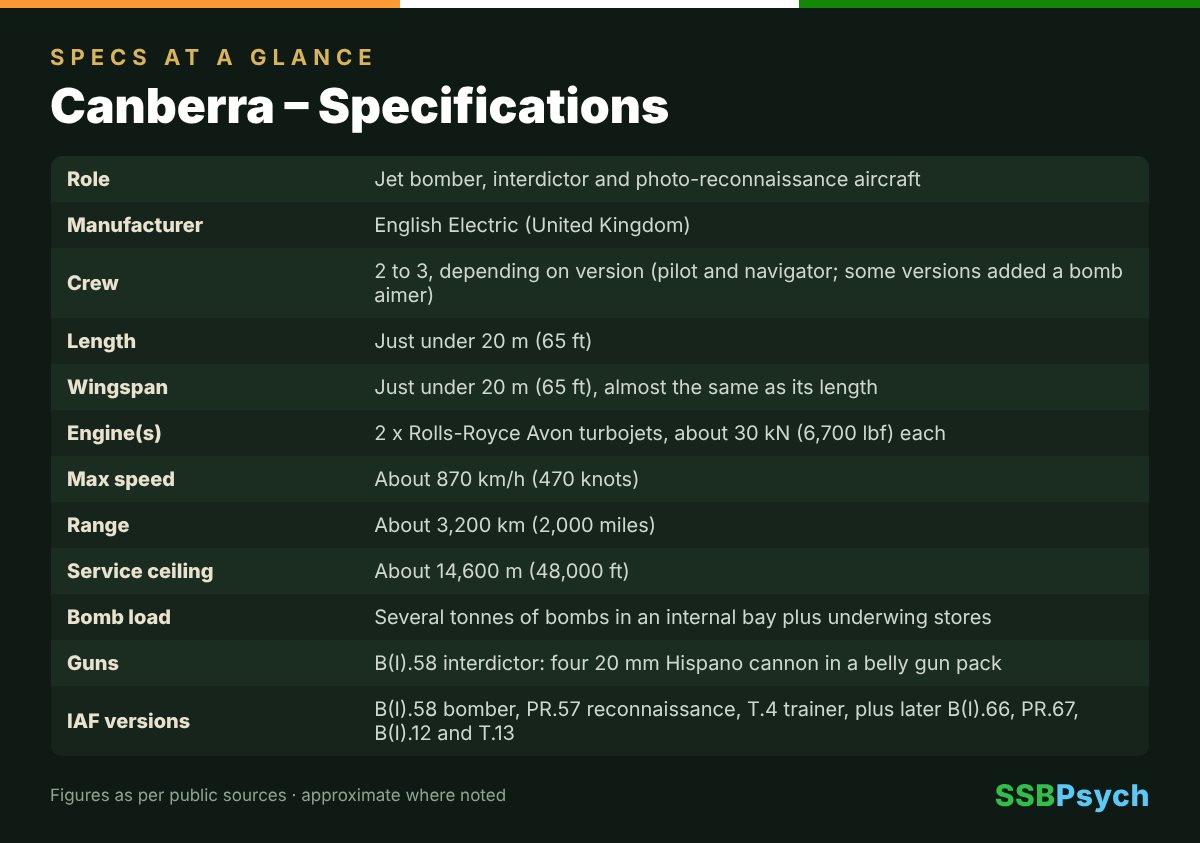
Canberra Specifications
| Role | Jet bomber, interdictor and photo-reconnaissance aircraft |
| Manufacturer | English Electric (United Kingdom) |
| Crew | 2 to 3, depending on version (pilot and navigator; some versions added a bomb aimer) |
| Length | Just under 20 m (65 ft) |
| Wingspan | Just under 20 m (65 ft), almost the same as its length |
| Engine(s) | 2 x Rolls-Royce Avon turbojets, about 30 kN (6,700 lbf) each |
| Max speed | About 870 km/h (470 knots) |
| Range | About 3,200 km (2,000 miles) |
| Service ceiling | About 14,600 m (48,000 ft) |
| Bomb load | Several tonnes of bombs in an internal bay plus underwing stores |
| Guns | B(I).58 interdictor: four 20 mm Hispano cannon in a belly gun pack |
| IAF versions | B(I).58 bomber, PR.57 reconnaissance, T.4 trainer, plus later B(I).66, PR.67, B(I).12 and T.13 |
| First flight | 13 May 1949 (prototype) |
| Inducted in IAF | 1957 |
| Retired from IAF | 2007, after about 50 years |
| Number in IAF | Over 100 acquired over the years |
Why India Needed the Canberra
In the early 1950s, India’s air force was still largely made up of propeller aircraft from the Second World War era, including the B-24 Liberator heavy bomber. The jet age had arrived, and the IAF needed a modern bomber that could fly fast and high, carry a good bomb load, and reach targets deep in enemy territory.
Britain’s English Electric Canberra was one of the best jet bombers of its time. It first flew in 1949 and quickly became famous for its high-altitude performance and smooth handling. India began talks in 1954; the Soviet Union reportedly offered its Il-28 bomber at a lower price, but India chose the Canberra. In January 1957, India placed a large order for 54 B(I).58 bombers, 8 PR.57 photo-reconnaissance aircraft and 6 T.4 trainers, and deliveries began that summer.
History of the Canberra in the IAF
The first unit to get the new jet was No. 5 Squadron ‘Tuskers’, which received Canberra B(I).58s in June 1957. A month earlier, in May 1957, No. 106 Squadron ‘Lynxes’ had been formed with PR.57 Canberras for strategic photo-reconnaissance, which means taking detailed pictures of far-off areas from high altitude. More aircraft were ordered over the next years, and India later added refurbished and second-hand Canberras, including ex-New Zealand aircraft. In total the IAF acquired well over 100 Canberras.
The Canberra’s first real combat came far from home. In 1961-62, IAF Canberras flew with United Nations forces in the Congo in Africa, in operations against the breakaway Katanga province. It was a proud moment for a young air force serving under the UN flag.
During the 1965 India-Pakistan war, Canberras flew bombing raids against Pakistani targets. One famous mission attacked the radar station at Badin, badly damaging it and putting it out of action. Canberras also raided Pakistani air bases, flying long and risky missions into enemy territory.
In the 1971 war, which led to the creation of Bangladesh, Canberras again played a key role. Their raid on the Karachi oil tanks helped the Indian Navy’s daring missile-boat attacks on the Pakistani coast, showing how the Air Force and Navy could work together.
The old bomber’s final war was in 1999. During the Kargil conflict, a PR.57 Canberra was flying a photo-reconnaissance mission near the Line of Control on 21 May 1999 when a Stinger shoulder-fired missile hit one of its engines. The crew kept their cool and flew the damaged aircraft back to base on the remaining engine. The pilot was later honoured with the Shaurya Chakra for this act of courage.
By the 2000s the Canberra fleet was very old. After a crash in December 2005, the fleet was grounded, and the IAF finally retired its last Canberras in 2007. No. 106 Squadron, the last user, moved on to other aircraft, ending an incredible half-century of service.
Engine and Performance Explained Simply
The Canberra was powered by two Rolls-Royce Avon turbojet engines, one in each wing, each giving about 30 kilonewtons of thrust. A turbojet sucks in air, squeezes it, mixes it with fuel, burns it and blasts the hot gas out of the back, pushing the aircraft forward. Two engines gave extra safety, which proved life-saving in Kargil.
Its top speed was about 870 km/h, nearly three times faster than a modern bullet train at about 320 km/h. In the 1950s that was very fast for a bomber. Even more impressive was its height: the service ceiling, meaning the highest height at which it could still usefully climb, was about 14,600 metres. That is around one and a half times the height of Mount Everest, and high enough that many early fighters struggled to reach it.
Its range was about 3,200 km, longer than the flying distance from Delhi to Kanyakumari. That long reach let it hit targets deep inside enemy territory or fly long photo missions.
The Canberra’s shape was elegant and simple. Its wingspan and length were both just under 20 metres, so from above it looked almost square. Twenty metres is about as long as four to five family cars parked in a line. Its big, broad wings gave excellent lift at high altitude, which is why it could fly so high and handle so smoothly.
Weapons and Missiles
- Free-fall bombs of 250, 500 and 1,000 lb in the internal bomb bay
- Four 20 mm Hispano cannon in a belly pack (B(I).58 interdictor)
- Bombs or unguided rockets on underwing hardpoints
- Long-range reconnaissance cameras on the PR.57 spy version
The B(I).58, the IAF’s main version, was an interdictor: a bomber designed to strike enemy supply lines, airfields and troops behind the front line. It could carry bombs inside its belly, bombs or rockets under its wings, and a pack of four 20 mm cannon for attacking ground targets. The PR.57 version carried no bombs, only powerful cameras.
How a Canberra Photo-Reconnaissance Mission Worked
Before satellites and drones became common, the only way to get a clear, up-to-date picture of enemy positions was to fly over them with a camera. The PR.57 Canberra was built for exactly this. Planners marked the area to be photographed, the crew worked out a route, and the aircraft flew a carefully measured straight line over the target while its cameras clicked away.
Holding that straight line was dangerous, because the aircraft could not twist and turn to dodge enemy fire while the cameras were running. After landing, the film was rushed for processing, and photo interpreters studied every frame to find bunkers, guns, vehicles and supply routes. In Kargil, such photographs helped commanders understand exactly where the intruders were sitting on the high ridges, which made the Canberra’s survival after the missile hit even more valuable.
Canberra Missions and Operations
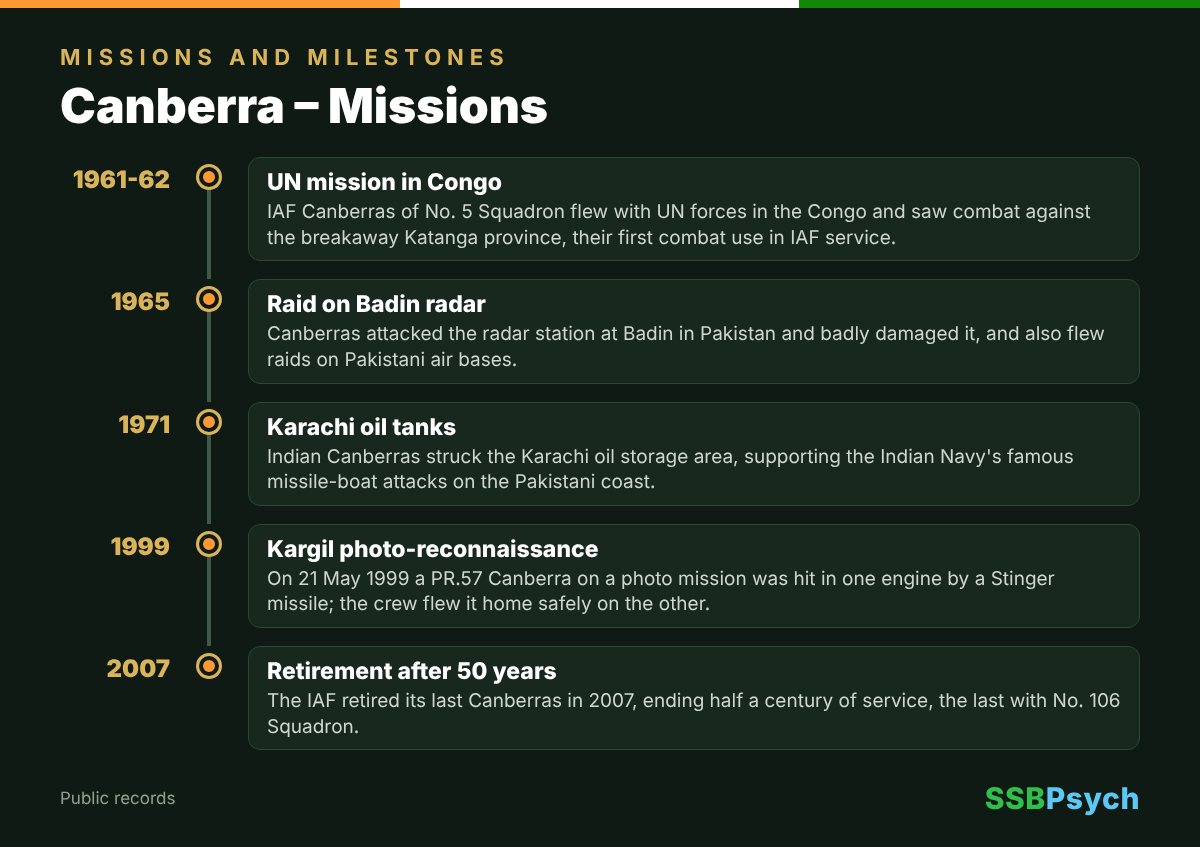
- 1961-62 – UN mission in Congo: IAF Canberras of No. 5 Squadron flew with UN forces in the Congo and saw combat against the breakaway Katanga province, their first combat use in IAF service.
- 1965 – Raid on Badin radar: Canberras attacked the radar station at Badin in Pakistan and badly damaged it, and also flew raids on Pakistani air bases.
- 1971 – Karachi oil tanks: Indian Canberras struck the Karachi oil storage area, supporting the Indian Navy’s famous missile-boat attacks on the Pakistani coast.
- 1999 – Kargil photo-reconnaissance: On 21 May 1999 a PR.57 Canberra on a photo mission was hit in one engine by a Stinger missile; the crew flew it home safely on the other.
- 2007 – Retirement after 50 years: The IAF retired its last Canberras in 2007, ending half a century of service, the last with No. 106 Squadron.

Where It Was Based and Who Flew It
Over 50 years, Canberras flew from several IAF bases. The photo-reconnaissance unit, No. 106 Squadron, was first positioned at Bareilly and later at Agra, as publicly recorded in squadron histories. No. 5 Squadron ‘Tuskers’ flew the bomber version until 1981, when it converted to the Jaguar.
Like other IAF squadrons, a Canberra squadron was usually commanded by a Wing Commander, supported by Squadron Leaders and younger officers. The Canberra had a pilot and a navigator working closely together, and some versions also carried a third crew member. The navigator’s job was vital: in the days before GPS, finding a target hundreds of kilometres away at night needed maps, stopwatches and sharp skills.
Pilots reached the Canberra after basic and advanced flying training, and the IAF’s T.4 dual-control trainers helped crews convert to the type. Becoming a mission-ready Canberra crew took several years of training and hundreds of flying hours.
Strengths and Limitations of the Canberra
- Strength: Very high operating altitude for its time, making it hard to intercept.
- Strength: Long range for deep strikes and long photo missions.
- Strength: Two engines, which saved the crew in Kargil.
- Strength: Flexible: bomber, interdictor, trainer and spy plane versions.
- Limitation: Slower than supersonic fighters, so it relied on night and surprise.
- Limitation: Range was still limited compared with bigger strategic bombers.
- Limitation: Old design by the 1990s, with ageing airframes and rising accidents.
- Limitation: No modern precision-guided weapons in its main IAF role.
Legacy of the Canberra in India
The Canberra was also a worldwide success. It served with many air forces, including those of Britain, Australia, New Zealand, Argentina and South Africa, and an American-built version flew with the United States. That India kept it flying until 2007 shows how sound the original design was and how well IAF engineers looked after it.
Although the Canberra is retired, you can still see one. A Canberra B(I).58 is displayed at the Indian Air Force Museum at Palam in New Delhi. Standing beside it, you can appreciate the long, broad wings that carried it so high for so many years.
Its roles have passed to modern aircraft. Long-range strike is now handled by jets like the Su-30MKI and Rafale, often with tanker support, while reconnaissance is done by specialised aircraft, drones and satellites. Yet the Canberra’s story, from Congo to Kargil, remains one of the proudest chapters in IAF history.
Why the Canberra Matters for SSB and AFCAT Aspirants
Questions on IAF history, the 1965 and 1971 wars, UN peacekeeping and Kargil appear regularly in AFCAT, CDS and NDA papers. In the SSB interview, an officer may ask about famous IAF operations or about India’s role in UN missions. The Canberra links all of these topics in one story.
It also teaches a lesson worth sharing in group discussions: a well-designed aircraft, kept in good condition and flown by skilled crews, can stay useful for decades, but every fleet eventually needs replacing on time. You can also use the Kargil Canberra story as an example of officer-like qualities: courage under fire, calm decision-making, teamwork between pilot and navigator, and a strong sense of duty to complete the mission and bring the aircraft and crew home safely.
Did You Know?
- The Canberra served the IAF for about 50 years, from 1957 to 2007.
- Its wingspan and length were almost the same, just under 20 metres.
- No. 5 Squadron ‘Tuskers’ was the first IAF Canberra bomber unit.
- IAF Canberras saw their first combat with UN forces in the Congo.
- A Canberra raid on Karachi’s oil tanks helped the Navy in the 1971 war.
- In Kargil, a Canberra survived a Stinger missile hit and flew home on one engine.
- A Canberra B(I).58 is on display at the IAF Museum, Palam.
Quiz: Test Your Knowledge of Canberra
Click an option to see if you are right. Your score updates live.
Canberra: Frequently Asked Questions
The Canberra served the IAF from 1957 until its retirement in 2007, about 50 years.
The Canberra could reach about 870 km/h and fly as high as about 14,600 metres.
IAF Canberras flew bombing missions, including a raid on the Karachi oil tanks that supported the Indian Navy’s missile-boat attacks.
On 21 May 1999 a PR.57 Canberra on a photo mission was hit by a Stinger missile in one engine, but the crew flew it safely back to base.
A Canberra B(I).58 is displayed at the Indian Air Force Museum at Palam, New Delhi.
This is part 20 of 50 in SSBPsych’s Indian Air Force aircraft series – a new aircraft every evening at 6 PM.
Sources: en.wikipedia.org, en.wikipedia.org, en.wikipedia.org, en.wikipedia.org.
Preparing for NDA, CDS, AFCAT or your SSB? Join SSBPsych’s online and offline batches – explore our courses or call +91 8076540582.