Project-77 nuclear attack submarine: India’s SSN Plan
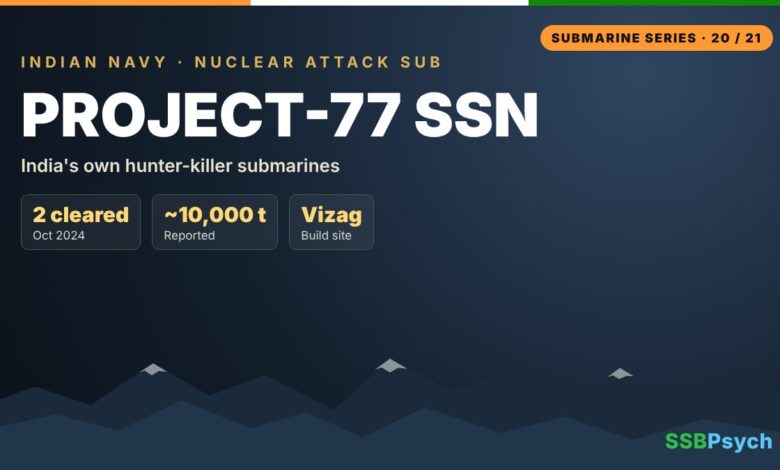
Picture a submarine that can cross the Indian Ocean at high speed without ever coming up for air, then wait silently for months near an enemy fleet, limited only by how much food it carries. That is a nuclear-powered attack submarine, and India is now designing its own. The Project-77 nuclear attack submarine programme, as it is widely called in the media, aims to give the Indian Navy home-built hunter-killer boats powered by a nuclear reactor.
In this explainer we cover what an SSN is, how it differs from India’s Arihant class, why the Navy wants these boats, what has been officially cleared, the reported cost and size, the timeline, what drives running costs, the dangers, and what life on a nuclear submarine is like. Many details of such programmes are secret, and we clearly mark what is only reported or not public.

What Is a Project-77 Nuclear Attack Submarine?
Navies use letter codes for submarine types. SS means submarine and N means nuclear-powered. So:
- SSK: a conventional diesel-electric attack submarine, like India’s Kalvari class.
- SSBN: a nuclear-powered submarine carrying ballistic missiles. Its main job is nuclear deterrence. India’s Arihant class boats are SSBNs.
- SSN: a nuclear-powered attack submarine, often called a hunter-killer. It hunts enemy submarines and ships, escorts the fleet and gathers intelligence.
Project-77 is about the third kind. The programme has been reported under a few names over the years, including Project-75 Alpha, but Project-77 is the name now most often used in news reports. The submarines are to be designed in India, with the Navy’s own designers playing a lead role.
How a Nuclear Submarine Works, in Simple Words
A diesel-electric submarine is like a phone that runs on a battery and must regularly come up to charge. A nuclear submarine is like a phone plugged into a power socket that never runs out. Inside it, a compact nuclear reactor produces heat. That heat turns water into steam, the steam spins turbines, and the turbines drive the propeller and generate electricity.
Because the reactor needs no air, the submarine never has to snorkel. It also makes its own fresh water and oxygen from sea water. Its real limits are food, crew endurance and maintenance. A nuclear boat can also run fast for long periods, something a battery-powered boat simply cannot do without draining itself in hours.
Why India Needs Its Own SSNs
The Indian Ocean is huge, and India’s interests stretch from the Gulf of Aden to the Malacca Strait. Conventional submarines are excellent closer to home, but they are slow when transiting long distances and must surface regularly. SSNs fill that gap.
- Reach and speed: an SSN can move quickly across the ocean and stay on station far from home.
- Protecting the fleet: SSNs can sail ahead of aircraft carrier groups like INS Vikrant, hunting hostile submarines.
- Guarding India’s SSBNs: attack submarines help keep areas safe for the Arihant class deterrent boats.
- Watching rivals: China operates nuclear submarines, and its ships and submarines are increasingly reported in the Indian Ocean.
- Self-reliance: designing and building SSNs at home gives India rare technology that only a few countries have.
Only a handful of nations, including the USA, Russia, China, the UK and France, design and build their own nuclear-powered attack submarines. Joining that group would be a major leap for Indian shipbuilding and science.
Project-77 nuclear attack submarine Timeline
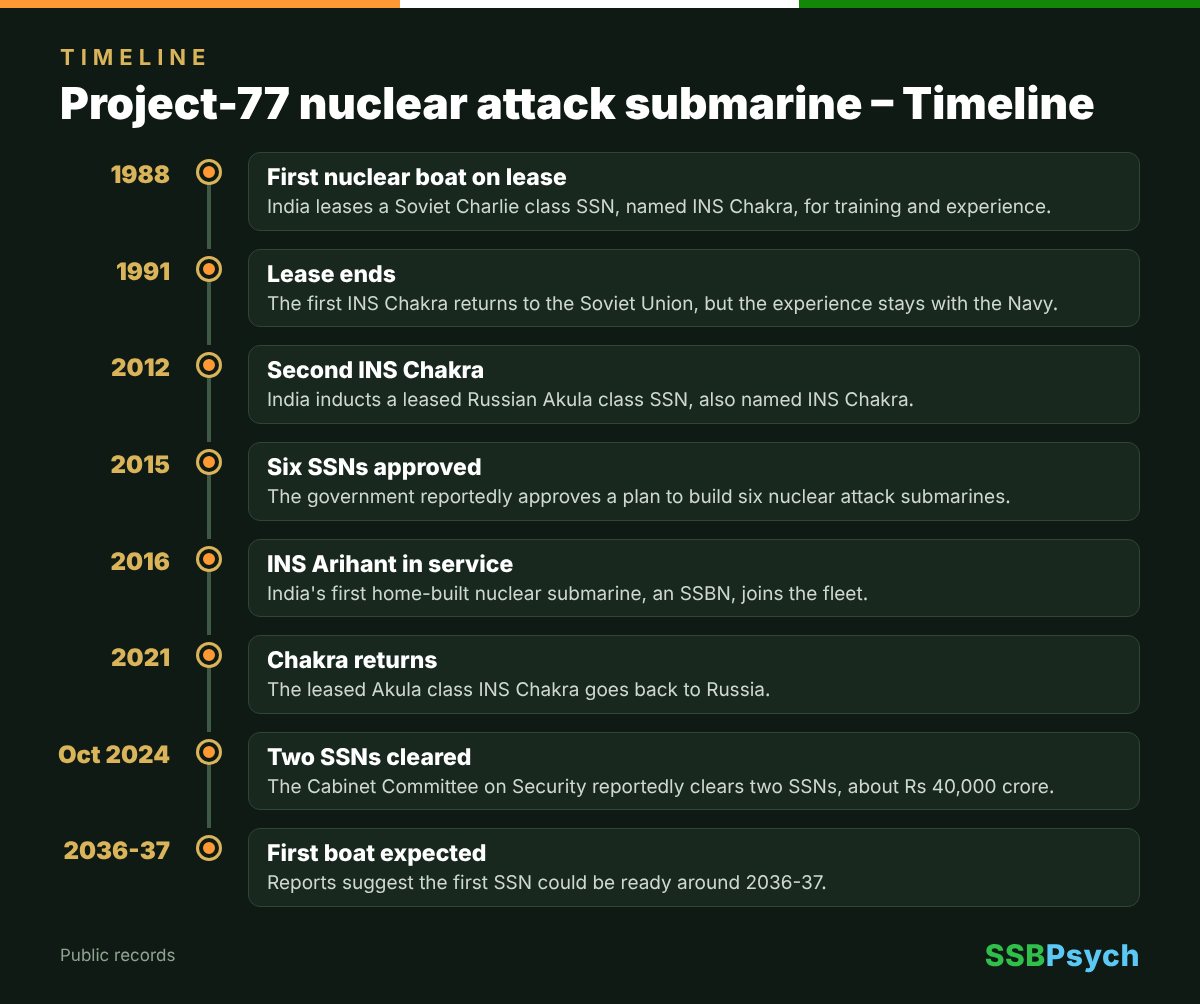
- 1988 – First nuclear boat on lease: India leases a Soviet Charlie class SSN, named INS Chakra, for training and experience.
- 1991 – Lease ends: The first INS Chakra returns to the Soviet Union, but the experience stays with the Navy.
- 2012 – Second INS Chakra: India inducts a leased Russian Akula class SSN, also named INS Chakra.
- 2015 – Six SSNs approved: The government reportedly approves a plan to build six nuclear attack submarines.
- 2016 – INS Arihant in service: India’s first home-built nuclear submarine, an SSBN, joins the fleet.
- 2021 – Chakra returns: The leased Akula class INS Chakra goes back to Russia.
- Oct 2024 – Two SSNs cleared: The Cabinet Committee on Security reportedly clears two SSNs, about Rs 40,000 crore.
- 2036-37 – First boat expected: Reports suggest the first SSN could be ready around 2036-37.
What Has Been Officially Cleared?
According to widely published reports, the government approved a plan for six nuclear attack submarines in 2015. In October 2024, the Cabinet Committee on Security, India’s top decision-making body on defence, reportedly cleared the construction of the first two SSNs. Navy leadership later said publicly that the long-term plan is for six boats.
The submarines are expected to be built at the Ship Building Centre (SBC) in Visakhapatnam, the same secure facility associated with the Arihant class. Private industry, including Larsen and Toubro, has been reported as a partner for parts of the work. A new, more powerful reactor for these boats has been reported to be under development by India’s atomic energy establishment.
Size, Speed, Crew and Diving Depth
Here honesty matters. Officially, very little has been published. October 2024 media reports described the planned boats as displacing close to 10,000 tonnes, which would make them several times heavier than a Kalvari class submarine. To picture it, that is roughly the weight of 8,000 cars.
The exact speed, crew size, weapons load and diving depth are not public, and for a nuclear submarine such details are normally classified. Any number you see on social media that claims to be the official diving depth should be treated with caution. Generally, SSNs carry heavyweight torpedoes and anti-ship and land-attack cruise missiles, but the final fit of the Indian boats has not been officially announced.
Who commands a nuclear submarine?
Nuclear submarines are commanded by an experienced senior officer, of Commander or Captain rank, who has served on submarines for many years. The crew includes officers trained specially in nuclear propulsion and reactor safety, alongside weapons, sonar, navigation and electrical specialists.

How Much Does the Project-77 Nuclear Attack Submarine Cost?
The October 2024 clearance for two boats was reported at about Rs 40,000 crore. Earlier media estimates for the programme varied widely, and the final cost will depend on the reactor, design changes, weapons and how long the build takes. Large defence projects of this kind often see their costs revised over a decade or more.
What drives running costs?
Running costs for Indian SSNs have not been reported. In general, the big cost drivers for any nuclear submarine are:
- Nuclear fuel and the strict safety systems around the reactor.
- Specialised shore infrastructure, such as secure berths, reactor maintenance facilities and radiation monitoring.
- Long, complex refits that can take years.
- Highly trained crews, often operating in two rotating teams so the boat can spend more time at sea.
- Costly weapons such as torpedoes and cruise missiles.
- Eventually, safe decommissioning and disposal of the reactor, which is itself expensive.
India’s Path to the SSN
India did not start from zero. In 1988 it leased a Soviet Charlie class nuclear attack submarine and named it INS Chakra. That boat returned in 1991, but it gave the Navy its first hands-on experience of nuclear operations. In 2012 India leased a Russian Akula class SSN, again named INS Chakra, which served until 2021. India was also reported in 2019 to have agreed to lease another Akula class submarine from Russia.
Alongside these leases, India built its own nuclear-powered ballistic missile submarines. INS Arihant was commissioned in 2016 and INS Arighaat in 2024. Building them gave Indian engineers experience in compact reactors, nuclear safety and hull construction, all of which feed into the SSN programme.
How an SSN Hunts Under the Sea
Underwater, light and radio waves barely travel, so submarines rely on sound. An SSN carries large sonar arrays in its bow and along its sides, and often a long cable of hydrophones, called a towed array, trailing far behind it. Trained sonar operators listen for the unique sounds of propellers, pumps and engines, almost like recognising a person by their voice. Once a target is identified and tracked, the commander can follow it quietly for hours or days, or attack if ordered in war.
The biggest advantage of an SSN in this game is that it can keep up. A diesel-electric boat chasing a fast-moving warship would soon run its battery flat. A nuclear boat can match the pace for as long as needed, which is why navies prize SSNs for escorting carrier groups and shadowing enemy submarines.
Challenges Ahead
Building an SSN is one of the hardest engineering jobs in the world. The reactor must be small, powerful, extremely safe and quiet. The hull must be strong yet light. Thousands of systems, from sonar to life support, must work together flawlessly. India also needs enough skilled engineers, welders and nuclear-trained sailors, along with secure shore facilities. These are the reasons the first boat is expected only in the second half of the 2030s. Steady funding and patience will decide how fast the programme moves.
Dangers on a Nuclear Submarine
Nuclear submarines are built with many layers of safety, but the environment is unforgiving. Fire, flooding and toxic gases are still the biggest dangers, as on any submarine. The reactor is heavily shielded, and crews wear dosimeters that track radiation exposure, which in normal service is kept very low. Deep below the surface, pressure is enormous, and any hull leak is serious. The 2000 loss of the Russian submarine Kursk after a torpedo explosion, and India’s own loss of the conventional submarine INS Sindhurakshak in a 2013 explosion in Mumbai harbour, are grim reminders of why safety drills never stop.
Life on Board a Nuclear Submarine
Bigger than conventional boats, nuclear submarines usually offer slightly more space, but life is still tough. Patrols can last for weeks or months with no sunlight. The boat makes its own oxygen and fresh water, so air and showers are less of a problem than on older diesel boats. Days are organised around watch shifts, maintenance, drills, meals and sleep. Communication with family is very limited during patrols, which tests the mental strength of every sailor.
Crews are selected carefully and trained for years. Officers need strong technical knowledge, calm judgment and leadership under pressure, the very qualities an SSB board looks for. Many submariners describe the sense of trust and brotherhood on board as unlike anything else in the armed forces.
Key Points for Defence Aspirants
- SSN means nuclear-powered attack submarine; SSBN means nuclear-powered ballistic missile submarine.
- India’s Arihant class boats are SSBNs, not SSNs.
- The CCS reportedly cleared two indigenous SSNs in October 2024, with six planned in total.
- The boats are to be built at the Ship Building Centre, Visakhapatnam.
- India earlier leased two SSNs named INS Chakra, in 1988 and 2012.
Did You Know?
- A nuclear submarine can make its own drinking water and oxygen from sea water.
- On a nuclear submarine, food is often the main limit on how long it stays submerged.
- INS Chakra was the name of both nuclear attack submarines India leased.
- Only a few countries design and build their own nuclear attack submarines.
- Nuclear submarines can run at high speed for long periods without surfacing, unlike battery-powered boats.
Quiz: Test Your Knowledge of Project-77 nuclear attack submarine
Click an option to see if you are right. Your score updates live.
Project-77 nuclear attack submarine: Frequently Asked Questions
It is India’s programme to design and build its own nuclear-powered attack submarines (SSNs). The first two were reportedly cleared by the Cabinet Committee on Security in October 2024.
An SSN is a nuclear-powered attack submarine that hunts ships and submarines. An SSBN carries ballistic missiles for nuclear deterrence, like India’s Arihant class.
The October 2024 clearance for two boats was reported at about Rs 40,000 crore. Final costs are not officially published.
Reports suggest the first boat could be ready around 2036-37, but timelines for such complex projects can change.
It has not been made public. Diving depth and speed of nuclear submarines are usually classified.
This is part 20 of 21 in SSBPsych’s submarine series – a new post every morning at 10 AM.
Sources: en.wikipedia.org, en.wikipedia.org, pib.gov.in, indiannavy.nic.in.
Preparing for NDA, CDS, AFCAT or your SSB? Join SSBPsych’s online and offline batches – explore our courses or call +91 8076540582.