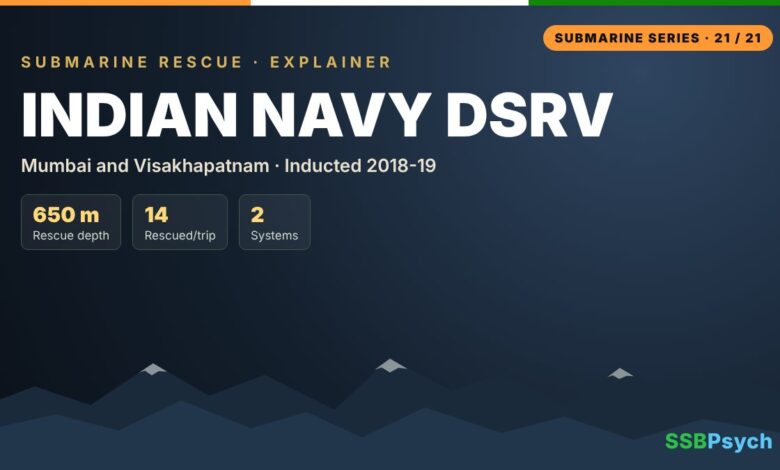
Indian Navy DSRV: How a Trapped Submarine Crew Is Rescued
It is every submariner’s worst nightmare. A fault, a fire or a collision, and suddenly the submarine is lying on the seabed, unable to surface. The air is slowly getting stale, the cold is creeping in, and the crew can only wait and hope. This is where the Indian Navy DSRV, a small rescue submarine built for exactly this moment, comes in.
In this explainer we look at what a DSRV is, how a trapped crew is actually rescued step by step, where India keeps its rescue systems, how deep they can go, what they cost, the dangers involved and how submariners train to survive. Everything here is based on publicly reported information.

What Is an Indian Navy DSRV?
DSRV stands for Deep Submergence Rescue Vehicle (sometimes called a Deep Submergence Rescue Vessel). It is a small, crewed rescue submarine that dives down to a disabled submarine, docks onto its escape hatch, takes the trapped sailors on board, and brings them back up safely. Think of it as an underwater lift that connects to the sunken boat like a space capsule docking with a space station.
India’s DSRV is part of a complete submarine rescue system. The system includes the rescue vehicle itself, a remotely operated vehicle (ROV) for scouting, side-scan sonar to find the wreck, a launch and recovery system to lower and lift the DSRV, and decompression chambers to treat rescued sailors. The whole package can be moved by air and road and fitted on a ship.
Escape versus rescue
- Escape means the crew leaves the submarine on their own, usually wearing special suits and rising to the surface. It is only possible at relatively shallow depths.
- Rescue means help comes from outside. A DSRV or rescue bell docks with the submarine and transfers the crew without exposing them to the sea. It works at much greater depths.
India’s Submarine Rescue Systems
For many years India depended on help from other navies for deep submarine rescue. That changed in 2016, when the Navy signed a contract with the UK company JFD (James Fisher Defence) for two third-generation rescue systems, reported to include long-term support. The first system was formally inducted in December 2018 in Mumbai, and the second came into service in 2019, based at Visakhapatnam.
This placement is smart. Mumbai hosts the Western Naval Command and Visakhapatnam the Eastern Naval Command, so one system covers each side of the peninsula. With these systems India became one of a small group of countries with its own dedicated deep submarine rescue capability.
Key figures (publicly reported)
- Rescue depth: up to about 650 metres.
- Capacity: a crew of 3 plus up to 14 rescued personnel per trip.
- During trials the DSRV reportedly dived beyond 660 metres and the ROV to about 750 metres.
- The system is air-transportable and can be launched from suitable ships.
- Endurance of the DSRV on a single dive: a few hours, as reported.
Indian Navy DSRV Timeline
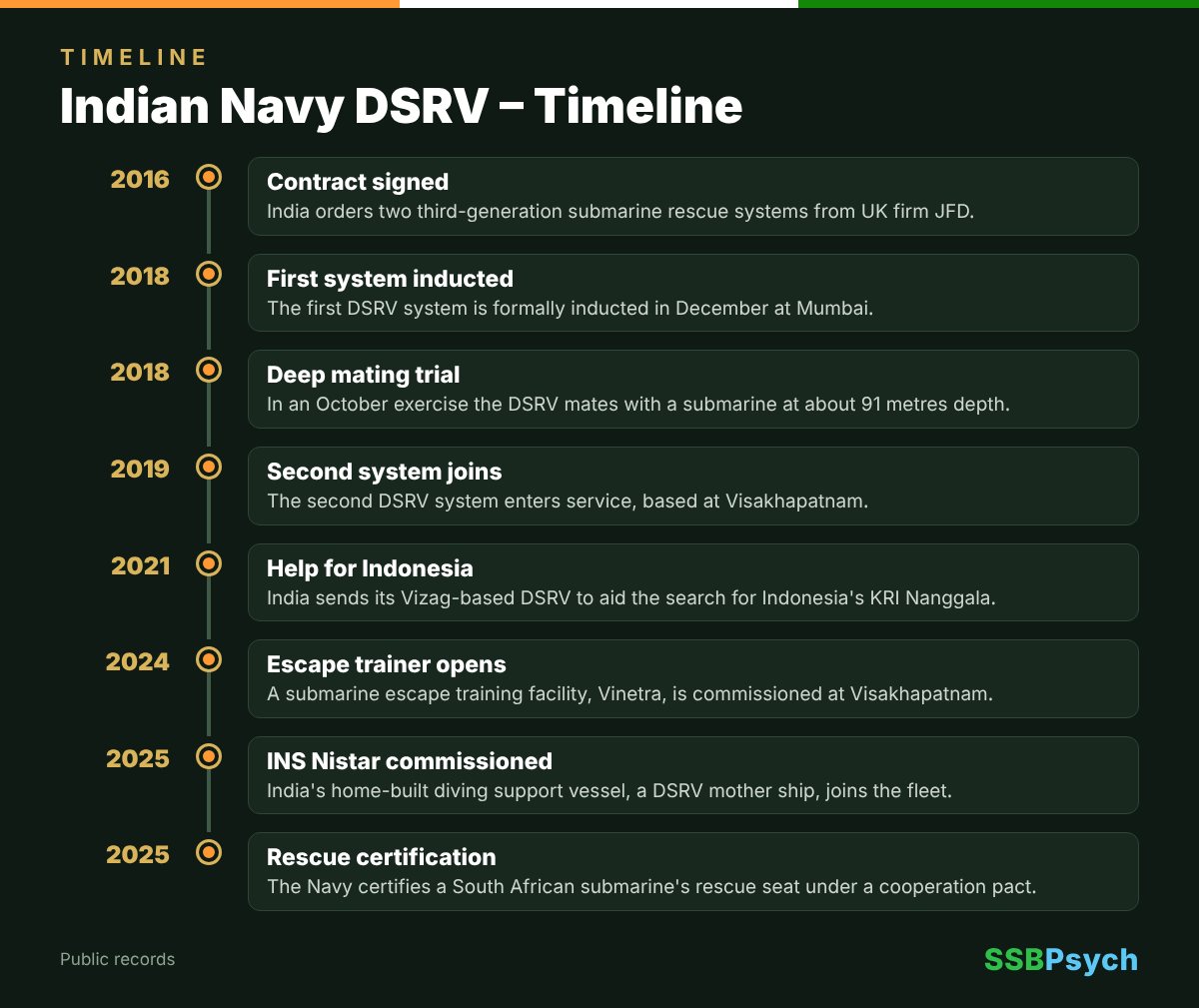
- 2016 – Contract signed: India orders two third-generation submarine rescue systems from UK firm JFD.
- 2018 – First system inducted: The first DSRV system is formally inducted in December at Mumbai.
- 2018 – Deep mating trial: In an October exercise the DSRV mates with a submarine at about 91 metres depth.
- 2019 – Second system joins: The second DSRV system enters service, based at Visakhapatnam.
- 2021 – Help for Indonesia: India sends its Vizag-based DSRV to aid the search for Indonesia’s KRI Nanggala.
- 2024 – Escape trainer opens: A submarine escape training facility, Vinetra, is commissioned at Visakhapatnam.
- 2025 – INS Nistar commissioned: India’s home-built diving support vessel, a DSRV mother ship, joins the fleet.
- 2025 – Rescue certification: The Navy certifies a South African submarine’s rescue seat under a cooperation pact.
How a Trapped Submarine Crew Is Rescued: Step by Step
Navies call a submarine in trouble on the seabed a DISSUB, short for disabled submarine. Here is how a rescue generally unfolds.
- 1. Alarm: the submarine misses a scheduled check-in or sends a distress signal. It may release an emergency buoy that floats up and transmits its position.
- 2. Mobilise: the rescue system is loaded onto its mother ship, or flown and trucked to a port and fitted on a suitable vessel.
- 3. Search: ships use sonar, including side-scan sonar, to find the submarine on the seabed.
- 4. Survey and supply: the ROV dives first to inspect the wreck, check the hatch and, if possible, pass emergency supplies such as oxygen-generating canisters and carbon dioxide absorbents.
- 5. Docking: the DSRV dives, lines up over the escape hatch and seals onto it with a special skirt. Water inside the skirt is pumped out, creating a dry tunnel.
- 6. Transfer: the hatches are opened and survivors climb into the DSRV, a group at a time.
- 7. Ascent and treatment: the DSRV returns to the mother ship. If the sailors have been breathing high-pressure air, they move under pressure into decompression chambers on deck so they can be brought back to normal pressure slowly.
- 8. Repeat: the DSRV goes back down again and again until everyone is out.
Each trip down and back can take hours, so a full rescue of a large crew can stretch over a long period. That is why time, preparation and practice matter so much.
Why decompression matters
If a damaged submarine floods partly, the air inside can become pressurised. The human body absorbs extra gas at high pressure. If the pressure drops suddenly, those gases form bubbles in the blood and tissues, causing the painful and dangerous condition called decompression sickness, or ‘the bends’. Decompression chambers reduce the pressure step by step, giving the body time to release the gas safely, just like a diver who rises slowly.
Operations and Missions
- Oct 2018 – Rescue exercise: The DSRV mated with an Indian submarine at about 91 m, proving the system at sea.
- Apr 2021 – KRI Nanggala search: The Visakhapatnam DSRV was flown and sailed to help Indonesia search for its lost submarine.
- 2024 – Exercise Milan: The DSRV capability was showcased to partner navies during Exercise Milan 2024 (reported).
- Aug 2025 – South Africa certification: Rescue seat certification completed for SAS Manthatisi under a 2024 pact.
Mother Ships: INS Nistar and INS Nipun
A DSRV needs a ship to carry it to the site and launch it. India has built its own diving support vessels for this job at Hindustan Shipyard Limited, Visakhapatnam. The first, INS Nistar, was commissioned in July 2025 and is based at Visakhapatnam. Its sister, INS Nipun, was delivered in 2026 and is intended to be based at Mumbai. These ships are about 118 metres long and are reported to displace over 9,000 tonnes.
Besides carrying the DSRV, these ships support deep-sea diving with decompression chambers and remotely operated vehicles. Before they arrived, the rescue system could be fitted on other suitable ships, known as vessels of opportunity, which is still a useful backup.

Submarine Escape: The First Line of Survival
Rescue takes time to arrive, so submariners are also trained to escape on their own in shallower water. Submariners use special full-body escape suits that keep them warm and act like a life jacket. Modern suits of this kind are rated for escape from depths of up to about 185 metres in ideal conditions. The sailor enters an escape trunk, the compartment is flooded and pressurised, the hatch opens and the sailor rises quickly to the surface, breathing out steadily to protect the lungs.
This is risky and demands perfect training. In 2024 the Navy commissioned Vinetra, a submarine escape training facility at Visakhapatnam, where crews practise these procedures in a controlled setting. Some older Indian submarines, such as the Shishumar class, are also reported to carry an escape sphere that can lift the crew to the surface together.
Why India Needs Its Own Indian Navy DSRV Capability
- Speed: trapped sailors have limited air and warmth. Waiting for foreign help could cost lives.
- Growing fleet: India operates conventional and nuclear submarines on both coasts, and more are coming.
- Morale: crews dive with more confidence knowing a rescue system is ready.
- Regional role: India can help friendly navies in the Indian Ocean, as it tried to do for Indonesia in 2021.
- Partnerships: rescue cooperation agreements build trust with other navies.
Cost and Running Cost Drivers
The 2016 JFD contract for two systems, including long-term support, was reported at about 193 million pounds. India-specific running costs are not public. In general, the costs come from keeping the systems on high alert round the clock, regular maintenance and certification of the DSRV and its pressure hull, operating the mother ships, training rescue crews and divers, and running frequent exercises with submarines. A rescue system that is not regularly exercised cannot be trusted on the day it is needed.
Dangers of Submarine Rescue
Rescue is dangerous for everyone involved. The disabled submarine may be lying at an awkward angle, making docking difficult. Strong currents, poor visibility and debris can hamper the DSRV. The rescue crew themselves are working at great depth inside a small vehicle. Inside the trapped submarine, rising carbon dioxide, falling oxygen, cold and possibly toxic gases from fire or batteries threaten survival. History shows how unforgiving this can be: in 2000 the entire crew of Russia’s Kursk was lost, while in 2005 all seven crew of the Russian mini-submarine AS-28, trapped at about 190 metres, were saved with international help.
Life of a Rescue Team
The DSRV is operated by a small team of specially trained Navy personnel, supported by divers, medical officers and technicians who handle the decompression chambers. They train regularly in mock rescues, practising docking with real submarines and transferring ‘survivors’ under pressure. The team must be ready to move at short notice, day or night. It is a quiet, rarely seen job, but every submariner on patrol knows these people are their lifeline.
Surviving the Wait Inside a Disabled Submarine
While rescuers race to the scene, the trapped crew has its own drill to follow. The senior surviving officer takes charge and moves everyone into the safest compartment. Sailors stay still and quiet as much as possible, because every movement uses more oxygen and produces more carbon dioxide. Emergency kits release oxygen, and chemical absorbents soak up carbon dioxide. Warm clothing is shared, since the sea at depth is cold. The crew may tap on the hull or use emergency signals so searchers can locate them. Calm leadership in these hours can make the difference between life and death.
How the Indian Navy DSRV Works With Other Navies
Submarine rescue is one area where navies cooperate even with countries they rarely work with otherwise, because every submariner faces the same danger. India’s systems are designed to mate with hatches of many different submarines, and the Navy has signed rescue cooperation arrangements with friendly countries. In 2025, for example, the Navy completed certification of a South African submarine’s rescue seat, the fitting where a DSRV docks, under a pact signed in 2024. International coordination is supported by ISMERLO, which helps match available rescue assets to an emergency anywhere in the world.
Did You Know?
- The DSRV docks with a submarine’s hatch using a sealing skirt, then pumps out the water to create a dry passage.
- India’s rescue systems are based on both coasts: Mumbai and Visakhapatnam.
- The international body ISMERLO, set up after the Kursk tragedy, helps coordinate submarine rescues worldwide.
- A rescued sailor may need hours in a decompression chamber before stepping outside.
- India sent its DSRV to help Indonesia search for KRI Nanggala in 2021.
- Modern rescue systems can be flown across the world by large cargo aircraft and fitted on a ship near the accident site.
Quiz: Test Your Knowledge of Indian Navy DSRV
Click an option to see if you are right. Your score updates live.
Indian Navy DSRV: Frequently Asked Questions
It is a Deep Submergence Rescue Vehicle, a small crewed rescue submarine that docks with a disabled submarine and brings trapped sailors to the surface. India has two such systems.
It is reported to be able to rescue crews from depths of up to about 650 metres.
One is based at Mumbai on the west coast and the other at Visakhapatnam on the east coast.
The submarine is located with sonar, an ROV surveys it, then the DSRV docks onto the escape hatch, transfers survivors and brings them up, where they may be treated in decompression chambers.
Escape means sailors leave on their own using escape suits, possible only at shallower depths. Rescue means a DSRV or rescue bell comes to take them out.
This is part 21 of 21 in SSBPsych’s submarine series – a new post every morning at 10 AM.
Sources: en.wikipedia.org, en.wikipedia.org, en.wikipedia.org, indiannavy.nic.in.
Preparing for NDA, CDS, AFCAT or your SSB? Join SSBPsych’s online and offline batches – explore our courses or call +91 8076540582.