An-32 in Indian Air Force: Specs, Payload, Speed and History
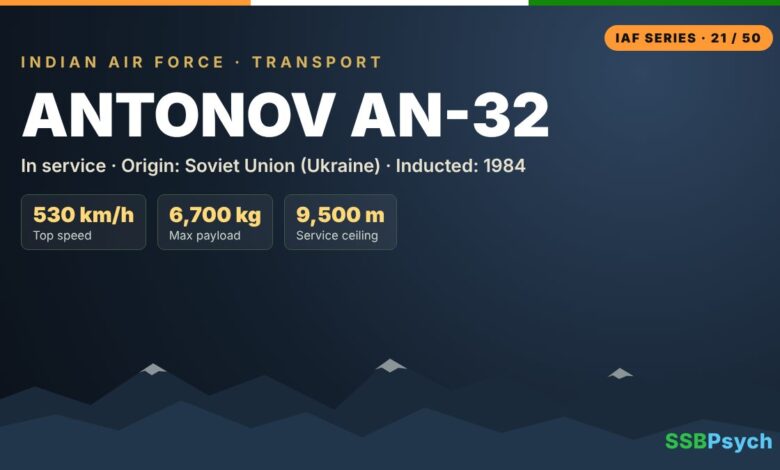
Picture a narrow strip of gravel more than 16,000 feet up in Ladakh, where the air is so thin that a fit person gasps after climbing a few stairs. Now picture a twin-engine aircraft loaded with soldiers, rations and fuel drums touching down there. That aircraft is the An-32, the tough Soviet-built transport that has quietly kept the Indian Air Force supplied for more than four decades.
Fighter jets grab the headlines, but wars and rescues are won by logistics. Without transport aircraft, the soldiers on the Siachen glacier, the posts in Arunachal Pradesh and the islands in the Bay of Bengal would run out of food, fuel and ammunition. The An-32 has been the IAF’s everyday delivery truck of the sky since 1984.
In this guide you will learn why India bought the An-32, how it performs in simple words, what it carries, the big missions it has flown, where it is based, its strengths and weak points, and what will replace it. At the end there is a quick quiz to test what you remember, perfect for NDA, CDS and AFCAT preparation.

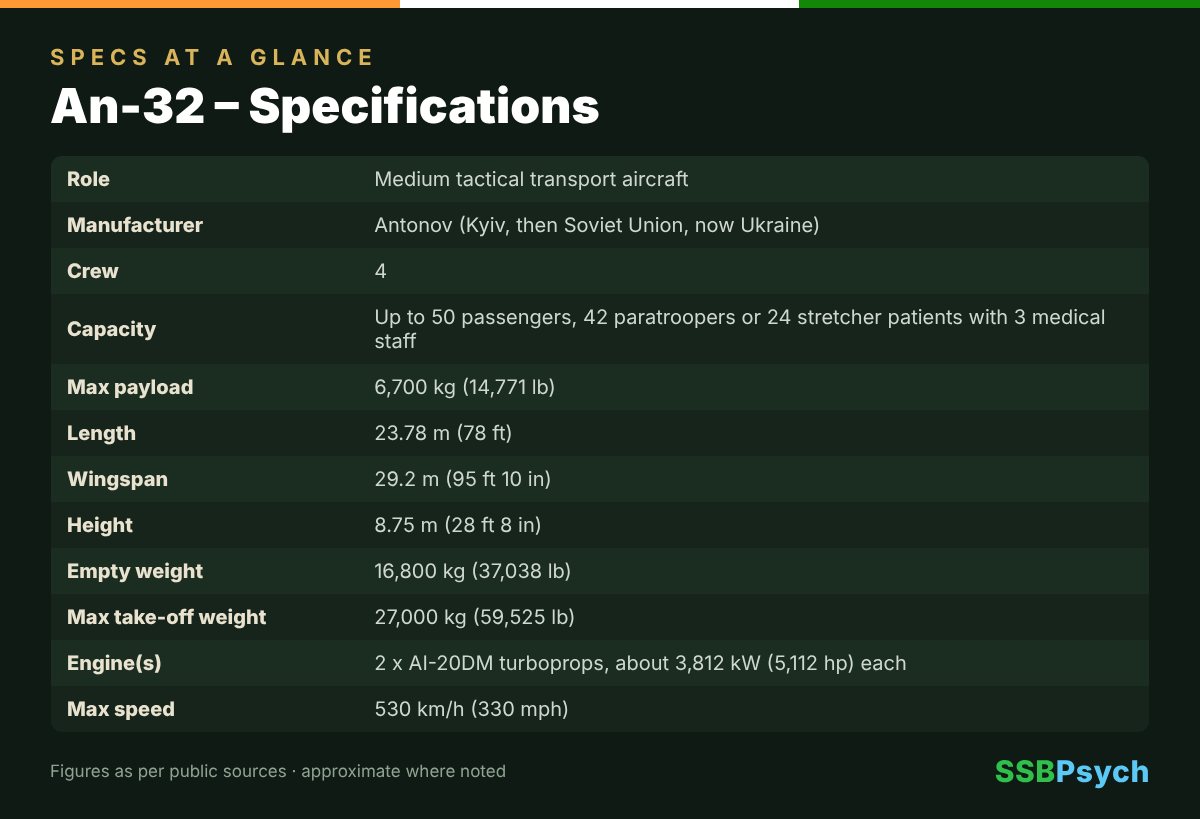
An-32 Specifications
| Role | Medium tactical transport aircraft |
| Manufacturer | Antonov (Kyiv, then Soviet Union, now Ukraine) |
| Crew | 4 |
| Capacity | Up to 50 passengers, 42 paratroopers or 24 stretcher patients with 3 medical staff |
| Max payload | 6,700 kg (14,771 lb) |
| Length | 23.78 m (78 ft) |
| Wingspan | 29.2 m (95 ft 10 in) |
| Height | 8.75 m (28 ft 8 in) |
| Empty weight | 16,800 kg (37,038 lb) |
| Max take-off weight | 27,000 kg (59,525 lb) |
| Engine(s) | 2 x AI-20DM turboprops, about 3,812 kW (5,112 hp) each |
| Max speed | 530 km/h (330 mph) |
| Cruise speed | 470 km/h (290 mph) |
| Range | About 2,500 km (1,600 mi) with a 3,700 kg load |
| Service ceiling | 9,500 m (31,200 ft) |
| First flight | 9 July 1976 |
| Inducted in IAF | 1984 (first aircraft received 10 July 1984) |
| Number in IAF | 125 bought between 1984 and 1991; around 100 reported still flying |
Why India Needed the An-32
By the early 1980s the IAF’s medium transport fleet was ageing. Many older piston-engine and early turboprop transports could not lift heavy loads from the hot plains in summer or from high mountain airfields, where thin air robs engines of power and wings of lift. India has some of the most difficult flying terrain on Earth, from the Thar desert to the Himalaya, and it needed an aircraft that could handle both.
The Antonov An-32 was designed for exactly this job. It is a development of the An-26, but with much more powerful engines mounted high above the wings. Antonov built it to take off in extreme heat of up to 55 degrees Celsius and from airfields as high as 4,500 metres (about 14,800 feet). That made it a natural fit for India, which also enjoyed close defence ties with the Soviet Union at the time.
India became the biggest customer for the type. Bharat Rakshak records that the IAF acquired 125 An-32s from the Soviet Union between 1984 and 1991, making it one of the largest single transport fleets the IAF has ever operated.
History of the An-32 in the IAF
Before saying yes, the IAF put the aircraft through tough trials in early 1984. Test teams flew it at Agra in the plains, at Jorhat, Walong and Along in the North-East, and at Leh and Thoise in Ladakh. The final debrief took place at Air Headquarters in March 1984. On 10 July 1984 the IAF formally received its first three An-32s at Palam in Delhi.
No. 12 Squadron was the first unit linked to the type in 1984, and Nos. 43, 48 and 49 Squadrons soon followed. Over the years at least eight IAF squadrons flew the An-32, along with the Paratroopers Training School at Agra and transport training units. For new paratroopers of the Army, the side door of an An-32 has often been the first door they jumped from.
Through the late 1980s and 1990s the An-32 became the backbone of air maintenance in the North-East, Jammu and Kashmir and Ladakh. It supported the Indian Peace Keeping Force in Sri Lanka, and in 1999 it was among the transports that kept troops and stores moving during the Kargil War.
Ageing aircraft need care. After a fatal crash in 2009, India signed a deal with Ukraine, reported at about 400 million US dollars, to modernise the fleet and stretch its life by around 15 years. Some aircraft were upgraded in Ukraine, and the rest are being upgraded in India at the IAF’s own Base Repair Depots in Kanpur and Chandigarh. Upgraded aircraft, often called the An-32RE, get modern navigation equipment, new radios and better cockpit displays.
An-32 Engine and Performance Explained Simply
The An-32 uses two AI-20DM turboprop engines. A turboprop is a jet engine that spins a large propeller instead of pushing out a fast jet of hot gas. Propellers grip the air very efficiently at low and medium speeds, which is why most tactical transports use them. Each An-32 engine produces about 5,112 horsepower, more than the combined power of 40 family hatchback cars.
The engines sit unusually high on top of the wings. This looks odd, but it is clever. It keeps the propellers far away from stones and gravel on rough strips, and the large wing flaps behind them get extra airflow. That helps the aircraft lift off from short, high-altitude runways.
Top speed is about 530 km/h, and it normally cruises at around 470 km/h. That is slower than a passenger jet, but still about 1.6 times the planned top speed of India’s Mumbai-Ahmedabad bullet train (320 km/h). A trip from Chandigarh to Leh that takes about two days by road can be flown in roughly an hour.
The service ceiling, the highest altitude at which the aircraft can still climb usefully, is about 9,500 metres (31,200 feet). That is higher than Mount Everest, which stands at 8,849 metres. With a load of 3,700 kg it can fly roughly 2,500 km, about the straight-line distance from Delhi to Chennai and a bit more.
Its payload, the useful weight it can carry, is up to 6,700 kg. Think of it as lifting about five small cars, or the food a whole army post needs for weeks. Fully loaded, the aircraft weighs up to 27,000 kg at take-off.
What It Carries
- Troops: up to about 50 passengers in the cabin
- Paratroopers: up to 42 fully equipped para jumpers
- Casualty evacuation: 24 stretchers plus 3 medical attendants
- Cargo: up to 6,700 kg of supplies, rations, fuel drums or equipment
- Air-dropped loads: supplies parachuted to posts where no runway exists
- Relief stores: food, medicines and tents during floods and disasters
The An-32 is a transport, so it does not carry missiles or guns in IAF service. Its real weapons are the soldiers, paratroopers, supplies and relief material it delivers. A rear loading ramp under the tail lets crews drive or push cargo straight in, and the same opening is used to air-drop supplies to posts that have no runway at all.
An-32 Missions and Operations
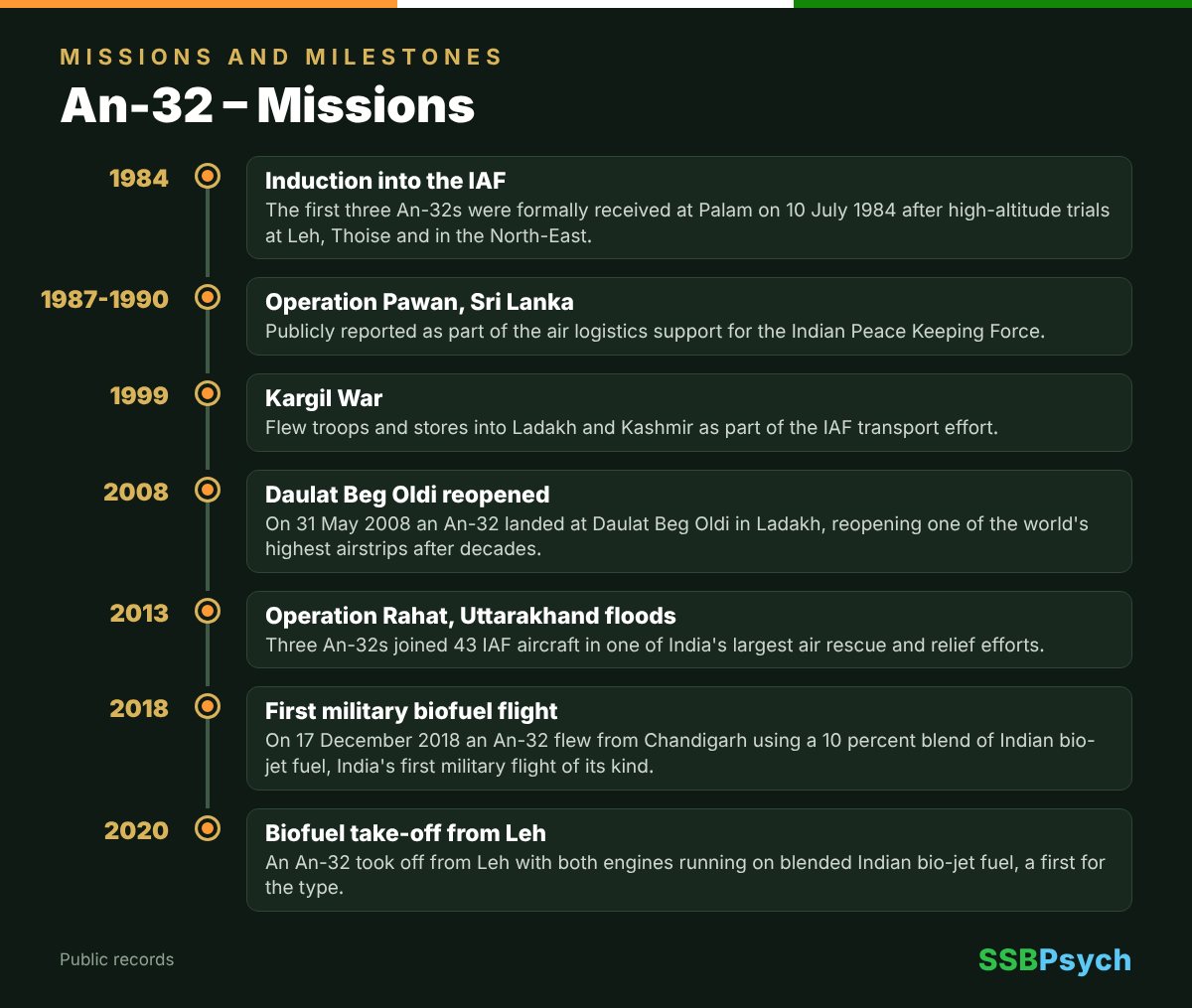
- 1984 – Induction into the IAF: The first three An-32s were formally received at Palam on 10 July 1984 after high-altitude trials at Leh, Thoise and in the North-East.
- 1987-1990 – Operation Pawan, Sri Lanka: Publicly reported as part of the air logistics support for the Indian Peace Keeping Force.
- 1999 – Kargil War: Flew troops and stores into Ladakh and Kashmir as part of the IAF transport effort.
- 2008 – Daulat Beg Oldi reopened: On 31 May 2008 an An-32 landed at Daulat Beg Oldi in Ladakh, reopening one of the world’s highest airstrips after decades.
- 2013 – Operation Rahat, Uttarakhand floods: Three An-32s joined 43 IAF aircraft in one of India’s largest air rescue and relief efforts.
- 2018 – First military biofuel flight: On 17 December 2018 an An-32 flew from Chandigarh using a 10 percent blend of Indian bio-jet fuel, India’s first military flight of its kind.
- 2020 – Biofuel take-off from Leh: An An-32 took off from Leh with both engines running on blended Indian bio-jet fuel, a first for the type.
The An-32 has also played a part in India’s green aviation story. On 17 December 2018 an IAF An-32 flew from Chandigarh using a 10 percent blend of bio-jet fuel made from Jatropha oil, a joint effort of the IAF, DRDO, CSIR-Indian Institute of Petroleum and quality assurance agencies. In the 2019 Republic Day fly-past an An-32 flew over Rajpath on blended biofuel, and in early 2020 one took off from Leh, more than 10,600 feet high, with both engines on the Indian blend.

Where the An-32 Is Based and Who Flies It
An-32 squadrons are spread across India so that help can reach every corner. Publicly reported bases over the years include Chandigarh, which supports Ladakh and Kashmir, Jorhat in Assam for the North-East, and Agra, home of the Paratroopers Training School. The aircraft also regularly flies into Advanced Landing Grounds in Arunachal Pradesh and Ladakh.
A transport squadron is usually commanded by an officer of the rank of Wing Commander, with Squadron Leaders, Flight Lieutenants and Flying Officers serving as flight commanders, captains and co-pilots. The crew of four typically includes two pilots, a navigator and a flight engineer, supported by loadmasters and technicians on the ground and in the cabin.
How do you become an An-32 pilot? After joining through NDA, CDSE or AFCAT, a flying cadet trains at the Air Force Academy, Dundigal, on basic trainers. Cadets are then split into fighter, transport and helicopter streams. Transport stream cadets move to multi-engine training, and after earning their wings they join a transport conversion course before reaching a squadron as co-pilots. Becoming a captain who can command the aircraft into a mountain strip takes several more years and hundreds of flying hours.
Strengths and Limitations
- Strength: built for heat and height, it can operate from airfields up to about 4,500 m and in temperatures up to 55 degrees Celsius.
- Strength: high-mounted engines and a rugged undercarriage let it use short, rough strips that bigger jets cannot.
- Strength: simple, proven design that Indian technicians know inside out, with upgrades done at home.
- Strength: very versatile, from paratrooping and cargo to casualty evacuation and disaster relief.
- Limitation: the basic design is from the 1970s, so even upgraded aircraft are getting old.
- Limitation: payload of about 6.7 tonnes is modest compared with newer transports like the C-130J.
- Limitation: the fleet has suffered several tragic accidents over the years, including the aircraft lost over the Bay of Bengal in 2016 and the crash in Arunachal Pradesh in 2019.
- Limitation: spares support has become harder because Antonov is based in Ukraine, which has been hit by war since 2022.
Future of the An-32
The An-32 is not retiring overnight. Upgrades at the Base Repair Depots are meant to keep a large part of the fleet flying into the next decade. Reports say the IAF plans to upgrade dozens more aircraft by around 2028-29.
At the same time, the IAF is looking to the future. The Airbus C-295, now being built in India by Tata Advanced Systems at Vadodara, is replacing the older Avro HS-748 and is expected to take over some An-32 roles. For the bigger job of fully replacing the An-32, the IAF has a Medium Transport Aircraft programme to find a modern aircraft that can lift more and fly further.
Until then, expect to see the familiar high-wing silhouette of the An-32 over Ladakh, Arunachal and the islands for years to come.
Why It Matters for SSB and AFCAT Aspirants
Questions on IAF transport aircraft appear regularly in AFCAT, CDS and NDA general awareness papers, and SSB interviewers love candidates who know their service well. If you want to join the transport stream, the An-32 tells you a lot about the job: flying into tough mountain strips, supporting soldiers, and saving lives in floods and earthquakes.
It also teaches an important lesson for Officer Like Qualities. Transport pilots work in a crew, plan carefully, respect the weather and take calm decisions under pressure. Those are exactly the qualities assessors look for in the Group Testing and Interview stages.
Did You Know?
- India bought 125 An-32s, making the IAF the largest operator of the type.
- The An-32’s engines are mounted above the wings to protect the propellers from stones on rough strips.
- An IAF An-32 reopened Daulat Beg Oldi in Ladakh, one of the highest airstrips in the world, on 31 May 2008.
- India’s first military flight on blended bio-jet fuel was flown by an An-32 on 17 December 2018.
- The An-32 can carry 42 paratroopers, which is why it has long served the Paratroopers Training School at Agra.
- Its service ceiling of 9,500 m is higher than the summit of Mount Everest.
Quiz: Test Your Knowledge of An-32
Click an option to see if you are right. Your score updates live.
An-32: Frequently Asked Questions
The An-32 has a top speed of about 530 km/h and usually cruises at around 470 km/h.
India bought 125 An-32s between 1984 and 1991. Around 100 are reported to be still in service, many of them upgraded.
It can lift up to 6,700 kg of cargo, or carry about 50 passengers, 42 paratroopers or 24 stretcher patients.
It can operate from short, high and hot airfields, so it keeps remote posts in Ladakh, Arunachal Pradesh and the islands supplied and supports relief work across India.
The C-295 is taking over some medium transport roles, and the IAF’s Medium Transport Aircraft programme aims to find a full replacement for the An-32.
This is part 21 of 50 in SSBPsych’s Indian Air Force aircraft series – a new aircraft every evening at 6 PM.
Sources: en.wikipedia.org, iafhistory.in, aajtak.in, onmanorama.com, tribuneindia.com.
Preparing for NDA, CDS, AFCAT or your SSB? Join SSBPsych’s online and offline batches – explore our courses or call +91 8076540582.