8 Gorkha Rifles: History, Motto, War Cry, Battles and Heroes
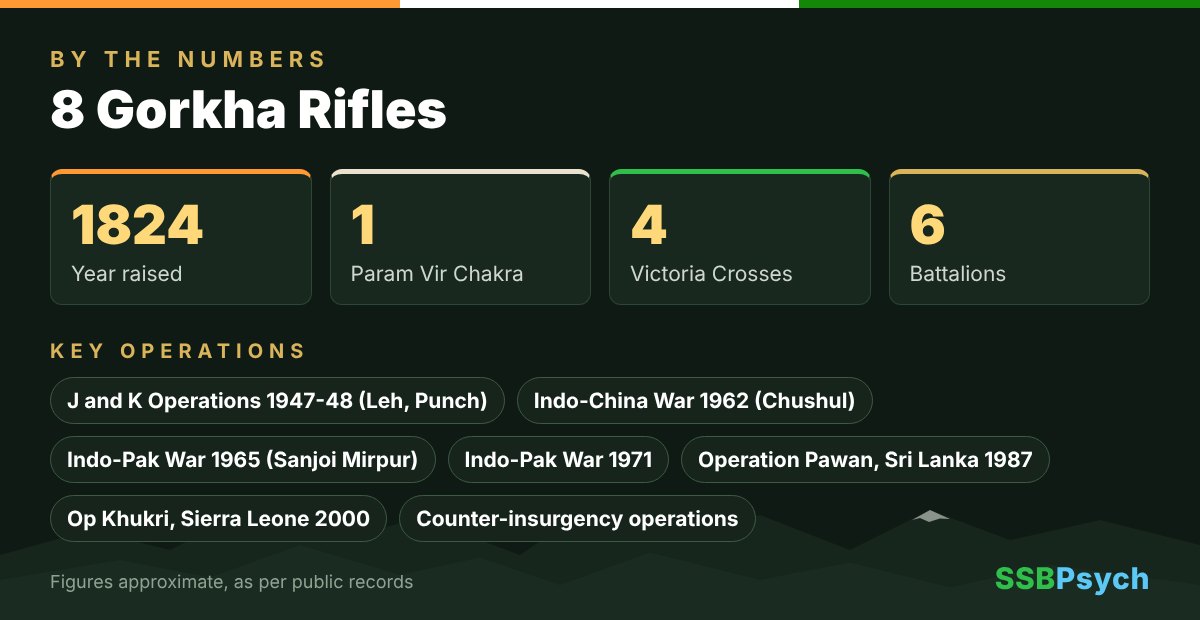
When Field Marshal Sam Manekshaw spoke about courage, he often spoke about Gorkhas, and the Gorkhas he knew best belonged to 8 Gorkha Rifles. Known proudly as the Shiny Eight, this regiment traces its roots to 1824 and has won four Victoria Crosses, a Param Vir Chakra and an army of admirers. For NDA, CDS and TES aspirants, 8 Gorkha Rifles is a perfect case study in loyalty, grit and leadership.
In this guide you will find the regiment’s history and lineage, a visual timeline, its major operations and battle honours, its motto and war cry, its greatest heroes, a look at life in a Gorkha battalion, what it means for SSB candidates, and a quiz at the end.
8 Gorkha Rifles – Quick Facts
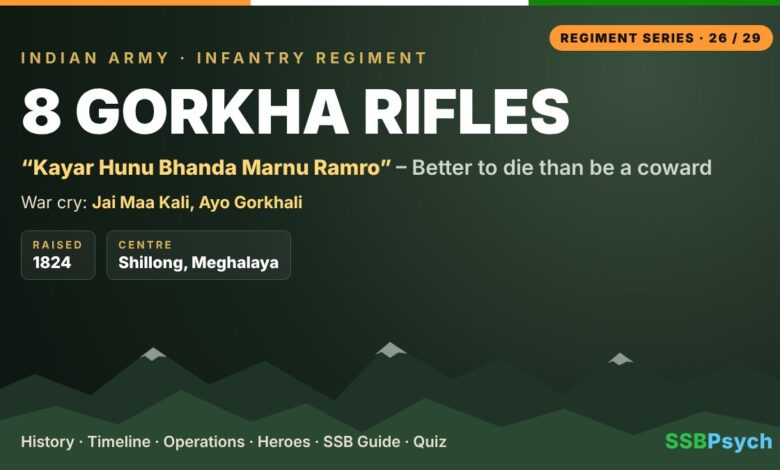
| Raised | 1824, as the 16th Sylhet Local Battalion |
| Present name | 8 Gorkha Rifles (8th Gurkha Rifles from 1903) |
| Regimental Centre | 58 Gorkha Training Centre, Shillong, Meghalaya |
| Motto | Kayar Hunu Bhanda Marnu Ramro (Better to die than be a coward) |
| War Cry | Jai Maa Kali, Ayo Gorkhali |
| Nickname | The Shiny Eight |
| Recruitment | Gorkhas from Nepal and Indian Gorkha communities |
| Battalions | 6 battalions |
| Param Vir Chakra | Major Dhan Singh Thapa, 1/8 GR, Ladakh 1962 |
| Victoria Crosses | 4, the last won by Rifleman Lachhiman Gurung in 1945 |
| Most famous officer | Field Marshal Sam Manekshaw |
History of the 8 Gorkha Rifles
The regiment began in 1824 in Sylhet, in the north-east of undivided Bengal, as the 16th Sylhet Local Battalion of the East India Company. Its first task came almost at once, as it led operations in the First Anglo-Burmese War. Over the next decades it guarded the eastern frontier, and its title changed many times: the 11th Sylhet Local Battalion, then the 44th Regiment of Bengal Native Infantry, the 44th Gurkha Rifles and finally, in 1903, the 8th Gurkha Rifles. A second battalion was added in 1907.
Frederick George Lister, who led the unit from 1828 to 1854, is remembered as the father of the regiment. Under him and his successors, the battalion fought in Bhutan in 1864 and in the Naga Hills in 1879, where Richard Ridgeway won its first Victoria Cross. In 1891, during the Manipur expedition, Lieutenant Charles Grant won a second VC for holding the post of Thobal against heavy odds. A third came in 1904, when John Duncan Grant won the VC at Gyantse during the expedition to Tibet.
In 1935, the regiment showed a different kind of courage during the Quetta earthquake. Soldiers worked to rescue people trapped under the rubble, and Nandlal Thapa was honoured with a gallantry medal that was later exchanged for the George Cross.
The First World War took the regiment to France, Egypt, Palestine and Mesopotamia. At the Battle of Loos in September 1915, the 2nd Battalion fought until only a handful of its men were left standing, a sacrifice still remembered in regimental history. The Second World War saw its battalions in Iraq, North Africa, Italy and Burma. At Taungdaw in Burma in May 1945, Rifleman Lachhiman Gurung held his trench against a determined enemy attack even after losing the use of his right hand, winning the regiment’s fourth Victoria Cross.
At Independence, the regiment was one of the six Gorkha regiments that came to the Indian Army under the 1947 Tripartite Agreement between India, Nepal and Britain. It later adopted the Indian spelling Gorkha, becoming 8 Gorkha Rifles.
8 Gorkha Rifles Timeline: From Raising to Today
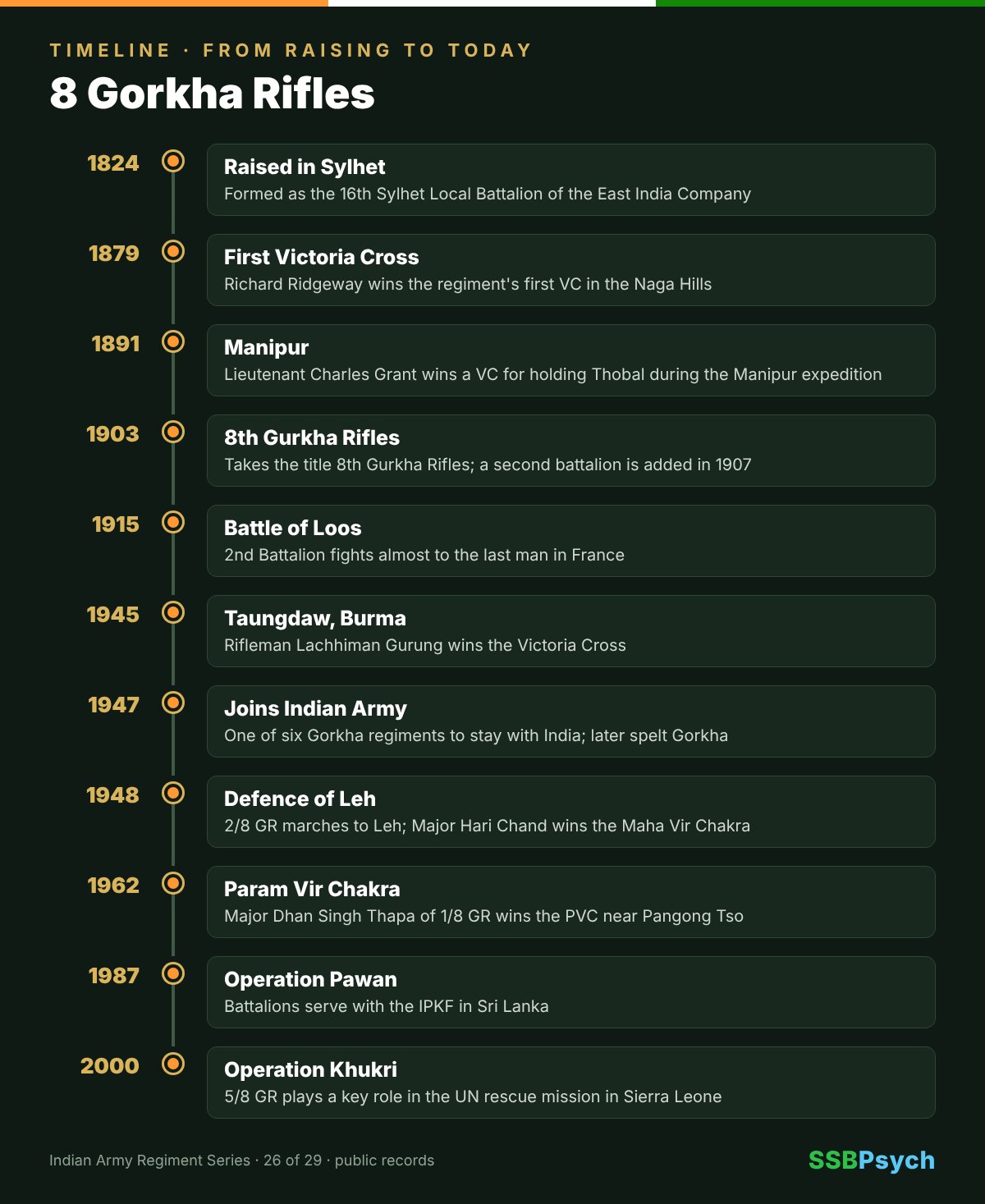
- 1824 – Raised in Sylhet: Formed as the 16th Sylhet Local Battalion of the East India Company
- 1879 – First Victoria Cross: Richard Ridgeway wins the regiment’s first VC in the Naga Hills
- 1891 – Manipur: Lieutenant Charles Grant wins a VC for holding Thobal during the Manipur expedition
- 1903 – 8th Gurkha Rifles: Takes the title 8th Gurkha Rifles; a second battalion is added in 1907
- 1915 – Battle of Loos: 2nd Battalion fights almost to the last man in France
- 1945 – Taungdaw, Burma: Rifleman Lachhiman Gurung wins the Victoria Cross
- 1947 – Joins Indian Army: One of six Gorkha regiments to stay with India; later spelt Gorkha
- 1948 – Defence of Leh: 2/8 GR marches to Leh; Major Hari Chand wins the Maha Vir Chakra
- 1962 – Param Vir Chakra: Major Dhan Singh Thapa of 1/8 GR wins the PVC near Pangong Tso
- 1987 – Operation Pawan: Battalions serve with the IPKF in Sri Lanka
- 2000 – Operation Khukri: 5/8 GR plays a key role in the UN rescue mission in Sierra Leone
Major Operations and Battle Honours of 8 Gorkha Rifles
After 1947, the regiment fought in every major war of independent India. Its post-Independence battle honours include Punch, Chushul and Sanjoi Mirpur, along with theatre honours for Jammu and Kashmir 1948, Ladakh 1962 and Jammu and Kashmir 1965.
1947-48: Saving Leh
In 1948 Leh was under threat from raiders. The 2nd Battalion made a hard forced march across the mountains to reach Leh and strengthen its defence. A company under Major Hari Chand carried out daring raids on enemy positions, including the destruction of mountain guns at Basgo. For this he was awarded the Maha Vir Chakra. Other battalions fought in the Punch sector and earned the battle honour Punch.
1962: Major Dhan Singh Thapa at Sirijap
In the 1962 war with China, the 1st Battalion held posts on the northern shore of Pangong Tso in Ladakh. Major Dhan Singh Thapa commanded a small post at Sirijap. His men beat back repeated Chinese attacks backed by heavy shelling until they were overwhelmed. Thapa was captured and was at first believed killed, but he later returned home from captivity. He was awarded the Param Vir Chakra, the regiment’s only PVC. The battalion earned the battle honour Chushul and the theatre honour Ladakh 1962.
1965 and 1971
In 1965 the 3rd Battalion fought in Jammu and Kashmir and earned the battle honour Sanjoi Mirpur, while other battalions fought in Punjab. In 1965 and 1971 together, members of the regiment won several Maha Vir Chakras.
Sri Lanka, Sierra Leone and Beyond
During Operation Pawan in Sri Lanka, the regiment’s soldiers served with the Indian Peace Keeping Force and won further gallantry awards. In 2000, the 5th Battalion played a key part in Operation Khukri, a UN mission in Sierra Leone to rescue Indian peacekeepers surrounded by rebels. Today the battalions serve in counter-insurgency operations and on India’s high-altitude borders.
Insignia, Motto and War Cry
The motto of 8 Gorkha Rifles is Kayar Hunu Bhanda Marnu Ramro, a Nepali saying meaning it is better to die than to be a coward. It reflects the Gorkha warrior code shared by many Gorkha regiments.
The war cry is Jai Maa Kali, Ayo Gorkhali, meaning Glory to Mother Kali, the Gorkhas are here. The insignia of the regiment carries the crossed khukris, the curved knife that every Gorkha soldier treasures, with the regimental number.
The nickname Shiny Eight is used with great affection by the regiment’s officers and men, and you will often hear veterans introduce themselves simply as Shiny Eight.
Heroes of the Shiny Eight
Here are some of the soldiers and officers who made the regiment famous:
- Major Dhan Singh Thapa, Param Vir Chakra – 1/8 GR; held Sirijap post near Pangong Tso against repeated Chinese attacks in 1962.
- Rifleman Lachhiman Gurung, VC – won the Victoria Cross at Taungdaw, Burma, in 1945, fighting on despite a crippled hand.
- Richard Ridgeway, VC – won the regiment’s first Victoria Cross in the Naga Hills in 1879.
- Lieutenant Charles Grant, VC – held Thobal during the Manipur expedition of 1891.
- John Duncan Grant, VC – won the Victoria Cross at Gyantse, Tibet, in 1904.
- Nandlal Thapa, George Cross – honoured for rescue work in the Quetta earthquake of 1935.
- Major Hari Chand, Maha Vir Chakra – led daring raids during the defence of Leh in 1948.
- Field Marshal Sam Manekshaw, MC – joined 8 GR after Independence, became Chief of the Army Staff, led India to victory in 1971 and was India’s first Field Marshal.
Manekshaw’s bond with the regiment was so strong that his Gorkha soldiers gave him the affectionate name Sam Bahadur, meaning Sam the Brave, a title that later became the name of a film on his life.
Sam Manekshaw and the 8 Gorkha Rifles
Sam Manekshaw was commissioned before Independence into a Frontier Force battalion, and he won the Military Cross in Burma in 1942 after being badly wounded. When his parent regiment went to Pakistan at Partition, he moved to 8 Gorkha Rifles. From then on, the Shiny Eight became his regimental home.
Manekshaw rose to become Chief of the Army Staff in 1969. Under his leadership the Indian Army won the 1971 war, which led to the creation of Bangladesh and the surrender of over 90,000 Pakistani troops. In 1973 he became India’s first Field Marshal. Through all of this he remained proud of his Gorkha connection, and stories of his wit and his care for ordinary soldiers are still told in Gorkha battalions.
For an aspirant, Manekshaw’s career shows that rank and success do not change the basic duties of an officer: know your men, be honest with your seniors and stay calm under pressure. These are the same officer-like qualities that the SSB tries to spot in a candidate.
How the Gorkha Regiments Came to India
Before 1947 there were ten Gorkha regiments in the British Indian Army. At Independence, India, Nepal and Britain signed the Tripartite Agreement. Under it, four regiments went to the British Army and six, including the 8th, stayed with India. Soldiers were allowed to choose, and many preferred to continue in the Indian Army. This agreement is still the basis on which Nepali citizens can serve in the Indian Army, and it is a common topic in SSB group discussions on India-Nepal relations.
Role and Life in the Regiment
8 Gorkha Rifles is an infantry rifle regiment. Its battalions are trained for mountain and high-altitude warfare, jungle operations, counter-insurgency and conventional war. They move between peace stations and field areas, spending long tenures in places such as Jammu and Kashmir, Ladakh and the North-East. The original 1st Battalion was later converted into a mechanised infantry battalion, and a new battalion was raised to keep the regiment’s strength.
Recruits train at the 58 Gorkha Training Centre in Shillong, which it shares with 5 Gorkha Rifles. The soldiers are Gorkhas from Nepal and from Indian Gorkha communities. Life in the battalion is built on discipline, humour and a family-like bond between officers and men. Festivals such as Dashain are celebrated together, and officers learn Gorkhali so they can speak to their soldiers in their own language.
Lessons for Future Officers
The story of the regiment holds simple lessons for an aspiring officer. Dhan Singh Thapa’s stand at Sirijap shows how a small, well-led team can hold out far longer than anyone expects. Hari Chand’s raids near Leh show the value of boldness and surprise. Manekshaw’s life shows that a great leader is honest, cares for his men and is not afraid to speak the truth to those above him.
Above all, the motto reminds every officer that fear is natural, but giving in to it is not an option. At the SSB, assessors look for this same quality: the willingness to keep trying, with a calm mind, even when a task looks impossible.
Quick Revision Points
- Raised in 1824 as the 16th Sylhet Local Battalion; became 8th Gurkha Rifles in 1903.
- Nickname: the Shiny Eight.
- Motto: Kayar Hunu Bhanda Marnu Ramro. War cry: Jai Maa Kali, Ayo Gorkhali.
- Recruits train at 58 Gorkha Training Centre, Shillong.
- Only PVC: Major Dhan Singh Thapa, 1/8 GR, 1962.
- Four Victoria Crosses, the last by Rifleman Lachhiman Gurung in 1945.
- Field Marshal Sam Manekshaw belonged to the regiment.
8 Gorkha Rifles for SSB Candidates: What You Should Know
How officers join
- Officers join through NDA, IMA (via CDS or entries such as TES and TGC) or OTA Chennai for Short Service Commission.
- All candidates must clear the SSB interview and a medical board.
- Arm and regiment are allotted at the academy based on the cadet’s choices, merit and vacancies, so no regiment is guaranteed in advance.
- Cadets who want a Gorkha regiment can list it in their infantry preferences.
How soldiers join
- Soldiers are Gorkhas, recruited from Nepal and from Indian Gorkha communities.
- Since 2022, new Indian Army soldiers join as Agniveers under the Agnipath scheme; recruitment from Nepal has been affected since then.
- Recruits train at the 58 Gorkha Training Centre, Shillong.
Questions you may face in the SSB interview, GD or lecturette
- Why are Gorkha soldiers known for their loyalty and courage?
- What can you tell us about Major Dhan Singh Thapa, PVC?
- What leadership qualities of Sam Manekshaw inspire you?
- What does the motto Kayar Hunu Bhanda Marnu Ramro mean to you?
- Lecturette topic: Field Marshal Sam Manekshaw and the 1971 war.
SSBPsych tip: Prepare a short, clear account of one Sam Manekshaw leadership story; interviewers often ask about role models, and a well-known example from this regiment shows genuine reading.
Read the stories of its Param Vir Chakra heroes: Major Dhan Singh Thapa.
Conclusion
From the forests of Sylhet in 1824 to the icy shores of Pangong Tso and the jungles of Sierra Leone, 8 Gorkha Rifles has lived its motto in every generation. Study its heroes, test yourself with the quiz below, and carry the spirit of the Shiny Eight into your SSB preparation.
Quiz: How Well Do You Know the 8 Gorkha Rifles?
Test yourself! Click an option to see if you are right. Your score updates live.
8 Gorkha Rifles: Frequently Asked Questions
The motto is Kayar Hunu Bhanda Marnu Ramro, meaning it is better to die than to be a coward.
Recruits of the regiment train at the 58 Gorkha Training Centre in Shillong, Meghalaya.
Yes. Sam Manekshaw joined 8 Gorkha Rifles after Independence and remained closely linked to it; his Gorkha soldiers called him Sam Bahadur.
Major Dhan Singh Thapa of the 1st Battalion won the Param Vir Chakra for defending Sirijap near Pangong Tso in Ladakh during the 1962 war.
Shiny Eight is the regiment’s long-standing nickname, used with pride by its serving soldiers and veterans alike.
Indian Army Regiments Series on SSBPsych
This is part 26 of 29 in our series on every infantry regiment of the Indian Army – a new regiment every day at 11 AM. Previous in the series: 5 Gorkha Rifles. Also follow our Param Vir Chakra series.
Sources: en.wikipedia.org, salute.co.in, en.wikipedia.org, en.wikipedia.org.
Preparing for NDA, CDS, AFCAT or your SSB? Join SSBPsych’s online and offline batches – explore our courses or call +91 8076540582.