4 Gorkha Rifles: History, Motto, Battle Honours and Heroes
Few regiments have fought in as many corners of the world as the 4 Gorkha Rifles. Raised in 1857, its battalions have marched through the passes of Afghanistan, landed at Gallipoli, entered Baghdad, fought in the deserts of North Africa and the mountains of Italy, and slipped behind Japanese lines in Burma with the famous Chindits. After independence, they wrote new chapters at Gurais in 1948 and on the frozen heights of Bilafond La in 1987.
In this guide for NDA, CDS, AFCAT and SSB aspirants, you will learn the history of 4 GR, see a clear timeline, read about its operations and battle honours, understand its insignia, motto and war cry, meet its heroes, discover life in a Gorkha battalion, and test yourself with a quiz.
4 Gorkha Rifles – Quick Facts
| Raised | 1857, as the Extra Goorkha Regiment |
| Present name | 4th Gorkha Rifles (4 GR), since 1950 |
| Regimental Centre | 14 Gorkha Training Centre, Sabathu, Himachal Pradesh (shared with 1 GR) |
| Old home | Bakloh, from 1866 to 1948 |
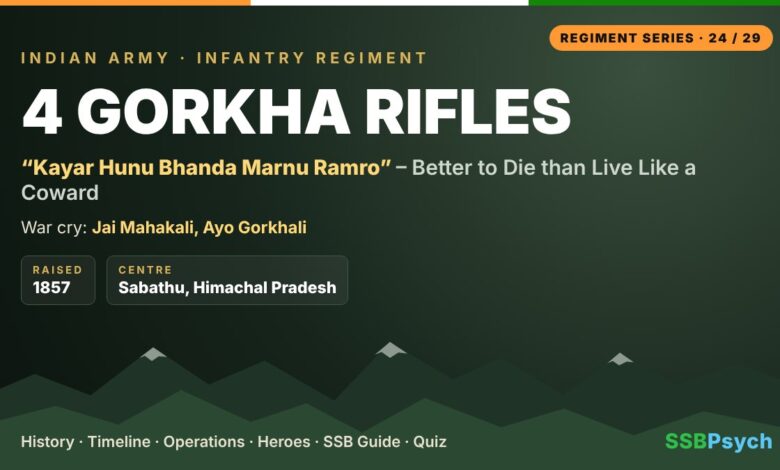
| Motto | Kayar Hunu Bhanda Marnu Ramro (Better to die than live like a coward) |
| War Cry | Jai Mahakali, Ayo Gorkhali (Hail Mahakali, the Gorkhas are here) |
| Recruitment | Gorkhas of Indian and Nepalese domicile, mainly Magars and Gurungs |
| Battalions | 5 regular battalions |
| Regimental Day | 11 March |
| Insignia | Crossed khukris, Roman numeral IV, Ashoka emblem above |
| Post-1947 honours | Punch, Gurais, Bilafond La |
History of 4 Gorkha Rifles
The regiment was raised in 1857, the year of the great uprising, as the Extra Goorkha Regiment of the East India Company’s army. For a short while it was known as the 19th Regiment of Bengal Native Infantry. When the Gurkha regiments were numbered in order in 1861, it became the 4th Goorkha Regiment.
In 1866 the regiment found a permanent home at Bakloh, in the hills of present-day Himachal Pradesh, which remained its base until 1948. In 1924 it was named the 4th Prince of Wales’s Own Gurkha Rifles. At independence it was one of six Gurkha regiments that stayed with the Indian Army, and in 1950, after India became a republic, it became the 4th Gorkha Rifles.
After Partition the centre moved several times, through Dharamshala, Chakrata and Dehradun. In April 1960 it settled at Sabathu in the Shimla hills, where it joined the centre of 1 Gorkha Rifles to form the 14 Gorkha Training Centre. In January 1948 Lieutenant Colonel Rajbir Chopra took over as the first Indian commandant of the regimental centre.
Frontier Wars and China
In the Second Afghan War of 1878-80 the regiment won the honours Ali Masjid, Kabul 1879 and Kandahar 1880. In the 1890s it fought on the North-West Frontier, in the Chitral and Tirah campaigns. In 1900 it was sent to China during the Boxer Rebellion. In 1903 Captain William George Walker, serving in Somaliland, won the regiment’s only Victoria Cross.
The First World War
The 1st Battalion went to France in 1914 and fought at Givenchy, Neuve Chapelle, Ypres and Festubert. In 1915 it landed at Gallipoli in Turkey, one of the bloodiest campaigns of the war, and later served in Mesopotamia. The 2nd Battalion fought its way up the Tigris and entered Baghdad on 11 March 1917. Today 11 March is the regiment’s Regimental Day, honouring both this event and the 1st Battalion’s action at Neuve Chapelle.
Gallipoli deserves a moment of reflection. Allied troops landed on a narrow strip of coast below steep hills held by Turkish forces, and months of fighting brought terrible losses on both sides. Gorkha soldiers, used to steep hillsides, were well suited to the ground, but the campaign ended in withdrawal. For the regiment, it remains one of the hardest and proudest chapters of its First World War service.
The Second World War
The regiment fought on many fronts in the Second World War. The 2nd Battalion served in Iraq, Syria and North Africa, where it was overrun at Mersa Matruh in June 1942, and later fought in Italy, winning honours such as Monte Cedrone. The 1st Battalion fought in Burma, including the battle for the Sittang Bridge in 1942. The 3rd Battalion served with the Chindits, the long-range force that fought deep behind Japanese lines in 1944. The 4th Battalion distinguished itself at Mandalay Hill in 1945.
Two famous names are linked to this era. Joe Lentaigne commanded 1/4 GR in Burma and later took over command of the Chindits after the death of Orde Wingate. John Masters, who served with the regiment in the 1930s and 1940s, won the DSO in Burma and later became a well-known author, writing about his regimental life in Bugles and a Tiger.
4 Gorkha Rifles Timeline: From Raising to Today
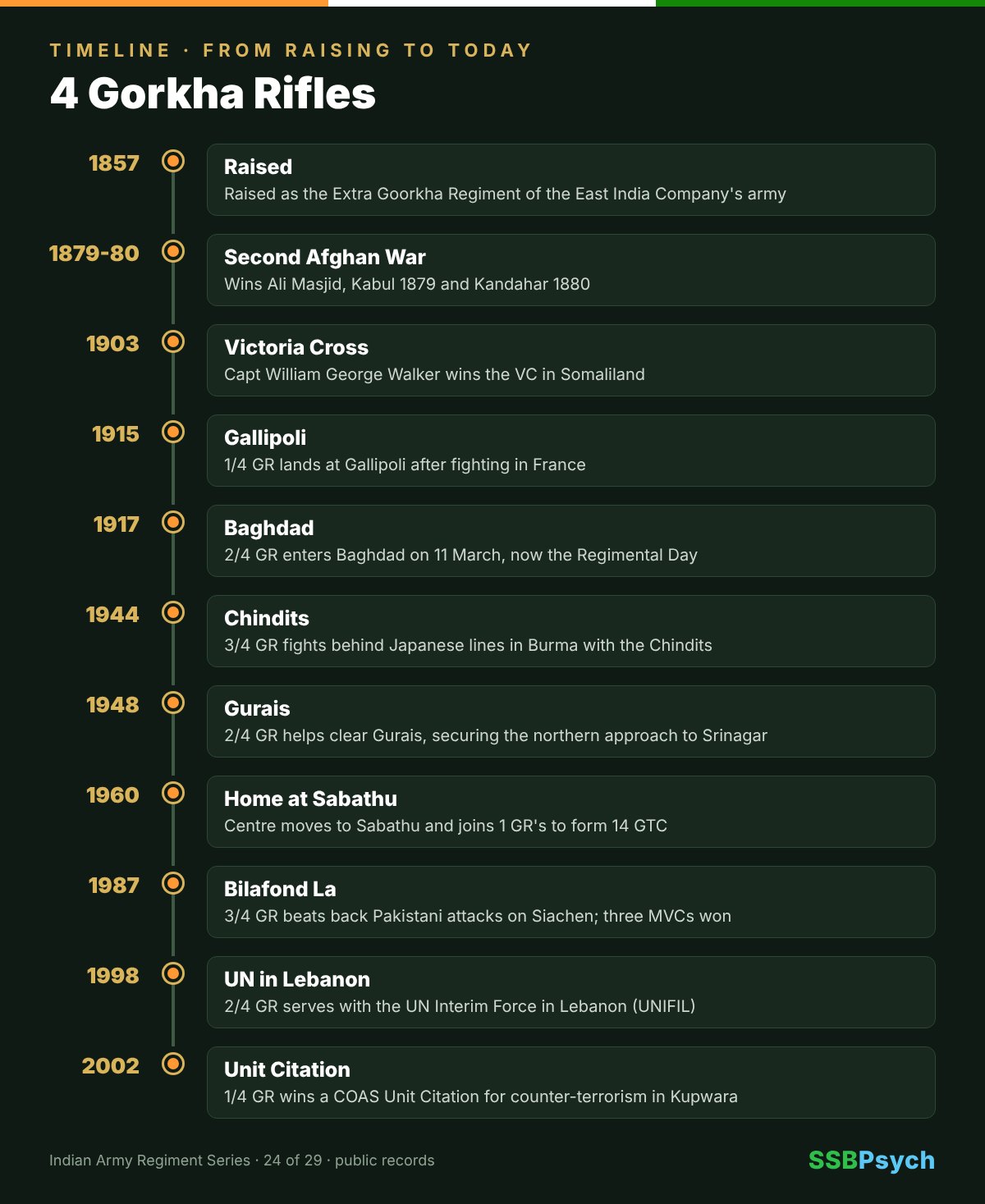
- 1857 – Raised: Raised as the Extra Goorkha Regiment of the East India Company’s army
- 1879-80 – Second Afghan War: Wins Ali Masjid, Kabul 1879 and Kandahar 1880
- 1903 – Victoria Cross: Capt William George Walker wins the VC in Somaliland
- 1915 – Gallipoli: 1/4 GR lands at Gallipoli after fighting in France
- 1917 – Baghdad: 2/4 GR enters Baghdad on 11 March, now the Regimental Day
- 1944 – Chindits: 3/4 GR fights behind Japanese lines in Burma with the Chindits
- 1948 – Gurais: 2/4 GR helps clear Gurais, securing the northern approach to Srinagar
- 1960 – Home at Sabathu: Centre moves to Sabathu and joins 1 GR’s to form 14 GTC
- 1987 – Bilafond La: 3/4 GR beats back Pakistani attacks on Siachen; three MVCs won
- 1998 – UN in Lebanon: 2/4 GR serves with the UN Interim Force in Lebanon (UNIFIL)
- 2002 – Unit Citation: 1/4 GR wins a COAS Unit Citation for counter-terrorism in Kupwara
Major Operations and Battle Honours of 4 Gorkha Rifles
1947-48: Punch and Gurais
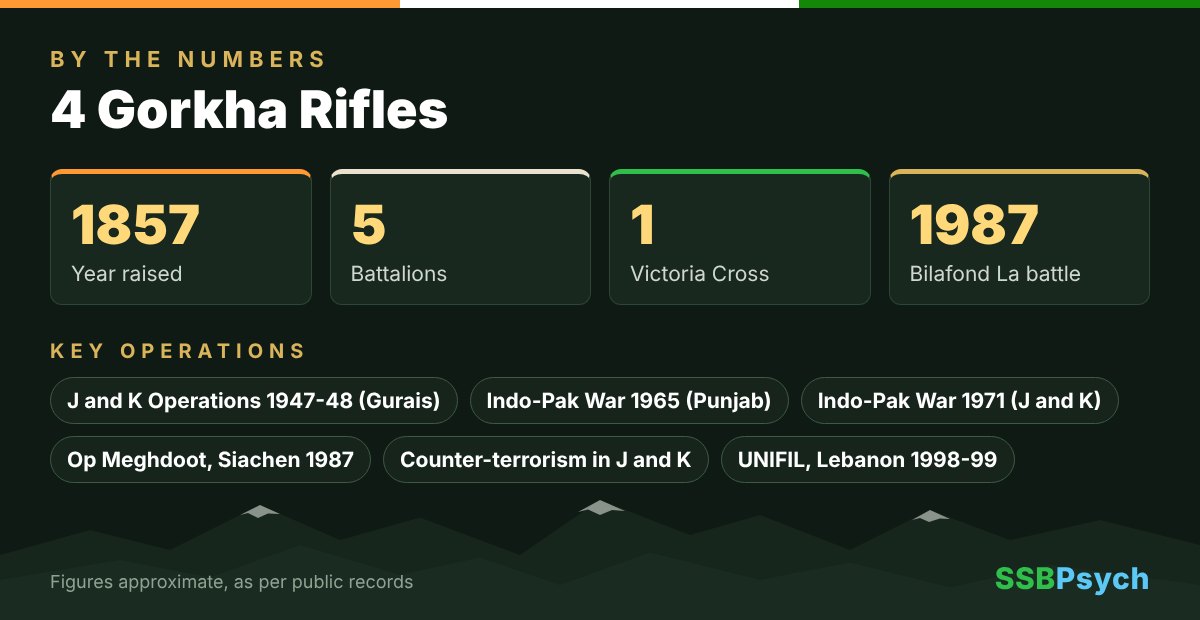
In the first Kashmir war the regiment won the battle honours Punch and Gurais. In June and July 1948 the 2nd Battalion, along with 1 Grenadiers, cleared the Gurais and Kanzalwan areas north of the Kashmir Valley. This removed the threat to Srinagar from the north and helped keep the valley safe.
1962 to 1971
After the 1962 war with China, the Army expanded quickly. The 4th Battalion was re-raised in November 1962 and the 5th Battalion was raised on 1 January 1963. In the 1965 war the regiment earned the theatre honour Punjab 1965, and in 1971 it earned the theatre honour Jammu and Kashmir 1971.
1987: The Defence of Bilafond La
The regiment’s most famous modern battle took place on the Siachen Glacier. Between 20 and 24 September 1987, during Operation Meghdoot, Pakistani troops launched repeated attacks to capture Indian posts in the Bilafond La area. The 3rd Battalion held its ground in extreme cold and thin air, beating back every assault. The battalion lost 13 men killed and 23 wounded, and won the battle honour Bilafond La, together with three Maha Vir Chakras and several Vir Chakras.
Think about what this meant. At such heights even walking a few steps is exhausting, weapons freeze, and every wounded man must be carried down slippery slopes. The Gorkhas of 3/4 GR fought in these conditions for days. Their stand ensured that Pakistan could not gain a foothold on the Saltoro Ridge in that area, which remains vital to India’s control of Siachen.
Peacekeeping and Counter-Terrorism
In 1998-99 the 2nd Battalion served with the United Nations Interim Force in Lebanon. In 2002 the 1st Battalion received a Chief of Army Staff Unit Citation for its counter-terrorism operations in Kupwara, Jammu and Kashmir, where Naib Subedar Deb Bahadur Thapa won the Kirti Chakra posthumously.
Counter-terrorism work in places like Kupwara is very different from a conventional battle. Soldiers must find hidden militants in forests and villages, protect civilians and avoid harming the innocent, all while staying alert to ambushes. It tests patience, discipline and judgement. A Unit Citation for such work shows that a battalion has done this difficult job with both courage and professionalism.
Insignia, Motto and War Cry
The insignia of 4 GR shows crossed khukris with the Roman numeral IV below and the Ashoka emblem on top. Soldiers wear a black metal 4 GR shoulder title, and the regiment’s colours are rifle green faced with black and red. Its pipers have traditionally worn tartan, a reminder of old links with Scottish regiments.
The motto is Kayar Hunu Bhanda Marnu Ramro, meaning Better to die than live like a coward, and the war cry is Jai Mahakali, Ayo Gorkhali, meaning Hail Goddess Mahakali, the Gorkhas are here. The regimental march, Barde Jaun, calls the soldiers to advance.
Heroes of 4 Gorkha Rifles
- Captain William George Walker, Victoria Cross – won in 1903 in the Somaliland campaign; the regiment’s only VC.
- Krishna Gopal Chatterjee, Maha Vir Chakra – officer of 3/4 GR decorated for the defence of Bilafond La, 1987.
- Lance Havildar Nar Bahadur Ale, Maha Vir Chakra (posthumous) – 3/4 GR; Bilafond La, Siachen, September 1987.
- Naik Prem Bahadur Gurung, Maha Vir Chakra (posthumous) – 3/4 GR; Bilafond La, Siachen, 1987.
- Naib Subedar Deb Bahadur Thapa, Kirti Chakra (posthumous) – 1/4 GR; counter-terrorism in Jammu and Kashmir.
- Lieutenant Colonel W.D.A. (Joe) Lentaigne – commanded 1/4 GR in Burma; later commanded the Chindits.
- John Masters, DSO – officer of the regiment and author of Bugles and a Tiger.
- Lieutenant Colonel Rajbir Chopra – first Indian commandant of the regimental centre, January 1948.
The heroes of Bilafond La deserve special respect. Nar Bahadur Ale and Prem Bahadur Gurung were junior non-commissioned officers, yet they held their posts against repeated attacks and gave their lives doing so. Their courage shows that in a Gorkha battalion, leadership exists at every level, from the section commander to the commanding officer.
Role and Life in a Gorkha Battalion
4 GR is an infantry regiment that trains for every type of terrain, with special strength in mountain warfare. Its soldiers are mainly Gorkhas from the Magar and Gurung communities, of Indian and Nepalese domicile. They are famous for their toughness, cheerful spirit and loyalty. Like other Gorkha regiments, it values physical fitness, marksmanship and fieldcraft above all, and its battalions regularly serve along the Line of Control and in high-altitude areas.
Each battalion has an affectionate Nepali nickname based on its order: the 1st is the Jethi Paltan, the 2nd the Maili Paltan, the 3rd the Sainli Paltan, the 4th the Kainli Paltan and the 5th the Kanchi Paltan. These names, which come from the Nepali words for eldest, second, third and so on, show how the regiment sees itself as one family.
An officer in 4 GR learns Nepali, joins in festivals such as Dashain, and earns his men’s trust by sharing their hardships. In return, Gorkha soldiers give a loyalty that officers often describe as the greatest reward of their career. Recruits train at the 14 Gorkha Training Centre, Sabathu, alongside those of 1 Gorkha Rifles.
Why 4 Gorkha Rifles Matters for SSB Aspirants
4 GR offers excellent examples for SSB interviews, group discussions and lecturettes. Bilafond La is a strong case study of defence at high altitude and of junior leadership. The Chindit story shows the value of daring and endurance. Gurais shows how one operation can secure a whole valley. Learn these examples well and you will be able to bring history alive when you speak, which always impresses the board.
When preparing, do not try to memorise every battle honour. Instead, pick three stories that you can tell well, for example Gallipoli, the Chindits and Bilafond La, and understand why each one matters. In the interview, a short, clear story with a lesson is far more powerful than a long list of names and dates.
4 Gorkha Rifles for SSB Candidates: What You Should Know
How officers join
- Officers reach the infantry through NDA (after Class 12) or CDS (IMA, for graduates), followed by training at IMA Dehradun.
- Short Service Commission officers train at OTA Chennai through CDS (OTA), NCC Special Entry and similar entries.
- Arm and regiment allotment is done during academy training based on your choice, merit and vacancies; you cannot apply directly to 4 GR.
- Officers of Gorkha regiments come from all over India and learn Nepali after commissioning.
How soldiers join
- Soldiers are Gorkhas, mainly Magars and Gurungs, of Indian and Nepalese domicile.
- Since 2022, Indian-domiciled Gorkhas join as Agniveers under the Agnipath scheme for four years, with up to 25 percent retained as regulars.
- News reports say recruitment of Nepal-domiciled Gorkhas has been on hold since 2022, as Nepal has not agreed to the Agnipath terms; check the latest position.
- Recruits train at 14 Gorkha Training Centre, Sabathu, Himachal Pradesh.
Questions you may face in the SSB interview, GD or lecturette
- What do you know about the defence of Bilafond La in 1987?
- Why is the Siachen Glacier strategically important to India?
- What makes Gorkha soldiers special, in your opinion?
- What were the Chindits and what can modern armies learn from them?
- How would you motivate soldiers posted for months at a high-altitude post?
SSBPsych tip: Practise a two-minute lecturette on Siachen using the Bilafond La story. Start with a short map-based context, then the action, then the lesson on junior leadership. A clear three-part structure always scores well.
From Afghanistan and Gallipoli to Gurais and Siachen, the 4 Gorkha Rifles has proved again and again that its motto is not just words. As you prepare for your SSB, carry that spirit with you: it is better to die than to live like a coward. Now take the quiz below and test what you have learnt.
Quiz: How Well Do You Know the 4 Gorkha Rifles?
Test yourself! Click an option to see if you are right. Your score updates live.
4 Gorkha Rifles: Frequently Asked Questions
The motto is Kayar Hunu Bhanda Marnu Ramro, which means Better to die than live like a coward.
4 GR trains its recruits at the 14 Gorkha Training Centre, Sabathu, Himachal Pradesh, which it shares with 1 Gorkha Rifles. Its old home was Bakloh.
It was raised in 1857 as the Extra Goorkha Regiment and became the 4th Goorkha Regiment in 1861. It took its present name in 1950.
In September 1987 the 3rd Battalion of 4 GR defended Indian posts at Bilafond La on the Siachen Glacier against repeated Pakistani attacks, earning a battle honour and three Maha Vir Chakras.
The war cry is Jai Mahakali, Ayo Gorkhali, meaning Hail Goddess Mahakali, the Gorkhas are here.
Indian Army Regiments Series on SSBPsych
This is part 24 of 29 in our series on every infantry regiment of the Indian Army – a new regiment every day at 11 AM. Previous in the series: 3 Gorkha Rifles. Also follow our Param Vir Chakra series.
Sources: en.wikipedia.org, honourpoint.in, honourpoint.in, en.wikipedia.org.
Preparing for NDA, CDS, AFCAT or your SSB? Join SSBPsych’s online and offline batches – explore our courses or call +91 8076540582.