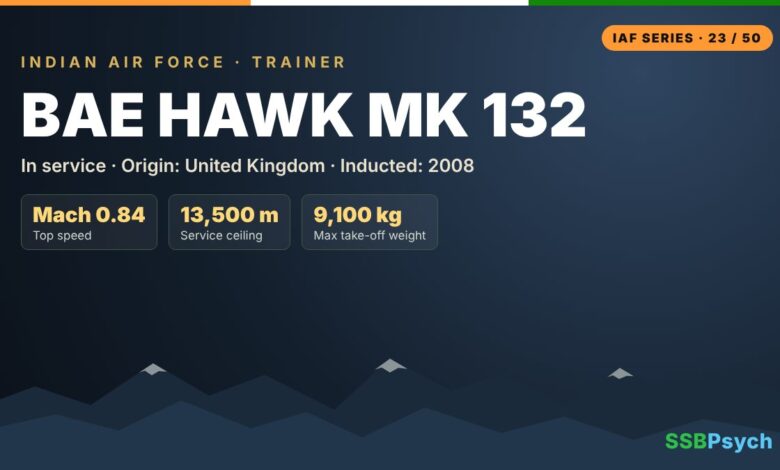
Hawk Mk 132 in Indian Air Force: Specs, Speed and Surya Kiran
Every Rafale, Su-30MKI and Tejas pilot in the Indian Air Force has one thing in common. Before they ever touched a frontline fighter, they learned to fly fast jets in the Hawk Mk 132. This sleek British-designed trainer is the bridge between a cadet who can fly a basic trainer and a confident fighter pilot ready for combat jets.
The Hawk is also the star of the IAF’s famous Surya Kiran aerobatic team, whose red and white jets paint the sky with tricolour smoke at air shows across India. So whether you have watched an air show in your city or dream of becoming a fighter pilot, this aircraft is worth knowing well.
In this guide you will find why India needed an advanced jet trainer, how the Hawk Mk 132 came to India, its performance explained simply, what it carries, where it is based, its strengths and limits, and what lies ahead. A 10-question quiz at the end will help you revise for NDA, CDS and AFCAT.

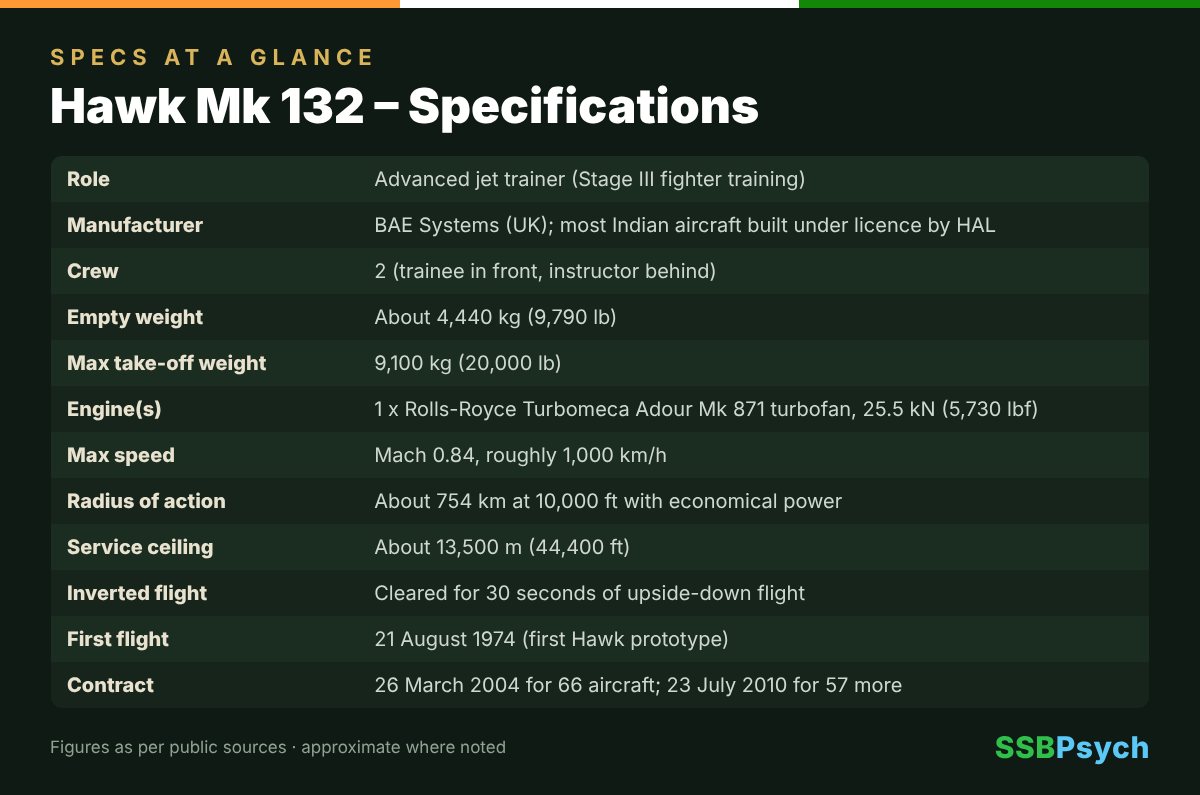
Hawk Mk 132 Specifications
| Role | Advanced jet trainer (Stage III fighter training) |
| Manufacturer | BAE Systems (UK); most Indian aircraft built under licence by HAL |
| Crew | 2 (trainee in front, instructor behind) |
| Empty weight | About 4,440 kg (9,790 lb) |
| Max take-off weight | 9,100 kg (20,000 lb) |
| Engine(s) | 1 x Rolls-Royce Turbomeca Adour Mk 871 turbofan, 25.5 kN (5,730 lbf) |
| Max speed | Mach 0.84, roughly 1,000 km/h |
| Radius of action | About 754 km at 10,000 ft with economical power |
| Service ceiling | About 13,500 m (44,400 ft) |
| Inverted flight | Cleared for 30 seconds of upside-down flight |
| First flight | 21 August 1974 (first Hawk prototype) |
| Contract | 26 March 2004 for 66 aircraft; 23 July 2010 for 57 more |
| Inducted in IAF | 23 February 2008 (deliveries began November 2007) |
| Number in IAF | 106 ordered for the IAF, plus 17 for the Indian Navy |
Why India Needed the Hawk Mk 132
Flying a modern fighter is a huge leap. Fighters fly close to the speed of sound or faster, and their pilots must handle complex systems, tight turns and weapons while thinking several steps ahead. For decades, IAF cadets moved from the slow HJT-16 Kiran trainer almost directly to demanding fighters such as the MiG-21. That jump was too big, and it was linked to many accidents.
The IAF first identified the need for a proper Advanced Jet Trainer in 1982. The idea was simple: give young pilots a jet that behaves much like a fighter, with a modern cockpit, high speed and agile handling, but which is safer and cheaper to fly. After a long selection process, India chose the BAE Systems Hawk, already used by the Royal Air Force and many other air forces.
The IAF’s pilot training now runs in three stages. Stage I is basic flying on a propeller trainer at the Air Force Academy. Stage II builds jet skills. Stage III, on the Hawk, is where future fighter pilots learn high-speed flying, formation, navigation at low level and weapons delivery before joining an operational squadron.
History of the Hawk Mk 132 in the IAF
India signed the contract on 26 March 2004 for 66 Hawks. Under the deal, 24 would be built by BAE Systems in the UK and 42 would be produced under licence by Hindustan Aeronautics Limited (HAL) in Bengaluru. This version for India was named the Hawk Mk 132. It is powered by the Adour Mk 871 engine.
BAE Systems began deliveries in November 2007, and on 23 February 2008 the Hawk Mk 132 formally entered service with the IAF. HAL handed over the first India-assembled Hawk on 14 August 2008. Training was built around the Hawk Operational Training Squadron at Air Force Station Bidar in Karnataka.
The Hawk proved a success, and on 23 July 2010 India signed for 57 more, all to be built by HAL: 40 for the IAF and 17 for the Indian Navy, whose pilots also train for carrier jets. That took the total Indian order to 123, with 106 for the IAF. The fleet crossed 100,000 flying hours by 29 November 2016.
In February 2015 the Hawk gave new life to the Surya Kiran Aerobatic Team, which had been grounded since 2011 because of a shortage of Kiran trainers. The team is officially No. 52 Squadron, the Sharks, based at Bidar. In March 2021 the Hawk-mounted team flew abroad for the first time after re-forming, at the Sri Lanka Air Force’s 70th anniversary celebrations.
Flying a tight formation of jets just a few metres apart at high speed needs extraordinary trust and skill. Surya Kiran pilots are experienced fighter or instructor pilots chosen for the team, and they practise for months before each display season. Their shows at events such as Aero India in Bengaluru and city air shows have become one of the IAF’s strongest tools for inspiring young people to join.
HAL has also used its experience to develop the Hawk-i, a company-funded upgrade with Indian-made systems such as a home-grown real-time operating system. In January 2021 the Hawk-i successfully released the DRDO-developed Smart Anti-Airfield Weapon off the Odisha coast, showing that the trainer could be given a stronger combat role.
Hawk Mk 132 Engine and Performance Explained Simply
The Hawk Mk 132 uses a single Rolls-Royce Turbomeca Adour Mk 871 turbofan. A turbofan is a jet engine with a large fan at the front that pushes extra air around the hot core, making it more fuel-efficient and quieter than an old-style turbojet. It produces about 25.5 kilonewtons of thrust, roughly the push needed to hold up 2,600 kg against gravity.
Top speed is around Mach 0.84. Mach 1 is the speed of sound, so Mach 0.84 means 84 percent of the speed of sound, roughly 1,000 km/h. That is more than three times faster than a bullet train running at 320 km/h. At that speed you could cross Delhi to Mumbai in well under two hours.
The service ceiling, the highest height at which the jet can still climb usefully, is about 13,500 metres (44,400 feet). That is around one and a half times the height of Mount Everest and higher than most airliners cruise. The Hawk is cleared to fly upside down for 30 seconds and to land in strong crosswinds, both important for teaching confident handling.
Empty, the Hawk weighs about 4,440 kg, about as much as three large SUVs. Fully loaded with fuel and stores it can take off at 9,100 kg. With economical power it has a radius of action of about 754 km, enough for long cross-country navigation exercises over the Deccan plateau.
Inside, the Hawk has a modern glass cockpit similar in feel to frontline fighters, with screens instead of rows of old round dials. The trainee sits in front and the instructor behind on a raised seat with a good view, ready to take control if needed. Solo flights are flown from the front cockpit.
What does a typical Hawk training sortie look like? The trainee and instructor brief together on the ground, walk out to the jet, and strap into ejection seats. After take-off they might practise steep turns, loops and rolls, then a low-level navigation run where the trainee must find a target using a map and a stopwatch, and finally a series of landings. Every sortie is debriefed in detail, because small mistakes in a trainer can become big mistakes in a fighter.
What It Carries
- Two seats in tandem: a trainee pilot in front and an instructor behind
- Underwing stations used to carry practice weapons for air-to-ground weapons training
- Coloured smoke system on Surya Kiran display aircraft
- Smart Anti-Airfield Weapon (SAAW): test-fired from HAL’s upgraded Hawk-i demonstrator in January 2021
- Night flying equipment: cleared for dual and solo night sorties
The Hawk Mk 132 is a trainer first, so its main job is to carry a student and an instructor safely. Its underwing stations let instructors teach air-to-ground weapons delivery, a key step before pilots move to frontline jets. On the Surya Kiran aircraft, a smoke system creates the famous coloured trails in the sky.
Hawk Mk 132 Missions and Operations
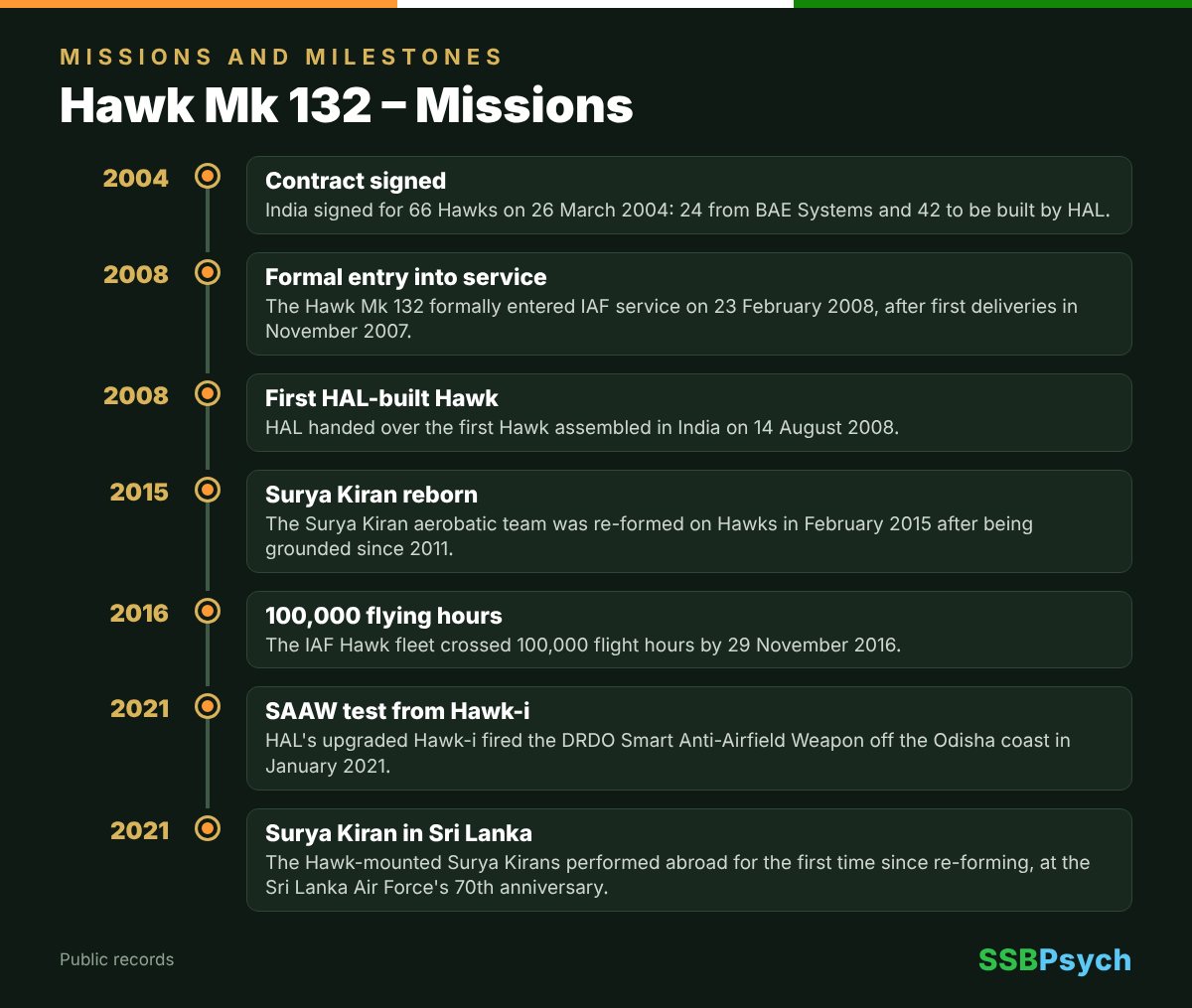
- 2004 – Contract signed: India signed for 66 Hawks on 26 March 2004: 24 from BAE Systems and 42 to be built by HAL.
- 2008 – Formal entry into service: The Hawk Mk 132 formally entered IAF service on 23 February 2008, after first deliveries in November 2007.
- 2008 – First HAL-built Hawk: HAL handed over the first Hawk assembled in India on 14 August 2008.
- 2015 – Surya Kiran reborn: The Surya Kiran aerobatic team was re-formed on Hawks in February 2015 after being grounded since 2011.
- 2016 – 100,000 flying hours: The IAF Hawk fleet crossed 100,000 flight hours by 29 November 2016.
- 2021 – SAAW test from Hawk-i: HAL’s upgraded Hawk-i fired the DRDO Smart Anti-Airfield Weapon off the Odisha coast in January 2021.
- 2021 – Surya Kiran in Sri Lanka: The Hawk-mounted Surya Kirans performed abroad for the first time since re-forming, at the Sri Lanka Air Force’s 70th anniversary.

Where the Hawk Is Based and Who Flies It
The main home of the IAF Hawk fleet is Air Force Station Bidar in Karnataka, publicly reported as the centre of Stage III fighter training and home of the Surya Kiran team. Hawks have also been publicly reported flying from Kalaikunda in West Bengal. The Indian Navy’s Hawks train naval aviators for jet operations.
A training squadron is usually commanded by a Wing Commander, supported by experienced Squadron Leaders and Flight Lieutenants who serve as Qualified Flying Instructors. Instructors are carefully selected and trained so they can safely teach young pilots to handle a fast jet.
The road to the Hawk starts when a cadet joins through NDA, the CDS exam or AFCAT. At the Air Force Academy, Dundigal, flying cadets learn the basics on a propeller trainer. Those selected for the fighter stream move to jet training and then to the Hawk for Stage III, which takes several months and many sorties. Only after earning their wings and finishing Hawk training do they go on to fly fighters such as the Su-30MKI, Rafale or Tejas, usually after further conversion training.
Strengths and Limitations
- Strength: closes the big gap between basic trainers and frontline fighters, making training safer and better.
- Strength: modern glass cockpit that prepares pilots for today’s fighters.
- Strength: agile and reliable, cleared for aerobatics, night flying and inverted flight.
- Strength: mostly built in India by HAL, so support and maintenance are close at hand.
- Strength: powers the Surya Kiran team, inspiring thousands of young Indians to join the Air Force.
- Limitation: it is subsonic, so pilots still need further training before flying supersonic fighters.
- Limitation: it is mainly a trainer, with only a limited combat role in IAF service.
- Limitation: the fleet has had several accidents, including a fatal mid-air collision of two Surya Kiran Hawks during Aero India rehearsals in 2019.
Future of the Hawk Mk 132
The Hawk will remain the IAF’s main Stage III trainer for years. HAL’s Hawk-i upgrade points the way to a more capable trainer with Indian avionics and the ability to carry smart weapons, and upgrades for the existing fleet have been discussed publicly.
At the same time, India is working on new home-grown trainers, including the HTT-40 basic trainer for Stage I. Over time, the training system could become almost entirely Indian, with the Hawk continuing as the final step before fighters.
Why It Matters for SSB and AFCAT Aspirants
If you want to be a fighter pilot, the Hawk Mk 132 is almost certainly the jet you will train on. Knowing the three stages of IAF flying training, the role of Bidar and the Surya Kiran team shows the interviewing officer that you have researched your dream career seriously.
It is also a great current affairs topic. Questions about the Surya Kiran team, the Hawk-i, HAL licence production and Make in India often appear in AFCAT and CDS general awareness sections. Combine these facts with a clear reason for choosing the flying branch, and your interview answers will stand out.
Did You Know?
- India’s total Hawk order of 123 aircraft (IAF and Navy) is one of the largest Hawk fleets outside the UK.
- The Surya Kiran team, No. 52 Squadron, is nicknamed the Sharks.
- The very first Hawk prototype flew on 21 August 1974.
- HAL handed over its first India-assembled Hawk on 14 August 2008.
- The Hawk Mk 132 is cleared for 30 seconds of inverted flight.
- In January 2021 an HAL Hawk-i released the Smart Anti-Airfield Weapon developed by DRDO.
Quiz: Test Your Knowledge of Hawk Mk 132
Click an option to see if you are right. Your score updates live.
Hawk Mk 132: Frequently Asked Questions
It is the IAF’s advanced jet trainer, used for Stage III training of fighter pilots and flown by the Surya Kiran aerobatic team.
Its top speed is about Mach 0.84, roughly 1,000 km/h, which is 84 percent of the speed of sound.
India ordered 123 Hawks in total: 106 for the IAF and 17 for the Indian Navy. Most were built under licence by HAL.
The main publicly reported base is Air Force Station Bidar in Karnataka, which is also home to the Surya Kiran team.
Hawk-i is HAL’s own upgraded version of the Hawk with Indian systems. In January 2021 it test-released the DRDO Smart Anti-Airfield Weapon.
This is part 23 of 50 in SSBPsych’s Indian Air Force aircraft series – a new aircraft every evening at 6 PM.
Sources: en.wikipedia.org, bharat-rakshak.com, en.wikipedia.org, iasgyan.in, naval-technology.com.
Preparing for NDA, CDS, AFCAT or your SSB? Join SSBPsych’s online and offline batches – explore our courses or call +91 8076540582.