C-295 in Indian Air Force: Specs, Payload, Make in India Story
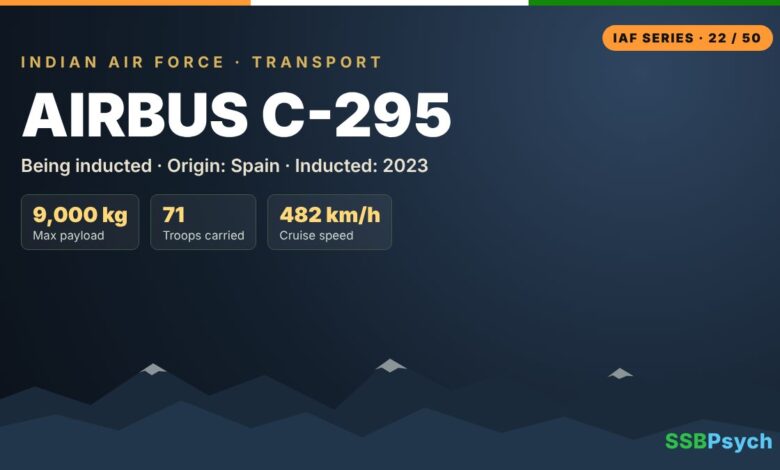
For the first time in India’s history, a private company is building a military aircraft on Indian soil. That aircraft is the C-295, a rugged twin-turboprop transport from Airbus that can land on short, rough strips, drop paratroopers and fly wounded soldiers to safety. For the Indian Air Force it is a brand-new workhorse; for India it is a giant step in the Make in India mission.
The IAF ordered 56 of these aircraft in 2021. The first 16 were built in Seville, Spain, and the remaining 40 are being made by Tata Advanced Systems in Vadodara, Gujarat. Each one replaces part of an ageing fleet and adds fresh muscle to the IAF’s ability to move people and supplies quickly.
In this guide you will learn why the IAF needed the C-295, how the deal works, what the aircraft can carry, how fast and far it flies in plain words, where it is based and what comes next. A 10-question quiz at the end will help you lock in the facts for NDA, CDS and AFCAT.

C-295 Specifications
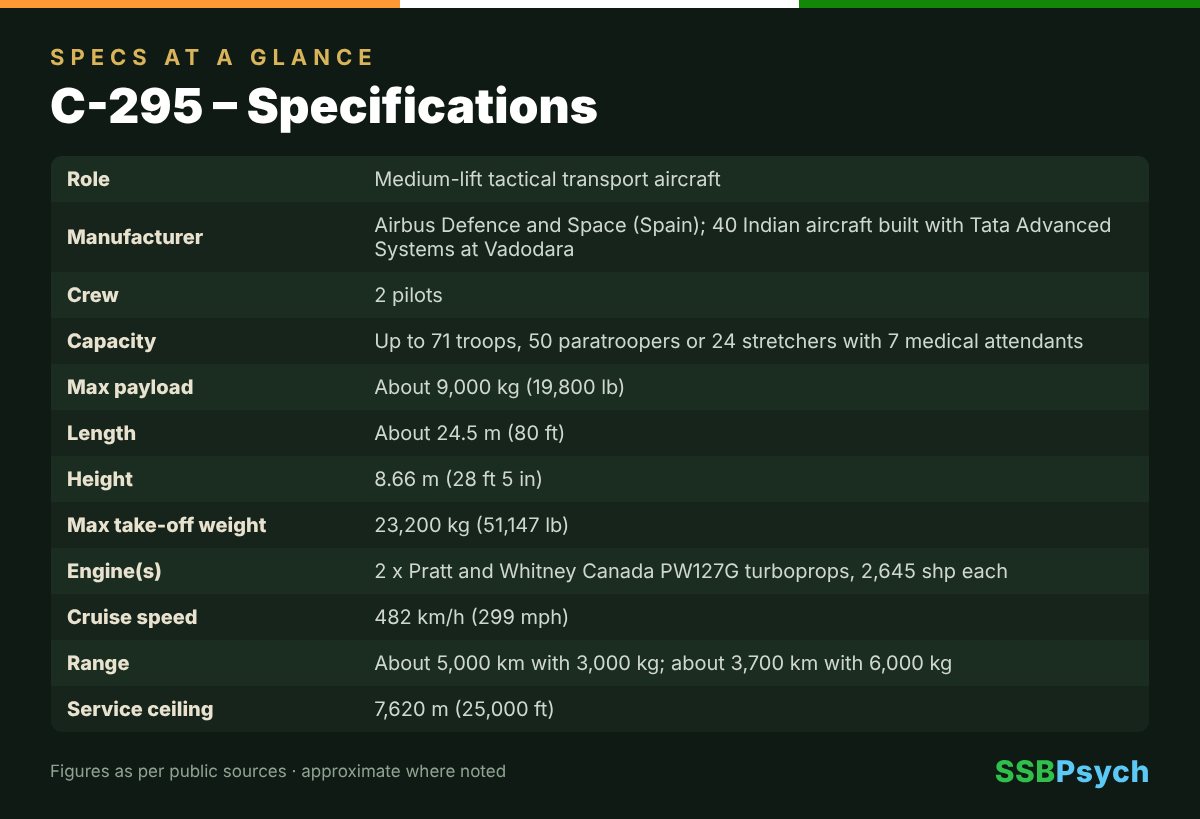
| Role | Medium-lift tactical transport aircraft |
| Manufacturer | Airbus Defence and Space (Spain); 40 Indian aircraft built with Tata Advanced Systems at Vadodara |
| Crew | 2 pilots |
| Capacity | Up to 71 troops, 50 paratroopers or 24 stretchers with 7 medical attendants |
| Max payload | About 9,000 kg (19,800 lb) |
| Length | About 24.5 m (80 ft) |
| Height | 8.66 m (28 ft 5 in) |
| Max take-off weight | 23,200 kg (51,147 lb) |
| Engine(s) | 2 x Pratt and Whitney Canada PW127G turboprops, 2,645 shp each |
| Cruise speed | 482 km/h (299 mph) |
| Range | About 5,000 km with 3,000 kg; about 3,700 km with 6,000 kg |
| Service ceiling | 7,620 m (25,000 ft) |
| First flight | 28 November 1997 (C-295 prototype) |
| Inducted in IAF | 25 September 2023 |
| Number in IAF | 56 ordered: 16 built in Spain and 40 to be built in India |
Why India Needed the C-295
For decades the IAF used the Avro HS-748, a British-designed twin turboprop built under licence by HAL, for light transport, training and communication duties. By the 2010s those aircraft were very old, and spares and safety had become a real concern. The IAF needed a modern replacement that could carry more, fly further and use small, unprepared runways.
The C-295 fitted the bill. It sits neatly between India’s small Dornier 228 and the larger C-130J Super Hercules. It has a rear ramp for quick loading, can operate from short and unpaved strips, and is already flown by dozens of air forces worldwide. Airbus says the type has hundreds of orders from more than 40 operators, so it is a proven design rather than an experiment.
Just as important was the industrial angle. India wanted the deal to build a real aircraft industry at home, not just to buy aeroplanes off the shelf. That is why most of the order is being made in India.
To understand where the C-295 fits, think of the IAF transport fleet as a set of delivery vehicles. The giant C-17 Globemaster III is the heavy truck that crosses continents with tanks and helicopters inside. The C-130J and Il-76 are large lorries. The An-32 and C-295 are the sturdy mini-trucks that reach smaller towns and rough mountain roads. The Dornier 228 is the light van for short hops. Each has a job, and the C-295 is the newest and most modern of the medium group.
A typical tactical mission might look like this: the crew loads soldiers and stores at a big base in the plains, flies to a short forward airstrip near the border, lands on a strip too small for heavy jets, unloads within minutes using the rear ramp, and takes injured personnel back for treatment. Speed, short landings and quick turnarounds are what make an aircraft like this so valuable.
History of the C-295 in the IAF
The Cabinet Committee on Security cleared the purchase on 8 September 2021, and the Ministry of Defence signed the contract with Airbus Defence and Space on 24 September 2021. The value was about Rs 21,935 crore. Under the deal, 16 aircraft would arrive in flyaway condition from Seville and 40 would be built in India in partnership with Tata Advanced Systems Limited.
Prime Minister Narendra Modi laid the foundation stone for the Vadodara facility on 30 October 2022. Less than a year later, on 13 September 2023, the first IAF C-295 was handed over at a ceremony in Seville attended by the then Chief of the Air Staff. It came fitted with an Indian-made electronic warfare suite for self-protection.
The aircraft reached Vadodara on 20 September 2023, and on 25 September 2023 Defence Minister Rajnath Singh formally inducted it at Hindan Air Force Station near Delhi. It joined No. 11 Squadron, known as the Rhinos, the first IAF unit to fly the type. In January 2024 the C-295 flew in the Republic Day fly-past for the first time.
On 28 October 2024 Prime Minister Modi and Spanish leader Pedro Sanchez opened the Final Assembly Line at Vadodara. Airbus says more than 85 percent of the structural and final assembly work for the 40 Indian aircraft will be done in India, including around 13,000 detail parts, with major components made in Hyderabad. Deliveries from Spain continued at roughly one a month and were scheduled to finish in August 2025.
In June 2026 the IAF announced that the first Made in India C-295 had completed its maiden flight from Vadodara. All 40 Indian-built aircraft are due to reach the IAF by August 2031.
C-295 Engine and Performance Explained Simply
The C-295 is powered by two Pratt and Whitney Canada PW127G turboprops, each giving about 2,645 shaft horsepower. A turboprop is a jet engine that spins a big propeller. It burns less fuel than a pure jet at medium speeds and gives strong thrust for short take-offs, which is exactly what a tactical transport needs.
It cruises at about 482 km/h. That is roughly one and a half times the planned top speed of India’s Mumbai-Ahmedabad bullet train. A trip from Delhi to Leh, which takes days by road, takes a little over an hour in a C-295.
Its payload, the weight of the useful load it carries, is up to about 9 tonnes. That is like lifting six or seven small hatchback cars at once. With a 3-tonne load the aircraft can fly around 5,000 km, roughly one and a half times the length of India from Kashmir to Kanyakumari. With a heavier 6-tonne load the range drops to about 3,700 km, still enough to cross India from Gujarat to Arunachal Pradesh.
The service ceiling, the highest height at which it can still climb usefully, is about 7,620 metres (25,000 feet). That is well above most Himalayan passes. Its maximum take-off weight is 23,200 kg, about the weight of 15 to 20 cars.
Modern touches make it easier to fly than the aircraft it replaces. The cockpit has dual controls for the pilot and co-pilot and digital displays, and the C-295 can reverse on the ground under its own power, which helps on narrow runways with little room to turn.
What It Carries
- Troops: up to 71 fully equipped soldiers
- Paratroopers: up to 50 for airborne drops
- Medical evacuation: 24 stretchers with up to 7 medical attendants
- Cargo: up to about 9 tonnes, or five standard cargo pallets
- Vehicles: up to three light vehicles about the size of a Land Rover
- Air-dropped supplies through the rear ramp
- Self-protection: an indigenous electronic warfare suite fitted on IAF aircraft
In IAF service the C-295 is a pure transport, so its job is to carry people and supplies, not missiles. Airbus has offered armed and patrol versions to other countries, but the IAF aircraft are in transport configuration. Its biggest strength is the big rear ramp, which lets troops run in and out quickly, vehicles drive in, and cargo or paratroopers leave the aircraft in flight.
C-295 Missions and Operations
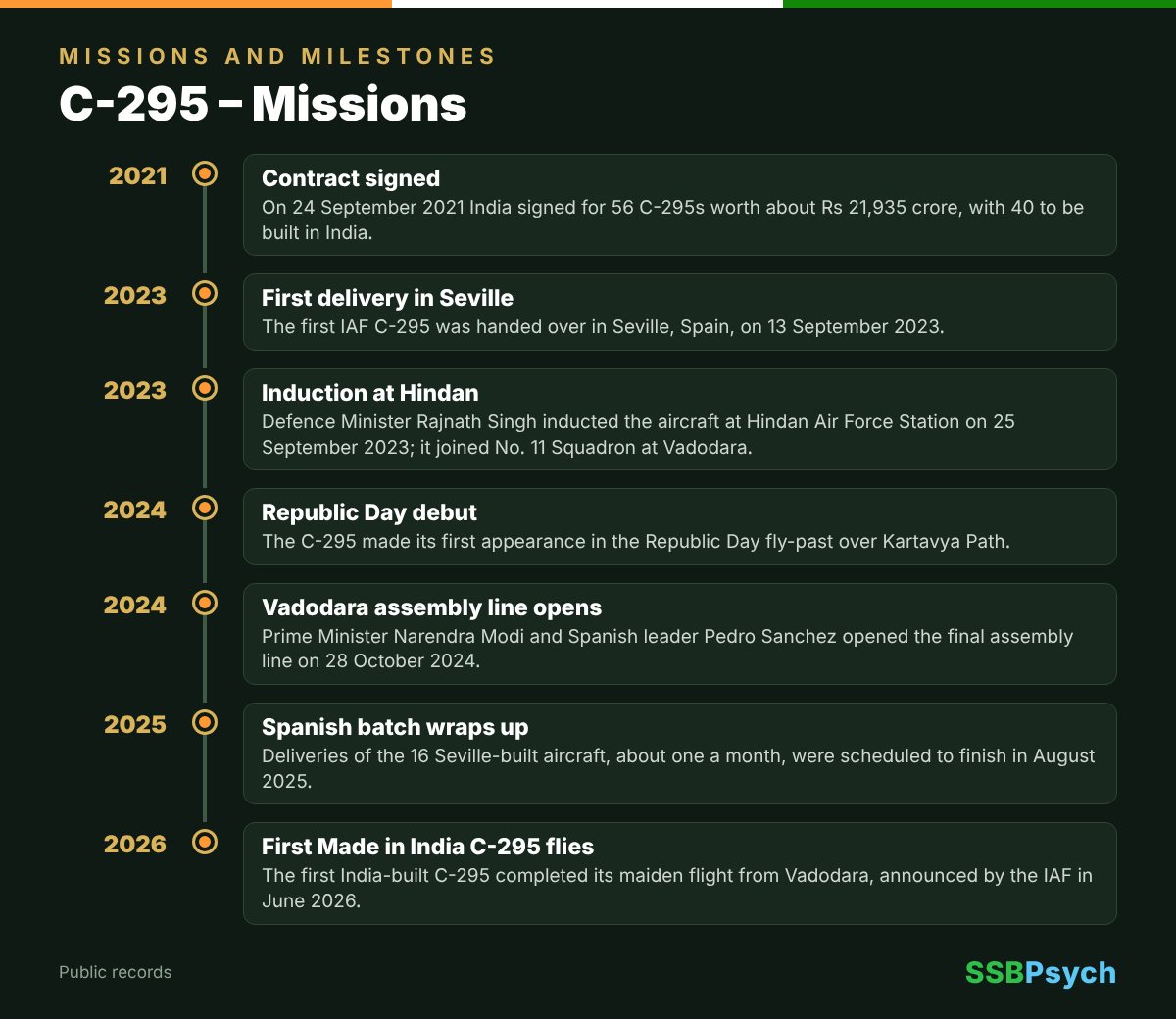
- 2021 – Contract signed: On 24 September 2021 India signed for 56 C-295s worth about Rs 21,935 crore, with 40 to be built in India.
- 2023 – First delivery in Seville: The first IAF C-295 was handed over in Seville, Spain, on 13 September 2023.
- 2023 – Induction at Hindan: Defence Minister Rajnath Singh inducted the aircraft at Hindan Air Force Station on 25 September 2023; it joined No. 11 Squadron at Vadodara.
- 2024 – Republic Day debut: The C-295 made its first appearance in the Republic Day fly-past over Kartavya Path.
- 2024 – Vadodara assembly line opens: Prime Minister Narendra Modi and Spanish leader Pedro Sanchez opened the final assembly line on 28 October 2024.
- 2025 – Spanish batch wraps up: Deliveries of the 16 Seville-built aircraft, about one a month, were scheduled to finish in August 2025.
- 2026 – First Made in India C-295 flies: The first India-built C-295 completed its maiden flight from Vadodara, announced by the IAF in June 2026.
Because the C-295 is so new in India, most of its story so far is about deliveries and milestones. As the fleet grows, expect to see it in disaster relief, airdrops in the mountains, medical evacuation and Army paratroop exercises, the same jobs older transports have done for decades.

Where the C-295 Is Based and Who Flies It
The first unit to fly the C-295 is No. 11 Squadron at Vadodara, publicly reported as its home. Vadodara is also where the Indian-built aircraft roll out of the factory, so pilots and engineers work close to the production line. More squadrons are expected to convert as deliveries continue.
A flying squadron in the IAF is usually commanded by a Wing Commander. Under him or her serve Squadron Leaders as flight commanders, and Flight Lieutenants and Flying Officers as captains and co-pilots. Ground crew, technicians and loadmasters keep the aircraft serviceable and load it correctly, which matters a lot for safety in a transport.
To fly a transport like the C-295, you first join the IAF through NDA, the CDS exam or AFCAT. Flying cadets begin on basic trainers at the Air Force Academy, Dundigal. Those chosen for the transport stream go on to multi-engine training, earn their wings, and then attend a conversion course on their squadron’s aircraft. A new officer usually starts as a co-pilot and builds up hundreds of hours over a few years before being cleared as captain.
Strengths and Limitations
- Strength: brand-new aircraft with modern avionics, replacing the very old HS-748 fleet.
- Strength: can take off and land on short, unpaved runways and Advanced Landing Grounds.
- Strength: large rear ramp for troops, vehicles, pallets and airdrops.
- Strength: 40 aircraft built in India, creating jobs, skills and a private aerospace supply chain.
- Strength: proven worldwide with many air forces, so spares and support are widely available.
- Limitation: payload of about 9 tonnes is far smaller than the C-130J or C-17, so it cannot carry tanks or heavy guns.
- Limitation: slower than jet transports, so long trips take more time.
- Limitation: the Indian production line is still ramping up, and full deliveries are not due until 2031.
Future of the C-295 in India
The C-295 story in India is only starting. Over the next few years the Vadodara line will deliver the 40 Indian-built aircraft, and the IAF will raise more squadrons. Airbus and Tata have also spoken about exporting from India and offering variants for maritime patrol and other roles, which could interest the Navy and Coast Guard.
Perhaps the bigger legacy will be industrial. The skills learned in making fuselages, wiring, and final assembly at Vadodara and Hyderabad can help Indian industry take on more ambitious aircraft projects in the future.
Why It Matters for SSB and AFCAT Aspirants
The C-295 deal is a favourite current affairs topic. Expect questions like which company is building it in India, where the assembly line is, how many aircraft were ordered and which aircraft it replaces. In the SSB interview, being able to explain Make in India in defence with a real example like this shows awareness and maturity.
If you dream of the transport stream, this is also the aircraft you might actually fly in a few years. Knowing its role, crew and capabilities will make your answers more convincing when the interviewing officer asks why you want to join the Air Force.
Did You Know?
- India is the largest customer for the C-295, with 56 aircraft on order.
- The C-295 is the first military aircraft to be manufactured in India by a private company.
- The first IAF C-295 was handed over in Seville, Spain, on 13 September 2023.
- No. 11 Squadron, the Rhinos, at Vadodara was the first IAF unit to fly it.
- The Vadodara Final Assembly Line was opened by the Prime Ministers of India and Spain on 28 October 2024.
- The C-295 replaces the IAF’s ageing Avro HS-748 transports.
- It can carry up to 71 soldiers or 50 paratroopers.
Quiz: Test Your Knowledge of C-295
Click an option to see if you are right. Your score updates live.
C-295: Frequently Asked Questions
It is a medium-lift tactical transport used to carry troops, paratroopers, cargo and casualties, and it can operate from short and unpaved runways.
India ordered 56 C-295s in September 2021. Sixteen were built in Spain and 40 are being built in India by Tata Advanced Systems with Airbus.
The Final Assembly Line is at Vadodara in Gujarat, with major components made in Hyderabad. It was inaugurated on 28 October 2024.
It can carry up to about 9 tonnes of cargo, or up to 71 troops or 50 paratroopers.
No. 11 Squadron, the Rhinos, based at Vadodara, was the first IAF unit to receive the C-295 in September 2023.
This is part 22 of 50 in SSBPsych’s Indian Air Force aircraft series – a new aircraft every evening at 6 PM.
Sources: en.wikipedia.org, airbus.com, airbus.com, indrastra.com, etvbharat.com.
Preparing for NDA, CDS, AFCAT or your SSB? Join SSBPsych’s online and offline batches – explore our courses or call +91 8076540582.