Naga Regiment: History, Motto, Kargil Battles and Heroes
The Naga Regiment is one of the youngest infantry regiments of the Indian Army. It was raised only in 1970, yet within thirty years its battalions were among the first to climb the frozen heights of Kargil, and one of its sepoys won the Maha Vir Chakra. Proud of its roots in Nagaland and known by the nickname The Head Hunters, it is a regiment with a story every defence aspirant should know.
This article is written for NDA, CDS, AFCAT and SSB aspirants. You will read about how the regiment was born, a step-by-step timeline, its wars and battle honours, its insignia, motto and war cry, its heroes, life in the regiment, tips for the SSB interview, and a quiz at the end.
Naga Regiment – Quick Facts
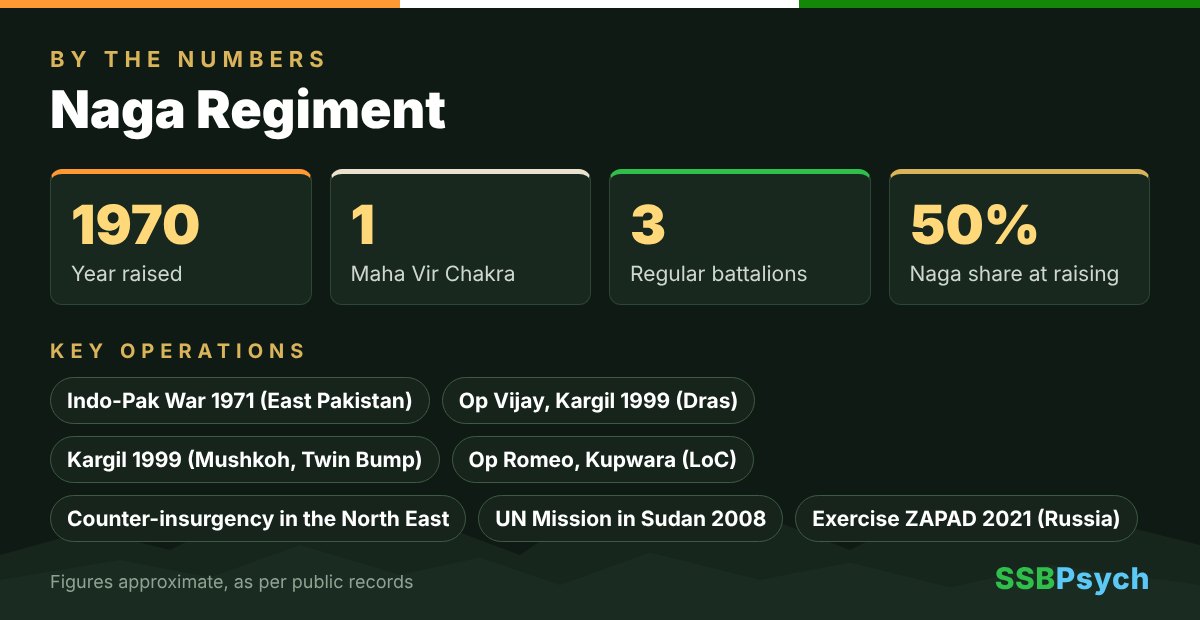
| Raised | 1 November 1970, at Ranikhet (1st Battalion) |
| Raised by | Lt Col R.N. Mahajan, VSM (later Lt Gen) |
| Regimental Centre | Kumaon Regimental Centre, Ranikhet, Uttarakhand |
| Affiliation | Affiliated to the Kumaon Regiment for regimental matters |
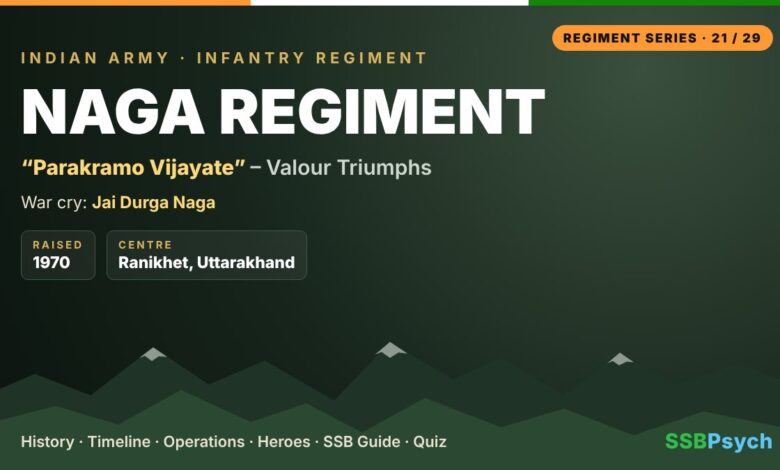
| Motto | Parakramo Vijayate (Valour Triumphs) |
| War Cry | Jai Durga Naga |
| Recruitment | About half Nagas; the rest Kumaonis, Garhwalis and Gorkhas |
| Battalions | 3 regular battalions plus a Territorial Army battalion in Nagaland |
| Nickname | The Head Hunters |
| Notable gallantry | 1 Maha Vir Chakra (Kargil), Kirti Chakra, Vir Chakras |
| Battle honours | Dras and Mushkoh (Kargil 1999) |
History of the Naga Regiment
Nagas had served in the Indian Army long before their own regiment existed, especially in the Assam Regiment. In 1960 a delegation of the Naga People’s Convention proposed a separate regiment so that the Naga people could play a bigger role in defending the nation. The idea took a decade to become reality.
On 1 November 1970 the first battalion, 1 Naga, was raised at the Kumaon Regimental Centre in Ranikhet, Uttarakhand. The task was given to Lieutenant Colonel R.N. Mahajan, VSM, who later rose to the rank of Lieutenant General. As it was the only battalion at first, it was simply called the Naga Regiment.
The new regiment had an unusual make-up. Half of its soldiers were to be Nagas, and the other half was to be made up of equal numbers of Kumaonis, Garhwalis and Gorkhas. Among the first Naga recruits were 69 men enrolled from rehabilitation camps for former underground fighters, along with young men from across Nagaland. Their decision to wear the Indian Army uniform was a powerful step towards peace and integration in the North East.
The regiment was affiliated to the Kumaon Regiment for all regimental matters, and it shares the Kumaon Regimental Centre at Ranikhet. Its first Colonel of the Regiment, appointed in 1971, was Major General T.N. Raina, MVC, who later became the Chief of the Army Staff. Even so, the Naga Regiment was given its own distinct uniform, flag and identity.
Growth of the Regiment
The second battalion, 2 Naga, was raised at Haldwani on 11 February 1985, and the third, 3 Naga, followed on 1 October 2009, also at Haldwani. A Territorial Army battalion, 164 Infantry Battalion (Home and Hearth), is based at Zakhama in Nagaland and draws on local volunteers.
Naga Regiment Timeline: From Raising to Today
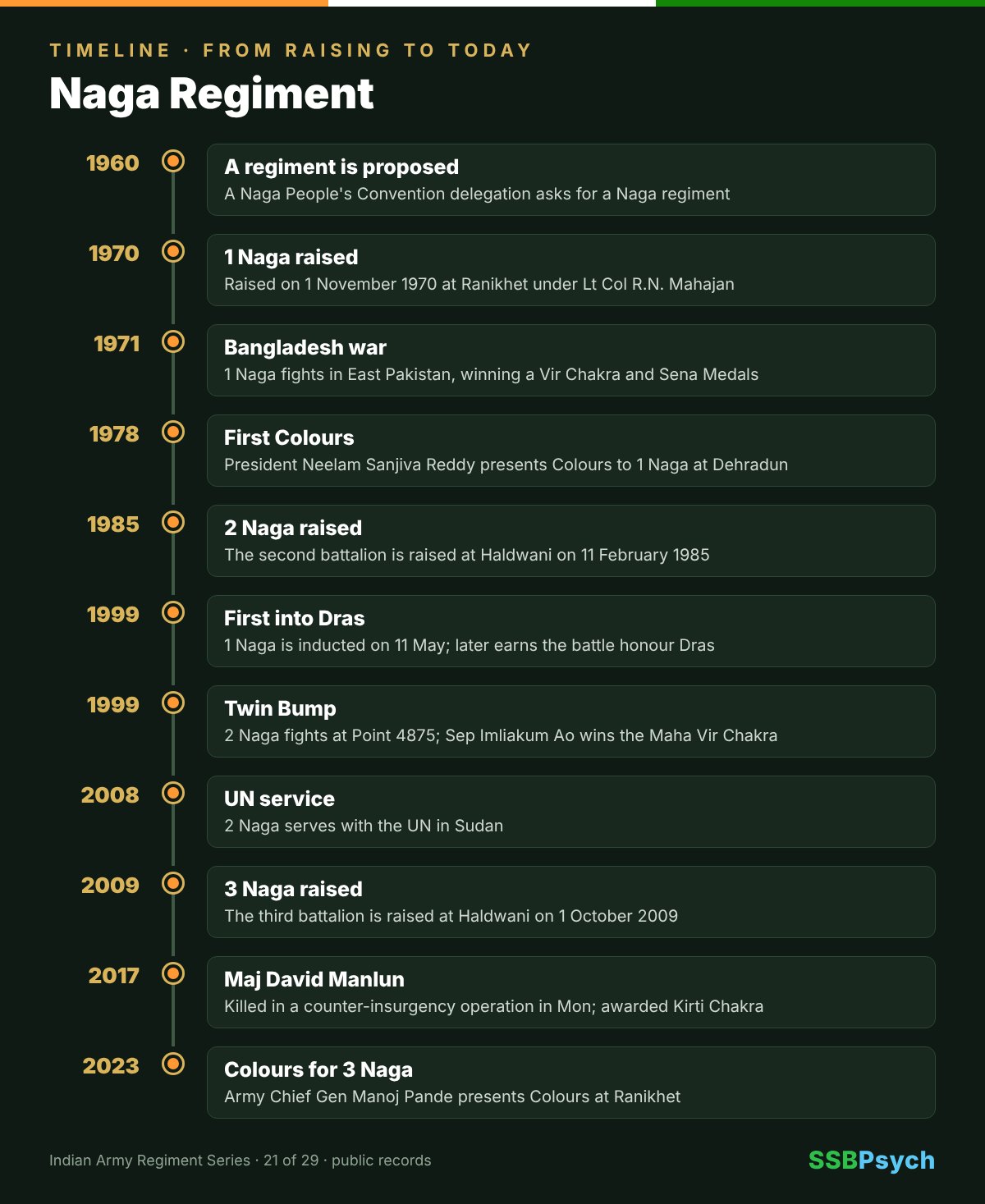
- 1960 – A regiment is proposed: A Naga People’s Convention delegation asks for a Naga regiment
- 1970 – 1 Naga raised: Raised on 1 November 1970 at Ranikhet under Lt Col R.N. Mahajan
- 1971 – Bangladesh war: 1 Naga fights in East Pakistan, winning a Vir Chakra and Sena Medals
- 1978 – First Colours: President Neelam Sanjiva Reddy presents Colours to 1 Naga at Dehradun
- 1985 – 2 Naga raised: The second battalion is raised at Haldwani on 11 February 1985
- 1999 – First into Dras: 1 Naga is inducted on 11 May; later earns the battle honour Dras
- 1999 – Twin Bump: 2 Naga fights at Point 4875; Sep Imliakum Ao wins the Maha Vir Chakra
- 2008 – UN service: 2 Naga serves with the UN in Sudan
- 2009 – 3 Naga raised: The third battalion is raised at Haldwani on 1 October 2009
- 2017 – Maj David Manlun: Killed in a counter-insurgency operation in Mon; awarded Kirti Chakra
- 2023 – Colours for 3 Naga: Army Chief Gen Manoj Pande presents Colours at Ranikhet
Major Operations and Battle Honours of the Naga Regiment
1971: Baptism of Fire
Barely a year after it was raised, 1 Naga went to war. In 1971 it fought in East Pakistan as part of 4 Infantry Division in the campaign that liberated Bangladesh. The young battalion earned a Vir Chakra and three Sena Medals, proving that a new regiment could fight like a veteran one.
Think about what this meant. Many of its Naga soldiers had joined only months earlier, and some had once been on the other side of the conflict in Nagaland. Yet in the swamps and rivers of East Pakistan they fought shoulder to shoulder with their Kumaoni, Garhwali and Gorkha comrades. The war turned a newly raised unit into a true fighting battalion and gave the regiment its first tradition of victory.
1999: First into Dras
When Pakistani intruders were discovered on the heights of Kargil in May 1999, 1 Naga was the first battalion inducted into the Dras sector, arriving on 11 May. It supported the famous Tololing battle and then captured a string of features with names that soldiers still remember: Black Rock, Thums Up, Pyramid and Pimple, which was later renamed Naga Hill. It also captured Point 5060. For this work 1 Naga received the battle honour Dras and the theatre honour Kargil.
Being first into Dras was no small honour. The sector sits along the vital Srinagar-Leh highway, and the enemy on the heights could watch and shell traffic on the road below. Every peak the Indian Army recaptured made the highway safer. The early work of 1 Naga in this sector, in thin air and bitter cold, helped prepare the ground for the larger attacks that followed.
1999: Twin Bump and Tiger Hill
2 Naga fought in the Mushkoh Valley. It took part in the battle for the Twin Bump feature in the Point 4875 complex and also attacked the Tiger Hill area from its left flank. In one of the most daring acts of the war, Sepoy Imliakum Ao moved forward under fire and helped silence enemy positions, winning the Maha Vir Chakra. 2 Naga received the battle honour Mushkoh and the theatre honour Kargil.
Tiger Hill became one of the most famous objectives of the war, and several battalions were involved in its capture. The Naga Regiment’s role on the flanks and on Twin Bump was part of this wider effort, in which units from many regiments worked together. The two Kargil battle honours, Dras and Mushkoh, remain the proudest entries in the regiment’s history so far.
Line of Control, North East and Abroad
2 Naga has carried out operations to dominate the Line of Control in the Keran sector of Kupwara under Operation Romeo, and the regiment’s battalions have served in counter-insurgency roles in the North East. In 2008 2 Naga served with the United Nations in Sudan and won a Force Commander’s Appreciation. In 2021, 3 Naga represented India at the multinational exercise ZAPAD in Russia.
Insignia, Motto and War Cry
The regimental crest is full of Naga symbolism. It shows two crossed Naga spears and a dao, the traditional Naga blade, set over a shield that carries the head of a mithun, the semi-wild bovine prized across Nagaland as a symbol of wealth and status. The regimental colours are gold, green and red: gold for the rising sun, green for the infantry, and red for authority among the Nagas.
The motto is Parakramo Vijayate, meaning Valour Triumphs. The commonly cited war cry is Jai Durga Naga. Soldiers of the regiment wear a golden hackle on the hat, and they were given permission to carry the dao with uniform, a rare mark of their unique heritage.
Heroes of the Naga Regiment
- Sepoy (later Subedar) Imliakum Ao, Maha Vir Chakra – 2 Naga; fought with outstanding courage at Twin Bump, Point 4875 complex, Kargil 1999.
- Major David Manlun, Kirti Chakra (posthumous) – 164 Infantry Battalion (TA), Naga Regiment; killed leading an operation against insurgents in Mon district, Nagaland, in June 2017.
- Havildar (later Subedar) Joseph Chang Anal, Vir Chakra – 2 Naga.
- Sepoy K. Ashuli, Vir Chakra (posthumous) – 1 Naga.
- Lieutenant Colonel (later Lieutenant General) R.N. Mahajan, VSM – raised and commanded the first battalion in 1970.
- General T.N. Raina, MVC – first Colonel of the Regiment (1971), who later served as Chief of the Army Staff.
Imliakum Ao’s story shows what one determined soldier can do. A sepoy, the most junior rank, he moved ahead under heavy fire, cleared enemy positions and helped his company win its objective. He was promoted soon after, and he later rose to the rank of Captain. His story is often told in Nagaland as a source of pride, and it reminds every SSB aspirant that leadership is about action, not rank.
Major David Manlun represents another kind of courage. Serving with the regiment’s Territorial Army battalion, he led his troops against insurgents near the Myanmar border and laid down his life. His Kirti Chakra, the second highest peacetime gallantry award, shows that the regiment’s battles are not only fought in wars.
Role and Life in the Regiment
Like every infantry regiment, the Naga Regiment’s battalions are trained for all types of terrain, but the mountains and jungles suit them especially well. Naga soldiers come from a hilly, forested land and are known for their stamina, fieldcraft and fierce loyalty to their comrades. Their battalions serve along the borders, in counter-insurgency grids and in peace stations across India.
Because of its mixed composition, a Naga battalion brings together soldiers from Nagaland, Kumaon, Garhwal and the Gorkha community. An officer must understand all of these cultures, their festivals, food and customs, and weld them into one team. The regiment’s young age also gives it a special energy: its traditions are still being written, and every officer who serves in it adds to that story.
Officers posted to the regiment often find that the bond with their men is especially close. Small details matter: learning a few words of the soldiers’ languages, joining their celebrations, and knowing their families. In return, the soldiers give a loyalty that is legendary in the Army. For a young lieutenant, this is the perfect school in which to learn that leadership begins with genuine care for the people you lead.
For the people of Nagaland, the regiment is a symbol of partnership with the rest of India. When 3 Naga received its President’s Colours at Ranikhet in 2023, it was a reminder of how far the regiment has come since a single battalion was raised there in 1970.
What the Naga Regiment Teaches SSB Aspirants
The Naga Regiment is a great example to use in discussions on national integration, the North East, and the role of the armed forces in nation-building. Its story connects peace efforts in Nagaland with the battlefield of Kargil. If you are asked about the North East in your interview or group discussion, mentioning this regiment shows depth, awareness and respect for India’s diversity.
A good way to prepare is to link the regiment to bigger themes. In a group discussion on the North East, you could mention how the raising of the Naga Regiment offered young men a path into national service. In a lecturette on Kargil, you could describe how 1 Naga was the first battalion to reach Dras. Real, specific examples like these make your points stronger and show the assessors that you read beyond the basics.
Naga Regiment for SSB Candidates: What You Should Know
How officers join
- Officers come to the infantry through NDA (after Class 12) or the CDS exam for graduates, and train at IMA Dehradun.
- Short Service Commission officers train at OTA Chennai through CDS (OTA), NCC Special Entry and similar schemes.
- Allotment to an arm and regiment is made during academy training based on your choice, merit and the vacancies available.
- You do not need to be from Nagaland to be commissioned into the Naga Regiment; officers come from all over India.
How soldiers join
- Soldiers are recruited mainly from Nagaland, along with Kumaonis, Garhwalis and Gorkhas, as per the regiment’s composition.
- Since 2022 soldiers join as Agniveers under the Agnipath scheme for four years, after which up to 25 percent can be selected for regular service.
- Recruits train at the Kumaon Regimental Centre, Ranikhet, which also serves the Naga Regiment.
Questions you may face in the SSB interview, GD or lecturette
- What do you know about the Naga Regiment and why was it raised?
- How has the Army contributed to peace and development in the North East?
- Tell us about the Naga Regiment’s role in the Kargil conflict.
- How would you lead a battalion with soldiers from very different cultures?
- What do you know about Imliakum Ao and his Maha Vir Chakra?
SSBPsych tip: Read up on the North East before your SSB. Being able to name Nagaland’s capital, its major festivals like Hornbill, and the Naga Regiment’s Kargil role shows the board you have real awareness, not just textbook knowledge.
Young in years but rich in courage, the Naga Regiment has already earned its place among the proud regiments of the Indian Army. Remember its motto as you prepare for your SSB: valour triumphs, but only when it is backed by preparation and teamwork. Now try the quiz below and check how much you have learnt.
Quiz: How Well Do You Know the Naga Regiment?
Test yourself! Click an option to see if you are right. Your score updates live.
Naga Regiment: Frequently Asked Questions
The motto of the Naga Regiment is Parakramo Vijayate, which means Valour Triumphs.
The Naga Regiment is affiliated to the Kumaon Regiment and uses the Kumaon Regimental Centre at Ranikhet, Uttarakhand.
Its first battalion was raised on 1 November 1970 at Ranikhet under Lieutenant Colonel R.N. Mahajan.
1 Naga was the first battalion inducted into Dras and captured several features, earning the honour Dras. 2 Naga fought at Twin Bump and Tiger Hill and earned Mushkoh, with Sepoy Imliakum Ao winning the Maha Vir Chakra.
Soldiers are mainly Nagas, along with Kumaonis, Garhwalis and Gorkhas. Officers come from all over India through NDA, CDS and other entries and are allotted regiments during training.
Indian Army Regiments Series on SSBPsych
This is part 21 of 29 in our series on every infantry regiment of the Indian Army – a new regiment every day at 11 AM. Previous in the series: Jammu and Kashmir Light Infantry. Also follow our Param Vir Chakra series.
Sources: en.wikipedia.org, bharat-rakshak.com, morungexpress.com, thebetterindia.com, honourpoint.in.
Preparing for NDA, CDS, AFCAT or your SSB? Join SSBPsych’s online and offline batches – explore our courses or call +91 8076540582.