3 Gorkha Rifles: History, Motto, Battle Honours and Heroes
The 3 Gorkha Rifles has a remarkable claim to fame: one of its riflemen, Kulbir Thapa, became the first Gurkha soldier ever to win the Victoria Cross. Raised in 1815, the regiment has fought from the walls of Delhi to the deserts of North Africa, and from the snows of Walong to the heights of Kargil. Its battalions have also given birth to another famous regiment, the Garhwal Rifles.
This guide for NDA, CDS, AFCAT and SSB aspirants covers the regiment’s history, a simple timeline, its operations and battle honours, its insignia, motto and war cry, its heroes, life in a Gorkha battalion, interview questions and a quiz to check your learning.
3 Gorkha Rifles – Quick Facts
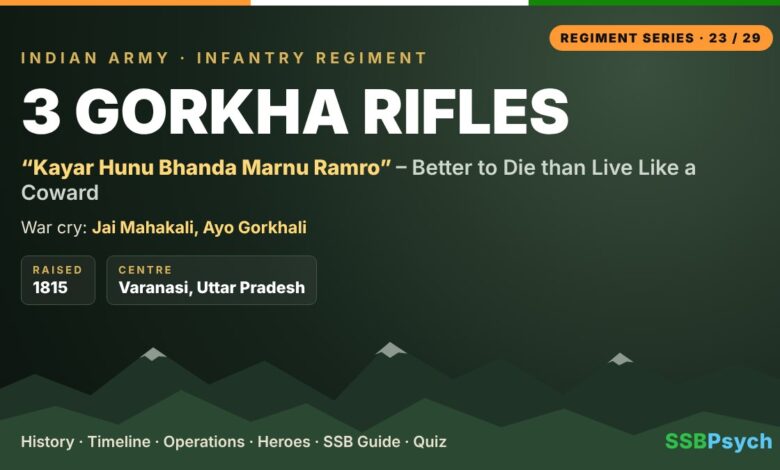
| Raised | 24 April 1815, as the Kemaoon (Kumaon) Battalion |
| Raised by | Sir Robert Colquhoun |
| Present name | 3rd Gorkha Rifles, since 1950 |
| Regimental Centre | 39 Gorkha Training Centre, Varanasi, Uttar Pradesh (shared with 9 GR) |
| Motto | Kayar Hunu Bhanda Marnu Ramro (Better to die than live like a coward) |
| War Cry | Jai Mahakali, Ayo Gorkhali (Hail Mahakali, the Gorkhas are here) |
| Recruitment | Gorkhas, mainly Magars and Gurungs |
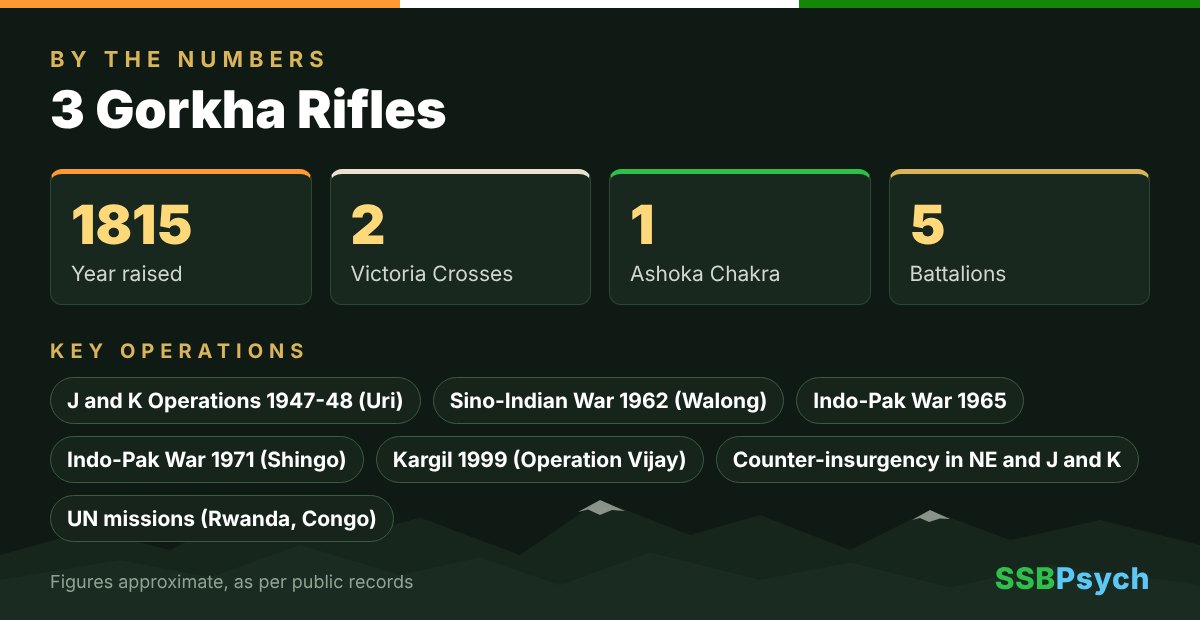
| Battalions | 5 regular battalions |
| Insignia | Crossed khukris with the numeral 3 |
| Notable gallantry | 2 Victoria Crosses, 1 Ashoka Chakra |
| Post-1947 honours | Pir Kanthi near Uri (1948), Shingo River Valley (1971) |
History of 3 Gorkha Rifles
After the Anglo-Nepalese War, the British began raising units from the hill soldiers who had fought so well against them. On 24 April 1815, Sir Robert Colquhoun raised the Kemaoon Battalion, named after the Kumaon hills. In its early years the battalion drew soldiers from Kumaon and Garhwal as well as Gorkhas. The regiment still honours its founder: its pipers wear the tartan of the Colquhoun clan.
In 1861 the battalion became the 3rd Gurkha (The Kumaon) Regiment. It went on to become a rifle regiment in 1891, the 3rd The Queen’s Own Gurkha Rifles in 1907, and the 3rd Queen Alexandra’s Own Gurkha Rifles in 1908. At independence it was one of the six Gurkha regiments that stayed with India, and in 1950 it took its present name, 3rd Gorkha Rifles.
The Birth of the Garhwal Rifles
One of the most interesting facts about 3 GR is its link with the Garhwal Rifles. In 1887 a second battalion made up of Garhwalis was raised in the regiment. A few years later it was separated to form the 39th (Garhwal) Regiment of Bengal Infantry, the ancestor of today’s Garhwal Rifles. A new 2nd Battalion of Gorkhas was then raised in 1890.
Battles of the Nineteenth Century
During the uprising of 1857 the regiment took part in the siege of Delhi and the storming of the Kashmiri Gate, winning the battle honour Delhi 1857. In the Second Afghan War it helped capture Kandahar in 1879 and fought at Ahmad Khel in April 1880, where the troops formed a square to beat off a massed attack. In 1897, during the Tirah campaign on the North-West Frontier, it took part in the assault on the Dargai Heights.
Two World Wars
In the First World War the regiment fought in France with the Garhwal Brigade, at places such as Neuve Chapelle, Festubert and Aubers, and later in Egypt and Palestine, including the capture of Jerusalem and the battles of Megiddo and Sharon. Two of its riflemen won the Victoria Cross. In the Second World War its battalions fought in North Africa, in Italy and in Burma, earning a long list of honours such as Imphal, Bishenpur, Meiktila and Pegu.
The Western Front of 1914-15 was a shock for soldiers from the Himalayan hills. They arrived in a cold, wet European winter with little warning, and faced machine guns, artillery and poison gas in muddy trenches. Yet the Gurkha battalions earned a lasting reputation for steadiness under fire. The regiment’s long list of First World War honours shows how much it gave in that conflict.
3 Gorkha Rifles Timeline: From Raising to Today
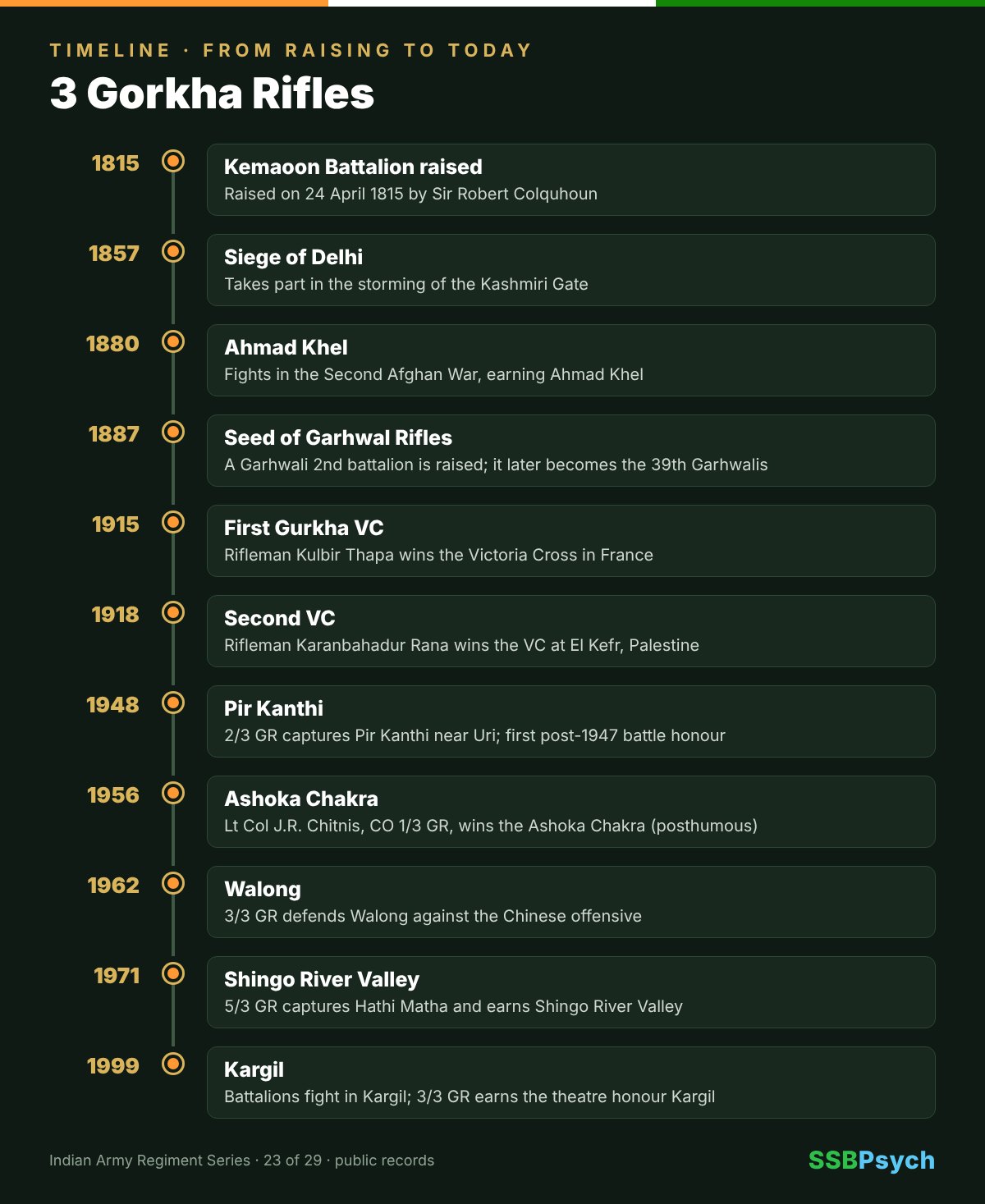
- 1815 – Kemaoon Battalion raised: Raised on 24 April 1815 by Sir Robert Colquhoun
- 1857 – Siege of Delhi: Takes part in the storming of the Kashmiri Gate
- 1880 – Ahmad Khel: Fights in the Second Afghan War, earning Ahmad Khel
- 1887 – Seed of Garhwal Rifles: A Garhwali 2nd battalion is raised; it later becomes the 39th Garhwalis
- 1915 – First Gurkha VC: Rifleman Kulbir Thapa wins the Victoria Cross in France
- 1918 – Second VC: Rifleman Karanbahadur Rana wins the VC at El Kefr, Palestine
- 1948 – Pir Kanthi: 2/3 GR captures Pir Kanthi near Uri; first post-1947 battle honour
- 1956 – Ashoka Chakra: Lt Col J.R. Chitnis, CO 1/3 GR, wins the Ashoka Chakra (posthumous)
- 1962 – Walong: 3/3 GR defends Walong against the Chinese offensive
- 1971 – Shingo River Valley: 5/3 GR captures Hathi Matha and earns Shingo River Valley
- 1999 – Kargil: Battalions fight in Kargil; 3/3 GR earns the theatre honour Kargil
Major Operations and Battle Honours of 3 Gorkha Rifles
1947-48: Pir Kanthi and Uri
In the first Kashmir war the 2nd Battalion fought in the Uri sector. On 26 June 1948 it captured the high feature of Pir Kanthi near the Uri-Domel road. This action earned the regiment its first battle honour after independence.
1956: Ashoka Chakra in the Naga Hills
On 14 June 1956, during counter-insurgency operations in the Naga Hills, the column of Lieutenant Colonel Jagannath Raoji Chitnis, Commanding Officer of 1/3 GR, was ambushed. He personally led the effort to clear the ambush and was killed. He was awarded the Ashoka Chakra posthumously, the regiment’s highest peacetime award.
1962: Walong
In the 1962 war with China, the 3rd Battalion fought in the Walong sector in the far east of what is now Arunachal Pradesh. Orders to withdraw failed to reach the battalion, which was cut off in difficult terrain. Walong is remembered as one of the places where Indian troops fought back hard in that war.
The 1962 war is often studied for its lessons in preparation, logistics and leadership at high altitude. For SSB aspirants, Walong is a reminder that soldiers sometimes have to fight with little support and broken communications, and that small-unit leaders must then make decisions on their own. This is exactly why the Army values initiative so highly in its young officers.
1965 and 1971
In 1965 several battalions saw action. The 1st Battalion fought in major actions during the advance towards Lahore, while others held the borders. In 1971 the 5th Battalion captured the feature of Hathi Matha and a string of enemy picquets in the Kargil area in winter, earning the battle honour Shingo River Valley. In the east, the 1st Battalion carried out an amphibious operation to cut off retreating Pakistani troops, a rare kind of mission for an Indian infantry battalion.
Both 1971 actions show the regiment’s versatility. Capturing mountain posts in the Kargil area in the middle of winter required careful planning, fitness and the ability to survive extreme cold. The amphibious task in the east, on the other hand, meant moving troops across water, a skill the infantry rarely practises. The 1st Battalion is recorded as the first Indian battalion after independence to carry out such an operation.
1999: Kargil and Beyond
Battalions of 3 GR took part in the Kargil conflict of 1999, and 3/3 GR received the theatre honour Kargil. The regiment’s battalions have also served in counter-insurgency operations, earning Army Commander citations, and two battalions have served on United Nations missions in Rwanda and the Congo, winning praise including a Force Commander’s citation.
Insignia, Motto and War Cry
The regimental insignia shows a pair of crossed khukris with the numeral 3. The regiment’s colours are rifle green faced with black, and the Kilmarnock cap was part of its traditional dress for many years.
Like the other Gorkha regiments, 3 GR’s motto is Kayar Hunu Bhanda Marnu Ramro, meaning Better to die than live like a coward. Its war cry is Jai Mahakali, Ayo Gorkhali, meaning Hail Goddess Mahakali, the Gorkhas are here. Few sounds on a battlefield are as feared as this cry followed by the flash of khukris.
Heroes of 3 Gorkha Rifles
- Rifleman Kulbir Thapa, Victoria Cross – 2nd Battalion; near Fauquissart, France, September 1915; the first Gurkha to win the VC. He rescued a wounded British soldier and two Gurkhas under fire.
- Rifleman Karanbahadur Rana, Victoria Cross – 2nd Battalion; El Kefr, Palestine, 10 April 1918.
- Lieutenant Colonel J.R. Chitnis, Ashoka Chakra (posthumous) – Commanding Officer, 1/3 GR; killed clearing an ambush in the Naga Hills, June 1956.
- Sir Robert Colquhoun – raised the Kemaoon Battalion in 1815.
- Lieutenant General M.K. Lahiri – as a young captain of the regiment, he played football for India.
- Naib Subedar N.D. Sherpa – 5/3 GR; a well-known Army mountaineer.
Kulbir Thapa’s story is about compassion as much as courage. During the Battle of Loos, though wounded himself, he found a badly injured soldier of the Leicestershire Regiment behind the German front line and refused to leave him, staying by his side through the night. Next morning he brought two wounded Gurkhas back to safety and then went out again in daylight to carry the British soldier back across open ground under fire. A great soldier does not only fight; he protects others, even strangers.
The regiment’s British officers also left a lasting legacy. Sir Ralph Turner, who served with the regiment in the First World War, wrote famous words praising the Gurkha as the bravest of the brave and the most faithful of friends. His tribute is carved on the Gurkha memorial in London, unveiled in 1997.
Role and Life in a Gorkha Battalion
3 GR is an infantry regiment, ready to fight in any terrain but especially strong in the mountains. Its soldiers are mainly Gorkhas from the Magar and Gurung communities, known for endurance, good humour and steady discipline. Recruits train at the 39 Gorkha Training Centre at Varanasi, which the regiment shares with 9 Gorkha Rifles.
An officer in a Gorkha battalion learns Nepali, takes part in festivals like Dashain, and builds a bond with his men that often lasts a lifetime. Gorkha soldiers are known to trust their officers completely, and they expect fairness, courage and care in return. For a young officer, this trust is both a privilege and a responsibility.
The regiment’s long history means every battalion has its own customs, nicknames and stories. Officers are expected to know these well, because sharing the battalion’s history with new soldiers is part of how esprit de corps is built.
Sport and adventure are also part of regimental life. The fact that a young captain of the regiment went on to play football for India, and that one of its soldiers became a respected mountaineer, says a lot about the balanced, active life that Gorkha battalions encourage.
Why 3 Gorkha Rifles Matters for SSB Aspirants
3 GR gives you strong examples for interviews and group tasks. Kulbir Thapa’s VC shows that compassion and courage go together. The regiment’s link to the Garhwal Rifles shows how the Army has grown and changed over two centuries. Its 1971 amphibious operation and its winter capture of Hathi Matha are good examples of initiative and planning. Using such examples naturally in your answers will make you stand out.
Remember also that the SSB interview often moves from a regiment to wider topics. A question on 3 GR can lead to India-Nepal relations, the Tripartite Agreement of 1947, the Agnipath scheme or the lessons of 1962. Prepare short, balanced views on each of these. Speak from facts, admit what you do not know, and avoid exaggeration. Honest, well-reasoned answers impress the board far more than memorised speeches or dramatic claims.
3 Gorkha Rifles for SSB Candidates: What You Should Know
How officers join
- Officers join the infantry through NDA (after Class 12) or CDS (IMA, for graduates), followed by training at IMA Dehradun.
- Short Service Commission officers train at OTA Chennai through CDS (OTA), NCC Special Entry and similar entries.
- Arm and regiment allotment is done during academy training based on your choice, merit and the vacancies available.
- You do not have to be a Gorkha to be an officer in 3 GR; officers come from all over India and learn Nepali after joining.
How soldiers join
- Soldiers are Gorkhas, mainly from the Magar and Gurung communities, of Indian and Nepalese domicile.
- Since 2022, Indian-domiciled Gorkhas join as Agniveers under the Agnipath scheme for four years, with up to 25 percent retained as regulars.
- News reports say recruitment of Nepal-domiciled Gorkhas has been on hold since 2022, as Nepal has not agreed to the Agnipath terms; check the latest position.
- Recruits train at 39 Gorkha Training Centre, Varanasi.
Questions you may face in the SSB interview, GD or lecturette
- What do you know about Gorkha regiments in the Indian Army?
- Who was Kulbir Thapa and why is he remembered?
- What happened at Walong in 1962 and what lessons did India learn from that war?
- How do India and Nepal share a special military relationship?
- How would you lead soldiers whose language you do not yet speak?
SSBPsych tip: When asked about a hero like Kulbir Thapa, connect his action to an Officer Like Quality, such as responsibility for others. The board values candidates who understand why an act was brave, not just what happened.
Two centuries after Sir Robert Colquhoun raised the Kemaoon Battalion, the 3 Gorkha Rifles remains a symbol of courage and loyalty. As you prepare for your SSB, let its motto guide you: better to die than live like a coward. Face every challenge with honesty and spirit. Now try the quiz below.
Quiz: How Well Do You Know the 3 Gorkha Rifles?
Test yourself! Click an option to see if you are right. Your score updates live.
3 Gorkha Rifles: Frequently Asked Questions
The motto is Kayar Hunu Bhanda Marnu Ramro, which means Better to die than live like a coward.
3 GR trains its recruits at the 39 Gorkha Training Centre in Varanasi, Uttar Pradesh, which it shares with 9 Gorkha Rifles.
It was raised on 24 April 1815 by Sir Robert Colquhoun as the Kemaoon Battalion, and took the name 3rd Gorkha Rifles in 1950.
Rifleman Kulbir Thapa (France, 1915), the first Gurkha to win the VC, and Rifleman Karanbahadur Rana (Palestine, 1918), both of the 2nd Battalion.
The war cry is Jai Mahakali, Ayo Gorkhali, meaning Hail Goddess Mahakali, the Gorkhas are here.
Indian Army Regiments Series on SSBPsych
This is part 23 of 29 in our series on every infantry regiment of the Indian Army – a new regiment every day at 11 AM. Previous in the series: 1 Gorkha Rifles. Also follow our Param Vir Chakra series.
Sources: en.wikipedia.org, salute.co.in, nawang.com, en.wikipedia.org, bharat-rakshak.com.
Preparing for NDA, CDS, AFCAT or your SSB? Join SSBPsych’s online and offline batches – explore our courses or call +91 8076540582.