1 Gorkha Rifles: Malaun Regiment History, Motto and Heroes
Some regiments are born from victory. The 1 Gorkha Rifles was born from a defeat that won the respect of its enemy. In 1815, after a hard siege at Malaun Fort, the British East India Company was so impressed by the Gorkha soldiers who had fought against it that it invited them to join its army. More than two centuries later, the regiment still proudly carries the name The Malaun Regiment, along with a Param Vir Chakra won in faraway Congo.
In this guide for NDA, CDS, AFCAT and SSB aspirants, you will find the history of 1 GR, a clear timeline, its major operations and battle honours, its insignia, motto and war cry, its heroes, life in a Gorkha battalion, interview questions and a quiz to test your knowledge.
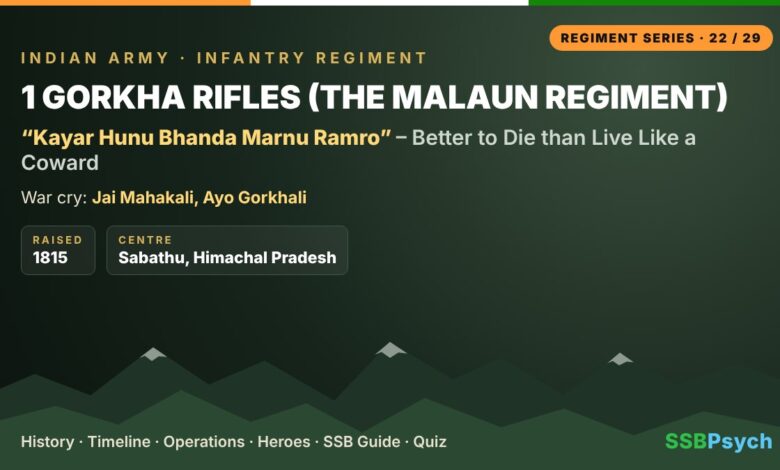
1 Gorkha Rifles – Quick Facts
| Raised | 24 April 1815, at Sabathu, as the First Nusseree Battalion |
| Also called | The Malaun Regiment |
| Regimental Centre | 14 Gorkha Training Centre, Sabathu, Himachal Pradesh (shared with 4 GR) |
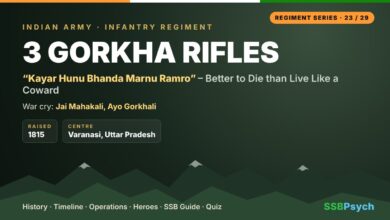
| Motto | Kayar Hunu Bhanda Marnu Ramro (Better to die than live like a coward) |
| War Cry | Jai Mahakali, Ayo Gorkhali (Hail Mahakali, the Gorkhas are here) |
| Recruitment | Gorkhas of Indian and Nepalese domicile, mainly Magars and Gurungs |
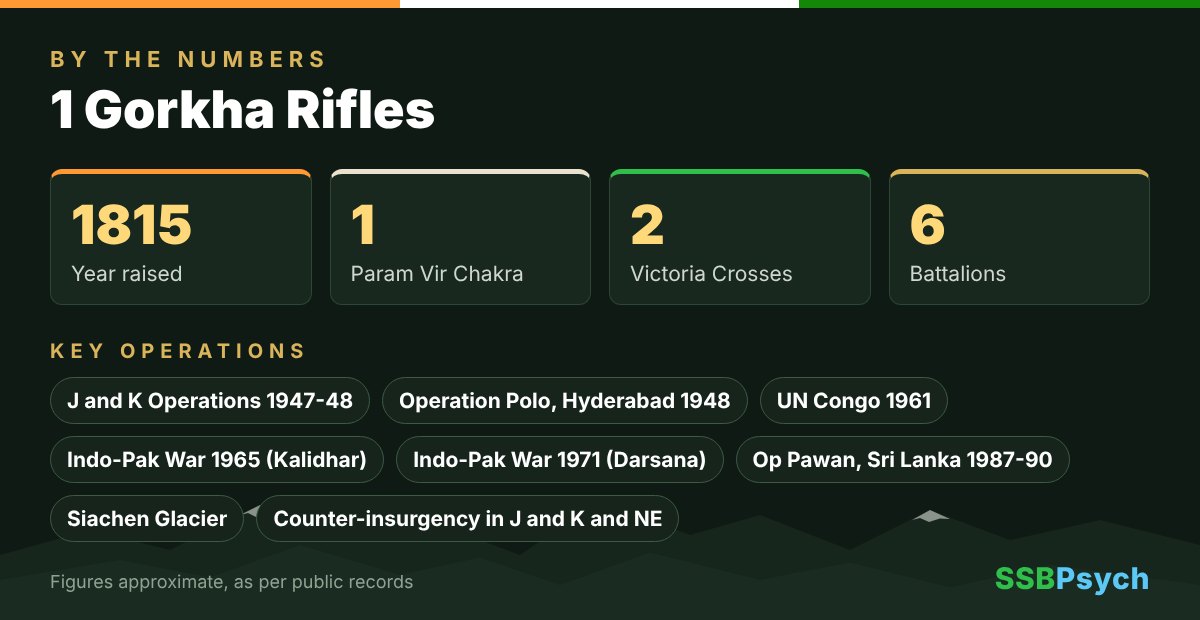
| Battalions | 6 regular battalions |
| Insignia | Crossed khukris with the numeral 1 above |
| Notable gallantry | 1 Param Vir Chakra, 2 Victoria Crosses |
| Post-1947 honours | Kalidhar (1965), Darsana (1971) |
History of 1 Gorkha Rifles
In the Anglo-Nepalese War of 1814-16, the British fought the Gorkha army of Nepal in the hills of what is now Himachal Pradesh and Uttarakhand. One of the toughest fights was the siege of Malaun Fort in Bilaspur, held by the famous Gorkha commander General Amar Singh Thapa. The British won, but they came away deeply impressed by the courage and skill of the Gorkha soldiers. A clause in the Treaty of Sugauli that followed allowed the British to recruit Gorkhas.
On 24 April 1815 survivors of Amar Singh Thapa’s army were formed into the First Nusseree Battalion at Sabathu in the Shimla hills. This date is still celebrated as the regiment’s raising day. The name Malaun, added to the regiment’s title in 1903, recalls the place where the story began. It has nothing to do with any insult; it is simply the name of the fort.
Many Names, One Regiment
Over the next century the regiment changed its name many times. In 1850 it became the 66th Goorkha Regiment of Bengal Native Infantry, and in 1861 the 1st Goorkha Regiment. It went on to become the 1st Goorkha Light Infantry, then a rifle regiment, and in 1910 the 1st King George’s Own Gurkha Rifles (The Malaun Regiment). At independence it was one of six Gurkha regiments that stayed with the Indian Army under the 1947 Tripartite Agreement between India, Britain and Nepal. In 1950, after India became a republic, it was named 1st Gorkha Rifles (The Malaun Regiment), using the Indian spelling.
The 1947 split is worth understanding. Before independence there were ten Gurkha regiments in the British Indian Army. Under the Tripartite Agreement, four went to the British Army and six, including the 1st, stayed with India. Gorkha soldiers were given a choice of which army to serve. Those who stayed with India became part of a new chapter, and the regiments soon adopted the spelling Gorkha to mark their Indian identity.
Battles Before Independence
The regiment’s first great battle was the siege of Bharatpur in 1826. Its battle honour Bharatpur was the first ever awarded to a Gurkha unit. Twenty years later, in the First Anglo-Sikh War, it fought at Aliwal and Sobraon. During the uprising of 1857-58, Lieutenant John Adam Tytler of the regiment won the Victoria Cross. In 1875 the regiment went overseas for the first time, to the Perak War in Malaya, where Captain George Nicolas Channer won a second Victoria Cross.
In the First World War the 1st Battalion reached France in December 1914 and fought at Givenchy, Neuve Chapelle, Ypres, Festubert and Loos. It then moved to Mesopotamia, where it took part in attempts to relieve the besieged garrison at Kut, and later to Palestine, fighting at Megiddo and Sharon in 1918. In the Second World War, the 2nd Battalion fought in Malaya at Jitra and Kampar and was captured when Singapore fell in February 1942. Other battalions fought at Imphal and in Burma until victory in 1945.
1 Gorkha Rifles Timeline: From Raising to Today
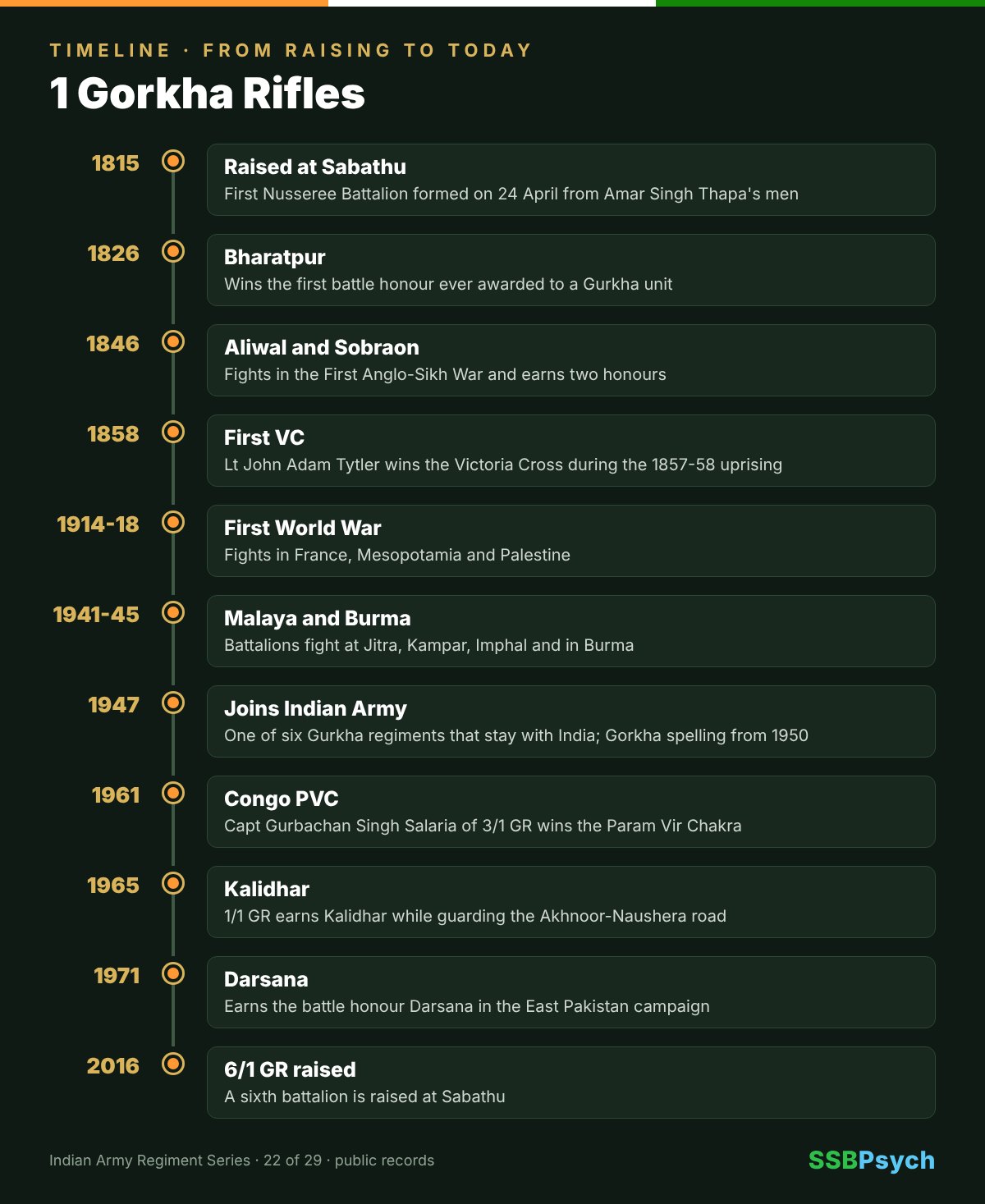
- 1815 – Raised at Sabathu: First Nusseree Battalion formed on 24 April from Amar Singh Thapa’s men
- 1826 – Bharatpur: Wins the first battle honour ever awarded to a Gurkha unit
- 1846 – Aliwal and Sobraon: Fights in the First Anglo-Sikh War and earns two honours
- 1858 – First VC: Lt John Adam Tytler wins the Victoria Cross during the 1857-58 uprising
- 1914-18 – First World War: Fights in France, Mesopotamia and Palestine
- 1941-45 – Malaya and Burma: Battalions fight at Jitra, Kampar, Imphal and in Burma
- 1947 – Joins Indian Army: One of six Gurkha regiments that stay with India; Gorkha spelling from 1950
- 1961 – Congo PVC: Capt Gurbachan Singh Salaria of 3/1 GR wins the Param Vir Chakra
- 1965 – Kalidhar: 1/1 GR earns Kalidhar while guarding the Akhnoor-Naushera road
- 1971 – Darsana: Earns the battle honour Darsana in the East Pakistan campaign
- 2016 – 6/1 GR raised: A sixth battalion is raised at Sabathu
Major Operations and Battle Honours of 1 Gorkha Rifles
Since 1947 the regiment’s battalions have served in every major Indian Army campaign and in some of the most difficult terrain in the world.
1947-48 and Operation Polo
In the first Kashmir war the 1st Battalion fought in Jammu and Kashmir and won the regiment’s first Maha Vir Chakra after independence. In September 1948 the 2nd Battalion took part in Operation Polo, the police action that integrated Hyderabad into India.
1961: Congo and the Param Vir Chakra
In 1961 the 3rd Battalion served with the United Nations force in the Congo. On 5 December 1961, at Elisabethville in Katanga, Captain Gurbachan Singh Salaria led a small force against a much larger group of armed mercenaries who were blocking a vital road. Charging with khukris and rifles, his men broke the enemy, but Salaria was badly wounded and died. He was awarded the Param Vir Chakra posthumously. He remains the only Indian to win the PVC while serving on a UN mission, and 3/1 GR is proudly called the Param Vir Chakra Paltan.
The Congo mission came at a time when the newly independent African nation was facing breakaway movements and foreign mercenaries. India sent a large brigade to support the United Nations, and Gorkha soldiers were among its most trusted troops. Salaria’s action showed the world that Indian peacekeepers were willing to fight hard to protect the mission they had been sent to support.
1965: Kalidhar
In the 1965 war with Pakistan, the 1st Battalion fought to stop the enemy from cutting the road between Akhnoor and Naushera in Jammu and Kashmir. Its success earned the battle honour Kalidhar.
1971: Darsana
In the 1971 war the regiment’s battalions fought both in Jammu and Kashmir and in East Pakistan. In the east they won the battle honour Darsana, and the regiment earned several Maha Vir Chakras and Vir Chakras during the war.
Sri Lanka, Siachen and Counter-Insurgency
Battalions of 1 GR served with the Indian Peace Keeping Force in Sri Lanka under Operation Pawan, where they won several gallantry awards. Between 1992 and 2000 three battalions served on the Siachen Glacier, and the 4th Battalion received the Northern Army Commander’s appreciation for its tenure there. Units have also earned Chief of Army Staff Unit Citations for counter-insurgency in Punjab, Jammu and Kashmir and the North East.
Siachen deserves a special note. Posts on the glacier sit at heights where the air is thin and the cold can be deadly even without enemy action. Soldiers must be fit, patient and alert for months at a stretch. For Gorkha troops, used to life in the hills, this is demanding but familiar ground, and the regiment’s record there shows that its men remain as hardy as their ancestors at Malaun.
Insignia, Motto and War Cry
The regimental insignia shows two crossed khukris, the famous curved Gorkha knife, with the numeral 1 above them. The khukri is the most recognised symbol of the Gorkha soldier, and it is carried with great pride.
The motto is Kayar Hunu Bhanda Marnu Ramro, a Nepali phrase meaning Better to die than live like a coward. The war cry, Jai Mahakali, Ayo Gorkhali, means Hail Goddess Mahakali, the Gorkhas are here. These words are shared by the Gorkha regiments of the Indian Army, and few war cries in the world are as famous.
Heroes of 1 Gorkha Rifles
- Captain Gurbachan Singh Salaria, Param Vir Chakra (posthumous) – 3/1 GR; led a charge against mercenaries at Elisabethville, Congo, on 5 December 1961.
- Lieutenant John Adam Tytler, Victoria Cross – won during the 1857-58 uprising; the regiment’s first Victoria Cross.
- Captain George Nicolas Channer, Victoria Cross – won in the Perak War, Malaya, in 1875.
- General Amar Singh Thapa – the Gorkha commander at Malaun, whose soldiers formed the regiment’s first battalion in 1815.
Captain Salaria’s story is a favourite in SSB preparation for good reason. He was a young officer of 26, far from home, under the UN flag. Facing an enemy many times his strength, he did not wait for the enemy to come to him. He attacked, and his boldness saved the situation. Born in Gurdaspur district of Punjab in 1935, he is also a reminder that Gorkha regiments are led by officers from every corner of India.
Role and Life in a Gorkha Battalion
The 1 Gorkha Rifles is an infantry regiment trained for all terrain, with special strength in the mountains. Gorkha soldiers come from hill communities in Nepal and in Indian regions such as Darjeeling, Sikkim, Himachal Pradesh and Uttarakhand. They are famous for their toughness, cheerfulness, discipline and complete loyalty to their officers.
An officer joining 1 GR is expected to learn Nepali (often called Gorkhali in the regiment) quickly, because talking to your men in their own language is the first step to winning their trust. Festivals like Dashain are celebrated with great energy in the battalion, and officers take part fully. The relationship between a Gorkha soldier and his officer is often described as a lifelong bond.
The regiment’s soldiers mostly come from the Magar and Gurung communities. Recruits train at the 14 Gorkha Training Centre at Sabathu, the regiment’s birthplace, which it shares with 4 Gorkha Rifles. In 2016 the regiment raised a new 6th Battalion at Sabathu, made up of Gorkhas domiciled in India.
Why 1 Gorkha Rifles Matters for SSB Aspirants
1 GR offers rich material for interviews and group discussions. Its origin teaches that respect can be earned even from an opponent. Its Congo PVC links the Indian Army to the wider story of UN peacekeeping, a common SSB topic. And its long history shows how a unit can keep its identity through many names and changes. Knowing these points will help you speak about the regiment with confidence.
You can also use the regiment’s story in the psychology tests. A Thematic Apperception Test picture of a small group facing danger, for example, can remind you of Salaria’s decision to attack rather than wait. The point is not to copy his story, but to show the same qualities in your own stories: quick thinking, initiative, courage and concern for the team.
1 Gorkha Rifles for SSB Candidates: What You Should Know
How officers join
- Officers join the infantry through NDA (after Class 12) or the CDS exam (IMA, for graduates), followed by training at IMA Dehradun.
- Short Service Commission officers train at OTA Chennai through CDS (OTA), NCC Special Entry and similar schemes.
- Arm and regiment allotment is decided during academy training on the basis of your choice, order of merit and vacancies.
- Officers of Gorkha regiments do not need to be Gorkhas; they come from all over India and learn Nepali after commissioning.
How soldiers join
- Soldiers are Gorkhas of Indian and Nepalese domicile, mainly from the Magar and Gurung communities.
- Since 2022, Indian-domiciled Gorkhas join as Agniveers under the Agnipath scheme for four years, with up to 25 percent retained as regulars.
- News reports say recruitment of Nepal-domiciled Gorkhas has been on hold since 2022, as Nepal has not agreed to the Agnipath terms; check the latest position.
- Recruits train at 14 Gorkha Training Centre, Sabathu, Himachal Pradesh.
Questions you may face in the SSB interview, GD or lecturette
- Why are Gorkha soldiers so highly respected around the world?
- What do you know about Captain Gurbachan Singh Salaria and the Congo operation?
- What is the role of the Indian Army in UN peacekeeping?
- How would you build trust with soldiers whose language and culture are different from yours?
- What do you understand by the Tripartite Agreement of 1947 on Gorkha soldiers?
SSBPsych tip: If you choose a Gorkha regiment as a preference, be ready to explain why with real reasons, such as their loyalty, history and the bond with officers. Saying you are willing to learn Nepali shows commitment.
Read the stories of its Param Vir Chakra heroes: Captain Gurbachan Singh Salaria.
From the walls of Malaun Fort to the streets of Elisabethville, the 1 Gorkha Rifles has shown that courage is its oldest tradition. As you prepare, remember its motto: it is better to die than to live like a coward. In SSB terms, that means facing every task with honesty and courage. Now take the quiz below.
Quiz: How Well Do You Know the 1 Gorkha Rifles?
Test yourself! Click an option to see if you are right. Your score updates live.
1 Gorkha Rifles: Frequently Asked Questions
The motto is Kayar Hunu Bhanda Marnu Ramro, which means Better to die than live like a coward.
1 GR trains its recruits at the 14 Gorkha Training Centre, Sabathu, Himachal Pradesh, which it shares with 4 Gorkha Rifles.
The name comes from Malaun Fort in Bilaspur, where Gorkha soldiers impressed the British during the Anglo-Nepalese War. Their survivors formed the regiment in 1815.
Captain Gurbachan Singh Salaria of 3/1 GR won the Param Vir Chakra posthumously in the Congo on 5 December 1961 while serving with the United Nations.
The war cry is Jai Mahakali, Ayo Gorkhali, meaning Hail Goddess Mahakali, the Gorkhas are here.
Indian Army Regiments Series on SSBPsych
This is part 22 of 29 in our series on every infantry regiment of the Indian Army – a new regiment every day at 11 AM. Previous in the series: Naga Regiment. Also follow our Param Vir Chakra series.
Sources: en.wikipedia.org, salute.co.in, bharat-rakshak.com, en.wikipedia.org, theprint.in.
Preparing for NDA, CDS, AFCAT or your SSB? Join SSBPsych’s online and offline batches – explore our courses or call +91 8076540582.