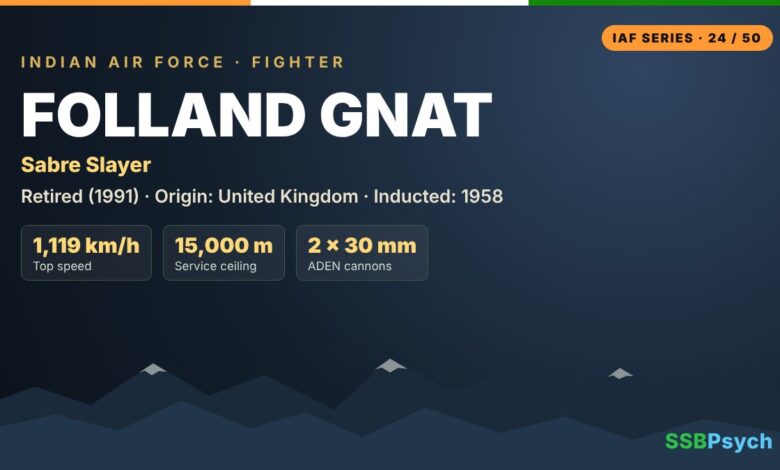
Folland Gnat in Indian Air Force: Sabre Slayer Specs and Wars
It was shorter than a city bus and weighed about as much as a large SUV. Yet this tiny jet became one of the most feared opponents in the skies over the subcontinent. The Folland Gnat, nicknamed the Sabre Slayer, helped the Indian Air Force win famous dogfights in 1965 and 1971 and carried the only IAF officer ever awarded the Param Vir Chakra.
The Gnat’s story is a lesson in how skill, courage and smart design can beat a bigger, more famous opponent. Its main rival, the American-built F-86 Sabre flown by the Pakistan Air Force, was a celebrated fighter of the Korean War era. Again and again, Indian pilots in their little Gnats got the better of it.
In this guide you will learn why India chose the Gnat, how it was built in India, how it performed, its weapons, the war stories that made it a legend, where you can still see one, and why it matters for every defence aspirant. A 10-question quiz waits at the end.

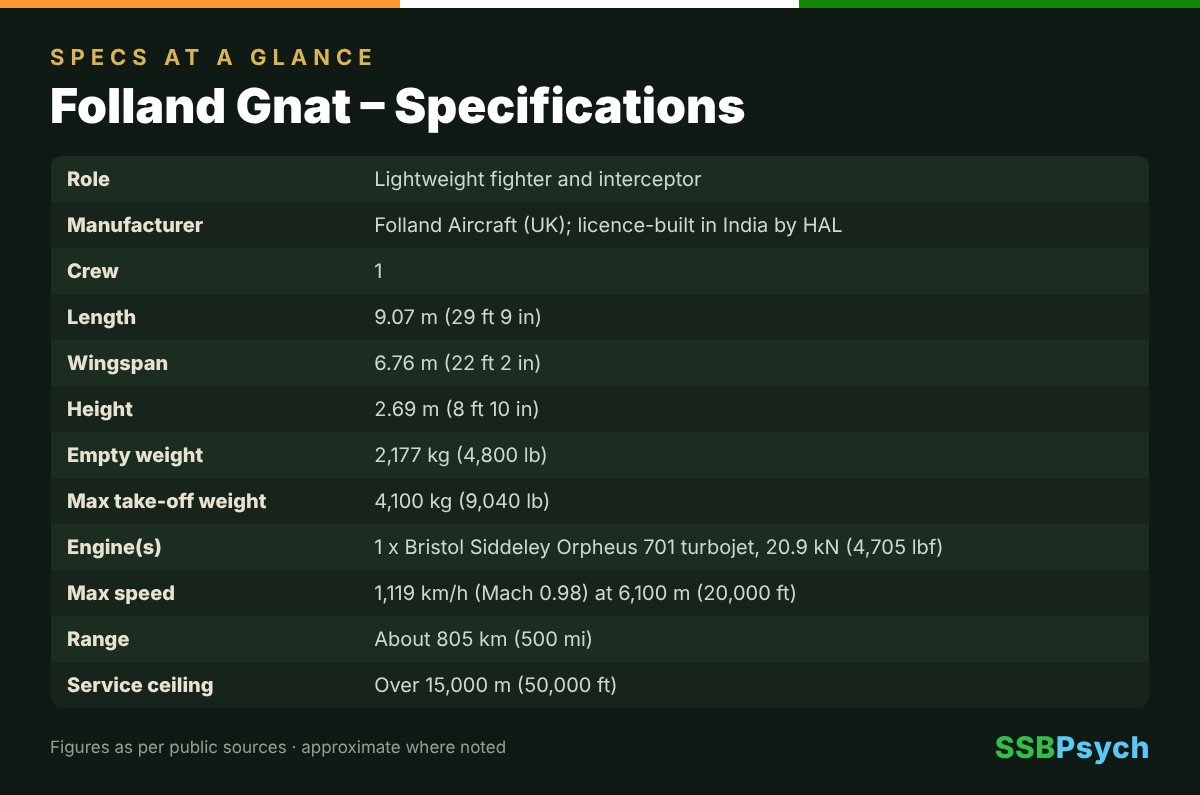
Folland Gnat Specifications
| Role | Lightweight fighter and interceptor |
| Manufacturer | Folland Aircraft (UK); licence-built in India by HAL |
| Crew | 1 |
| Length | 9.07 m (29 ft 9 in) |
| Wingspan | 6.76 m (22 ft 2 in) |
| Height | 2.69 m (8 ft 10 in) |
| Empty weight | 2,177 kg (4,800 lb) |
| Max take-off weight | 4,100 kg (9,040 lb) |
| Engine(s) | 1 x Bristol Siddeley Orpheus 701 turbojet, 20.9 kN (4,705 lbf) |
| Max speed | 1,119 km/h (Mach 0.98) at 6,100 m (20,000 ft) |
| Range | About 805 km (500 mi) |
| Service ceiling | Over 15,000 m (50,000 ft) |
| Guns | 2 x 30 mm ADEN cannons, 115 rounds each |
| Inducted in IAF | 1958 (first aircraft accepted 30 January 1958) |
| First IAF squadron | No. 23 Squadron, converted 18 March 1960 |
| Number in IAF | Over 200 built under licence by HAL, plus UK-built aircraft |
| Retired | The Gnat family, including its Ajeet successor, left service in March 1991 |
Why India Chose the Folland Gnat
In the 1950s fighters were becoming bigger, heavier and far more expensive. A British company, Folland Aircraft, took the opposite approach. It designed a light, simple and cheap fighter that could still fly close to the speed of sound and climb very fast. The Royal Air Force did not buy it as a fighter, but India saw its potential.
For a young nation with a limited budget, a fighter that was affordable, easy to maintain and suitable for licence production at home was very attractive. In September 1956 India signed a contract for the Gnat and its Orpheus engine, including the right to build both in India. This made the Gnat an important early step for Indian aircraft manufacturing.
History of the Folland Gnat in the IAF
The first IAF Gnat flew in the United Kingdom on 11 January 1958 and was accepted by the Air Force on 30 January 1958. The first aircraft were assembled in England, and then Hindustan Aircraft, today’s HAL, took over assembly and later full production in Bangalore. The first Indian-built Gnat flew in May 1962, and the last Indian-built Gnat was delivered on 31 January 1974. In all, HAL built more than 200 of them.
No. 23 Squadron, the Cheetahs, became the first Gnat squadron when it converted from the de Havilland Vampire on 18 March 1960. Several more squadrons followed, and the little jet soon earned a reputation as a quick, agile dogfighter.
The 1965 India-Pakistan war made the Gnat famous. On 3 September 1965, over the Chhamb sector of Jammu and Kashmir, Squadron Leader Trevor Keelor chased a Sabre until it caught fire and broke up. It was the IAF’s first air-to-air victory of the war, and he was awarded the Vir Chakra. On 19 September his brother, Squadron Leader Denzil Keelor, also shot down a Sabre in a Gnat and received the Vir Chakra too. By the end of the war Gnats had been credited with seven Sabres, and the little jet earned its proud nickname, the Sabre Slayer.
Not every story was a victory. One Gnat flown by Squadron Leader Brij Pal Singh Sikand made a forced landing at an abandoned airstrip at Pasrur in Pakistan after an electrical failure, and the aircraft was captured.
In the 1971 war the Gnat struck again. On 22 November 1971, days before full-scale war began, four Gnats of No. 22 Squadron intercepted Pakistani Sabres attacking ground positions in the Boyra salient near the East Pakistan border. Two Sabres were shot down and a third was damaged, and two Pakistani pilots were captured. This was the Battle of Boyra.
Then came the most celebrated moment in Gnat history. On 14 December 1971, Pakistani Sabres attacked Srinagar airfield. Flying Officer Nirmal Jit Singh Sekhon of No. 18 Squadron, the Flying Bullets, took off under attack and fought six Sabres on his own, hitting at least one before he was shot down and killed. He was awarded the Param Vir Chakra posthumously, and he remains the only member of the Indian Air Force to receive India’s highest wartime gallantry award.
After the 1971 war the IAF asked for an improved version with better systems and more fuel. HAL developed the Ajeet, meaning invincible, which entered service in 1977. The Gnat family’s 33-year journey ended when the last Ajeets were phased out in March 1991.
Gnat Engine and Performance Explained Simply
The Gnat used a single Bristol Siddeley Orpheus turbojet producing about 20.9 kilonewtons of thrust. A turbojet sucks in air, squeezes it, burns fuel in it and blasts the hot gas out of the back to push the aircraft forward. Because the Gnat weighed only around 2,200 kg empty, about as much as a large SUV, that engine gave it lively acceleration and a fast climb.
Its top speed was about 1,119 km/h at 20,000 feet, or Mach 0.98, which means 98 percent of the speed of sound. That is about three and a half times the planned top speed of India’s bullet train.
The service ceiling, the highest height where it could still climb usefully, was more than 15,000 metres (50,000 feet), over one and a half times the height of Mount Everest. Range was about 805 km, roughly the distance from Delhi to Ahmedabad and a little more, enough for short, sharp air defence missions.
Now for its secret weapon: size. The Gnat was just 9.07 m long with a wingspan of 6.76 m, smaller than a typical city bus. In a dogfight, a target that small is very hard to spot and even harder to keep in your gunsight. Combined with its quick roll rate and tight turns at medium heights, it could get behind a Sabre and stay there.
To understand why this mattered, picture a 1960s dogfight. There were no long-range radar missiles to fire from miles away. Pilots had to spot the enemy with their own eyes, turn hard to get behind him, close in to within a few hundred metres and then fire their guns. Whoever saw the other first, and could turn and point his nose faster, usually won. In that kind of close fight, a small, agile jet flown by a well-trained pilot had a real edge over a larger fighter.
Weapons and Missiles
- 2 x 30 mm ADEN cannons with 115 rounds per gun
- Up to 12 x 76 mm (3 inch) unguided rockets
- Up to 2 x 500 lb (227 kg) bombs
The Gnat’s punch came from two powerful 30 mm ADEN cannons. A 30 mm shell is large for a light fighter, so even a short accurate burst could cripple an enemy aircraft. Pilots had only 115 rounds per gun, which meant every trigger press had to count. For ground attack it could carry rockets or two 500 lb bombs.
Folland Gnat Missions and Operations
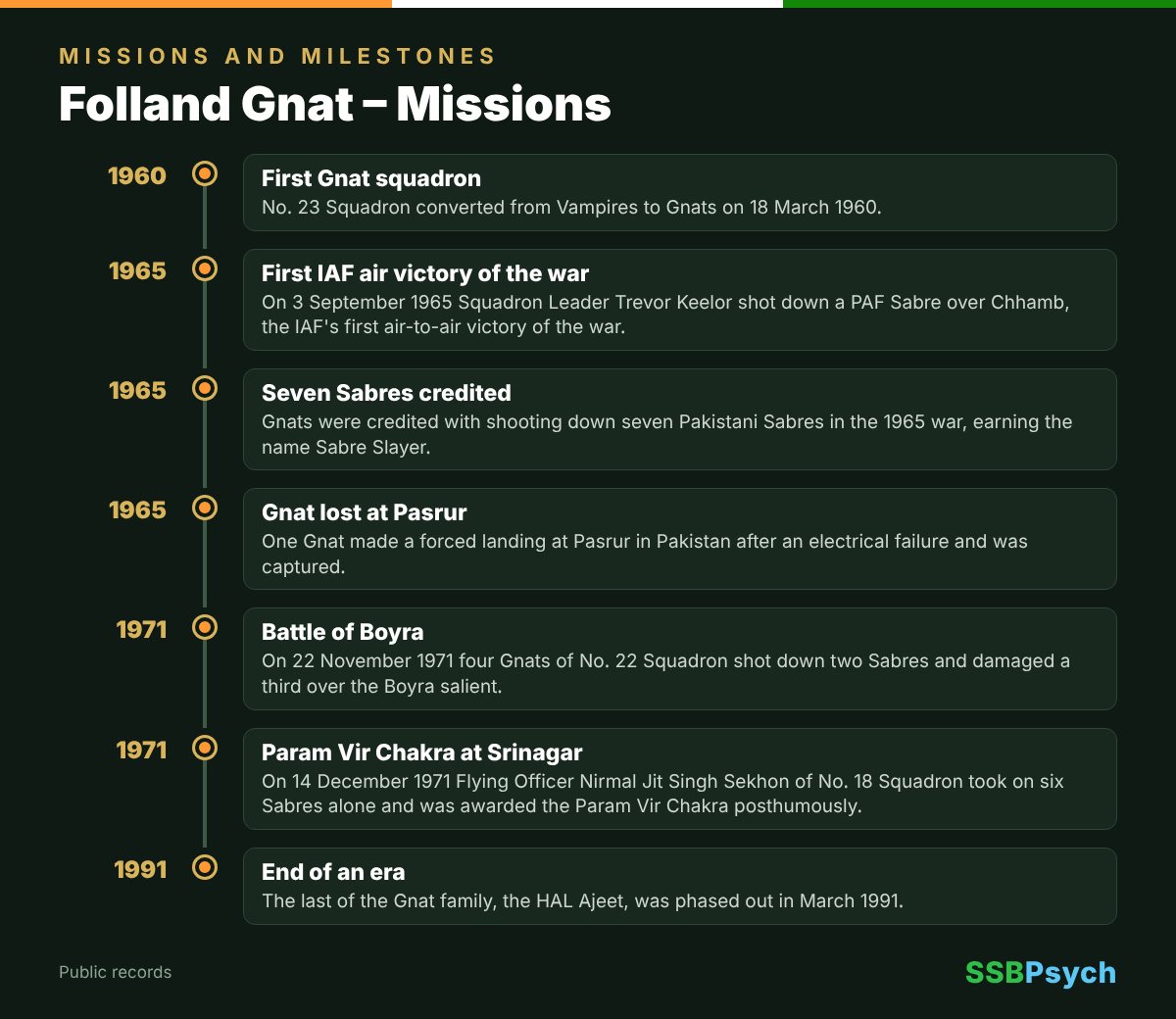
- 1960 – First Gnat squadron: No. 23 Squadron converted from Vampires to Gnats on 18 March 1960.
- 1965 – First IAF air victory of the war: On 3 September 1965 Squadron Leader Trevor Keelor shot down a PAF Sabre over Chhamb, the IAF’s first air-to-air victory of the war.
- 1965 – Seven Sabres credited: Gnats were credited with shooting down seven Pakistani Sabres in the 1965 war, earning the name Sabre Slayer.
- 1965 – Gnat lost at Pasrur: One Gnat made a forced landing at Pasrur in Pakistan after an electrical failure and was captured.
- 1971 – Battle of Boyra: On 22 November 1971 four Gnats of No. 22 Squadron shot down two Sabres and damaged a third over the Boyra salient.
- 1971 – Param Vir Chakra at Srinagar: On 14 December 1971 Flying Officer Nirmal Jit Singh Sekhon of No. 18 Squadron took on six Sabres alone and was awarded the Param Vir Chakra posthumously.
- 1991 – End of an era: The last of the Gnat family, the HAL Ajeet, was phased out in March 1991.

Where the Gnat Was Based and Who Flew It
Gnat squadrons were spread across India to defend key bases. Publicly recorded examples include No. 18 Squadron at Srinagar during the 1971 war and No. 22 Squadron in the eastern sector for the Battle of Boyra. No. 23 Squadron was the first unit to fly the type, and No. 2 Squadron was the last to fly the Ajeet.
Then, as now, a fighter squadron was usually commanded by a Wing Commander, with Squadron Leaders as flight commanders and Flight Lieutenants and Flying Officers as line pilots. Young Flying Officers like Sekhon flew combat missions alongside senior officers, which shows how quickly fighter pilots are trusted with huge responsibility.
Fighter pilots then, as today, joined through the academies, learned to fly on basic trainers, progressed to jet trainers and then converted to frontline fighters like the Gnat. Today’s cadets follow a similar path through the Air Force Academy, Dundigal, and the Hawk advanced jet trainer before reaching modern fighters.
Strengths and Limitations
- Strength: tiny size made it very hard to see and hit in a dogfight.
- Strength: light weight gave quick acceleration, fast climb and nimble handling.
- Strength: two 30 mm cannons packed a heavy punch.
- Strength: cheap to buy and simple enough to be built in India by HAL.
- Limitation: very little fuel, so missions were short and range limited.
- Limitation: small airframe meant limited weapons and few modern systems.
- Limitation: its hydraulic and control systems needed a lot of care, one reason HAL redesigned them for the Ajeet.
- Limitation: no radar or guided missiles, so pilots relied on eyesight and guns.
Legacy of the Folland Gnat
The Gnat’s biggest legacy is confidence. It proved that Indian pilots, flying a small and inexpensive fighter, could defeat a respected enemy aircraft through training and courage. It also helped HAL build skills in jet production, leading to the Ajeet and later projects.
The Gnat also shaped how the IAF thought about training and tactics. Its pilots showed that careful planning, good teamwork in pairs and aggressive but disciplined flying could beat a technically respected opponent. Those lessons are still taught to young fighter pilots today.
You can still see the Sabre Slayer in person. A Gnat is displayed at the Indian Air Force Museum at Palam in Delhi, and others stand at Air Headquarters, at the Kerala State Science and Technology Museum in Thiruvananthapuram, at the war memorial in Dharamshala and at the Nirmal Jit Singh Sekhon memorial in Ludhiana. Several Ajeets are also preserved, including at Palam.
Why It Matters for SSB and AFCAT Aspirants
Questions on the 1965 and 1971 wars, the Battle of Boyra and Nirmal Jit Singh Sekhon appear often in NDA, CDS and AFCAT papers. Knowing that Sekhon is the only IAF Param Vir Chakra recipient, and that he flew a Gnat, is a fact you must never forget.
The Gnat story is also perfect material for the SSB. In the interview or a Group Discussion on defence preparedness, it shows that technology matters, but people matter more. Sekhon’s decision to take off under attack and fight against six enemy aircraft is the very definition of courage and sense of responsibility, two Officer Like Qualities assessors look for.
Did You Know?
- The Gnat was nicknamed the Sabre Slayer for its success against Pakistani F-86 Sabres.
- Flying Officer Nirmal Jit Singh Sekhon, a Gnat pilot, is the only IAF Param Vir Chakra recipient.
- Brothers Trevor and Denzil Keelor both shot down Sabres in Gnats in 1965 and both received the Vir Chakra.
- The Gnat’s wingspan was only 6.76 m, smaller than a city bus is long.
- HAL built more than 200 Gnats in Bangalore.
- The improved HAL Ajeet, meaning invincible, was developed from the Gnat and served until March 1991.
- The Battle of Boyra on 22 November 1971 took place before the war was formally declared.
Quiz: Test Your Knowledge of Folland Gnat
Click an option to see if you are right. Your score updates live.
Folland Gnat: Frequently Asked Questions
Because IAF Gnats shot down several Pakistani F-86 Sabres in the 1965 and 1971 wars. In 1965 alone they were credited with seven Sabres.
The Gnat could reach about 1,119 km/h, or Mach 0.98, at around 20,000 feet.
Flying Officer Nirmal Jit Singh Sekhon of No. 18 Squadron flew a Gnat when he fought six Sabres over Srinagar on 14 December 1971. He is the only IAF Param Vir Chakra recipient.
The Gnat family served for about 33 years. Its final version, the HAL Ajeet, was phased out in March 1991.
A Gnat is on display at the Indian Air Force Museum at Palam, Delhi. Others are preserved at memorials and museums, including in Ludhiana, Dharamshala and Thiruvananthapuram.
This is part 24 of 50 in SSBPsych’s Indian Air Force aircraft series – a new aircraft every evening at 6 PM.
Sources: en.wikipedia.org, bharat-rakshak.com, en.wikipedia.org, en.wikipedia.org, en.wikipedia.org.
Preparing for NDA, CDS, AFCAT or your SSB? Join SSBPsych’s online and offline batches – explore our courses or call +91 8076540582.