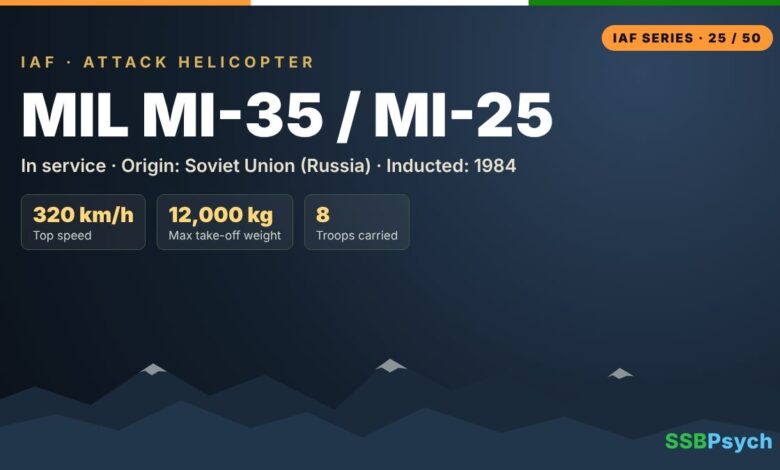
Mi-35 in Indian Air Force: Attack Helicopter Specs and History
Imagine a helicopter so heavily armoured that soldiers called it a flying tank, armed with rockets, missiles and machine guns, and still able to carry eight troops in its belly. That is the Mi-35, along with its older sibling the Mi-25. These Soviet-built gunships gave the Indian Air Force its very first dedicated attack helicopters and served India in jungles, deserts and even in Africa.
With its two bubble cockpits, one behind the other, its stubby wings bristling with weapons and its distinctive hunched shape, the Hind, as NATO called the Mi-24 family, is one of the most recognisable helicopters ever built. India has flown it for more than four decades.
In this guide you will discover why India bought attack helicopters, how the Mi-25 and Mi-35 arrived, their engines and performance in simple words, their weapons, their key missions, where they are based, their strengths and weaknesses, and what comes next. A 10-question quiz at the end will help you revise for NDA, CDS and AFCAT.

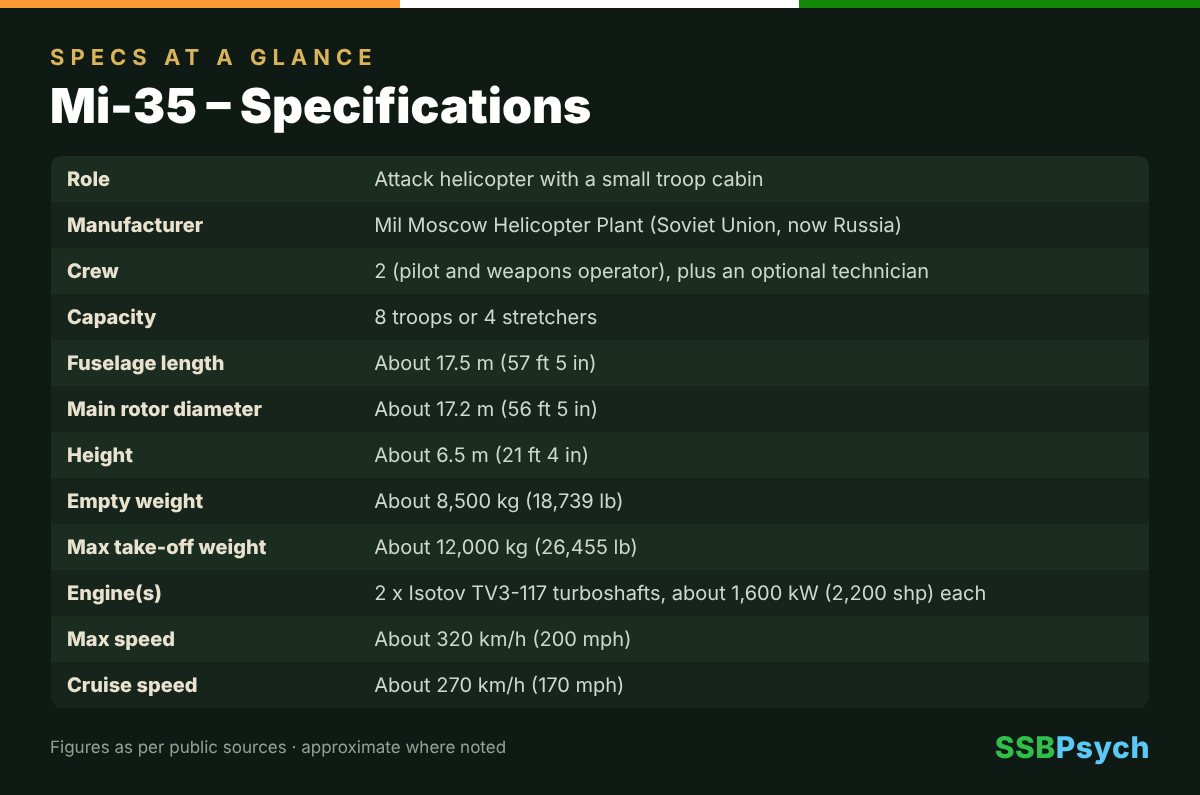
Mi-35 Specifications
| Role | Attack helicopter with a small troop cabin |
| Manufacturer | Mil Moscow Helicopter Plant (Soviet Union, now Russia) |
| Crew | 2 (pilot and weapons operator), plus an optional technician |
| Capacity | 8 troops or 4 stretchers |
| Fuselage length | About 17.5 m (57 ft 5 in) |
| Main rotor diameter | About 17.2 m (56 ft 5 in) |
| Height | About 6.5 m (21 ft 4 in) |
| Empty weight | About 8,500 kg (18,739 lb) |
| Max take-off weight | About 12,000 kg (26,455 lb) |
| Engine(s) | 2 x Isotov TV3-117 turboshafts, about 1,600 kW (2,200 shp) each |
| Max speed | About 320 km/h (200 mph) |
| Cruise speed | About 270 km/h (170 mph) |
| Range | About 450 km (280 mi) |
| Service ceiling | About 5,750 m (18,860 ft) |
| First flight | 19 September 1969 (Mi-24 family) |
| Inducted in IAF | Mi-25 from 1984 (first unit raised 1 November 1983); Mi-35 from 1990 |
| Number in IAF | About 15 reported in service (2023), in one squadron |
Why India Needed the Mi-35
By the early 1980s armies around the world had learned that helicopters could be deadly tank hunters. A gunship can hide behind trees or hills, pop up, fire a missile at an enemy tank several kilometres away and disappear again. India, facing large tank forces along its western border, needed this capability.
The Soviet Mil Mi-24 was one of the most powerful attack helicopters available, and India already had strong defence ties with the Soviet Union. The export version known as the Mi-25 was chosen first. It combined heavy firepower with armour that could shrug off small-arms fire, and it could even carry a squad of soldiers, something most attack helicopters cannot do.
An attack helicopter fills a special gap between fighter jets and ground forces. A fighter is too fast to linger over a battlefield, and artillery cannot always see what is behind a ridge. A gunship can hover low near friendly troops, talk to commanders on the ground, find targets with its own eyes and sensors, and strike within minutes. For an Army fighting in the plains of Punjab or the Rajasthan desert, that kind of close support can decide a battle.
History of the Mi-35 and Mi-25 in the IAF
The IAF raised its first attack helicopter unit, No. 125 Helicopter Squadron, the Gladiators, on 1 November 1983 at Pathankot in Punjab. The first Mi-25 landed there in 1984, and two Mi-25s were shown to the public at the Air Force Day celebrations in New Delhi on 8 October 1984.
The new gunships were soon tested in action. From October 1987 Mi-25s flew in Sri Lanka with the Indian Peace Keeping Force during Operation Pawan. They gave heavy fire support to Indian troops fighting the LTTE, which reportedly nicknamed them Mudhalai, a Tamil word for a crocodile-like reptile. Indian losses were reduced by this support, and no IAF Hind was lost in the operation.
In 1990 the more capable Mi-35 arrived. No. 104 Helicopter Squadron received Mi-35s in April 1990, and No. 125 Squadron added them in June 1990. In 1998 India contracted an Israeli upgrade for a large part of the fleet, adding day and night targeting sensors, night vision goggles for pilots, GPS and a new mission computer.
The Mi-35 also served India’s commitment to world peace. In 2000 three IAF Mi-35s went to Sierra Leone with the UN and took part in Operation Khukri. From around 2003-04, IAF Mi-35s were based at Goma in the Democratic Republic of Congo, where they supported UN peacekeepers and helped beat back rebel attacks on the city in 2006 and 2008. In Congo the IAF unit flew its helicopters hard, reportedly logging 1,000 flying hours within ten months of one deployment, and its gunships were nicknamed Vipers.
In 2015-16 India gave four Mi-25/35 helicopters to Afghanistan to strengthen its security forces. In January 2016, when terrorists attacked Pathankot airbase, Mi-35s fired their guns at the attackers, their first operational use on Indian soil and their first shots in anger in about 25 years.
In 2019 No. 125 Squadron at Pathankot switched to the American AH-64E Apache, and the older Hinds there were retired. That same year, after the Balakot air strikes, the IAF placed an emergency order for Russian Ataka anti-tank missiles for its Mi-35s. Between 2022 and 2023 the remaining fleet was overhauled in Russia to extend its life by about six years.
Mi-35 Engine and Performance Explained Simply
The Mi-35 has two TV3-117 turboshaft engines. A turboshaft is a jet engine whose power turns a shaft instead of pushing out hot gas, and that shaft spins the rotor blades. Each engine gives about 2,200 shaft horsepower, together roughly as much as 35 to 40 family cars.
Top speed is about 320 km/h, and it cruises at around 270 km/h. That is about the same as the planned top speed of India’s bullet train, which is very fast for a helicopter.
The service ceiling, the highest height where it can still climb usefully, is about 5,750 metres (18,860 feet). That is enough for plains, deserts and lower hills, but it struggles in the very high Himalaya, which is one reason India later built lighter helicopters like the LCH Prachand for mountain warfare. Range is about 450 km, roughly the distance from Delhi to Lucknow.
At about 12,000 kg on take-off, a loaded Mi-35 weighs as much as eight or nine cars. The main rotor is about 17 metres across, not far short of the 20-metre length of a cricket pitch. The pilot sits in the rear cockpit, raised for a better view, while the weapons operator sits in the front cockpit.
How does an attack helicopter actually fight? It flies low, using trees, buildings and folds in the ground to stay hidden from enemy radar and guns. Pilots call this nap-of-the-earth flying. When the target is found, the helicopter rises just enough for the weapons operator to aim, launches a missile or a burst of rockets, and drops back into cover. The Mi-35’s speed lets it dash between hiding places faster than most helicopters of its era.
Weapons and Missiles
- Nose-mounted 12.7 mm four-barrel Yak-B machine gun
- Underwing gun pods
- Unguided rocket pods, such as the 57 mm S-5 rocket
- 9K114 Shturm anti-tank guided missiles
- 9M120 Ataka anti-tank guided missiles, ordered for IAF Mi-35s in 2019
- Bombs carried on the stub-wing pylons
- Up to 8 armed troops in the rear cabin
The Mi-35 is built to destroy tanks, bunkers and vehicles. Its stub wings carry anti-tank missiles at the tips and rocket pods, gun pods or bombs on the pylons beneath. A heavy machine gun in a turret under the nose can swing towards targets on the ground. The 2019 Ataka missile purchase gave the fleet a more modern anti-tank punch.
Mi-35 Missions and Operations
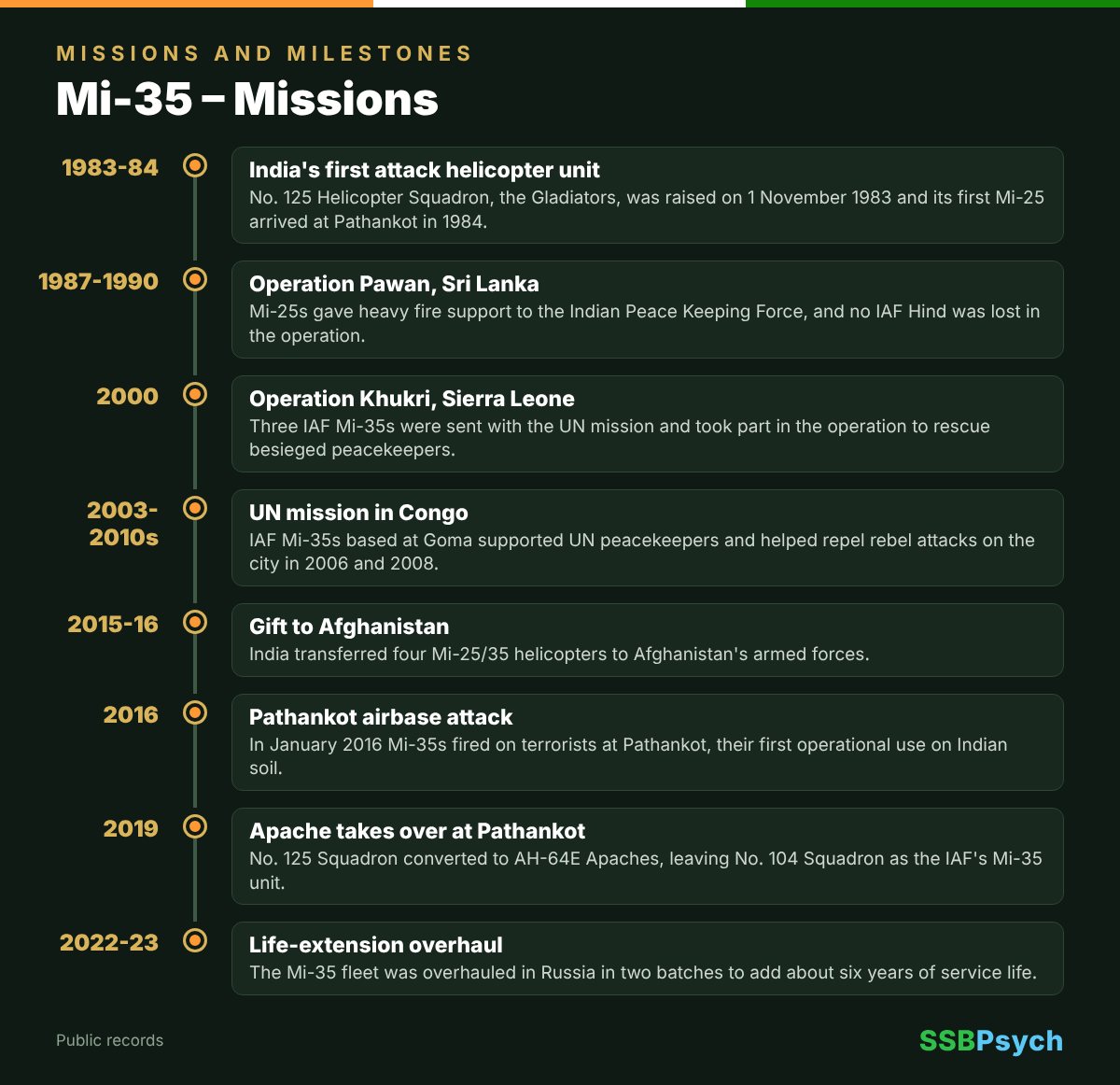
- 1983-84 – India’s first attack helicopter unit: No. 125 Helicopter Squadron, the Gladiators, was raised on 1 November 1983 and its first Mi-25 arrived at Pathankot in 1984.
- 1987-1990 – Operation Pawan, Sri Lanka: Mi-25s gave heavy fire support to the Indian Peace Keeping Force, and no IAF Hind was lost in the operation.
- 2000 – Operation Khukri, Sierra Leone: Three IAF Mi-35s were sent with the UN mission and took part in the operation to rescue besieged peacekeepers.
- 2003-2010s – UN mission in Congo: IAF Mi-35s based at Goma supported UN peacekeepers and helped repel rebel attacks on the city in 2006 and 2008.
- 2015-16 – Gift to Afghanistan: India transferred four Mi-25/35 helicopters to Afghanistan’s armed forces.
- 2016 – Pathankot airbase attack: In January 2016 Mi-35s fired on terrorists at Pathankot, their first operational use on Indian soil.
- 2019 – Apache takes over at Pathankot: No. 125 Squadron converted to AH-64E Apaches, leaving No. 104 Squadron as the IAF’s Mi-35 unit.
- 2022-23 – Life-extension overhaul: The Mi-35 fleet was overhauled in Russia in two batches to add about six years of service life.
Where the Mi-35 Is Based and Who Flies It
Today the IAF’s Mi-35s serve with No. 104 Helicopter Squadron, publicly reported to be based at Suratgarh in Rajasthan, close to the desert sector where tank battles would most likely be fought. For decades No. 125 Squadron flew Hinds from Pathankot before converting to the Apache in 2019.
A helicopter squadron is usually commanded by a Wing Commander, with Squadron Leaders as flight commanders and Flight Lieutenants and Flying Officers as pilots and weapons operators. Engineers and technicians keep the complex machines ready, which is a big job for an older helicopter fleet.
To fly a gunship, a cadet joins the IAF through NDA, the CDS exam or AFCAT and begins basic flying at the Air Force Academy, Dundigal. Those chosen for the helicopter stream move to helicopter training, earn their wings, and usually gain experience on utility helicopters before converting to an attack helicopter. It takes several years and hundreds of hours to become a fully operational attack pilot.
Strengths and Limitations
- Strength: heavy armour protects the crew and engines from small-arms fire.
- Strength: wide range of weapons, from machine guns and rockets to anti-tank missiles.
- Strength: unusual ability to carry up to eight troops along with its weapons.
- Strength: fast for a helicopter, with a top speed of about 320 km/h.
- Strength: combat-proven with India in Sri Lanka, Africa and at home.
- Limitation: heavy design limits its performance in very high mountains.
- Limitation: an old fleet that needs careful maintenance and overseas overhauls.
- Limitation: dependence on Russian spares and support.
Future of the Mi-35
The 2022-23 overhaul was meant to keep the Mi-35 flying for several more years. Meanwhile, the IAF has inducted the AH-64E Apache, with two Apache squadrons, and the indigenous HAL LCH Prachand, whose first squadron was raised at Jodhpur in October 2022. These newer helicopters will take over the attack role as the Hinds eventually retire.
Comparing old and new tells the story. The Apache has no passenger cabin, but it brings modern sensors, digital systems and advanced missiles. The LCH Prachand is designed to fight at very high altitudes in the Himalaya, where the heavy Mi-35 struggles. Together they mark a shift from a single all-purpose gunship to specialised machines for different battlefields.
When that day comes, the Mi-35 will be remembered as the helicopter that introduced the IAF to attack aviation and taught a generation of pilots how to use a helicopter as a weapon.
Why It Matters for SSB and AFCAT Aspirants
Questions on India’s attack helicopters, the Apache, the LCH Prachand and older types like the Mi-35 are common in AFCAT and CDS papers. Operations such as Operation Pawan in Sri Lanka and India’s role in UN peacekeeping in Congo and Sierra Leone are also popular topics in SSB interviews and group discussions.
If you are interested in the helicopter stream, the Mi-35 shows that helicopter pilots do far more than rescue missions. They fly close to danger, work closely with the Army and take quick decisions in difficult conditions, qualities every officer must have.
A quick tip for interviews: when you talk about any aircraft, link it to a mission and a lesson. For the Mi-35, you could mention how its fire support helped protect Indian soldiers in Sri Lanka, and what that teaches about teamwork between the Army and the Air Force. That kind of answer shows understanding, not just memorised facts.
Did You Know?
- No. 125 Helicopter Squadron, the Gladiators, was the IAF’s first attack helicopter unit, raised on 1 November 1983.
- The Mi-24 family, including the Mi-35, is often called a flying tank because of its armour.
- Unlike most attack helicopters, the Mi-35 can carry up to eight soldiers.
- IAF Mi-35s served with UN peacekeepers in Sierra Leone and in Congo.
- India gave four Mi-25/35 helicopters to Afghanistan in 2015-16.
- In January 2016 Mi-35s were used against terrorists at Pathankot airbase.
Quiz: Test Your Knowledge of Mi-35
Click an option to see if you are right. Your score updates live.
Mi-35: Frequently Asked Questions
The Mi-35 is an attack helicopter used to destroy tanks, vehicles and enemy positions. It can also carry up to eight troops.
The Mi-35 can fly at about 320 km/h, which is very fast for a helicopter.
Yes. About 15 were reported in service in 2023 with one squadron, No. 104, and the fleet was overhauled in 2022-23 to extend its life.
Both are export versions of the Soviet Mi-24 Hind. The IAF got the Mi-25 first in 1984 and the more capable Mi-35 from 1990.
The AH-64E Apache and the indigenous HAL LCH Prachand are taking over the IAF’s attack helicopter role.
This is part 25 of 50 in SSBPsych’s Indian Air Force aircraft series – a new aircraft every evening at 6 PM.
Sources: en.wikipedia.org, vayuaerospace.in, en.wikipedia.org, en.wikipedia.org, bharat-rakshak.com.
Preparing for NDA, CDS, AFCAT or your SSB? Join SSBPsych’s online and offline batches – explore our courses or call +91 8076540582.