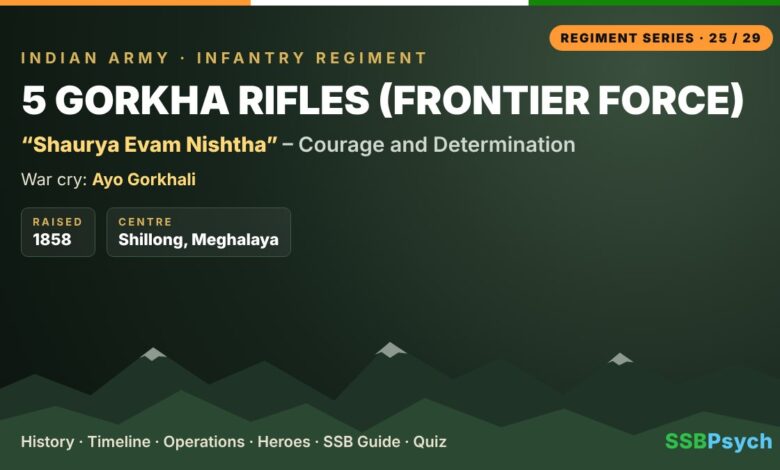
5 Gorkha Rifles: History, Motto, War Cry, Battles and Heroes
Few units in the Indian Army carry a story as long and as rich as 5 Gorkha Rifles (Frontier Force). Raised in 1858 on the wild north-west frontier, it fought in Afghanistan, at Gallipoli, in the jungles of Burma and in the mountains of Italy, and after Independence it became the first Indian Army unit to be carried into battle by helicopter. For any NDA, CDS or TES aspirant who dreams of wearing the Gorkha hat, 5 Gorkha Rifles is a lesson in loyalty, simplicity and fearless courage.
In this guide we cover the history and lineage of the regiment, a visual timeline, its major operations and battle honours, its motto and war cry, the heroes who made it famous, life inside a Gorkha battalion, what it all means for SSB candidates, and a short quiz to test what you have learnt.
5 Gorkha Rifles – Quick Facts
| Raised | 1858, as the 25th Punjab Infantry (Hazara Goorkha Battalion) |
| Present name | 5 Gorkha Rifles (Frontier Force), since 1950 |
| Regimental Centre | 58 Gorkha Training Centre, Shillong, Meghalaya |
| Motto | Shaurya Evam Nishtha (Courage and Determination) |
| War Cry | Ayo Gorkhali (The Gorkhas are here) |
| Nicknames | The Sober Fifth, and PIFFERs (Punjab Frontier Force legacy) |
| Recruitment | Gorkhas from Nepal and Indian Gorkha communities |
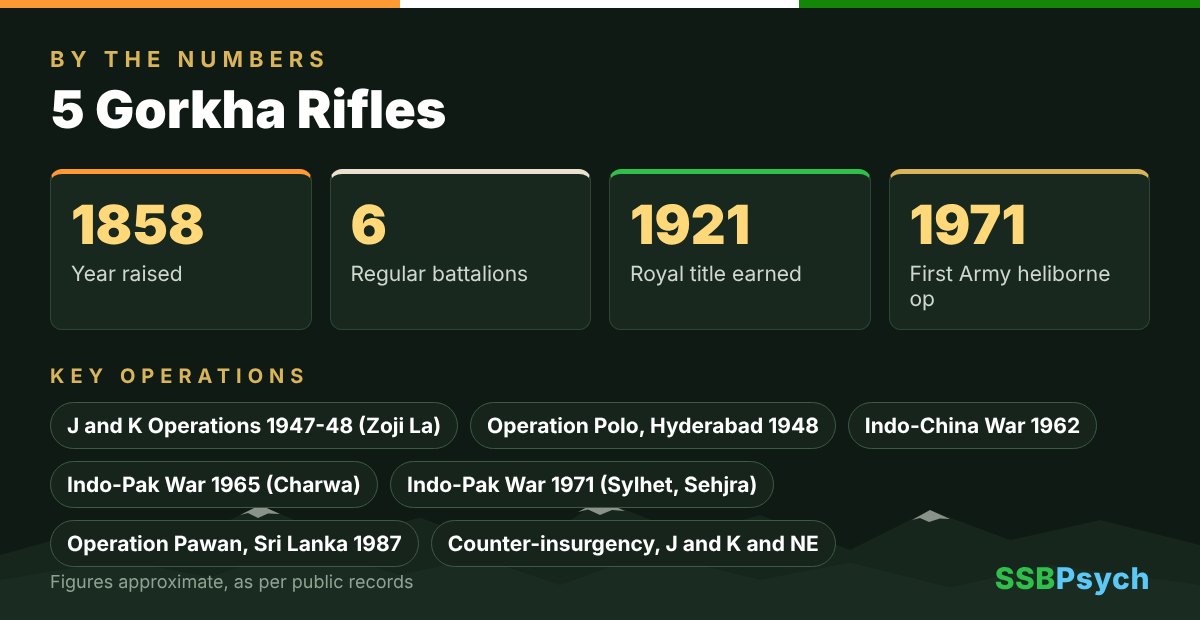
| Battalions | 6 regular battalions |
| Victoria Crosses | Several, from Afghanistan 1878 to Italy 1944 |
| Notable first | Indian Army’s first heliborne operation, Sylhet, 1971 |
| Famous Army Chief | General Dalbir Singh Suhag (commissioned into 4/5 GR) |
History of 5 Gorkha Rifles (Frontier Force)
The regiment was born in 1858 at Abbottabad, in the Hazara region of what is now Pakistan. It was first called the 25th Punjab Infantry, but because its soldiers were Gorkhas from Nepal it was popularly known as the Hazara Goorkha Battalion. Its job was to guard the restless frontier as part of the Punjab Irregular Force, whose soldiers were nicknamed PIFFERs. That frontier link is why the words Frontier Force still sit proudly in the regiment’s name.
In 1861 the unit was renumbered as the 5th Gurkha Regiment. Over the next decades its title changed several times, becoming the 5th Gurkha Rifles in 1901 and the 5th Gurkha Rifles (Frontier Force) in 1903. Its first battle honour came at Peiwar Kotal in the Second Afghan War of 1878, where Captain John Cook won the Victoria Cross. More frontier honours followed at Charasiah, Kabul and Kandahar, and in 1891 two of its officers won the Victoria Cross during the Hunza-Nagar campaign in the far north.
The First World War took the regiment far from home. The 1st Battalion landed at Gallipoli in 1915 and suffered heavy losses within hours of going ashore, then fought at Sari Bair and Suvla. The 2nd Battalion fought in Mesopotamia. In recognition of this service, the regiment was given the title Royal in 1921, becoming the 5th Royal Gurkha Rifles (Frontier Force).
The Second World War was the regiment’s finest hour in the British era. Its battalions fought in Italy, including the battles around the Sangro and Cassino, and in Burma, from the bitter retreat at the Sittang River in 1942 to the return through Imphal and Mogaung. Several battalions were raised for the war, and the regiment won further Victoria Crosses, three of them in Burma and one in Italy.
When India became independent in 1947, the Tripartite Agreement between India, Nepal and Britain divided the ten Gorkha regiments. Six, including the 5th, came to the Indian Army. In 1950, when India became a Republic, the regiment dropped the Royal title, adopted the Indian spelling Gorkha and became 5 Gorkha Rifles (Frontier Force), the name it carries today.
5 Gorkha Rifles Timeline: From Raising to Today
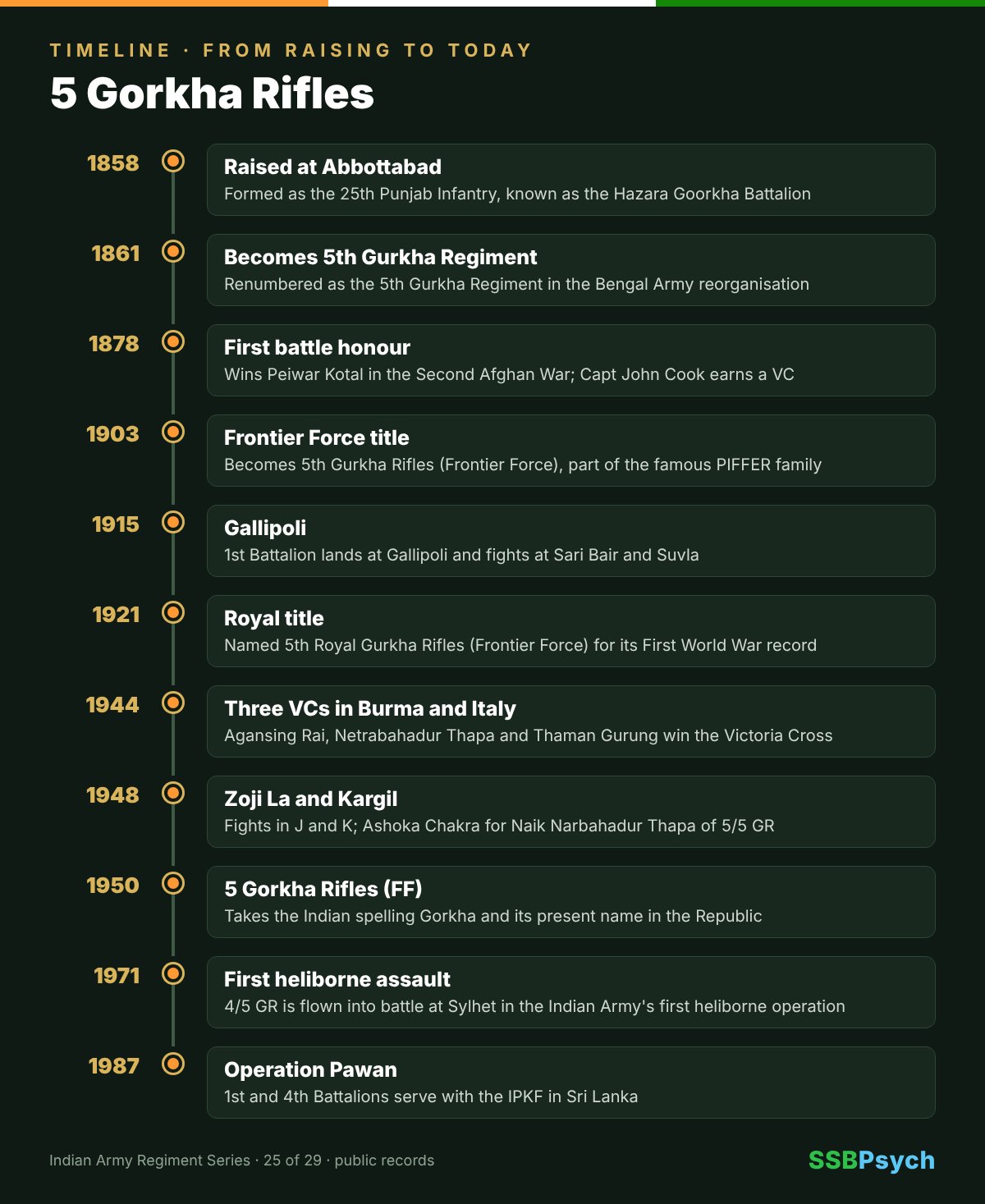
- 1858 – Raised at Abbottabad: Formed as the 25th Punjab Infantry, known as the Hazara Goorkha Battalion
- 1861 – Becomes 5th Gurkha Regiment: Renumbered as the 5th Gurkha Regiment in the Bengal Army reorganisation
- 1878 – First battle honour: Wins Peiwar Kotal in the Second Afghan War; Capt John Cook earns a VC
- 1903 – Frontier Force title: Becomes 5th Gurkha Rifles (Frontier Force), part of the famous PIFFER family
- 1915 – Gallipoli: 1st Battalion lands at Gallipoli and fights at Sari Bair and Suvla
- 1921 – Royal title: Named 5th Royal Gurkha Rifles (Frontier Force) for its First World War record
- 1944 – Three VCs in Burma and Italy: Agansing Rai, Netrabahadur Thapa and Thaman Gurung win the Victoria Cross
- 1948 – Zoji La and Kargil: Fights in J and K; Ashoka Chakra for Naik Narbahadur Thapa of 5/5 GR
- 1950 – 5 Gorkha Rifles (FF): Takes the Indian spelling Gorkha and its present name in the Republic
- 1971 – First heliborne assault: 4/5 GR is flown into battle at Sylhet in the Indian Army’s first heliborne operation
- 1987 – Operation Pawan: 1st and 4th Battalions serve with the IPKF in Sri Lanka
Major Operations and Battle Honours of 5 Gorkha Rifles
Since Independence, the regiment has taken part in every major war fought by India, along with peacekeeping and counter-insurgency tasks. Here are the highlights every aspirant should know.
Jammu and Kashmir 1947-48 and Operation Polo
Soon after Independence, battalions of the regiment were sent to Jammu and Kashmir to push back raiders and Pakistani troops. They earned the battle honours Zoji La and Kargil, along with the theatre honour Jammu and Kashmir 1947-48. Fighting at such heights in winter, with little equipment, set the tone for the mountain warfare that Gorkha battalions are now famous for. During Operation Polo in Hyderabad in 1948, Naik Narbahadur Thapa of 5/5 GR earned the Ashoka Chakra, India’s highest peacetime gallantry award.
1962 and 1965
Units of the regiment served during the 1962 conflict with China. In the 1965 war with Pakistan, the regiment fought in Punjab and won the battle honour Charwa, along with the theatre honour Punjab 1965.
1971: The First Heliborne Assault
The 1971 war produced the most famous chapter of the regiment’s modern history. In the eastern sector, the 4th Battalion (4/5 GR) was lifted by helicopters of the Indian Air Force and landed near Sylhet, deep behind enemy lines. This was the Indian Army’s first heliborne operation in war. The Gorkhas held their ground against a much larger enemy force and helped bring about the surrender of Pakistani troops in the area. Major Ian Cardozo, who joined the battalion during this operation, was badly wounded by a mine and later went on to become a Major General despite losing a leg. The regiment also fought in the west, earning the battle honour Sehjra and theatre honours for Jammu and Kashmir and Punjab.
Sri Lanka and Counter-Insurgency
During Operation Pawan in 1987, the 1st and 4th Battalions served with the Indian Peace Keeping Force against the LTTE in Sri Lanka. The Commanding Officer of 4/5 GR, Lieutenant Colonel Inder Bal Singh Bawa, was fatally wounded in action. In later years the regiment’s battalions have served in counter-insurgency operations in Jammu and Kashmir and the North-East, and on high-altitude borders.
Across its history the regiment has collected battle honours from Peiwar Kotal and Kandahar to Gallipoli, Cassino, Imphal and Mogaung, and after 1947 from Zoji La and Kargil to Charwa, Sylhet and Sehjra.
Insignia, Motto and War Cry
The motto of 5 Gorkha Rifles is Shaurya Evam Nishtha, which means Courage and Determination (some sources translate it as courage and dedication). It sums up what the regiment values most: bravery in battle and steady commitment to duty.
Its war cry is the famous Ayo Gorkhali, meaning The Gorkhas are here. Like all Gorkha regiments, its insignia features the crossed khukris, the curved Gorkha knife that has become a symbol of the Gorkha soldier around the world.
The regiment is also known as the Sober Fifth because of its simple, understated dress, with black being its favoured colour. Its frontier heritage gives it a second nickname, the PIFFERs.
Heroes of the 5 Gorkha Rifles
The regiment has produced Victoria Cross winners, gallantry award winners and some of the best-known generals of the Indian Army. A few names every aspirant should remember:
- Captain John Cook, VC – won the regiment’s first Victoria Cross at Peiwar Kotal in the Second Afghan War, 1878.
- Havildar Gaje Ghale, VC – 2nd Battalion; won the Victoria Cross in Burma in 1943 for leading his men while badly wounded.
- Naik Agansing Rai, VC – 2nd Battalion; won the Victoria Cross in Burma in 1944 for capturing enemy positions under heavy fire.
- Jemadar Netrabahadur Thapa, VC – 2nd Battalion; awarded the Victoria Cross posthumously for holding a post in Burma in 1944.
- Rifleman Thaman Gurung, VC – 1st Battalion; awarded the Victoria Cross posthumously in Italy in 1944 for covering his comrades’ withdrawal.
- Naik Narbahadur Thapa, Ashoka Chakra – 5/5 GR; honoured for bravery during Operation Polo in Hyderabad.
- General Dalbir Singh Suhag – commissioned into 4/5 GR in 1974; rose to become Chief of the Army Staff.
- Lieutenant General Zorawar Chand Bakshi, MVC, VrC – a highly decorated officer of the regiment.
- Lieutenant General S. K. Sinha – former Vice Chief of the Army Staff, later Governor of Assam and of Jammu and Kashmir.
- Major General Ian Cardozo – wounded at Sylhet in 1971; the first war-disabled officer to command a battalion and a brigade.
Role and Life in the Regiment
5 Gorkha Rifles is a rifle regiment of infantry. Its battalions are trained for mountain warfare, jungle fighting, counter-insurgency and conventional operations, and they rotate between peace stations, high-altitude posts and field areas such as Jammu and Kashmir and the North-East.
Recruits are trained at the 58 Gorkha Training Centre in Shillong, Meghalaya, before joining their battalions. The soldiers are Gorkhas, drawn from Nepal and from Indian Gorkha communities. Life in a Gorkha battalion is known for strong discipline, a cheerful spirit, close bonds between officers and men, and festivals such as Dashain that bring the whole unit together.
Officers who join a Gorkha battalion are expected to learn Gorkhali (Nepali) and to understand the customs and families of their men. Many officers say this bond of trust is the real secret behind the Gorkha soldier’s legendary loyalty.
Lessons from the 5 Gorkha Rifles for Future Officers
The story of the regiment is more than a list of dates and medals. It carries clear lessons for anyone preparing to lead soldiers. The first is adaptability. The same regiment that began by guarding frontier passes later fought in the trenches of Gallipoli, the jungles of Burma, the mountains of Kashmir and the rivers of East Pakistan. Each time, it learnt the new terrain and the new kind of war quickly.
The second lesson is initiative. The 1971 heliborne operation at Sylhet was a bold idea. Landing a battalion behind enemy lines with limited support was risky, yet careful planning, surprise and the steady nerve of the Gorkha soldiers turned it into a success. SSB assessors look for exactly this mix of planning and boldness in group tasks and the outdoor tasks.
The third lesson is leadership by example. Many of the regiment’s Victoria Cross citations describe soldiers who kept fighting or leading their men even after being wounded. Officers like Ian Cardozo, who returned to command despite a severe war injury, show that determination, the second half of the regimental motto, is as important as courage.
Finally, the regiment teaches the value of simplicity. The Sober Fifth was known for plain dress and quiet professionalism rather than show. For a young officer, being honest, humble and dependable often earns more respect than words.
Quick Revision Points
- Raised in 1858 at Abbottabad as the 25th Punjab Infantry (Hazara Goorkha Battalion).
- Got the Frontier Force title in 1903 and the Royal title in 1921; became 5 Gorkha Rifles (FF) in 1950.
- Motto: Shaurya Evam Nishtha. War cry: Ayo Gorkhali.
- Recruits train at 58 Gorkha Training Centre, Shillong.
- 4/5 GR carried out the Indian Army’s first heliborne operation at Sylhet in 1971.
- Post-1947 battle honours include Zoji La, Kargil (1948), Charwa, Sylhet and Sehjra.
- General Dalbir Singh Suhag, a former Army Chief, was commissioned into 4/5 GR.
5 Gorkha Rifles for SSB Candidates: What You Should Know
How officers join
- Officers join the Indian Army through NDA, IMA (via CDS or direct entries such as TES and TGC) or OTA Chennai (SSC entries).
- Every officer candidate must clear the SSB interview and the medical examination.
- Arm and regiment allotment is done at the academy, based on the cadet’s preferences, merit and available vacancies, so no one is promised a particular regiment in advance.
- Cadets who wish to join a Gorkha regiment can list it among their infantry choices; a family link with the regiment may be considered but is not a guarantee.
How soldiers join
- Soldiers of the regiment are Gorkhas, recruited from Nepal and from Indian Gorkha communities.
- Since 2022, new soldiers in the Indian Army join as Agniveers under the Agnipath scheme; recruitment from Nepal has been affected since the scheme began.
- Recruits train at the 58 Gorkha Training Centre, Shillong, before joining a battalion.
Questions you may face in the SSB interview, GD or lecturette
- Why do you want to join a Gorkha regiment such as 5 Gorkha Rifles?
- What was special about the 1971 heliborne operation at Sylhet?
- What does the motto Shaurya Evam Nishtha teach a young officer?
- How would you build trust with soldiers whose language and culture differ from yours?
- Lecturette topic: The Gorkha soldier and India-Nepal relations.
SSBPsych tip: Read about the 1971 Sylhet heliborne operation before your SSB; it is a strong example of initiative, surprise and teamwork that you can quote in interviews and group discussions.
Conclusion
From the frontier forts of 1858 to the helicopters over Sylhet in 1971, 5 Gorkha Rifles (Frontier Force) has shown that courage and steady commitment can win against any odds. Learn its story well, take the quiz below, and let the spirit of Shaurya Evam Nishtha guide your own preparation for the SSB.
Quiz: How Well Do You Know the 5 Gorkha Rifles?
Test yourself! Click an option to see if you are right. Your score updates live.
5 Gorkha Rifles: Frequently Asked Questions
The motto is Shaurya Evam Nishtha, which means Courage and Determination.
The regiment’s recruits are trained at the 58 Gorkha Training Centre in Shillong, Meghalaya.
It was raised in 1858 at Abbottabad as the 25th Punjab Infantry, also called the Hazara Goorkha Battalion.
The regiment began as part of the Punjab Frontier Force that guarded the north-west frontier of British India, and it kept the Frontier Force title after Independence.
General Dalbir Singh Suhag, who was commissioned into 4/5 GR in 1974, became Chief of the Army Staff.
Indian Army Regiments Series on SSBPsych
This is part 25 of 29 in our series on every infantry regiment of the Indian Army – a new regiment every day at 11 AM. Previous in the series: 4 Gorkha Rifles. Also follow our Param Vir Chakra series.
Sources: en.wikipedia.org, salute.co.in, en.wikipedia.org, en.wikipedia.org, en.wikipedia.org.
Preparing for NDA, CDS, AFCAT or your SSB? Join SSBPsych’s online and offline batches – explore our courses or call +91 8076540582.