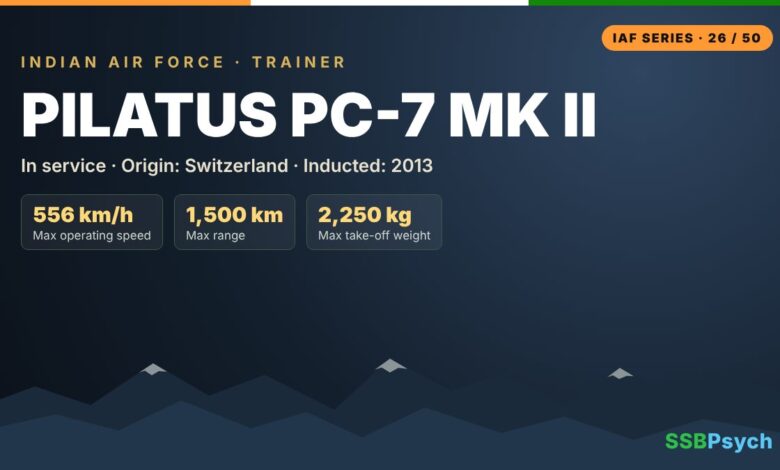
Pilatus PC-7 Mk II in IAF: Specs, Speed, Training, History
Before a pilot ever touches a Rafale, a Sukhoi or a C-17, there is one aircraft that teaches them how to fly. In today’s Indian Air Force that aircraft is the Pilatus PC-7 Mk II, a nimble, propeller-driven trainer from Switzerland. It looks small and friendly, yet it can loop, roll and spin like a mini fighter. For thousands of young cadets, its cockpit at the Air Force Academy in Dundigal is where the dream of wings first becomes real.
In this guide we break the PC-7 Mk II down in simple words: why India bought it, how its engine works, how fast and how high it goes, what it is like to train on it, its strengths and weak points, and what comes next. At the end there is a 10-question quiz and an FAQ section, perfect for quick revision before your AFCAT, NDA or SSB interview.

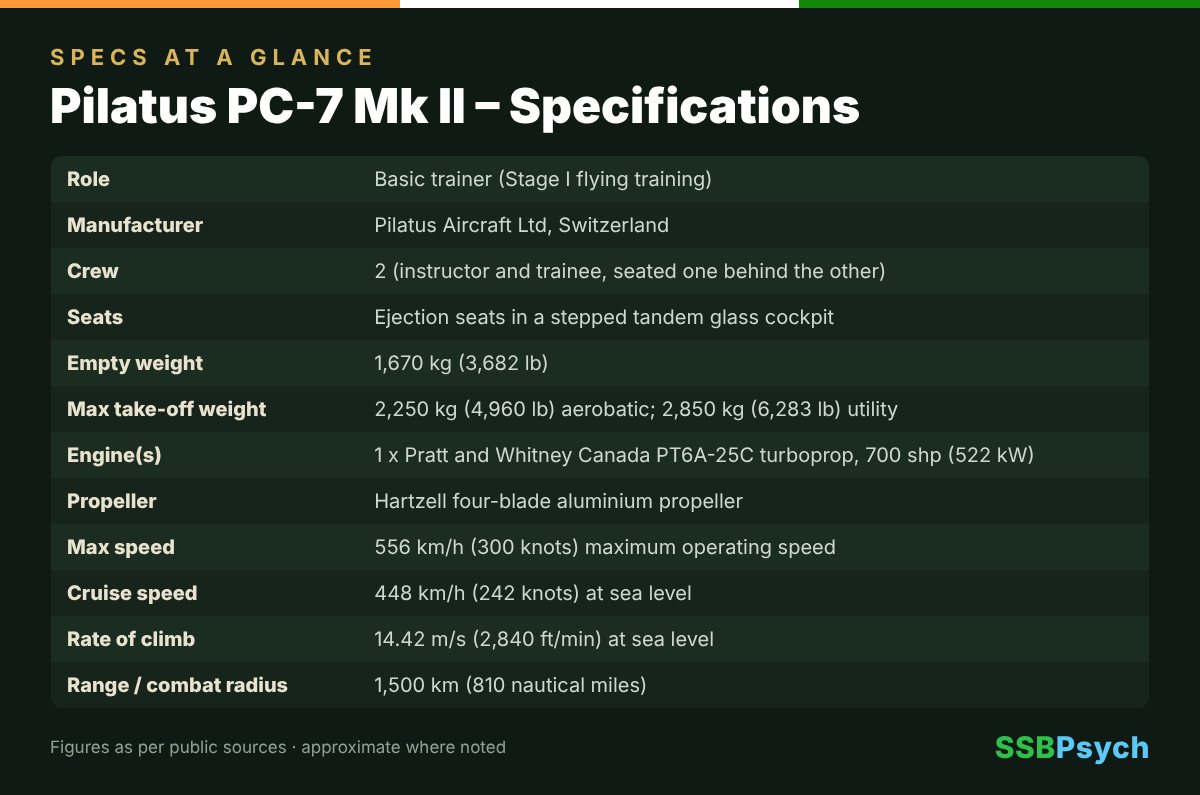
Pilatus PC-7 Mk II Specifications
| Role | Basic trainer (Stage I flying training) |
| Manufacturer | Pilatus Aircraft Ltd, Switzerland |
| Crew | 2 (instructor and trainee, seated one behind the other) |
| Seats | Ejection seats in a stepped tandem glass cockpit |
| Empty weight | 1,670 kg (3,682 lb) |
| Max take-off weight | 2,250 kg (4,960 lb) aerobatic; 2,850 kg (6,283 lb) utility |
| Engine(s) | 1 x Pratt and Whitney Canada PT6A-25C turboprop, 700 shp (522 kW) |
| Propeller | Hartzell four-blade aluminium propeller |
| Max speed | 556 km/h (300 knots) maximum operating speed |
| Cruise speed | 448 km/h (242 knots) at sea level |
| Rate of climb | 14.42 m/s (2,840 ft/min) at sea level |
| Range / combat radius | 1,500 km (810 nautical miles) |
| Service ceiling | About 10,000 m (33,000 ft) |
| G limits | +7 g to -3.5 g (aerobatic) |
| First flight | 28 September 1992 (PC-7 Mk II) |
| Inducted in IAF | First aircraft February 2013; formal induction 31 May 2013 |
| Number in IAF | 75 delivered (2013 to 2015) |
Why India Needed the Pilatus PC-7 Mk II
Every air force needs a basic trainer, the first aircraft on which a cadet learns take-offs, landings, turns, stalls, aerobatics and flying by instruments. For decades the IAF used the HAL HPT-32 Deepak for this stage. After a series of accidents, the HPT-32 fleet was grounded in 2009. That left a serious gap: cadets had to be trained on the next-stage jets or wait, and the training pipeline came under pressure.
India needed a proven basic trainer quickly. A tender was issued, and the Swiss PC-7 Mk II was selected. The contract for 75 aircraft was signed on 24 May 2012, worth about ₹2,896 crore. The deal also covered a ground-based training system, logistics support and an option to buy more aircraft later.
The choice made sense. The PC-7 family has been in service with many air forces around the world since the late 1970s, and the Mk II version combines the strong airframe and modern cockpit of the bigger PC-9 with the PC-7 wing. In short, India got a tested design that could be put to work almost immediately.
History of the PC-7 Mk II in the IAF
Things moved fast after the contract. The first batch of trainers landed at the Air Force Academy (AFA), Dundigal, near Hyderabad, in February 2013.
On 31 May 2013, the aircraft was formally inducted at the academy by the then Minister of State for Defence. From July 2013, flight cadets began their basic flying on it. Deliveries continued smoothly, and the 75th aircraft was handed over at Dundigal in 2015, well ahead of the original schedule.
The impact on training was large. According to Pilatus, by late 2015 the fleet had already flown more than 40,000 hours and over 80,000 landings. The company also reported that basic flying hours per cadet rose by about 220 percent compared with the old system, and the number of solo flights a cadet makes at this stage jumped from just one to fourteen. More solo time means more confident young pilots.
Later, India considered ordering more PC-7s, including 38 extra aircraft under the option. In the end the Ministry of Defence chose to buy the home-grown HAL HTT-40 for future basic training instead, while the 75 PC-7 Mk IIs continue to carry the main load today.
Engine and Performance Explained Simply
The PC-7 Mk II has a single Pratt and Whitney Canada PT6A-25C turboprop engine. A turboprop is a jet-style turbine engine that, instead of pushing out a hot jet, turns a propeller. That gives the smooth reliability of a turbine with the fuel economy and gentle handling of a propeller aircraft. The engine produces about 700 shaft horsepower (522 kW). For comparison, a powerful family SUV makes around 200 horsepower, so this trainer has the power of about three or four SUVs packed into one small airframe.
That power spins a four-blade Hartzell propeller. The engine also has digital electronic control, which keeps it running correctly and reduces the chance that a nervous student makes a mistake with the power lever.
Speed: The maximum operating speed is about 556 km/h. That is roughly three times the top speed of a Vande Bharat Express train, and it is the fastest the aircraft is cleared to fly. At sea level it can cruise at around 448 km/h. At the other end, it can fly as slowly as about 124 to 139 km/h before the wing stops lifting, which is called the stall speed. Learning to handle stalls safely is one of the most important lessons in basic training.
Climb and height: At sea level it can climb at about 14 metres every second, so in one minute it rises about 860 metres, the height of nearly twelve Qutub Minars stacked on top of each other. Its maximum altitude, or service ceiling, is about 33,000 feet (around 10 km), close to where airliners cruise. Trainees, of course, spend most of their time much lower.
Range: It can fly about 1,500 km on its fuel, roughly the road distance from Delhi to Mumbai. That is far more than a training sortie needs, but it allows long navigation exercises and ferry flights between bases.
G-force: In aerobatic mode the airframe is cleared from +7 g to -3.5 g. At +7 g, a 70 kg cadet feels as if they weigh about 490 kg. Learning to handle this, with the help of the anti-g system, prepares cadets for the much higher loads of fighter jets later on.
What It Carries
- No weapons in IAF service: it flies as an unarmed basic trainer
- Two crew: an instructor and a trainee pilot
- Ejection seats for both crew members
- Glass cockpit with primary flight display and multifunction display
- Anti-g system to help pilots cope with tight turns
- On-board oxygen generating system (OBOGS)
- Wing able to carry external stores, though IAF trainers fly clean
Pilatus PC-7 Mk II Missions and Operations
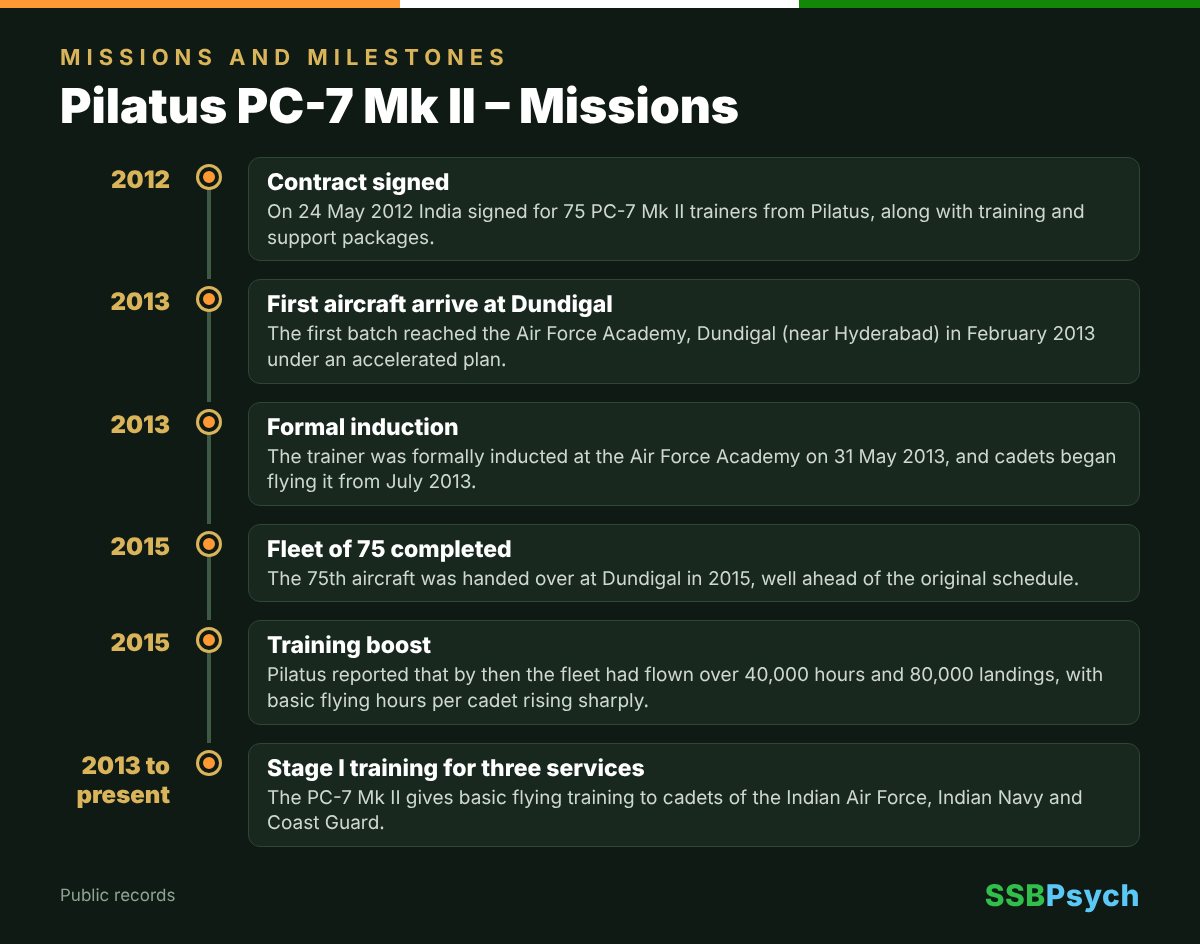
- 2012 – Contract signed: On 24 May 2012 India signed for 75 PC-7 Mk II trainers from Pilatus, along with training and support packages.
- 2013 – First aircraft arrive at Dundigal: The first batch reached the Air Force Academy, Dundigal (near Hyderabad) in February 2013 under an accelerated plan.
- 2013 – Formal induction: The trainer was formally inducted at the Air Force Academy on 31 May 2013, and cadets began flying it from July 2013.
- 2015 – Fleet of 75 completed: The 75th aircraft was handed over at Dundigal in 2015, well ahead of the original schedule.
- 2015 – Training boost: Pilatus reported that by then the fleet had flown over 40,000 hours and 80,000 landings, with basic flying hours per cadet rising sharply.
- 2013 to present – Stage I training for three services: The PC-7 Mk II gives basic flying training to cadets of the Indian Air Force, Indian Navy and Coast Guard.
Where It Is Based and Who Flies It
The PC-7 Mk II fleet is publicly reported to be based at the Air Force Academy, Dundigal, near Hyderabad. This is the cradle of the IAF’s officer corps, where flying branch cadets from the National Defence Academy and direct-entry routes such as AFCAT and CDS come for their training.
Here, Stage I or basic flying training is done on the PC-7 Mk II. The trainer is also used to teach cadets of the Indian Navy and the Indian Coast Guard, so naval and Coast Guard pilots start their flying life in the same cockpit as their IAF course-mates.
Who teaches them? Qualified Flying Instructors, experienced IAF pilots who have done a special instructor course. In the IAF, a flying training unit or squadron is usually led by an officer of Wing Commander rank, with Squadron Leaders and Flight Lieutenants serving as flight commanders and instructors. The academy as a whole is commanded by a senior Air Marshal.
The cadet’s path in general terms: A cadet first learns basic flying on the PC-7 Mk II, including the proud moment of the first solo flight. Based on performance and service needs, cadets are then streamed into fighter, transport or helicopter branches and move on to intermediate and advanced trainers. The whole journey from first flight to earning the pilot’s wings and becoming a commissioned officer takes well over a year, and fighter pilots continue training on advanced jets after that.
Strengths and Limitations
- Strength: A proven Swiss design used by many air forces, so spares, experience and training know-how are widely available.
- Strength: The turboprop engine is reliable and fuel efficient, which keeps the cost of each training hour low.
- Strength: Fully aerobatic, with +7 g capability, so cadets learn real manoeuvring skills early.
- Strength: Modern glass cockpit similar in layout to later jets, which makes the move to advanced trainers easier.
- Strength: Tandem seating lets the instructor watch, guide and take over from the student when needed.
- Limitation: It is a propeller aircraft, so it cannot teach the feel of jet speeds and handling; cadets must learn that later.
- Limitation: With only 75 aircraft and no further orders, the fleet must work hard to meet the training needs of three services.
- Limitation: As a foreign aircraft, long-term support depends partly on overseas supply chains.
Future of the Pilatus PC-7 Mk II in India
The PC-7 Mk II is expected to remain the backbone of basic training for years to come. However, India has chosen a home-grown partner for it. In 2023, the Ministry of Defence signed a contract with HAL for 70 HTT-40 basic trainers. The HTT-40 is also a turboprop trainer, designed and built in India, and it will gradually share the load with the PC-7 Mk II at the academy.
This is a classic example of how India’s defence policy works today: buy a proven foreign system to fill an urgent gap, then build an Indian product for the long term. The PC-7 Mk II bought valuable time and rebuilt the training pipeline, while the HTT-40 aims to make India self-reliant in this area.
Why It Matters for SSB and AFCAT Aspirants
If you are aiming for the flying branch through NDA, CDS or AFCAT, the PC-7 Mk II is very likely to be the first aircraft you fly as a cadet. Knowing about it shows the interview officer that you have done your homework about the career you want.
In the SSB personal interview, you may be asked simple questions such as: Where is the Air Force Academy? What are the stages of pilot training? Which aircraft do cadets fly first? Why did India buy a foreign trainer and what is the Indian replacement? A crisp answer, for example that the PC-7 Mk II was bought from Switzerland in 2012 after the HPT-32 was grounded, and that the HAL HTT-40 is the indigenous trainer now being added, shows awareness and a genuine interest in the Air Force.
It is also a good topic for group discussions on Make in India in defence. The story of PC-7 to HTT-40 is a ready example of moving from import to self-reliance.
Did You Know?
- The PC-7 Mk II flew for the first time on 28 September 1992.
- It borrows its airframe and cockpit from the larger Pilatus PC-9 but keeps the PC-7 wing.
- The first IAF PC-7 Mk IIs arrived at Dundigal in February 2013, barely nine months after the contract was signed.
- All 75 aircraft were delivered by 2015, ahead of the planned schedule.
- Pilatus reported that solo flights per cadet at the basic stage rose from one to fourteen after the PC-7 Mk II arrived.
- Cadets of the Indian Navy and Coast Guard also learn basic flying on the IAF’s PC-7 Mk II fleet.
- It has a four-blade propeller turned by a 700 shp Pratt and Whitney Canada turboprop engine.
Quiz: Test Your Knowledge of Pilatus PC-7 Mk II
Click an option to see if you are right. Your score updates live.
Pilatus PC-7 Mk II: Frequently Asked Questions
It is the Indian Air Force’s basic trainer. Cadets at the Air Force Academy, Dundigal learn their first flying skills on it, including their first solo flight.
Its maximum operating speed is about 556 km/h (300 knots). It cruises at around 448 km/h at sea level.
India ordered 75 PC-7 Mk II trainers in 2012, and all 75 were delivered between 2013 and 2015.
The first aircraft arrived in February 2013 and the type was formally inducted on 31 May 2013 at the Air Force Academy, Dundigal.
India ordered 70 HAL HTT-40 basic trainers in 2023. These indigenous trainers will work alongside the PC-7 Mk II in basic pilot training.
This is part 26 of 50 in SSBPsych’s Indian Air Force aircraft series – a new aircraft every evening at 6 PM.
Sources: en.wikipedia.org, airforce-technology.com, sicc.ch, infolotnicze.pl, mail.saairforce.co.za.
Preparing for NDA, CDS, AFCAT or your SSB? Join SSBPsych’s online and offline batches – explore our courses or call +91 8076540582.