Ladakh Scouts: History, War Cry, Battles and the Snow Warriors
High above the clouds, where the air is thin and the temperature can fall far below freezing, the Indian Army relies on soldiers who were born to these mountains. They are the Ladakh Scouts, the famous Snow Warriors of India. Born from a band of local volunteers in 1948 and raised as a formal force in 1963, the Ladakh Scouts have fought at Turtuk, Siachen and Kargil, and today they are a full infantry regiment with a reputation few units can match.
In this guide you will read about the history and origins of the regiment, a visual timeline, its major operations and battle honours, its insignia and war cry, its heroes, life in the regiment, what it means for SSB candidates, and a quiz at the end.
Ladakh Scouts – Quick Facts
| Raised | 1 June 1963, from the 7th and 14th Battalions of the J and K Militia |
| Roots | Nubra Guards, raised in 1948 |
| Became a full regiment | Around 2000, after the Kargil War |
| Regimental Centre | Ladakh Scouts Regimental Centre, Leh, Ladakh |
| War Cry | Ki Ki So So Lhargyalo (Victory to the Gods) |
| Nicknames | Snow Warriors, Snow Leopards |
| Recruitment | Mainly Ladakhi and Tibetan communities |
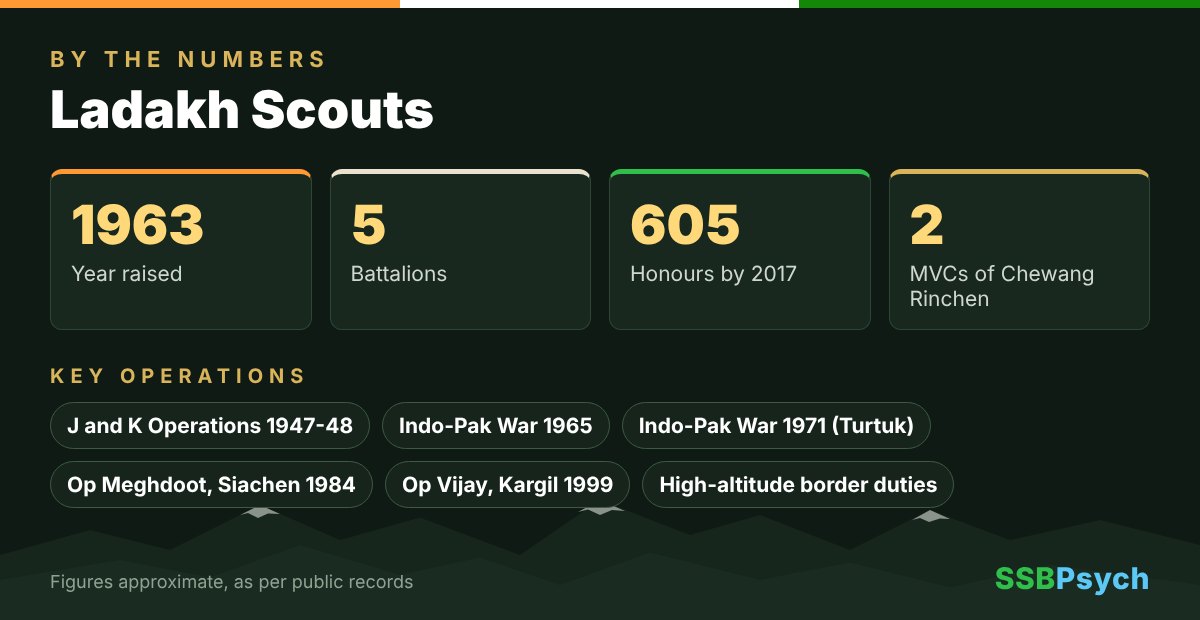
| Battalions | 5 battalions |
| Specialty | High-altitude and mountain warfare, reconnaissance, raids |
| Honours and awards | 605 by 2017, including two Maha Vir Chakras won by Col Chewang Rinchen |
| President’s Colours | Presented at Leh on 21 August 2017 |
History of the Ladakh Scouts
The story begins in 1947-48, when raiders from Pakistan pushed towards Ladakh. Leh was in danger and regular troops were few. Local Ladakhis came forward to defend their homeland. A small force under Lieutenant Colonel Prithi Chand crossed the snowbound Zoji La in winter to reach Leh and organised these volunteers. Out of this effort came the Nubra Guards, raised in 1948 to patrol the remote valleys of Ladakh.
Among the first to volunteer was a 17-year-old boy named Chewang Rinchen. He fought so bravely in the Nubra valley that he was awarded the Maha Vir Chakra while still a teenager. He would go on to become a legend of the regiment.
In 1952 the Nubra Guards became the 7th Battalion of the Jammu and Kashmir Militia. A second Ladakhi battalion, the 14th, was raised in 1959. Then came the 1962 war with China, which showed the need for troops who could live, move and fight at extreme altitude without long periods of acclimatisation.
On 1 June 1963, the 7th and 14th Battalions of the militia were brought together to form the Ladakh Scouts. Their role was reconnaissance and interdiction in the high mountains along India’s northern borders: watching the enemy, raiding his positions and guiding larger forces through difficult terrain.
After their outstanding performance in the Kargil War of 1999, the Ladakh Scouts were converted into a regular infantry regiment of the Indian Army around 2000. Leading Ladakhi figures had also urged that the Scouts be given full regimental status. Today the regiment has five battalions and its own Regimental Centre at Leh.
Ladakh Scouts Timeline: From Raising to Today
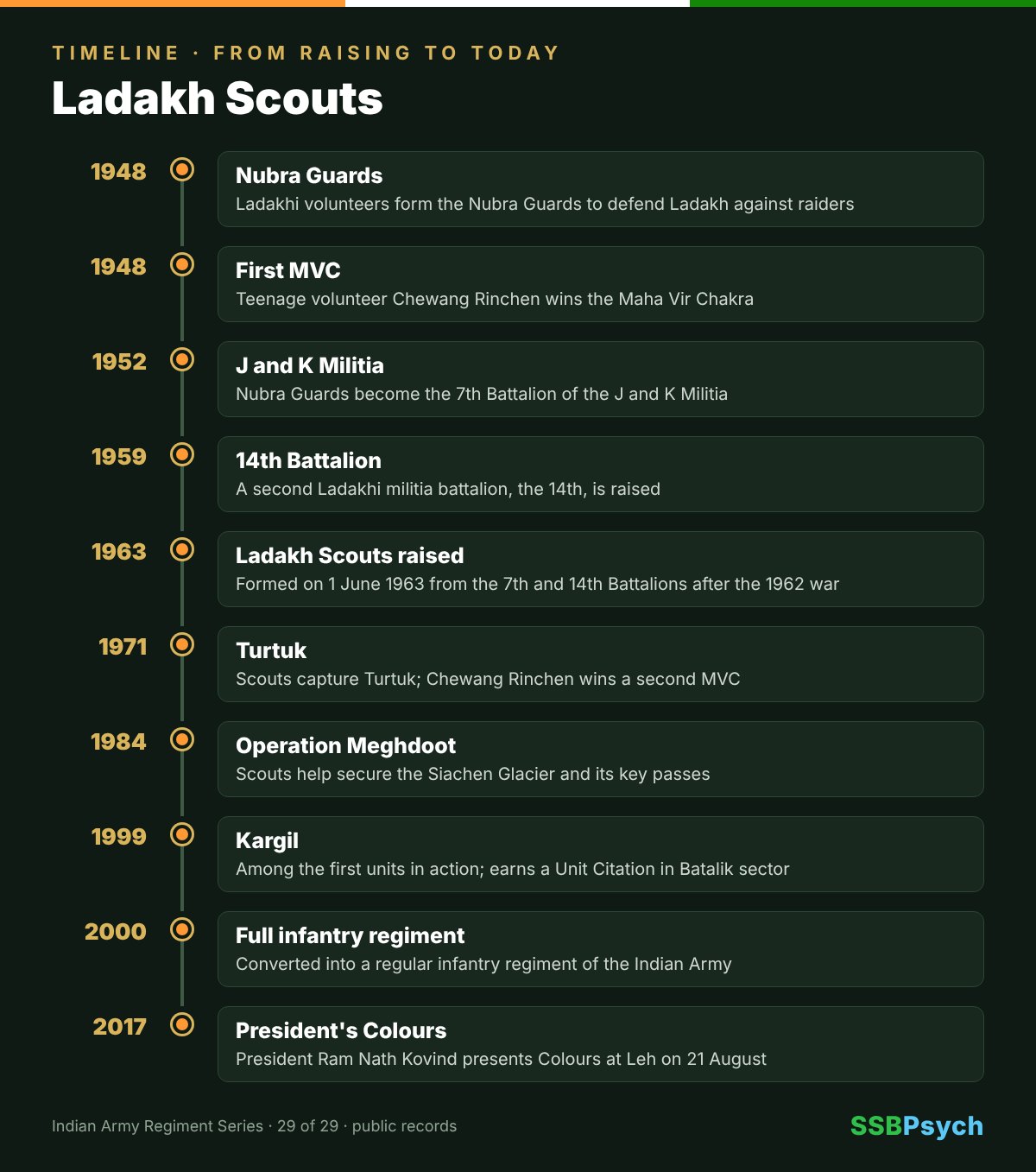
- 1948 – Nubra Guards: Ladakhi volunteers form the Nubra Guards to defend Ladakh against raiders
- 1948 – First MVC: Teenage volunteer Chewang Rinchen wins the Maha Vir Chakra
- 1952 – J and K Militia: Nubra Guards become the 7th Battalion of the J and K Militia
- 1959 – 14th Battalion: A second Ladakhi militia battalion, the 14th, is raised
- 1963 – Ladakh Scouts raised: Formed on 1 June 1963 from the 7th and 14th Battalions after the 1962 war
- 1971 – Turtuk: Scouts capture Turtuk; Chewang Rinchen wins a second MVC
- 1984 – Operation Meghdoot: Scouts help secure the Siachen Glacier and its key passes
- 1999 – Kargil: Among the first units in action; earns a Unit Citation in Batalik sector
- 2000 – Full infantry regiment: Converted into a regular infantry regiment of the Indian Army
- 2017 – President’s Colours: President Ram Nath Kovind presents Colours at Leh on 21 August
Major Operations and Battle Honours of the Ladakh Scouts
Small in size, the regiment has taken part in almost every major operation in the northern mountains since the 1960s.
1948: Defending Ladakh
As the Nubra Guards, Ladakhi volunteers helped hold the Nubra valley and the approaches to Leh during the 1947-48 operations. Their knowledge of the land and their ability to move fast across the mountains made up for their small numbers and limited weapons.
1965 and 1971: Turtuk
The Scouts saw action in the 1965 war. In 1971 they made their most famous advance. Led by Chewang Rinchen, by then a seasoned officer, Ladakh Scouts troops pushed into the area north of the Shyok river and captured Turtuk and the surrounding villages, bringing a large area under Indian control. Rinchen received a second Maha Vir Chakra, and the regiment earned the battle honour Turtuk and the theatre honour Jammu and Kashmir 1971. Turtuk remains part of India today and is now a popular destination for visitors to Ladakh.
1984: Operation Meghdoot on the Siachen Glacier
In April 1984, India launched Operation Meghdoot to secure the Siachen Glacier before Pakistan could. Troops of the Ladakh Scouts, along with battalions of the Kumaon Regiment, were flown by helicopter and moved on foot to occupy key passes on the Saltoro Ridge, including Sia La and Bilafond La, at heights of around 18,000 to 20,000 feet. India has held these heights ever since, and the regiment still serves on the glacier.
1999: Kargil
When intruders were found on the heights of Kargil in 1999, the Ladakh Scouts were among the first units sent into action. They fought in the Batalik sector, capturing positions such as Point 5000, Dog Hill and Padma Go in July 1999. Major Sonam Wangchuk, who led his men to a key ridge in the Chorbat La area, was awarded the Maha Vir Chakra. For its role in the war the regiment received a Unit Citation, and the Chief of the Army Staff also honoured it with the COAS Banner.
Guarding the Northern Borders
Today the Scouts are deployed along India’s high-altitude borders in Ladakh, including the Siachen sector. Their battalions take turns at extreme altitude, and their skill at moving light and fast in the mountains makes them invaluable for patrols and surveillance.
Insignia, Motto and War Cry
The insignia of the Ladakh Scouts features the Himalayan ibex, the hardy wild goat of the high mountains. The choice is fitting: like the ibex, the Scouts are at home on steep slopes and in extreme cold.
The war cry of the regiment is Ki Ki So So Lhargyalo, a traditional Ladakhi invocation meaning Victory to the Gods. Rooted in the faith and culture of the region, it carries deep meaning for the soldiers who shout it.
The regiment is popularly known as the Snow Warriors and also as the Snow Leopards. Reliable sources do not record a separate formal motto, so the war cry serves as the regiment’s best-known rallying call.
Heroes of the Ladakh Scouts
Every Ladakhi child knows the names of the regiment’s heroes. Here are the ones every aspirant should know:
- Colonel Chewang Rinchen, MVC and Bar, Sena Medal – volunteered at 17 in 1948 and won the Maha Vir Chakra; won the Sena Medal in 1962 and a second MVC in 1971 for the capture of Turtuk. He later became Honorary Colonel of the Ladakh Scouts.
- Major Sonam Wangchuk, Maha Vir Chakra – led Ladakh Scouts troops in the Batalik sector during the Kargil War of 1999; he later rose to the rank of Colonel.
- Lieutenant Colonel Prithi Chand – led the small force that crossed Zoji La in winter in 1948 and organised Ladakhi volunteers for the defence of Leh.
By the time the regiment received its President’s Colours in 2017, its soldiers had earned 605 honours and awards for gallantry and distinguished service, a remarkable record for a regiment of its size.
Role and Life in the Regiment
The Ladakh Scouts specialise in high-altitude and mountain warfare, long-range patrols, reconnaissance and raids in difficult terrain. Because most soldiers grow up at heights of over 10,000 feet, they adapt to thin air and extreme cold far more easily than troops from the plains. This makes them ideal for posts on the glacier and along the Line of Actual Control.
Recruits come mainly from the Ladakhi and Tibetan communities and train at the Ladakh Scouts Regimental Centre in Leh. Officers and some specialist personnel are posted in from other parts of the Army. Life in the regiment combines long tenures in harsh field areas with strong community ties at home, as many soldiers serve close to their own villages.
The Scouts have also distinguished themselves in sports and adventure activities, a natural extension of their mountain way of life.
The President’s Colours, 2017
On 21 August 2017, President Ram Nath Kovind travelled to Leh and presented the President’s Colours to all five battalions of the Ladakh Scouts and to the Ladakh Scouts Regimental Centre. It was his first visit outside Delhi after taking office. The President’s Colours are among the highest honours a unit can receive in peacetime, and the ceremony recognised more than half a century of service by the people of Ladakh to the nation.
Why the Ladakh Scouts Matter Today
Ladakh shares borders with both China and Pakistan-occupied territory, and much of it lies at heights where ordinary soldiers struggle to breathe. In such terrain, troops who already know the land, the weather and the people are a huge advantage. They can read the mountains, spot changes in snow and ice, and travel light across passes that would stop other units.
The Ladakh Scouts also strengthen the bond between the Army and the people of Ladakh. Almost every village in the region has a son or relative in the regiment, and the respect for the Scouts is visible across the Union Territory. For SSB candidates, this is a useful example of how a regiment rooted in a local community can serve both national security and regional pride.
With tensions along the Line of Actual Control in recent years, the importance of high-altitude specialists has only grown. The Snow Warriors remain one of the Army’s most trusted tools for holding India’s highest frontiers.
Lessons for Future Officers
The regiment’s history is a lesson in how ordinary people rise to extraordinary challenges. In 1948 there was no regiment, only local volunteers who knew their mountains and loved their land. Their courage turned into a proud fighting force. For an aspirant, this shows that motivation and initiative matter more than resources.
Chewang Rinchen’s life is another lesson. He started as a teenage volunteer and retired as a Colonel with two Maha Vir Chakras. His story is proof that steady effort, courage and learning from experience can take a person from the humblest start to the very top.
Finally, the Scouts teach the value of local knowledge. Officers who respect the people, culture and terrain of the area where they serve become far better leaders, a point that SSB assessors often explore through situation reaction tests and interviews.
Quick Revision Points
- Roots in the Nubra Guards of 1948; raised as Ladakh Scouts on 1 June 1963.
- Formed from the 7th and 14th Battalions of the J and K Militia.
- Became a full infantry regiment around 2000, after Kargil.
- War cry: Ki Ki So So Lhargyalo. Insignia: the Himalayan ibex.
- Regimental Centre at Leh; five battalions.
- Battle honour Turtuk (1971); key roles in Operation Meghdoot (1984) and Kargil (1999).
- President’s Colours presented on 21 August 2017.
Ladakh Scouts for SSB Candidates: What You Should Know
How officers join
- Officers join the Indian Army through NDA, IMA (via CDS or entries such as TES and TGC) or OTA Chennai for Short Service Commission.
- Every candidate must clear the SSB interview and a medical board.
- Arm and regiment allotment is done at the academy based on preferences, merit and vacancies; no regiment is guaranteed in advance.
- Officers of the Ladakh Scouts are drawn from the Army’s officer cadre and posted as per service needs.
How soldiers join
- Soldiers are recruited mainly from the Ladakhi and Tibetan communities of the region.
- Since 2022, new soldiers join the Indian Army as Agniveers under the Agnipath scheme.
- Recruits train at the Ladakh Scouts Regimental Centre in Leh.
Questions you may face in the SSB interview, GD or lecturette
- Why are locally recruited troops so valuable at high altitude?
- What do you know about Operation Meghdoot and the Siachen Glacier?
- Who was Colonel Chewang Rinchen?
- How would you prepare your men for duty at extreme altitude?
- Lecturette topic: The strategic importance of Ladakh.
SSBPsych tip: Learn the basic geography of Ladakh, including Siachen, Saltoro Ridge, Turtuk and Batalik, on a map; SSB interviewers often test map awareness of India’s northern borders.
Conclusion
From a handful of brave volunteers in 1948 to a full regiment guarding the roof of India, the Ladakh Scouts embody courage, endurance and love for the homeland. Study their story, take the quiz below, and carry the spirit of the Snow Warriors into your SSB preparation.
Quiz: How Well Do You Know the Ladakh Scouts?
Test yourself! Click an option to see if you are right. Your score updates live.
Ladakh Scouts: Frequently Asked Questions
The war cry is Ki Ki So So Lhargyalo, meaning Victory to the Gods.
The Ladakh Scouts Regimental Centre is at Leh in the Union Territory of Ladakh.
The regiment was raised on 1 June 1963 from two battalions of the J and K Militia, with roots in the Nubra Guards of 1948. It became a full infantry regiment after the Kargil War.
Their soldiers come from Ladakh’s high mountains and specialise in fighting in snow, extreme cold and thin air, which earned them the nickname Snow Warriors.
Colonel Chewang Rinchen, who won the Maha Vir Chakra twice, and Major Sonam Wangchuk, who won the Maha Vir Chakra in the Kargil War, are the best-known heroes of the regiment.
Indian Army Regiments Series on SSBPsych
This is part 29 of 29 in our series on every infantry regiment of the Indian Army – a new regiment every day at 11 AM. Previous in the series: 11 Gorkha Rifles. Also follow our Param Vir Chakra series.
Sources: en.wikipedia.org, bharat-rakshak.com, ramnathkovind.nic.in, thebetterindia.com, salute.co.in.
Preparing for NDA, CDS, AFCAT or your SSB? Join SSBPsych’s online and offline batches – explore our courses or call +91 8076540582.