9 Gorkha Rifles: History, Motto, War Cry, Battles and Heroes
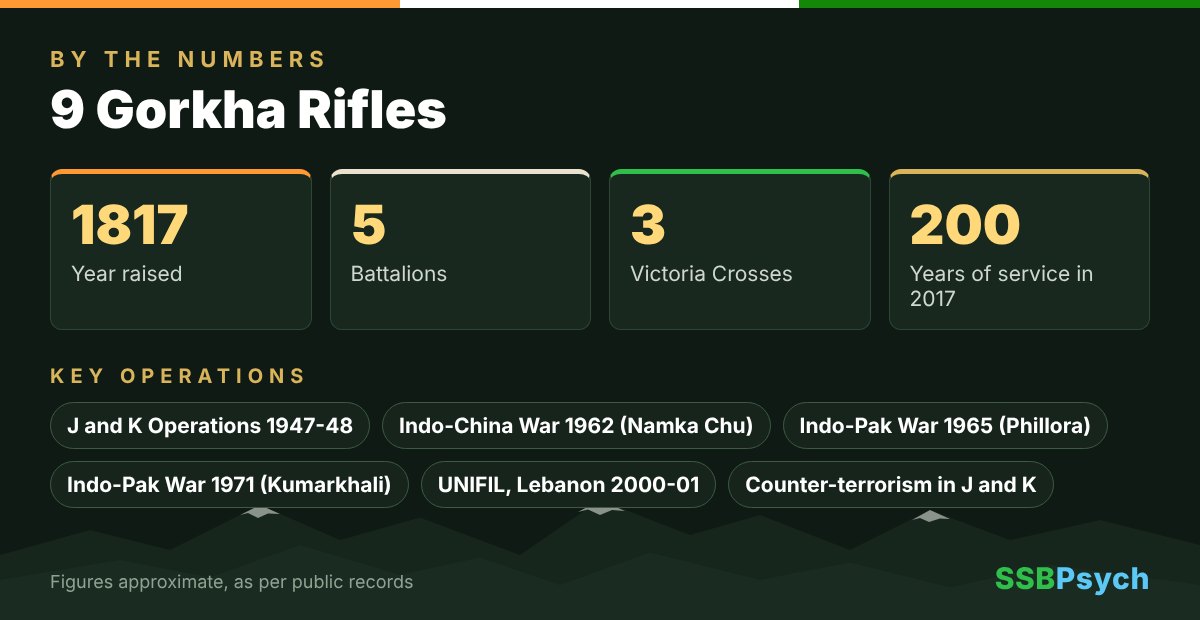
Some regiments are old; 9 Gorkha Rifles is ancient by Indian Army standards. Raised in 1817, it celebrated its bicentenary in 2017 and has fought in nearly every major campaign of the last two centuries, from the walls of Bharatpur to the slopes of Monte Cassino and the icy Namka Chu river. For NDA, CDS and TES aspirants, 9 Gorkha Rifles offers lessons in endurance, tradition and quiet courage.
This guide covers the regiment’s history and lineage, a visual timeline, its major operations and battle honours, its motto and war cry, its heroes, life in a Gorkha battalion, what it means for SSB candidates, and a 10-question quiz.
9 Gorkha Rifles – Quick Facts
| Raised | 1817, as the Fatehgarh Levy |
| Present name | 9 Gorkha Rifles (9th Gurkha Rifles from 1903) |
| Regimental Centre | 39 Gorkha Training Centre, Varanasi, Uttar Pradesh |
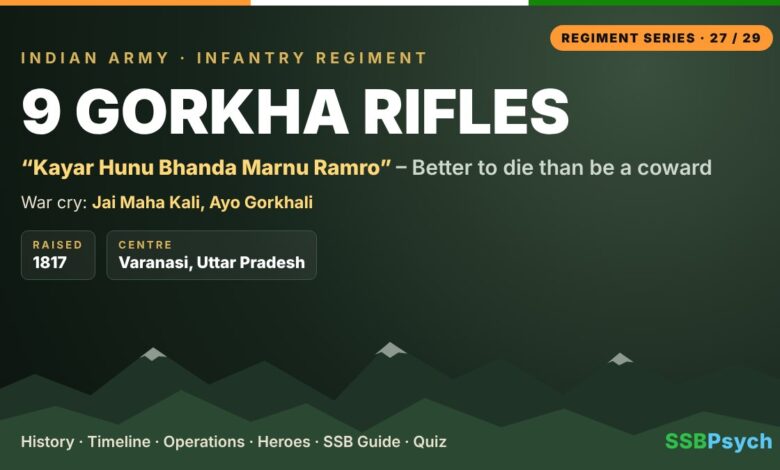
| Motto | Kayar Hunu Bhanda Marnu Ramro (Better to die than be a coward) |
| War Cry | Jai Maha Kali, Ayo Gorkhali |
| Recruitment | Mainly Chhetri and Thakuri Gorkhas of Nepal, plus Indian Gorkhas |
| Battalions | 5 battalions |
| Victoria Crosses | 3 (1917 and two in 1944) |
| Bicentenary | Celebrated in 2017 |
| Post-1947 battle honours | Phillora, Kumarkhali, Dera Baba Nanak |
History of the 9 Gorkha Rifles
The regiment began in 1817 as the Fatehgarh Levy, a local force raised by the East India Company in the Fatehgarh area of present-day Uttar Pradesh. Soon afterwards it moved to Mainpuri and was called the Mainpuri Levy. In the 1820s it was taken into the regular Bengal Army as a battalion of native infantry.
Its early battle honours came at Bharatpur, where the Company’s army stormed the famous fort, and at Sobraon in 1846 during the First Anglo-Sikh War. After the great reorganisation of the Bengal Army in 1861, it became the 9th Regiment of Bengal Native Infantry.
In the later nineteenth century the regiment began to enlist Gorkhas, and by 1893 it had become a fully Gorkha unit. It took the title 9th Gurkha Rifles in 1903, and a 2nd Battalion was raised in 1904. Its soldiers saw service in Afghanistan in 1879-80 and on the North-West Frontier.
The First World War took the regiment to France and Flanders, where it fought at La Bassee, Neuve Chapelle and Loos, and then to Mesopotamia. In February 1917, during the crossing of the Tigris at Shumran Bend, Major George Wheeler of the 2nd Battalion led a small party across the river under fire and held on against counter-attacks, winning the regiment’s first Victoria Cross.
In the Second World War the regiment fought in Malaya, North Africa, Italy and Burma. In Italy, its 1st Battalion fought at Cassino, including the famous action at Hangman’s Hill, and later at Tavoleto and San Marino. In Burma, the 3rd and 4th Battalions served with the Chindits, the long-range force that fought deep behind Japanese lines. Two more Victoria Crosses were won in 1944.
At Independence, the regiment was one of the six Gorkha regiments that came to India under the 1947 Tripartite Agreement. It later took the Indian spelling and became 9 Gorkha Rifles.
Hangman’s Hill, Cassino, 1944
One of the proudest episodes in the regiment’s story came at Monte Cassino in Italy in March 1944. The 1st Battalion pushed up the steep slopes below the famous monastery and seized a rocky feature known as Hangman’s Hill, very close to the German positions. Cut off from the rest of the force, the Gorkhas held on for days, supplied partly by air drops, before they were ordered to withdraw. Hangman’s Hill became a battle honour of the regiment and a symbol of Gorkha tenacity.
With the Chindits in Burma
In 1944 the 3rd and 4th Battalions marched and flew deep into Japanese-held Burma with the Chindits. These columns lived for months behind enemy lines, carrying everything on their backs or on mules and depending on supplies dropped from aircraft. Disease, hunger and constant fighting took a heavy toll, but the Gorkhas earned a lasting reputation for long-range operations. It was here that Major Frank Blaker, attached to the 3rd Battalion, won his Victoria Cross while leading an attack on a Japanese position.
9 Gorkha Rifles Timeline: From Raising to Today
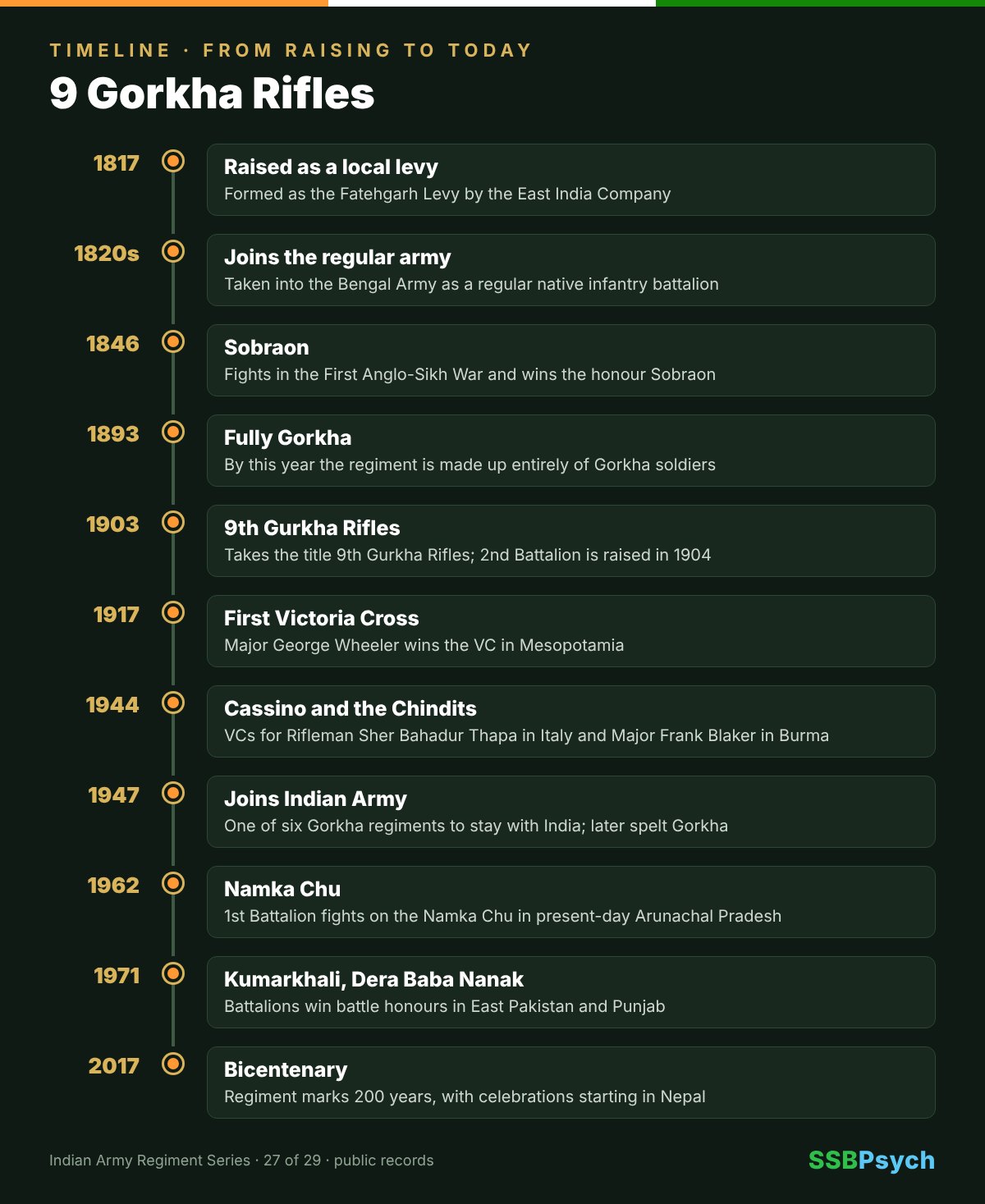
- 1817 – Raised as a local levy: Formed as the Fatehgarh Levy by the East India Company
- 1820s – Joins the regular army: Taken into the Bengal Army as a regular native infantry battalion
- 1846 – Sobraon: Fights in the First Anglo-Sikh War and wins the honour Sobraon
- 1893 – Fully Gorkha: By this year the regiment is made up entirely of Gorkha soldiers
- 1903 – 9th Gurkha Rifles: Takes the title 9th Gurkha Rifles; 2nd Battalion is raised in 1904
- 1917 – First Victoria Cross: Major George Wheeler wins the VC in Mesopotamia
- 1944 – Cassino and the Chindits: VCs for Rifleman Sher Bahadur Thapa in Italy and Major Frank Blaker in Burma
- 1947 – Joins Indian Army: One of six Gorkha regiments to stay with India; later spelt Gorkha
- 1962 – Namka Chu: 1st Battalion fights on the Namka Chu in present-day Arunachal Pradesh
- 1971 – Kumarkhali, Dera Baba Nanak: Battalions win battle honours in East Pakistan and Punjab
- 2017 – Bicentenary: Regiment marks 200 years, with celebrations starting in Nepal
Major Operations and Battle Honours of 9 Gorkha Rifles
Before 1947 the regiment collected honours such as Bharatpur, Sobraon, Afghanistan 1879-80, Neuve Chapelle, Loos, Kut-al-Amara, Cassino I, Hangman’s Hill, Tavoleto, San Marino and Chindits 1944. After Independence it added new honours in three wars.
1962: Namka Chu
In October 1962, the 1st Battalion was deployed along the Namka Chu river in what was then NEFA, now Arunachal Pradesh. The Indian brigade there faced a much larger Chinese force with poor supplies, little artillery and no time to acclimatise. The Gorkhas fought hard in very difficult conditions, and the battle remains an important study in why leaders must match tasks to resources.
1965: Phillora
In the 1965 war, battalions of the regiment fought in Jammu and Kashmir and Punjab. The regiment earned the battle honour Phillora, linked to the major armoured and infantry battles in the Sialkot sector.
1971: Kumarkhali and Dera Baba Nanak
In 1971 the regiment fought on both fronts. In East Pakistan, the 2nd Battalion earned the battle honour Kumarkhali. In the west, the 1st Battalion earned Dera Baba Nanak in Punjab, close to the holy town of the same name on the border.
Peacekeeping and Counter-Terrorism
The 5th Battalion served with the UN Interim Force in Lebanon (UNIFIL) from late 2000 to the end of 2001. The regiment’s battalions have served long tenures in counter-terrorism operations in Jammu and Kashmir, and each of its five battalions has received a Chief of the Army Staff Unit Citation. In 2017 the regiment celebrated its bicentenary, beginning the celebrations with its veterans in Pokhara, Nepal.
Insignia, Motto and War Cry
The motto of the regiment is Kayar Hunu Bhanda Marnu Ramro, a Nepali saying that means it is better to die than to be a coward. It is the heart of the Gorkha warrior code.
The war cry is Jai Maha Kali, Ayo Gorkhali, meaning Hail Goddess Kali, the Gorkhas are here. Like other Gorkha regiments, the insignia carries crossed khukris with the regimental number.
Traditionally the regiment has recruited mainly from the Chhetri and Thakuri communities of Nepal, along with Nepali-speaking Indian Gorkhas, which gives it a distinct identity among the Gorkha regiments.
Heroes of the 9 Gorkha Rifles
The regiment’s roll of honour includes Victoria Cross winners and modern-day heroes:
- Major George Campbell Wheeler, VC – 2nd Battalion; crossed the Tigris under fire at Shumran Bend in 1917 and held his ground.
- Rifleman Sher Bahadur Thapa, VC – 1st Battalion; awarded the Victoria Cross posthumously for bravery in Italy in September 1944.
- Major Frank Blaker, VC, MC – attached to the 3rd Battalion; won the Victoria Cross posthumously with the Chindits in Burma, 1944.
- Colonel Munindra Nath Rai, YSM, Shaurya Chakra – commanding 42 Rashtriya Rifles; killed in a counter-terrorist operation in Kashmir in January 2015, a day after receiving the Yudh Seva Medal.
- Lieutenant General B. K. N. Chhibber – later Governor of Punjab and Administrator of Chandigarh.
- Lieutenant General Anil Kumar Bhatt – served as Director General of Military Operations and commanded the Chinar Corps.
Recruitment and Traditions of the 9 Gorkha Rifles
Each Gorkha regiment has its own character, and much of it comes from where its soldiers come from. The 9th has traditionally drawn its men mainly from the Chhetri and Thakuri communities of Nepal, along with domiciled Indian Gorkhas, who form a sizeable part of its strength. Soldiers often follow fathers, uncles and grandfathers into the same battalion, so the regiment feels like an extended family spread across Nepal and India.
Regimental traditions are taken seriously. Battle honour days are remembered with ceremonies, veterans are invited back to their battalions, and the khukri is treated with great respect. When the regiment turned 200 in 2017, thousands of veterans and their families gathered in Pokhara, showing how strong the bond between the regiment and its old soldiers remains.
Role and Life in the Regiment
9 Gorkha Rifles is an infantry rifle regiment. Its battalions are trained for mountain warfare, high-altitude operations, jungle fighting and counter-terrorism. They serve in turns at peace stations and in field areas such as Jammu and Kashmir, the North-East and the northern borders.
Recruits are trained at the 39 Gorkha Training Centre in Varanasi, Uttar Pradesh, where they learn basic soldiering, weapon handling, drill and regimental traditions before passing out to join their battalions. The regiment has a strong veteran community in Nepal, and the Indian Army’s pension and welfare offices there keep the link alive.
Officers in a Gorkha battalion learn Gorkhali and take part in festivals such as Dashain with their men. The regiment is also known for its sporting and patrolling skills: a team from the 4th Battalion became the first Indian team to win a gold medal at the Cambrian Patrol, a tough international patrolling competition held in Wales.
For a young officer, the first posting to a Gorkha battalion is a special experience. You are expected to know every soldier by name, understand his family situation and earn his trust through fairness and example. In return, Gorkha soldiers are known for giving their officers complete loyalty. Many senior officers say that the years they spent with their Gorkha battalion taught them more about leadership than any course.
Lessons for Future Officers
The regiment’s history is full of lessons for aspirants. Major Wheeler’s crossing of the Tigris shows how a small, determined team led from the front can open the way for a whole army. The Chindit battalions show the value of endurance and self-reliance when supplies are far away. The battle of Namka Chu teaches that brave soldiers must also be given clear plans and proper resources, a point every future leader should remember.
Colonel M. N. Rai’s story is a modern example of leading from the front. As a commanding officer, he could have stayed back, but he chose to be with his men in the operation. Officer-like qualities such as courage, responsibility and initiative are exactly what the SSB looks for.
Quick Revision Points
- Raised in 1817 as the Fatehgarh Levy; bicentenary in 2017.
- Became fully Gorkha by 1893 and the 9th Gurkha Rifles in 1903.
- Motto: Kayar Hunu Bhanda Marnu Ramro. War cry: Jai Maha Kali, Ayo Gorkhali.
- Recruits train at 39 Gorkha Training Centre, Varanasi.
- Three Victoria Crosses: Wheeler (1917), Sher Bahadur Thapa and Blaker (1944).
- Post-1947 battle honours: Phillora (1965), Kumarkhali and Dera Baba Nanak (1971).
- 1st Battalion fought at Namka Chu in 1962.
9 Gorkha Rifles for SSB Candidates: What You Should Know
How officers join
- Officers join through NDA, IMA (via CDS or entries such as TES and TGC) or OTA Chennai for Short Service Commission.
- Every candidate must clear the SSB interview and a medical board.
- Arm and regiment allotment happens at the academy, based on the cadet’s preferences, merit and vacancies; no regiment is promised in advance.
- Cadets keen on a Gorkha regiment can include it in their infantry choices.
How soldiers join
- Soldiers are Gorkhas, traditionally mainly Chhetri and Thakuri from Nepal, along with Indian Gorkhas.
- Since 2022, new Indian Army soldiers join as Agniveers under the Agnipath scheme; recruitment from Nepal has been affected since then.
- Recruits train at the 39 Gorkha Training Centre, Varanasi.
Questions you may face in the SSB interview, GD or lecturette
- Why do you think Gorkha soldiers are respected across the world?
- What lessons does the 1962 battle of Namka Chu teach a young officer?
- What do you know about the India-Nepal Tripartite Agreement of 1947?
- How would you lead soldiers from a background very different from yours?
- Lecturette topic: The Gorkha soldier through 200 years.
SSBPsych tip: Read a short account of the 1962 war in Arunachal Pradesh, including Namka Chu; SSB interviewers often test whether a candidate can discuss military history calmly and draw balanced lessons from it.
Conclusion
Two hundred years after it was raised, 9 Gorkha Rifles remains a living link between India’s past and present. Its soldiers have fought on four continents and in every major Indian war. Learn its story, try the quiz below, and carry its message of courage into your SSB preparation.
Quiz: How Well Do You Know the 9 Gorkha Rifles?
Test yourself! Click an option to see if you are right. Your score updates live.
9 Gorkha Rifles: Frequently Asked Questions
The motto is Kayar Hunu Bhanda Marnu Ramro, meaning it is better to die than to be a coward.
Recruits of the regiment train at the 39 Gorkha Training Centre in Varanasi, Uttar Pradesh.
It was raised in 1817 as the Fatehgarh Levy and celebrated its bicentenary in 2017.
The war cry is Jai Maha Kali, Ayo Gorkhali, meaning Hail Goddess Kali, the Gorkhas are here.
Three: Major George Wheeler in 1917, and Rifleman Sher Bahadur Thapa and Major Frank Blaker in 1944.
Indian Army Regiments Series on SSBPsych
This is part 27 of 29 in our series on every infantry regiment of the Indian Army – a new regiment every day at 11 AM. Previous in the series: 8 Gorkha Rifles. Also follow our Param Vir Chakra series.
Sources: en.wikipedia.org, salute.co.in, kathmandupost.com, en.wikipedia.org, en.wikipedia.org.
Preparing for NDA, CDS, AFCAT or your SSB? Join SSBPsych’s online and offline batches – explore our courses or call +91 8076540582.