HF-24 Marut: India’s First Fighter Jet, Specs, 1971 War, History
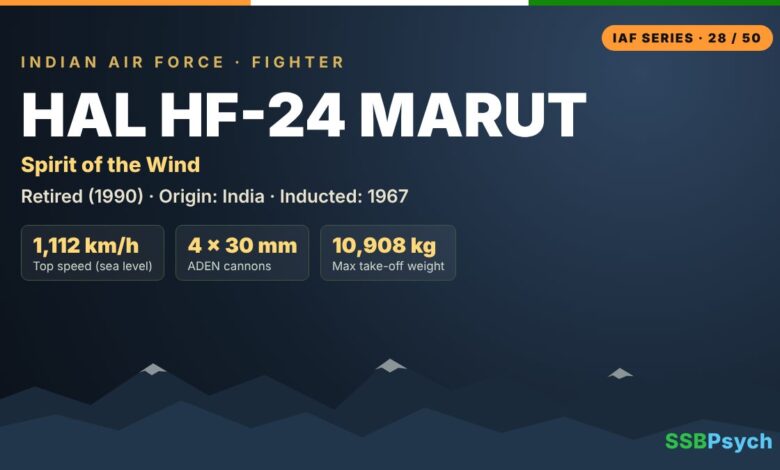
Today India proudly flies the home-grown Tejas. But the story of Indian fighter jets began more than six decades ago with a sleek, swept-wing aircraft called the HF-24 Marut. Its name means ‘Spirit of the Wind’. It was India’s first indigenous jet fighter, built by Hindustan Aeronautics Limited (HAL) in Bengaluru, and in December 1971 its pilots took it into battle against Pakistan and brought home real results.
In this guide we explain why India built the Marut, who designed it, how its engines worked (and why they held it back), what it did in the 1971 war, why it retired, and where you can still see one. A 10-question quiz and FAQs at the end will help you lock the facts in for AFCAT, NDA, CDS and SSB.

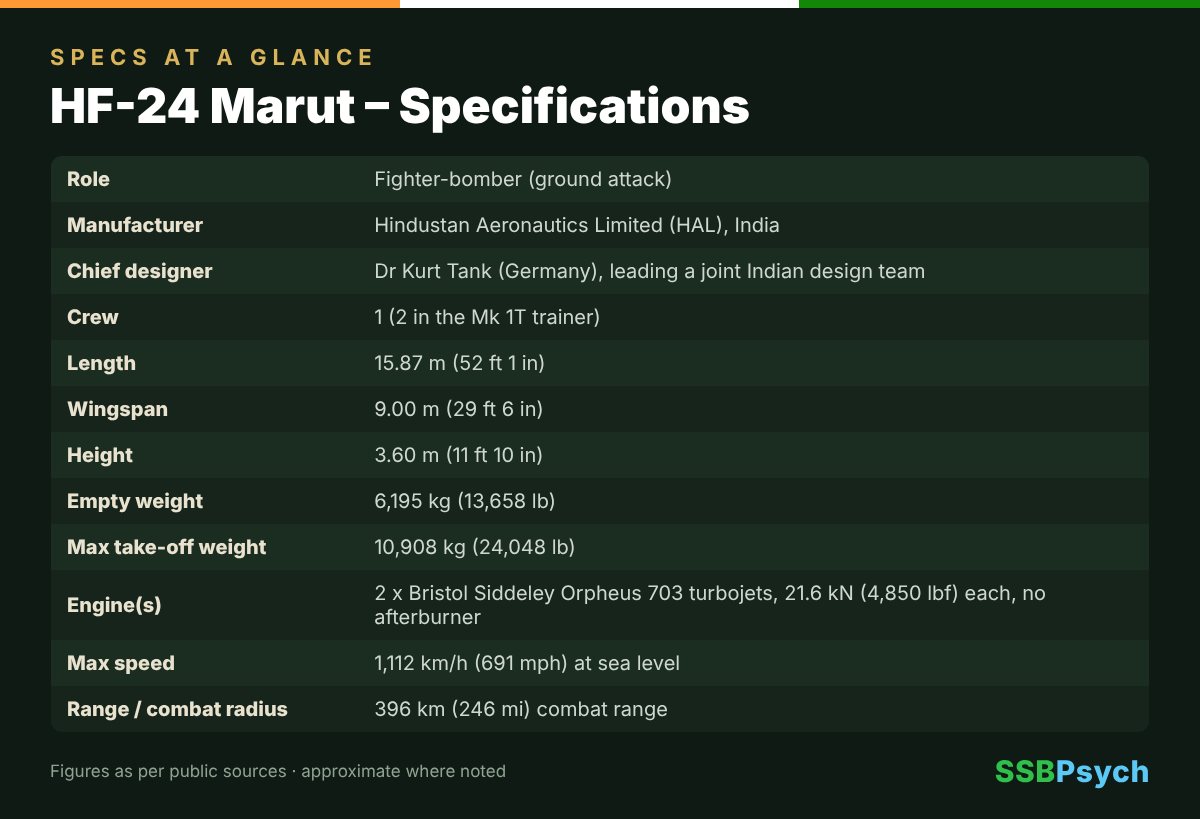
HF-24 Marut Specifications
| Role | Fighter-bomber (ground attack) |
| Manufacturer | Hindustan Aeronautics Limited (HAL), India |
| Chief designer | Dr Kurt Tank (Germany), leading a joint Indian design team |
| Crew | 1 (2 in the Mk 1T trainer) |
| Length | 15.87 m (52 ft 1 in) |
| Wingspan | 9.00 m (29 ft 6 in) |
| Height | 3.60 m (11 ft 10 in) |
| Empty weight | 6,195 kg (13,658 lb) |
| Max take-off weight | 10,908 kg (24,048 lb) |
| Engine(s) | 2 x Bristol Siddeley Orpheus 703 turbojets, 21.6 kN (4,850 lbf) each, no afterburner |
| Max speed | 1,112 km/h (691 mph) at sea level |
| Range / combat radius | 396 km (246 mi) combat range |
| Climb | 12,000 m (40,000 ft) in about 9 minutes 20 seconds |
| First flight | 17 June 1961 |
| Inducted in IAF | 1 April 1967 (first production aircraft accepted) |
| Number built | 147, including 18 two-seat trainers |
| Retired | Phased out during the 1980s; final retirement generally given as 1990 |
Why India Needed the HF-24 Marut
After independence, India bought its fighters from abroad and built some, such as the Vampire and the Gnat, under licence. Licence building teaches you how to assemble an aircraft, but not how to design one. Indian leaders wanted the country to stand on its own feet in defence technology, so in the mid-1950s HAL set out to design a modern combat jet in India.
To lead the effort, India invited Dr Kurt Tank, a famous German aircraft designer whose earlier work included the Focke-Wulf Fw 190 fighter of the Second World War. He arrived in 1956 and led a joint team of German and Indian engineers.
The goal was ambitious: a twin-engine, swept-wing fighter capable of supersonic speed. The design was sound, and the aircraft was strong and pleasant to fly at low level. The big problem, as we will see, was the engine.
History of the HF-24 Marut in the IAF
Before building a powered jet, the team made a full-size wooden glider and towed it behind a Dakota to test the shape in the air. The first prototype, flown by Wing Commander Suranjan Das, made its first flight on 17 June 1961. This was a proud moment: India had designed and flown its own jet fighter.
The first production Marut was accepted by the IAF on 1 April 1967. In all, 147 were built, including 18 two-seat Mk 1T trainers. The type served with No. 10 Squadron, No. 220 Squadron and No. 31 Squadron. Its steadiness at low level suited the ground attack role it was given.
Its finest hour came in the 1971 India-Pakistan war. Nos. 10 and 220 Squadrons flew from Jodhpur, with detachments at Uttarlai, close to the Rajasthan border. Over two weeks, the Maruts flew many combat sorties: close support to Indian troops, attacks on airfields and railway yards in Sindh, and armed reconnaissance. On 6 and 7 December, Marut pilots were credited with destroying several Pakistani tanks.
The Maruts also joined the air effort in the Longewala sector, where Pakistani armour had already been devastated by IAF Hunters in one of the most famous actions of the war. And on 7 December, Squadron Leader K. K. Bakshi of No. 220 Squadron shot down a PAF F-86 Sabre, showing that this ground attack jet could bite in the air too.
The war was not easy for the ground crews either. On the very first day, 4 December 1971, Pakistani bombers raided Uttarlai several times and bombs left the runway temporarily unusable. The base kept fighting, launching aircraft from a parallel taxi track while repairs went on. On 11 December, Pakistani F-104 Starfighters strafed Uttarlai just as two Maruts were preparing to take off, destroying one of them on the ground. Stories like these show that an air force’s strength lies as much in the technicians, engineers and airfield teams as in the pilots.
Courage came at a cost. Flight Lieutenant P. V. Apte of No. 220 Squadron was hit by ground fire and killed; he was awarded the Vir Chakra posthumously. Squadron Leader Bakshi also received the Vir Chakra. Importantly, no Marut was lost in air-to-air combat during the war; the losses came from ground fire and an attack on the airfield.
By the 1980s, the Marut was outclassed by newer jets. No. 220 Squadron converted to the MiG-23BN in June 1981, and the Marut was steadily phased out. Its final retirement is generally given as 1990.
Engine and Performance Explained Simply
The Marut had two Bristol Siddeley Orpheus 703 turbojet engines, built under licence in India. Each produced about 21.6 kN of thrust. Think of thrust as the push from the back of the aircraft. The problem was that these engines had no afterburner, the ‘turbo boost’ that sprays extra fuel into the exhaust to give a big kick of extra push.
Kurt Tank’s design was meant for more powerful engines, and the airframe could have flown faster than sound. But one engine plan after another fell through, for reasons of cost and politics. The Marut was left with engines that historians often describe as underpowered. It became a fast, subsonic jet instead of the supersonic fighter it was designed to be. An afterburning version, the Mk 1A, was tested but did not enter squadron service.
Speed: Even so, it could reach about 1,112 km/h at sea level. That is about six times the top speed of a Vande Bharat Express, and very fast for flying close to the ground, which is exactly where ground attack happens. Low and fast is a hard target for enemy gunners.
Climb: It could climb to 12,000 m (40,000 ft) in a little over nine minutes. That height is above the top of Mount Everest and higher than most airliners cruise today.
Range: Its combat range was about 396 km. In simple words, it could fly out, deliver its weapons on targets a couple of hundred kilometres away and return to base. For the 1971 war on the western front, that was enough to reach many targets from bases in Rajasthan.
Weight: Empty it weighed about 6.2 tonnes, roughly as much as five small cars. Fully loaded with fuel, guns and bombs, it could weigh nearly 11 tonnes.
Weapons and Missiles
- 4 x 30 mm ADEN cannons with 120 rounds per gun, mounted in the nose
- Retractable Matra pack carrying 50 x 68 mm (2.68 in) unguided rockets in the belly
- Up to about 1,800 kg (4,000 lb) of bombs and stores on four underwing pylons
- Unguided rockets and bombs for attacking tanks, trains, airfields and gun positions
- Underwing stations could also be used for extra fuel tanks
HF-24 Marut Missions and Operations
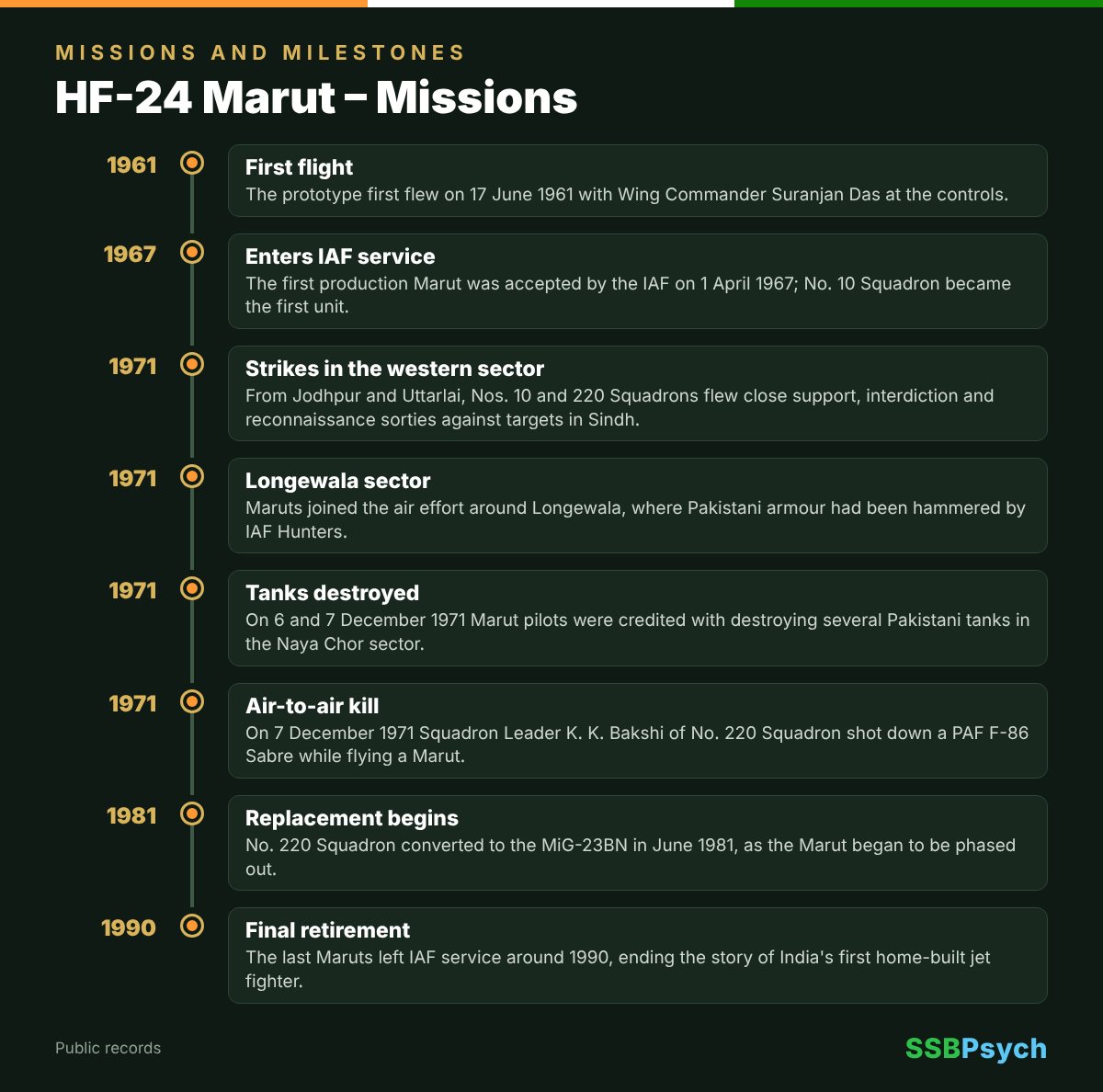
- 1961 – First flight: The prototype first flew on 17 June 1961 with Wing Commander Suranjan Das at the controls.
- 1967 – Enters IAF service: The first production Marut was accepted by the IAF on 1 April 1967; No. 10 Squadron became the first unit.
- 1971 – Strikes in the western sector: From Jodhpur and Uttarlai, Nos. 10 and 220 Squadrons flew close support, interdiction and reconnaissance sorties against targets in Sindh.
- 1971 – Longewala sector: Maruts joined the air effort around Longewala, where Pakistani armour had been hammered by IAF Hunters.
- 1971 – Tanks destroyed: On 6 and 7 December 1971 Marut pilots were credited with destroying several Pakistani tanks in the Naya Chor sector.
- 1971 – Air-to-air kill: On 7 December 1971 Squadron Leader K. K. Bakshi of No. 220 Squadron shot down a PAF F-86 Sabre while flying a Marut.
- 1981 – Replacement begins: No. 220 Squadron converted to the MiG-23BN in June 1981, as the Marut began to be phased out.
- 1990 – Final retirement: The last Maruts left IAF service around 1990, ending the story of India’s first home-built jet fighter.

Where It Was Based and Who Flew It
Before the 1971 war, Nos. 10 and 220 Squadrons moved from Pune to Jodhpur in December 1970, and during the war they also operated from Uttarlai in Rajasthan, as publicly recorded in histories of the conflict. These desert bases put the Marut close to the battle zone in the western sector.
Like all IAF fighter squadrons, a Marut squadron was usually commanded by a Wing Commander, with Squadron Leaders leading flights and Flight Lieutenants and Flying Officers as line pilots. The Mk 1T two-seat trainers helped new pilots convert to the type with an instructor beside them.
The 18 two-seat Mk 1T trainers were important in their own right. Converting from a small trainer to a heavy twin-engine fighter is a big jump, and having an instructor on board made that step safer. Bharat Rakshak also records that, apart from the three squadrons, a separate Marut flight was used to train radar intercept officers. It was a small but useful extra job for the type.
In general terms, an IAF fighter pilot of that era, as today, first trained at the Air Force Academy and on jet trainers before joining a squadron, a journey of well over a year, followed by further training on the squadron’s own aircraft before being declared fully operational.
Strengths and Limitations
- Strength: India’s first home-designed jet fighter, a huge step for the country’s aircraft industry.
- Strength: Stable and fast at low level, ideal for ground attack missions.
- Strength: Heavy punch from four 30 mm cannons plus a belly pack of 50 rockets.
- Strength: Proved itself in the 1971 war, with no losses in air-to-air combat.
- Limitation: Underpowered engines without afterburners kept it subsonic.
- Limitation: Limited combat range of about 396 km.
- Limitation: Only 147 built, well short of the planned number, so it never became a mass fighter.
- Limitation: Outclassed by newer jets by the 1980s.
Legacy of the HF-24 Marut and Museums
The Marut did not become the world-class supersonic fighter its designers dreamed of, but its legacy is huge. It proved that Indian engineers could design, build, test and operate a combat jet. It also taught hard lessons: a great airframe is not enough without a suitable engine. That lesson still echoes in India’s push today for home-grown fighter engines.
You can still see Maruts on display. Examples are preserved at the Indian Air Force Museum, Palam in Delhi and at the HAL Heritage Centre and Aerospace Museum in Bengaluru, which has a two-seat trainer. Another stands in Kamla Nehru Park, Pune, and one Marut even went to Germany, where it has been displayed in aviation museums, a fitting link to Kurt Tank’s role.
Why the HF-24 Marut Matters for SSB and AFCAT Aspirants
Questions like ‘Which was India’s first indigenous fighter aircraft?’ or ‘Who designed the HF-24 Marut?’ are classic defence GK. The answer, the HF-24 Marut, designed by a team led by Kurt Tank and built by HAL, should be at your fingertips.
In the SSB interview and group discussions on self-reliance in defence, the Marut is a perfect example. You can explain how India started designing fighters in the 1950s, why engines are the hardest part, and how that history connects to Tejas and future projects. It shows depth, not just headline knowledge.
The 1971 war stories of Marut pilots such as Flight Lieutenant Apte and Squadron Leader Bakshi also reflect the officer-like qualities the board looks for: courage, initiative and commitment to the mission. When you speak about such heroes in your interview, speak with respect and accuracy; the board values honesty far more than dramatic exaggeration.
Did You Know?
- Marut means ‘Spirit of the Wind’.
- Before the first jet flew, HAL tested a full-size wooden glider towed by a Dakota.
- The HF-24 Marut first flew on 17 June 1961.
- 147 Maruts were built, including 18 two-seat trainers.
- A retractable belly pack held 50 rockets and was lowered out of the fuselage for firing.
- Squadron Leader K. K. Bakshi shot down a PAF Sabre in a Marut on 7 December 1971.
- Designer Kurt Tank had earlier designed the famous German Fw 190 fighter.
Quiz: Test Your Knowledge of HF-24 Marut
Click an option to see if you are right. Your score updates live.
HF-24 Marut: Frequently Asked Questions
The HAL HF-24 Marut was India’s first indigenous jet fighter. It first flew in 1961 and entered IAF service in 1967.
It was designed by a team of German and Indian engineers at HAL led by Dr Kurt Tank, the German designer of the Fw 190.
The Marut could reach about 1,112 km/h at sea level. Its engines lacked afterburners, so it remained subsonic.
Yes. In the 1971 India-Pakistan war, Maruts of Nos. 10 and 220 Squadrons flew ground attack, interdiction and reconnaissance missions in the western sector and none was lost in air combat.
The Marut was phased out during the 1980s, with its final retirement generally given as 1990. Examples are preserved at the IAF Museum, Palam and the HAL museum in Bengaluru.
This is part 28 of 50 in SSBPsych’s Indian Air Force aircraft series – a new aircraft every evening at 6 PM.
Sources: en.wikipedia.org, bharat-rakshak.com, capssindia.org, en.wikipedia.org.
Preparing for NDA, CDS, AFCAT or your SSB? Join SSBPsych’s online and offline batches – explore our courses or call +91 8076540582.