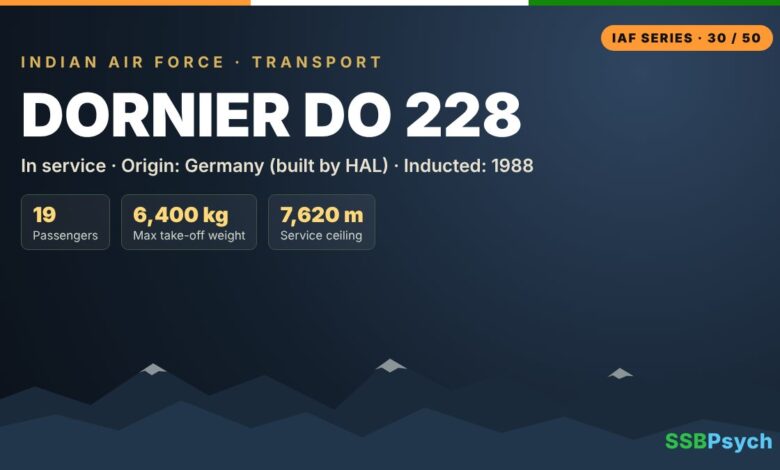
Dornier 228 in Indian Air Force: Specs, Roles, History, Bases
Not every hero of the Indian Air Force breaks the sound barrier. Some quietly carry people, parcels and young pilots, day after day, to places big jets cannot easily reach. The Dornier 228 is one such workhorse. Designed in Germany and built under licence by HAL in Kanpur, this small twin-engine turboprop has served the IAF since the late 1980s as a light transport, a communication aircraft and the classroom in which future transport pilots learn their trade.
In this guide we look at why the IAF chose the Dornier 228, its history, its engines and performance in plain words, its many roles, where it is publicly reported to be based, and what lies ahead. Finish with our 10-question quiz and FAQs to boost your AFCAT, NDA, CDS and SSB preparation.

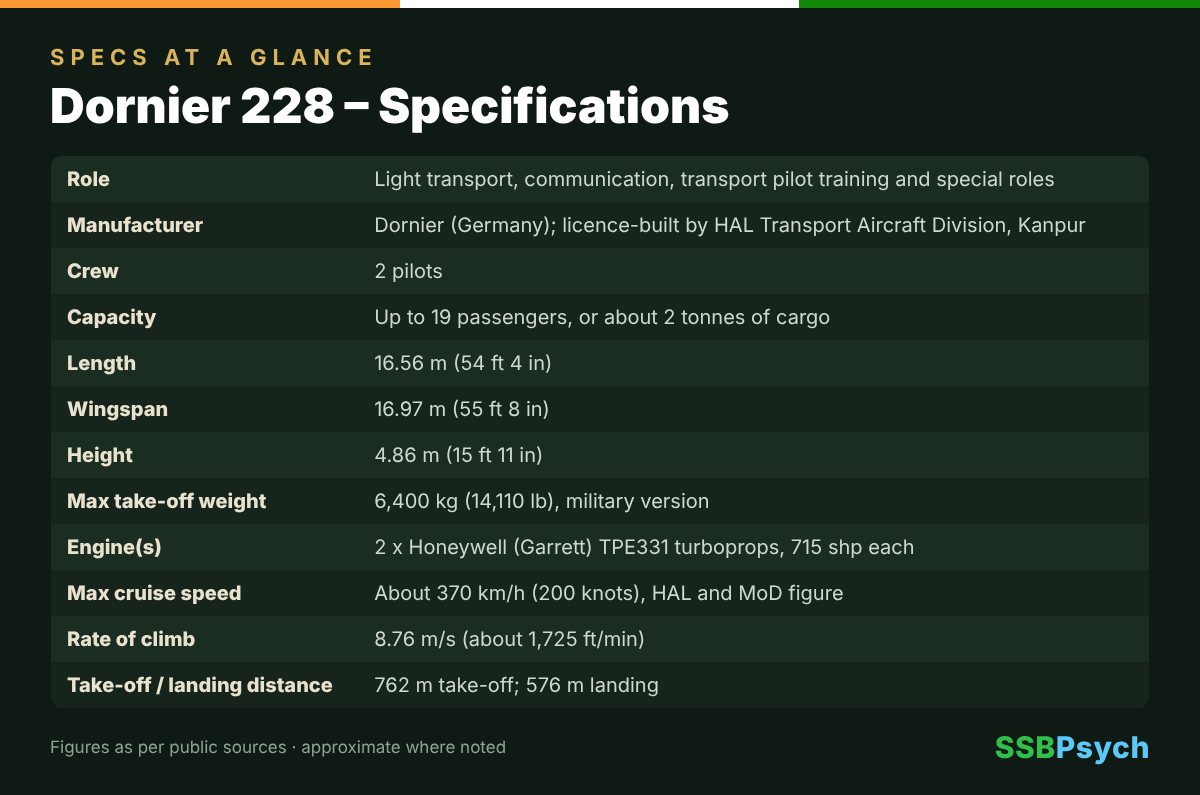
Dornier 228 Specifications
| Role | Light transport, communication, transport pilot training and special roles |
| Manufacturer | Dornier (Germany); licence-built by HAL Transport Aircraft Division, Kanpur |
| Crew | 2 pilots |
| Capacity | Up to 19 passengers, or about 2 tonnes of cargo |
| Length | 16.56 m (54 ft 4 in) |
| Wingspan | 16.97 m (55 ft 8 in) |
| Height | 4.86 m (15 ft 11 in) |
| Max take-off weight | 6,400 kg (14,110 lb), military version |
| Engine(s) | 2 x Honeywell (Garrett) TPE331 turboprops, 715 shp each |
| Max cruise speed | About 370 km/h (200 knots), HAL and MoD figure |
| Rate of climb | 8.76 m/s (about 1,725 ft/min) |
| Take-off / landing distance | 762 m take-off; 576 m landing |
| Service ceiling | 7,620 m (25,000 ft), military version |
| First flight | 28 March 1981 (Dornier prototype) |
| Inducted in IAF | First deliveries late 1987; formally inducted April 1988 |
| Number in IAF | Exact number not public; 14 more ordered in 2015 and 6 in 2023 |
Why India Needed the Dornier 228
By the 1980s, the IAF was flying ageing light aircraft such as the de Havilland Canada Otter and the de Havilland Devon for communication and liaison work. These were the small aircraft that moved officers, documents and light loads between bases and to forward areas. They needed a modern replacement.
The German Dornier 228 was a good fit. It is a rugged, high-wing twin turboprop that can use short runways, carry up to 19 passengers, and be fitted out for many jobs. Just as important, India wanted to build it at home. In November 1983, HAL signed an agreement with Dornier for licence production and step-by-step transfer of technology. A production line was set up at HAL’s Kanpur facility, and the first Indian-built aircraft rolled out in 1985.
This meant the IAF, the Indian Navy and the Coast Guard could all get a modern utility aircraft made in India, with spares and support close at hand. Over the years, HAL Kanpur has built well over a hundred Dornier 228s for Indian and foreign customers. The Navy and the Coast Guard use their Dorniers mainly for maritime patrol and surveillance over the sea, while the IAF focuses on transport, communication and training. One basic design thus serves very different needs, simply by changing the equipment inside.
History of the Dornier 228 in the IAF
The first IAF Dorniers arrived in late 1987, and the type was formally inducted in April 1988. They took over communication and liaison tasks with squadrons such as No. 41 Squadron, nicknamed the Otters after the aircraft it once flew, and No. 59 Squadron.
A large share of the fleet went to the Transport Training Wing at Yelahanka near Bengaluru. Here, pilots selected for the transport stream after their basic training at the Air Force Academy learn to fly a multi-engine aircraft, work as a two-pilot crew and handle navigation over long distances. From here, newly trained pilots go on to transport squadrons flying larger aircraft.
The IAF kept faith with the aircraft. On 5 February 2015, HAL won a contract worth about ₹1,090 crore to supply 14 more Dornier 228s, along with six spare engines and a flight simulator. In December 2019, the Chief of the Air Staff inducted a specially modified Dornier fitted with a Flight Inspection System at Air Force Station Palam. This aircraft checks and calibrates navigation aids at IAF airfields, a job that keeps landings safe in bad weather.
In March 2023, the Ministry of Defence signed for six more Dornier 228s from HAL, worth about ₹667 crore. These newer aircraft have upgraded, fuel-efficient engines and five-blade composite propellers. The ministry said they would be used for short-haul flights from small or semi-prepared runways, mainly on India’s island chains and in the Northeast, as well as for communication duties and training future transport pilots.
Engine and Performance Explained Simply
The Dornier 228 is powered by two Honeywell TPE331 turboprop engines, originally made by Garrett. A turboprop is a small gas-turbine engine, like a jet engine, but instead of using the exhaust to push the aircraft, it uses the turbine to spin a propeller. Turboprops are efficient at lower speeds and heights, which is perfect for short trips and small airfields. Each engine gives about 715 shaft horsepower, so the two together are as powerful as about seven family SUVs.
Speed: According to HAL and Ministry of Defence data, the maximum cruise speed is about 370 km/h, roughly twice the top speed of a Vande Bharat Express. That is not fast for an aircraft, but on short routes the time saved by using small, nearby airstrips matters far more than raw speed.
Short take-off and landing: The Dornier needs about 762 m to take off and about 576 m to land under the official figures. In simple words, it can use runways only a fraction of the length big jets need. That is why it is so useful for islands and hilly regions.
Height: The military version can fly up to 7,620 m (25,000 ft), almost as high as the top of Mount Everest. It climbs at nearly 9 metres every second.
Size and weight: It is 16.56 m long, about as long as a city bus and a half, with a wingspan of almost 17 m. Fully loaded, the military version can weigh up to 6,400 kg, about the weight of five or six cars.
Why Airfield Calibration Matters
The Flight Inspection System Dornier deserves a closer look. When pilots land in fog, rain or darkness, they rely on radio navigation aids on the ground that guide them towards the runway. These aids must be accurate; even a small error could lead an aircraft away from the safe path. Calibration means flying a specially equipped aircraft through the guidance signals and measuring them precisely, then adjusting the ground equipment if needed.
Having its own calibration aircraft lets the IAF check its airfields in-house and on its own schedule. This became especially important as IAF airfields were modernised with new navigation and landing equipment. It is a perfect example of a quiet job that makes every other mission safer.
What It Carries
- No weapons: the IAF’s Dornier 228 is an unarmed light transport
- Up to 19 passengers in the cabin
- About 2 tonnes of cargo in the freight role
- Can be fitted for casualty evacuation and VIP or executive transport
- Flight Inspection System for calibrating airfield navigation aids (special aircraft with No. 41 Squadron)
- Optional underwing hardpoints on the military version for mission equipment
Dornier 228 Missions and Operations
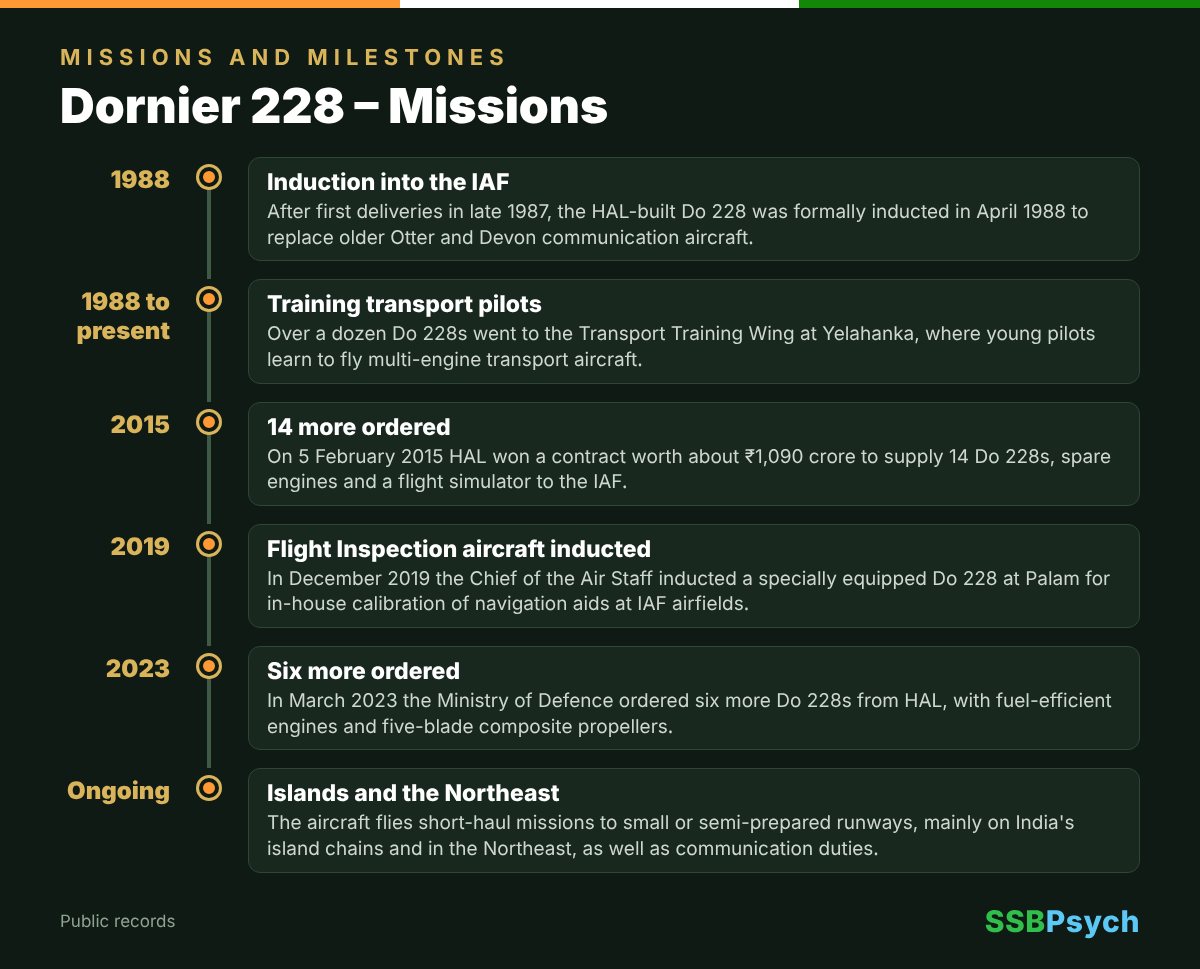
- 1988 – Induction into the IAF: After first deliveries in late 1987, the HAL-built Do 228 was formally inducted in April 1988 to replace older Otter and Devon communication aircraft.
- 1988 to present – Training transport pilots: Over a dozen Do 228s went to the Transport Training Wing at Yelahanka, where young pilots learn to fly multi-engine transport aircraft.
- 2015 – 14 more ordered: On 5 February 2015 HAL won a contract worth about ₹1,090 crore to supply 14 Do 228s, spare engines and a flight simulator to the IAF.
- 2019 – Flight Inspection aircraft inducted: In December 2019 the Chief of the Air Staff inducted a specially equipped Do 228 at Palam for in-house calibration of navigation aids at IAF airfields.
- 2023 – Six more ordered: In March 2023 the Ministry of Defence ordered six more Do 228s from HAL, with fuel-efficient engines and five-blade composite propellers.
- Ongoing – Islands and the Northeast: The aircraft flies short-haul missions to small or semi-prepared runways, mainly on India’s island chains and in the Northeast, as well as communication duties.

Where It Is Based and Who Flies It
Publicly reported Dornier 228 units include No. 41 Squadron ‘Otters’ at Air Force Station Palam in New Delhi, which also flies the Flight Inspection System aircraft, and the Transport Training Wing at Yelahanka near Bengaluru, which uses it to train transport pilots. No. 59 Squadron has also flown the type in the communication role.
Like all IAF flying squadrons, a Dornier squadron is usually commanded by an officer of Wing Commander rank. Squadron Leaders serve as flight commanders, while Flight Lieutenants and Flying Officers make up the younger pilots. Instructors at the training wing are experienced transport pilots who have completed an instructor course.
The transport pilot’s path in general terms: a cadet learns basic flying on the Pilatus PC-7 Mk II at the Air Force Academy, Dundigal. Those selected for the transport stream then move to multi-engine training, which is where the Dornier comes in. After earning their wings and commission, they join a transport squadron and gradually gain experience on bigger aircraft. Becoming a captain of a large transport aircraft usually takes several years of flying after commissioning.
Strengths and Limitations
- Strength: Built in India by HAL, so spares, repairs and upgrades are available at home.
- Strength: Short take-off and landing ability lets it use small and semi-prepared runways.
- Strength: Very versatile: passenger, cargo, training, casualty evacuation and calibration roles.
- Strength: Economical turboprop engines keep operating costs low.
- Strength: Simple, rugged design that suits training new pilots.
- Limitation: Small cabin, so it carries only 19 people or about 2 tonnes of cargo.
- Limitation: Not pressurised like a jet airliner, so it is better suited to lower-altitude flights.
- Limitation: Slower than jet transports, so not ideal for long-distance missions.
Future of the Dornier 228 in the IAF
With fresh aircraft ordered in 2015 and 2023, the Dornier 228 is set to serve the IAF for many more years. The newer aircraft bring more efficient engines and modern five-blade propellers, making them quieter and cheaper to run. HAL has also developed a civil version, the Hindustan 228, which received Indian civil type certification in 2017 and has been used on regional routes.
This keeps the production line in Kanpur busy and gives India valuable know-how in small transport aircraft, which could help future indigenous designs. For the IAF, the Dornier will remain the first multi-engine classroom for transport pilots and a handy link to small airfields on islands and in the Northeast.
Why the Dornier 228 Matters for SSB and AFCAT Aspirants
If you are applying for the flying branch, there is a real chance that, if you are streamed into transport flying, the Dornier 228 will be one of your first multi-engine aircraft. Knowing about it shows the interview board that you understand the full pilot training path, not just fighter jets.
The Dornier is also an excellent example of licence production and technology transfer, a common topic in group discussions on Make in India. You can explain how a German design became a product built for decades in Kanpur, how it serves all three armed services and even civil airlines, and why such partnerships help build national capability.
Finally, its role in calibrating airfield navigation aids is a good reminder that an air force runs on many unseen jobs. Officers who appreciate teamwork across roles show the maturity the SSB looks for. A useful tip for your interview: when asked about IAF aircraft, do not stop at fighters. Mention a trainer, a transport and a support aircraft like the Dornier, and explain how each one fits into the bigger picture. That kind of complete answer shows genuine interest in the service as a whole, not just its most glamorous jets.
Did You Know?
- The Dornier 228 prototype first flew on 28 March 1981 in Germany.
- HAL signed the licence production deal with Dornier in November 1983, and the first Kanpur-built aircraft rolled out in 1985.
- No. 41 Squadron is nicknamed ‘Otters’ after the de Havilland Canada Otter it flew before the Dornier.
- A special IAF Dornier with a Flight Inspection System calibrates navigation aids at IAF airfields.
- The 2023 batch has five-blade composite propellers.
- The Dornier 228 is used by the IAF, the Indian Navy and the Indian Coast Guard.
- HAL’s civil version is called the Hindustan 228.
Quiz: Test Your Knowledge of Dornier 228
Click an option to see if you are right. Your score updates live.
Dornier 228: Frequently Asked Questions
The IAF uses the Dornier 228 for light transport and communication, for training transport pilots at Yelahanka, and in a special version for calibrating airfield navigation aids.
Hindustan Aeronautics Limited (HAL) builds it under licence at its Transport Aircraft Division in Kanpur, under a 1983 agreement with Dornier of Germany.
It can carry up to 19 passengers, or about 2 tonnes of cargo, with two pilots in the cockpit.
HAL and Ministry of Defence data give a maximum cruise speed of about 370 km/h for the Do 228.
The first IAF Dornier 228s arrived in late 1987, and the type was formally inducted in April 1988. More were ordered in 2015 and 2023.
This is part 30 of 50 in SSBPsych’s Indian Air Force aircraft series – a new aircraft every evening at 6 PM.
Sources: en.wikipedia.org, bharat-rakshak.com, ddpmod.gov.in, indiatvnews.com, psuwatch.com.
Preparing for NDA, CDS, AFCAT or your SSB? Join SSBPsych’s online and offline batches – explore our courses or call +91 8076540582.