11 Gorkha Rifles: History, Motto, War Cry, Kargil and Heroes
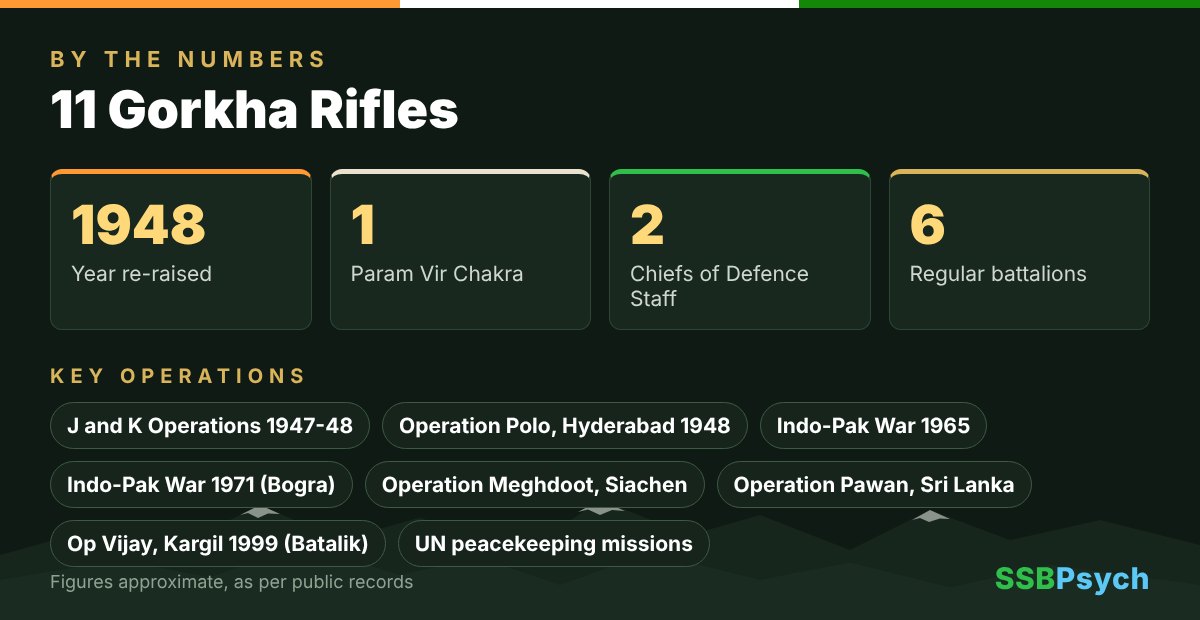
Every Indian who remembers the Kargil War remembers the words of a young officer who said that if death struck before he could prove his blood, he would kill death. That officer, Captain Manoj Kumar Pandey, PVC, belonged to 11 Gorkha Rifles. Raised on 1 January 1948, it was the first regiment raised by independent India, and it has since given the nation a Param Vir Chakra, an Ashoka Chakra and its first two Chiefs of Defence Staff. For any NDA, CDS or TES aspirant, 11 Gorkha Rifles is a story that feels very close to home.
In this guide we look at the regiment’s unusual birth, a visual timeline, its major operations and battle honours, its motto and war cry, its heroes, life in the regiment, what it means for SSB candidates, and a quiz to test you at the end.
11 Gorkha Rifles – Quick Facts
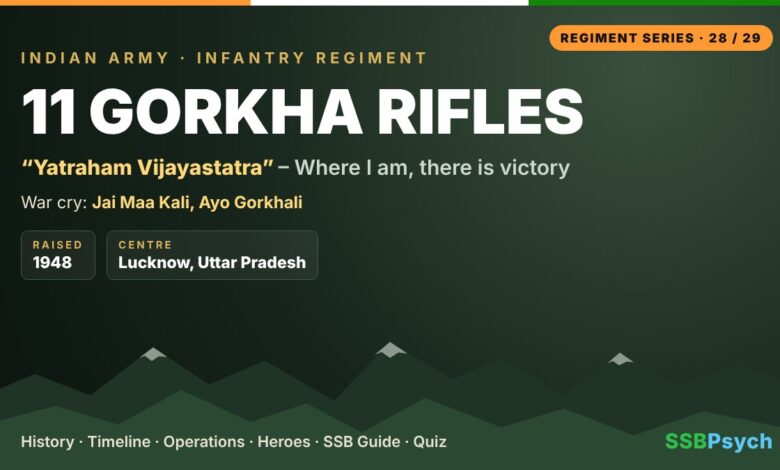
| Raised | 1 January 1948 (an earlier 11th Gurkha Rifles existed from 1918 to 1922) |
| Distinction | First regiment raised after Independence |
| Regimental Centre | 11 Gorkha Rifles Regimental Centre, Lucknow |
| Motto | Yatraham Vijayastatra (Where I am, there is victory) |
| War Cry | Jai Maa Kali, Ayo Gorkhali |
| Recruitment | Mainly Rai and Limbu Gorkhas of eastern Nepal, Darjeeling, Sikkim and the North-East |
| Battalions | 6 regular battalions plus a Territorial Army battalion |
| Param Vir Chakra | Captain Manoj Kumar Pandey, 1/11 GR, Kargil 1999 |
| Famous officers | Gen Bipin Rawat and Gen Anil Chauhan, India’s first two CDSs |
| Key battle honours | Bogra, Shingo River Valley, Batalik |
History of the 11 Gorkha Rifles
The number eleven first appeared among Gurkha regiments during the First World War. An 11th Gurkha Rifles was formed in 1918 from men of other Gurkha regiments, served for a short time and was disbanded in 1922.
The present regiment was born out of Partition. Under the 1947 Tripartite Agreement between India, Nepal and Britain, six Gorkha regiments stayed with India and four went to the British Army. Two of those four, the 7th and 10th Gurkha Rifles, recruited mainly Rai and Limbu soldiers from eastern Nepal. Each soldier was given a choice, and a large number of these men chose to remain in the Indian Army rather than go with the British.
To keep these experienced soldiers and maintain a link with eastern Nepal, the Indian Army decided to raise a new regiment. Orders were issued in December 1947, and on 1 January 1948 the Regimental Centre and the 3rd Battalion were raised at Palampur and at Santa Cruz in Mumbai. This made 11 Gorkha Rifles the first regiment raised after Independence. Major Harnarain Singh Chauhan, an officer of the Rajput Regiment, is credited with leading the re-raising in those early, difficult months.
The young regiment moved its centre several times, from Palampur and Mumbai to Jalapahar near Darjeeling, then to Clement Town in Dehradun, and finally to Lucknow, where it is located today. More battalions followed over the years, including the 1st Battalion, raised at Clement Town on 1 September 1960.
11 Gorkha Rifles Timeline: From Raising to Today
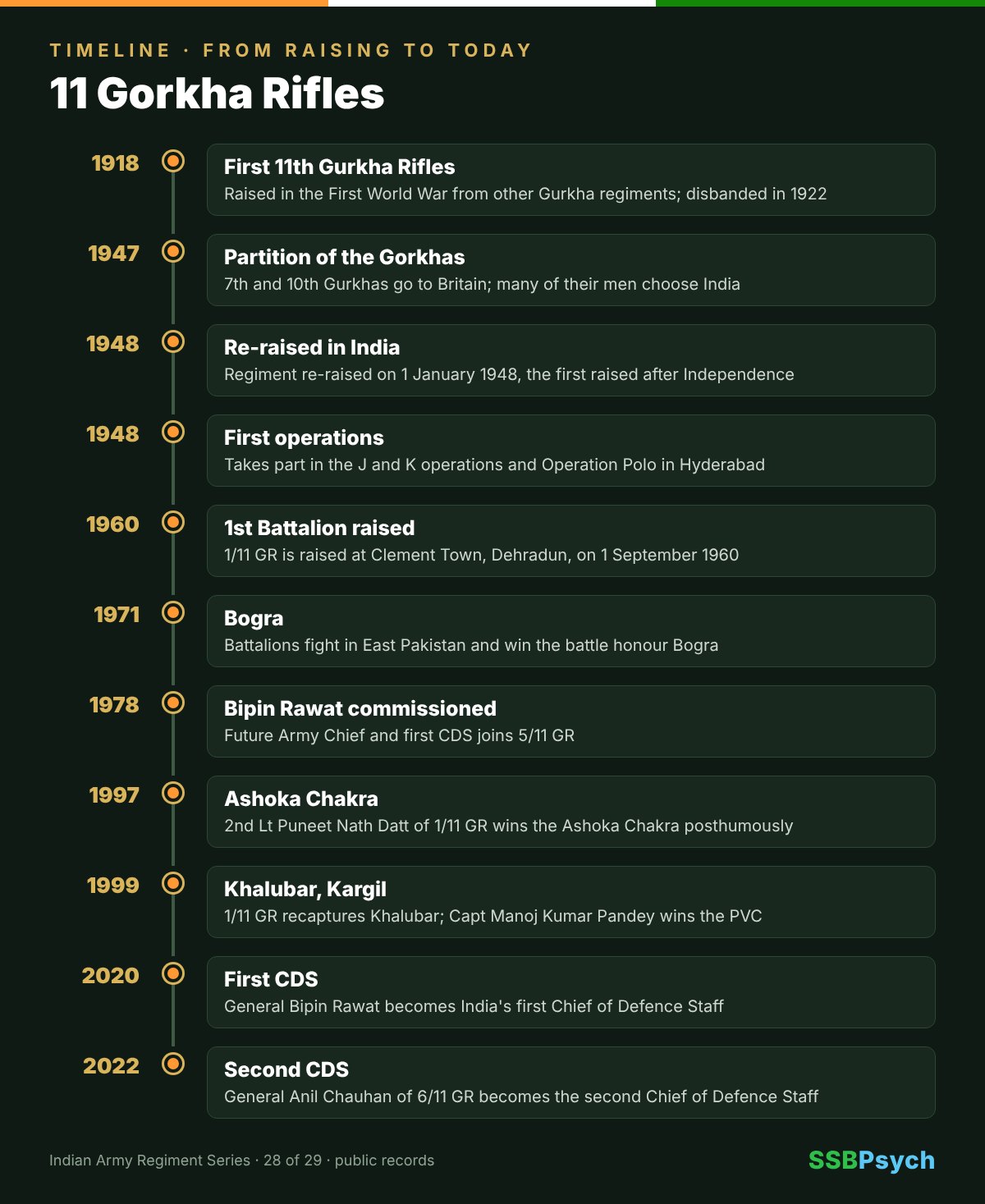
- 1918 – First 11th Gurkha Rifles: Raised in the First World War from other Gurkha regiments; disbanded in 1922
- 1947 – Partition of the Gorkhas: 7th and 10th Gurkhas go to Britain; many of their men choose India
- 1948 – Re-raised in India: Regiment re-raised on 1 January 1948, the first raised after Independence
- 1948 – First operations: Takes part in the J and K operations and Operation Polo in Hyderabad
- 1960 – 1st Battalion raised: 1/11 GR is raised at Clement Town, Dehradun, on 1 September 1960
- 1971 – Bogra: Battalions fight in East Pakistan and win the battle honour Bogra
- 1978 – Bipin Rawat commissioned: Future Army Chief and first CDS joins 5/11 GR
- 1997 – Ashoka Chakra: 2nd Lt Puneet Nath Datt of 1/11 GR wins the Ashoka Chakra posthumously
- 1999 – Khalubar, Kargil: 1/11 GR recaptures Khalubar; Capt Manoj Kumar Pandey wins the PVC
- 2020 – First CDS: General Bipin Rawat becomes India’s first Chief of Defence Staff
- 2022 – Second CDS: General Anil Chauhan of 6/11 GR becomes the second Chief of Defence Staff
Major Operations and Battle Honours of 11 Gorkha Rifles
Though it is younger than most Indian infantry regiments, 11 Gorkha Rifles has been in action almost from the day it was raised.
1947-48 and Operation Polo
Within months of its raising, the regiment’s soldiers took part in the operations in Jammu and Kashmir and in Operation Polo, which brought Hyderabad into the Indian Union in 1948.
1965 and 1971
The regiment fought in the 1965 war with Pakistan and again in 1971. In the eastern sector in 1971, its battalions advanced into East Pakistan, captured enemy troops and helped secure crossings, including a bridgehead across the Meghna river. They earned the battle honour Bogra and the theatre honour East Pakistan 1971. The regiment also holds the battle honour Shingo River Valley and the theatre honour Jammu and Kashmir 1971.
Siachen and Sri Lanka
Battalions of the regiment have served on the Siachen Glacier under Operation Meghdoot, one of the toughest deployments in the world, and with the Indian Peace Keeping Force in Sri Lanka during Operation Pawan. They have also fought long counter-insurgency campaigns in the North-East and in Jammu and Kashmir.
Service at such heights is a test of endurance as much as courage. Soldiers live for months in extreme cold, thin air and constant danger from avalanches and crevasses. Gorkha soldiers from the hills of eastern Nepal, Darjeeling and Sikkim have earned a strong reputation for coping with these conditions, and the regiment’s battalions have been regularly entrusted with such demanding tasks.
Kargil 1999: Khalubar
The regiment’s most famous battle came in 1999. The 1st Battalion (1/11 GR) had just finished a tenure in Siachen when it was sent to the Batalik sector, where Pakistani intruders had occupied high ridges. Under its Commanding Officer, Colonel Lalit Rai, the battalion attacked a series of peaks, including Khalubar, at around 17,000 feet. On the night of 2-3 July, Captain Manoj Kumar Pandey led his platoon up a steep slope under heavy fire, cleared several enemy bunkers and kept going even after being badly wounded, until he fell at the last bunker. He was awarded the Param Vir Chakra posthumously.
For its role in Kargil, the battalion received a Chief of the Army Staff Unit Citation, along with the battle honour Batalik and the theatre honour Kargil. Colonel Lalit Rai was awarded the Vir Chakra.
Peacekeeping
Units of the regiment have also served with United Nations peacekeeping missions abroad, carrying the Gorkha reputation for discipline and professionalism to other parts of the world.
Insignia, Motto and War Cry
The motto of the regiment is Yatraham Vijayastatra, a Sanskrit phrase that can be understood as Where I am, there is victory. It expresses the confidence that every soldier of the regiment carries into battle. In its early years the regiment used the motto Nisswarth Kartavya, meaning selfless duty.
The war cry is Jai Maa Kali, Ayo Gorkhali, meaning Glory to Mother Kali, the Gorkhas are here. Like other Gorkha regiments, its insignia carries crossed khukris with the regimental number.
Heroes of the 11 Gorkha Rifles
For a young regiment, the list of heroes is remarkable:
- Captain Manoj Kumar Pandey, Param Vir Chakra – 1/11 GR; led the assault on Khalubar in Kargil, 1999, and gave his life clearing the final bunker.
- 2nd Lieutenant Puneet Nath Datt, Ashoka Chakra – 1/11 GR; awarded posthumously for gallantry in a counter-terrorist operation in Jammu and Kashmir in 1997.
- Colonel Lalit Rai, Vir Chakra – Commanding Officer of 1/11 GR during the Kargil War.
- General Bipin Rawat – commissioned into 5/11 GR in 1978; served as Chief of the Army Staff and became India’s first Chief of Defence Staff in 2020.
- General Anil Chauhan – commissioned into 6/11 GR in 1981; became India’s second Chief of Defence Staff in 2022.
- Lieutenant General J. B. S. Yadava – a decorated officer of the regiment who won the Vir Chakra as a young officer.
The 1st Battalion is proudly called the Bravest of the Brave because it has produced both a Param Vir Chakra and an Ashoka Chakra, India’s highest wartime and peacetime gallantry awards.
Two Chiefs of Defence Staff from One Regiment
In 2019 the Government of India created the post of Chief of Defence Staff (CDS), the senior-most uniformed officer who works to bring the Army, Navy and Air Force closer together in planning, training and procurement. General Bipin Rawat, who had served as Chief of the Army Staff from 2016, took over as the first CDS on 1 January 2020. He died in a helicopter crash in Tamil Nadu in December 2021, a loss felt across the nation.
In 2022, General Anil Chauhan was appointed the second CDS. Like Rawat, he had begun his career as a young officer in an 11 Gorkha Rifles battalion. That a regiment raised only in 1948 has produced both of India’s first two Chiefs of Defence Staff is a matter of great pride for every soldier and veteran of the regiment.
For SSB candidates, the CDS is a popular topic in interviews, group discussions and lecturettes. Knowing that both officers came from the same Gorkha regiment is an easy way to show that your general awareness goes beyond headlines.
Role and Life in the Regiment
11 Gorkha Rifles is an infantry rifle regiment trained for mountain warfare, high-altitude operations, counter-insurgency and conventional war. Its battalions rotate between peace stations and field areas such as Siachen, Ladakh, Jammu and Kashmir and the North-East. A Territorial Army battalion based in Darjeeling is also part of the regimental family, and the Sikkim Scouts are affiliated to the regiment.
Recruits train at the 11 Gorkha Rifles Regimental Centre in Lucknow. The regiment draws its soldiers mainly from the Rai and Limbu communities, with smaller numbers of Sunuwar, Tamang and Yakkha, from eastern Nepal, Darjeeling, Kalimpong, the Dooars, Sikkim and other parts of the North-East.
Life in the regiment is built on trust between officers and men. Officers learn Gorkhali, share festivals such as Dashain with their soldiers, and are expected to lead from the front, a tradition set by heroes like Manoj Kumar Pandey.
Lessons for Future Officers
Manoj Kumar Pandey’s story speaks directly to SSB aspirants. In his SSB interview he was asked why he wanted to join the Army, and he is widely reported to have said that he wanted to win the Param Vir Chakra. He did, at the age of 24. His story shows that a clear goal, combined with hard work and courage, can carry a young person very far.
The careers of Bipin Rawat and Anil Chauhan show another side of leadership. Both began as young officers in Gorkha battalions, learning to lead soldiers in tough field areas, and both rose to the highest military appointment in the country. Their journey is a reminder that the habits you build as a junior officer, such as caring for your men and mastering your profession, shape the leader you become.
Finally, the very birth of the regiment teaches loyalty. Thousands of soldiers chose India in 1947 even when another option was open to them. That spirit of choosing duty to India is what the regiment still stands for.
Quick Revision Points
- Re-raised on 1 January 1948; the first regiment raised after Independence.
- Formed largely from soldiers of the 7th and 10th Gurkhas who chose India.
- Motto: Yatraham Vijayastatra. War cry: Jai Maa Kali, Ayo Gorkhali.
- Regimental Centre: Lucknow.
- PVC: Capt Manoj Kumar Pandey, 1/11 GR, Khalubar, Kargil 1999.
- Ashoka Chakra: 2nd Lt Puneet Nath Datt, 1/11 GR, 1997.
- Gen Bipin Rawat and Gen Anil Chauhan, India’s first two CDSs, both came from the regiment.
11 Gorkha Rifles for SSB Candidates: What You Should Know
How officers join
- Officers join the Indian Army through NDA, IMA (via CDS or entries such as TES and TGC) or OTA Chennai for Short Service Commission.
- Every candidate must clear the SSB interview and a medical board.
- Arm and regiment allotment is done at the academy based on the cadet’s preferences, merit and vacancies, so no regiment is guaranteed in advance.
- Cadets who want a Gorkha regiment can list it in their infantry preferences.
How soldiers join
- Soldiers are Gorkhas, mainly Rai and Limbu, from eastern Nepal, Darjeeling, Sikkim and the North-East.
- Since 2022, new Indian Army soldiers join as Agniveers under the Agnipath scheme; recruitment from Nepal has been affected since then.
- Recruits train at the 11 Gorkha Rifles Regimental Centre, Lucknow.
Questions you may face in the SSB interview, GD or lecturette
- What inspires you about Captain Manoj Kumar Pandey?
- Why was 11 Gorkha Rifles raised in 1948?
- What is the role of the Chief of Defence Staff?
- If you had a clear goal like Manoj Pandey, how would you prepare for it?
- Lecturette topic: The Kargil War and the battle for Batalik.
SSBPsych tip: If you mention Manoj Kumar Pandey at your SSB, be ready to discuss his actual actions at Khalubar and what you have done to work towards your own goals; assessors value depth over slogans.
Read the stories of its Param Vir Chakra heroes: Lt Manoj Kumar Pandey.
Conclusion
Born in the first days of free India, 11 Gorkha Rifles has grown into one of the most celebrated regiments of the Indian Army. Its story, from Palampur in 1948 to the heights of Khalubar in 1999, shows what courage and loyalty can achieve. Read it, take the quiz, and let its motto remind you that victory follows those who never give up.
Quiz: How Well Do You Know the 11 Gorkha Rifles?
Test yourself! Click an option to see if you are right. Your score updates live.
11 Gorkha Rifles: Frequently Asked Questions
The motto is Yatraham Vijayastatra, a Sanskrit phrase meaning roughly Where I am, there is victory.
The 11 Gorkha Rifles Regimental Centre is in Lucknow, Uttar Pradesh.
In 1947 the 7th and 10th Gurkha Rifles went to the British Army, but many of their soldiers chose India. The regiment was raised on 1 January 1948 to keep these men and the link with eastern Nepal.
Captain Manoj Kumar Pandey of 1/11 GR won the Param Vir Chakra posthumously for the capture of Khalubar during the Kargil War in 1999.
General Bipin Rawat, India’s first CDS, and General Anil Chauhan, the second CDS, were both commissioned into 11 Gorkha Rifles.
Indian Army Regiments Series on SSBPsych
This is part 28 of 29 in our series on every infantry regiment of the Indian Army – a new regiment every day at 11 AM. Previous in the series: 9 Gorkha Rifles. Also follow our Param Vir Chakra series.
Sources: en.wikipedia.org, bharat-rakshak.com, archive.pib.gov.in, en.wikipedia.org, en.wikipedia.org.
Preparing for NDA, CDS, AFCAT or your SSB? Join SSBPsych’s online and offline batches – explore our courses or call +91 8076540582.