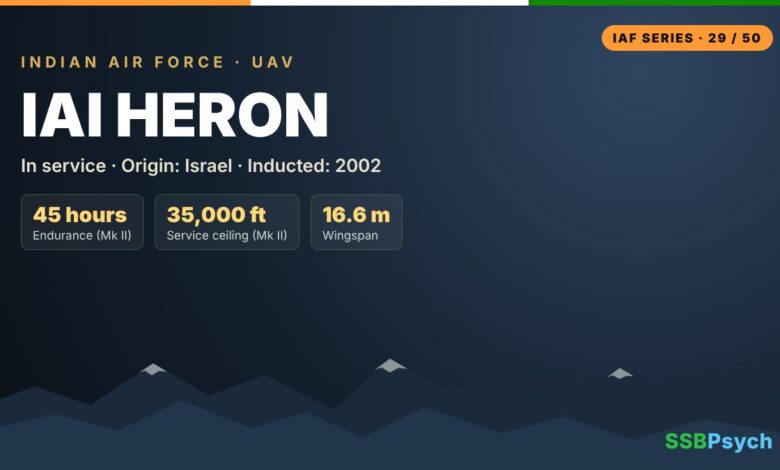
Heron Drone in Indian Air Force: Mk II Specs, Endurance, Role
Picture an aircraft that takes off on Monday morning and is still quietly circling high above the mountains on Tuesday evening, watching, listening and sending pictures home the whole time. No pilot inside gets tired, hungry or sleepy. That is the Heron drone, an Israeli-built unmanned aerial vehicle (UAV) that has served as one of the Indian Air Force’s most important eyes in the sky for over two decades.
In this guide we explain what the Heron is, why India bought it, how the new Heron Mk II is different, how it flies for so long, what sensors it carries, where it is publicly reported to operate, and what comes next. At the end you will find a 10-question quiz and FAQs to sharpen your preparation for AFCAT, NDA, CDS and the SSB interview.
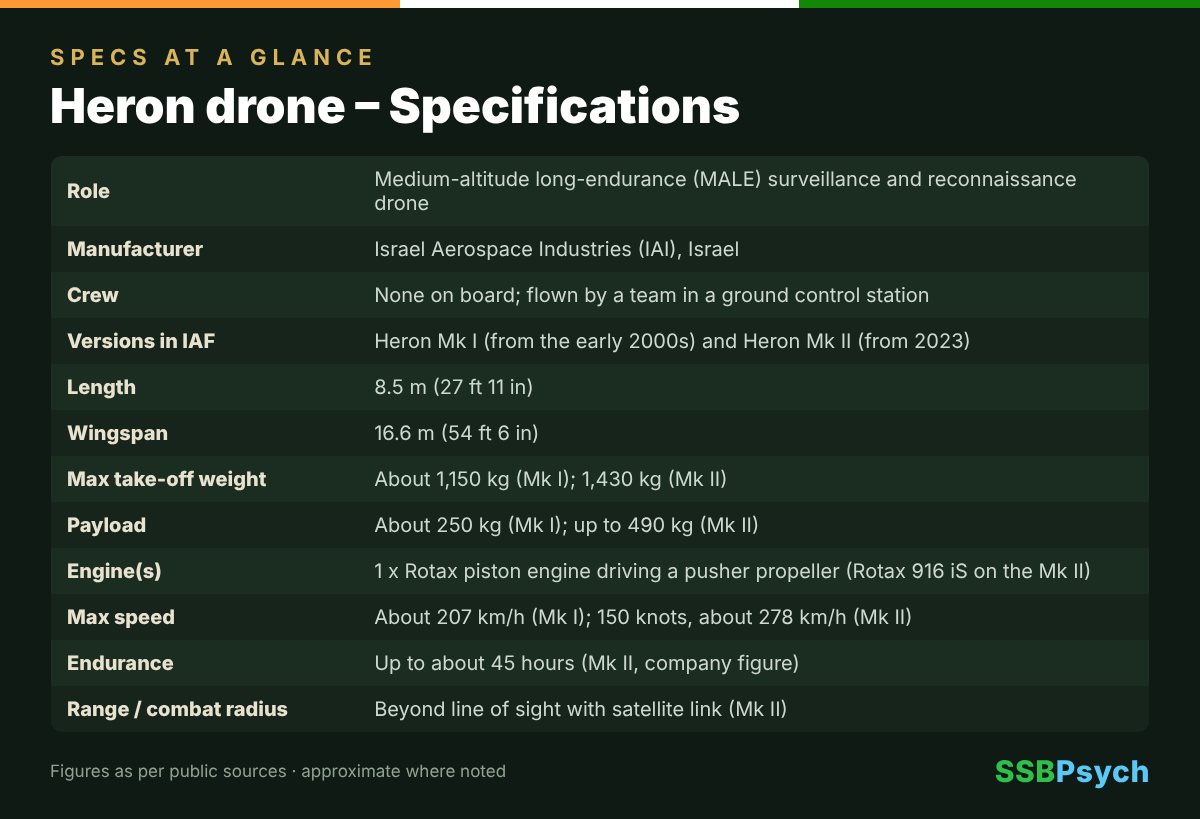
Heron drone Specifications
| Role | Medium-altitude long-endurance (MALE) surveillance and reconnaissance drone |
| Manufacturer | Israel Aerospace Industries (IAI), Israel |
| Crew | None on board; flown by a team in a ground control station |
| Versions in IAF | Heron Mk I (from the early 2000s) and Heron Mk II (from 2023) |
| Length | 8.5 m (27 ft 11 in) |
| Wingspan | 16.6 m (54 ft 6 in) |
| Max take-off weight | About 1,150 kg (Mk I); 1,430 kg (Mk II) |
| Payload | About 250 kg (Mk I); up to 490 kg (Mk II) |
| Engine(s) | 1 x Rotax piston engine driving a pusher propeller (Rotax 916 iS on the Mk II) |
| Max speed | About 207 km/h (Mk I); 150 knots, about 278 km/h (Mk II) |
| Endurance | Up to about 45 hours (Mk II, company figure) |
| Range / combat radius | Beyond line of sight with satellite link (Mk II) |
| Service ceiling | About 10,000 m (Mk I); 35,000 ft, about 10,700 m (Mk II) |
| First flight | 1994 (original Heron) |
| Inducted in IAF | Heron Mk I in the early 2000s; first four Heron Mk II in August 2023 |
| Number in IAF | Mk I number not public; 6 Heron Mk II ordered by end-2023 |
Why India Needed the Heron Drone
India has long land borders, many of them in high mountains, deserts and jungles. Watching them all the time with manned aircraft is costly and tiring for crews, and it can put pilots in danger. The Kargil conflict of 1999 also showed how important it is to know early what is happening across difficult terrain.
A MALE drone, which stands for medium-altitude long-endurance, solves this problem. It flies high enough to stay out of reach of small arms and to see a wide area, and it stays up for a very long time. The Heron, built by Israel Aerospace Industries (IAI), was one of the best-known MALE drones in the world. India bought its first batch in 2002, and the IAF, Army and Navy all came to operate the type.
For the IAF, the Heron added persistent surveillance: the ability to keep watching one place for many hours, rather than flashing past it at high speed as a fighter or spy jet would. That is very useful for spotting new construction, troop movements or unusual activity.
History of the Heron Drone in the IAF
The first Herons, now called Heron Mk I, entered Indian service in the early 2000s. Over the years India built up a sizeable fleet across the three services. Like all aircraft, drones have accidents, and several Indian Herons have been lost over the years due to technical faults, human error or loss of contact. Each loss led to lessons in maintenance and operating procedures.
In July 2021, the Defence Acquisition Council approved Project Cheetah, a plan to upgrade India’s Herons with satellite communication, better reconnaissance equipment and possibly weapons. Reports in 2023 said that the plan to arm them had been dropped, and that the upgrades would be done within India.
The big leap came in August 2023, when the IAF inducted four Heron Mk II drones at a forward air base in the northern sector. The Mk II has a satellite link, so it can be controlled far beyond the line of sight of its ground station. Reports said a single Mk II sortie can keep watch on both the China and Pakistan borders. In November 2023, the IAF ordered two more through emergency procurement, for a total of six Mk IIs.
After Operation Sindoor in 2025, reports said that all three services, including the Navy, had decided to buy more Heron Mk II drones under emergency provisions. Talks have also been reported about manufacturing the Heron Mk II in India with Indian partners, in line with the push for self-reliance.
Engine and Performance Explained Simply
Surprisingly, the Heron does not use a jet engine. It is powered by a Rotax piston engine, a cousin of the engines used in small private aircraft, turning a pusher propeller at the back. The Mk II uses the Rotax 916 iS. Piston engines are very fuel efficient at low power, and that is the secret of the Heron’s amazing endurance.
Endurance: The company figure for the Heron Mk II is up to about 45 hours in the air. The original Heron once flew for 52 hours. In simple terms, it can take off, fly for nearly two full days and only then need to land. Indian reports on the IAF’s Mk II mentioned missions of close to 36 hours. A human pilot simply could not stay alert that long; drone crews in the ground station work in shifts instead.
Height: The Mk II can climb to about 35,000 feet, roughly 10.7 km. That is higher than Mount Everest, which stands at about 8,849 m, and around the height where airliners cruise. From there, its cameras and radars can watch a huge area.
Speed: The Mk II’s top speed is about 150 knots, or about 278 km/h, roughly one and a half times the top speed of a Vande Bharat Express. That is slow for an aircraft, but speed is not the point. The job is to loiter, which means to stay over an area for a long time.
Size: The wingspan is 16.6 m, about as long as four family cars parked end to end, while the body is only 8.5 m long. Long, thin wings like a glider give lots of lift for little fuel, another reason it can stay up so long.
Payload: Payload means the useful equipment it carries. The Mk II can carry up to about 490 kg of sensors and electronics, nearly double the roughly 250 kg of the original Heron.
What the Heron Drone Sees: Sensors Made Simple
A drone is only as useful as what it can see and hear. The Heron carries a ball-shaped turret under its nose with electro-optical cameras for daylight and infrared cameras that see heat. Infrared lets operators spot vehicles with warm engines or people at night, even when the human eye would see nothing.
It can also carry radar, which sends out radio waves and listens for echoes. Radar works through clouds and darkness, so the drone can keep watch in bad weather. Other payloads listen to the enemy’s radio and radar signals; this is called electronic intelligence and communications intelligence. By studying these signals, analysts can work out where enemy radars and command posts are.
The Mk II can also laser-illuminate a target. That means it shines an invisible laser spot on the target so that a fighter aircraft can guide a laser-guided bomb onto it. In this way, an unarmed drone can still play a part in a precise strike carried out by manned aircraft.
What It Carries
- No weapons in IAF service: the Heron is an unarmed surveillance drone
- Day and night electro-optical and infrared cameras
- Long-range observation sensors and radars
- Electronic and communications intelligence payloads (ESM, ELINT, COMINT)
- Communication relay payload
- Laser illumination of targets to guide strikes by fighter aircraft (Mk II)
- Satellite communication link for beyond-line-of-sight control (Mk II)
Heron drone Missions and Operations
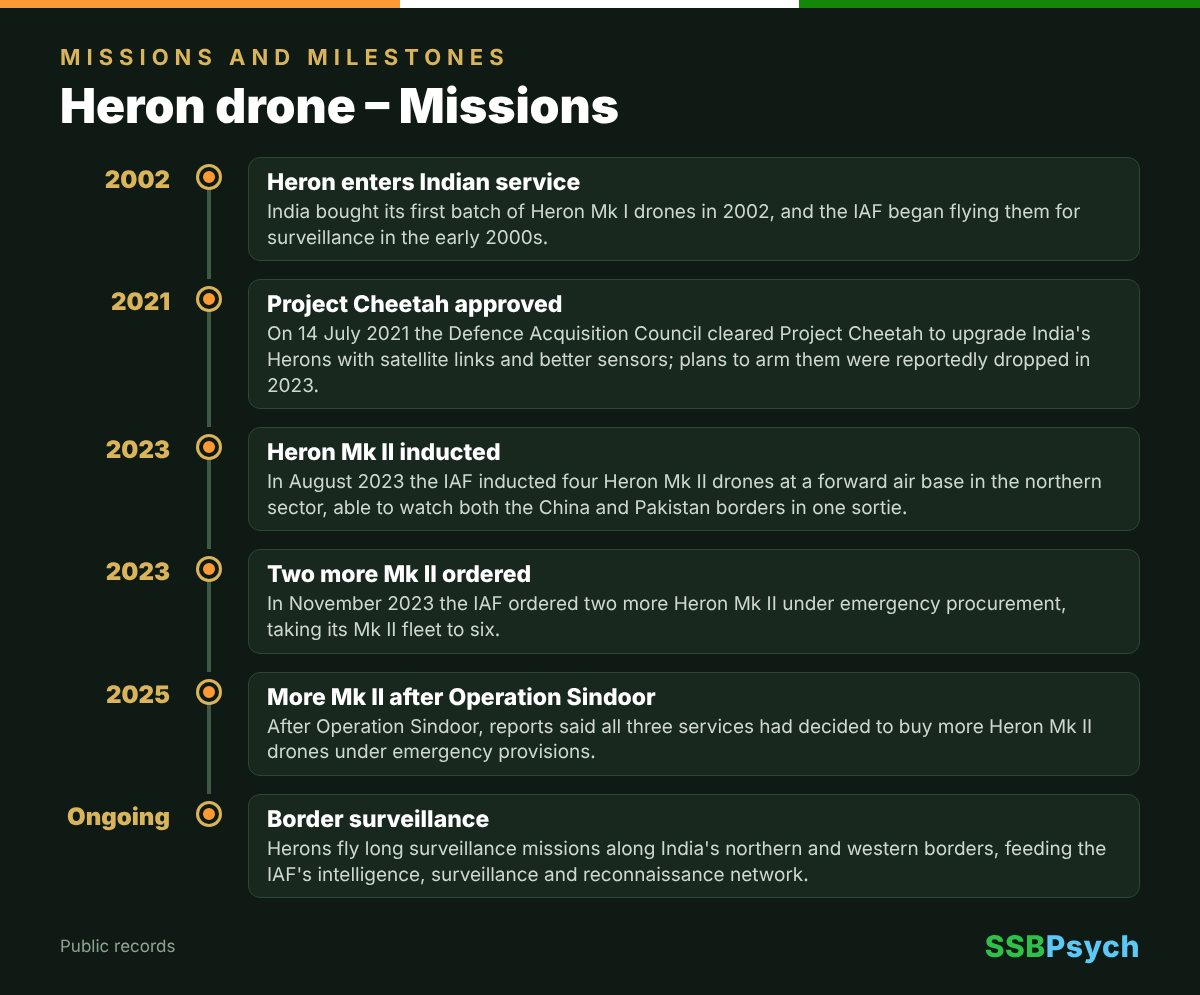
- 2002 – Heron enters Indian service: India bought its first batch of Heron Mk I drones in 2002, and the IAF began flying them for surveillance in the early 2000s.
- 2021 – Project Cheetah approved: On 14 July 2021 the Defence Acquisition Council cleared Project Cheetah to upgrade India’s Herons with satellite links and better sensors; plans to arm them were reportedly dropped in 2023.
- 2023 – Heron Mk II inducted: In August 2023 the IAF inducted four Heron Mk II drones at a forward air base in the northern sector, able to watch both the China and Pakistan borders in one sortie.
- 2023 – Two more Mk II ordered: In November 2023 the IAF ordered two more Heron Mk II under emergency procurement, taking its Mk II fleet to six.
- 2025 – More Mk II after Operation Sindoor: After Operation Sindoor, reports said all three services had decided to buy more Heron Mk II drones under emergency provisions.
- Ongoing – Border surveillance: Herons fly long surveillance missions along India’s northern and western borders, feeding the IAF’s intelligence, surveillance and reconnaissance network.
Where It Is Based and Who Flies It
For security reasons, the exact bases of drone units are not widely publicised. What has been publicly reported is that the IAF’s first Heron Mk IIs were deployed at a forward air base in the northern sector, from where they can watch both the northern and western borders.
A drone like the Heron is flown from a ground control station. The team includes an operator who flies the drone, a payload operator who controls the cameras and sensors, and analysts who study the information that streams in. Technicians on the ground prepare, launch and recover the aircraft.
As with other IAF units, a drone squadron is usually commanded by an officer of Wing Commander rank, with Squadron Leaders and Flight Lieutenants as flight commanders and operators. Officers who fly drones go through the IAF’s normal officer training and then specialist UAV training on the system, its sensors and its procedures.
Strengths and Limitations
- Strength: Extremely long endurance, up to about 45 hours for the Mk II, which allows persistent watch over an area.
- Strength: No pilot on board, so no risk to aircrew over dangerous territory.
- Strength: Satellite link on the Mk II lets it operate far beyond the line of sight of its ground station.
- Strength: Wide range of sensors, from day and night cameras to radar and electronic intelligence payloads.
- Strength: Fuel-efficient piston engine keeps running costs low compared with manned jets.
- Limitation: Slow speed makes it vulnerable to modern air defence systems and fighter aircraft.
- Limitation: Unarmed in IAF service, so it cannot strike targets by itself.
- Limitation: Depends on secure data links that an enemy may try to jam.
Future of the Heron Drone in India
The Heron Mk II is likely to remain a key part of IAF surveillance for many years, especially with more units being ordered after Operation Sindoor. Local manufacturing, if it goes ahead, would help India maintain and upgrade the fleet at home.
At the same time, India is building a bigger family of unmanned systems: larger armed drones bought from abroad, Indian-designed MALE drones, and many smaller drones. The Heron’s long years of service have given the IAF deep experience in running drone operations, and that experience will shape how future Indian drones are used.
Why the Heron Drone Matters for SSB and AFCAT Aspirants
Drones are now a constant theme in defence news, group discussions and interviews. Knowing that the Heron drone is an Israeli MALE UAV, that the IAF inducted the satellite-linked Heron Mk II in 2023, and that India is pushing to make such systems at home, gives you accurate, up-to-date points to speak on.
Interview officers may ask how drones are changing warfare, whether drones will replace pilots, or what self-reliance in defence means. The Heron is a good example: it shows that unmanned systems handle long, dull and dangerous tasks, while manned aircraft and human judgment remain essential. A balanced answer like that reflects maturity and clear thinking.
For AFCAT candidates, remember too that the IAF needs officers who understand technology, data and intelligence, not only flying. The Heron’s world of sensors, data links and analysts is part of the modern Air Force you may join.
Did You Know?
- The original Heron first flew in 1994.
- Heron is a MALE drone: medium-altitude long-endurance.
- The Heron Mk II can stay airborne for up to about 45 hours, according to its maker.
- Its 16.6 m wingspan is almost twice the length of its body.
- The Heron uses a piston engine and pusher propeller, not a jet engine.
- The IAF’s first four Heron Mk II drones were inducted in August 2023 in the northern sector.
- Project Cheetah, approved in 2021, aimed to upgrade India’s Heron fleet with satellite links.
Quiz: Test Your Knowledge of Heron drone
Click an option to see if you are right. Your score updates live.
Heron drone: Frequently Asked Questions
The Heron is an unarmed surveillance and reconnaissance drone. It watches borders and areas of interest for many hours, sending images and data to IAF analysts.
Israel Aerospace Industries gives the Heron Mk II an endurance of up to about 45 hours, and Indian reports mentioned missions of close to 36 hours.
The IAF inducted its first four Heron Mk II drones in August 2023 at a forward air base in the northern sector, and ordered two more in November 2023.
No. In IAF service the Heron is unarmed. Project Cheetah once considered arming Indian Herons, but reports in 2023 said that plan was dropped.
The Heron Mk II has a top speed of about 150 knots, roughly 278 km/h. It is designed to loiter for long hours rather than fly fast.
This is part 29 of 50 in SSBPsych’s Indian Air Force aircraft series – a new aircraft every evening at 6 PM.
Sources: en.wikipedia.org, theweek.in, janes.com, tribuneindia.com.
Preparing for NDA, CDS, AFCAT or your SSB? Join SSBPsych’s online and offline batches – explore our courses or call +91 8076540582.