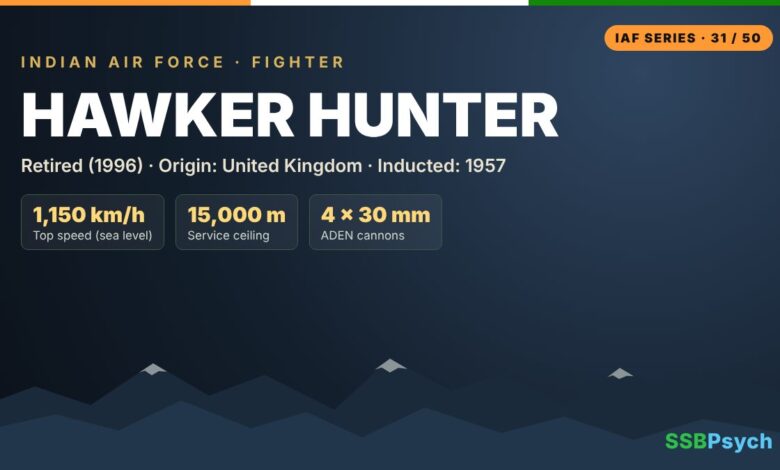
Hawker Hunter in Indian Air Force: History, Wars, Specs, Quiz
Picture a sleek silver jet screaming low over the Thar Desert, its cannons blazing at a column of enemy tanks heading for a tiny Indian border post. That was the Hawker Hunter at Longewala in December 1971. For almost forty years this elegant British fighter was one of the busiest warplanes in the Indian Air Force, guarding the skies in 1965, pounding targets in 1971 and even dancing in formation as the famous Thunderbolts display team.
In this guide you will learn why India bought the Hunter, how it fought in Goa, 1965 and 1971, what made it so loved by pilots, its full specifications explained in simple words, the guns and rockets it carried, where you can still see one today, and why it matters for NDA, CDS, AFCAT and SSB aspirants. Stay till the end for a 10-question quiz and quick FAQs.

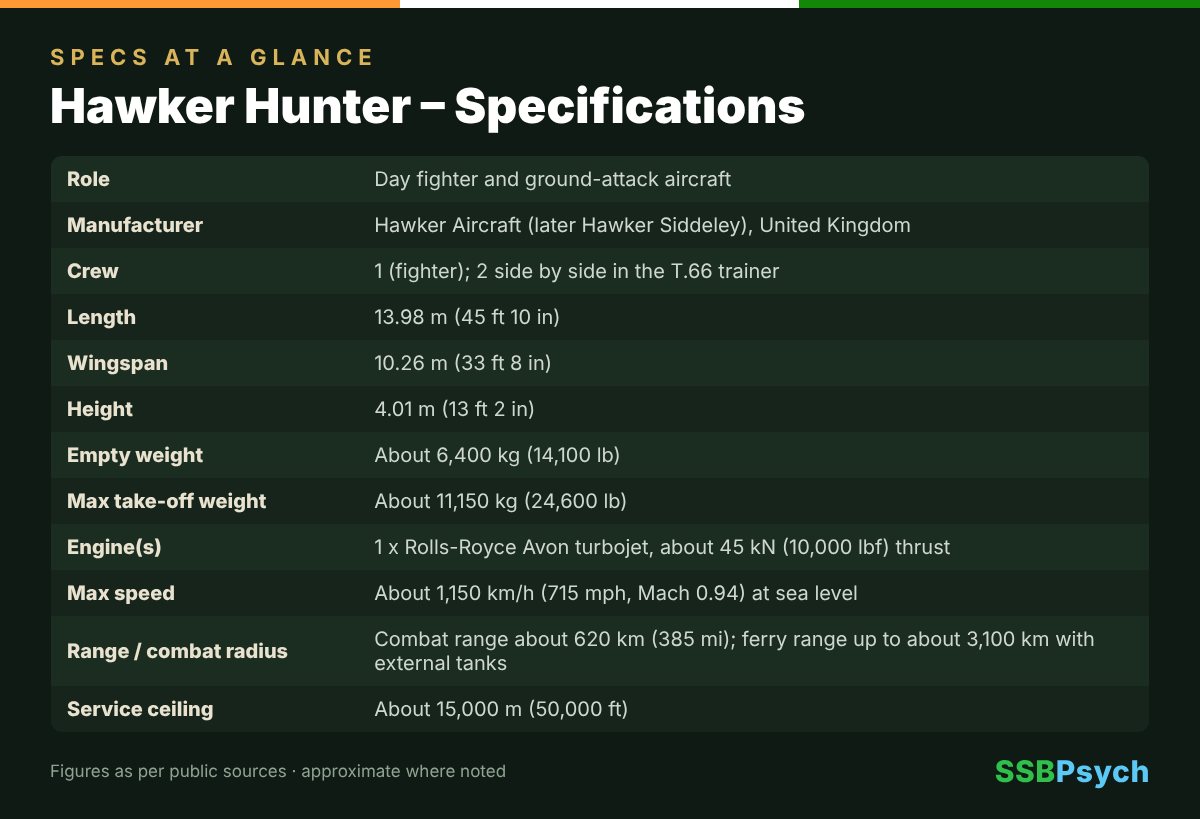
Hawker Hunter Specifications
| Role | Day fighter and ground-attack aircraft |
| Manufacturer | Hawker Aircraft (later Hawker Siddeley), United Kingdom |
| Crew | 1 (fighter); 2 side by side in the T.66 trainer |
| Length | 13.98 m (45 ft 10 in) |
| Wingspan | 10.26 m (33 ft 8 in) |
| Height | 4.01 m (13 ft 2 in) |
| Empty weight | About 6,400 kg (14,100 lb) |
| Max take-off weight | About 11,150 kg (24,600 lb) |
| Engine(s) | 1 x Rolls-Royce Avon turbojet, about 45 kN (10,000 lbf) thrust |
| Max speed | About 1,150 km/h (715 mph, Mach 0.94) at sea level |
| Range / combat radius | Combat range about 620 km (385 mi); ferry range up to about 3,100 km with external tanks |
| Service ceiling | About 15,000 m (50,000 ft) |
| Guns | 4 x 30 mm ADEN cannons |
| First flight | 20 July 1951 (prototype) |
| Inducted in IAF | 1957 |
| Number in IAF | Over 250 supplied in total, new-built and refurbished |
| Retired from IAF | Front-line squadrons by 1996 |
Why India Needed the Hawker Hunter
In the 1950s the young Indian Air Force was flying first-generation jets like the de Havilland Vampire and the French Ouragan, known in India as the Toofani. Jet technology was racing ahead, and neighbours were acquiring modern American fighters such as the F-86 Sabre. India needed a fast, tough, well-armed fighter that could both defend the sky and hit ground targets.
The Hawker Hunter fitted the bill perfectly. It was one of the best transonic fighters of its time, which means it flew just below the speed of sound in level flight and could go past it in a steep dive. It had four heavy 30 mm cannons, a strong airframe and very pleasant handling. Its Rolls-Royce Avon engine also coped well with hot weather, an important point for a country like India.
History of the Hawker Hunter in the IAF
The first new-built single-seat Hunter F.56s reached India between 1957 and 1959. The IAF also became the first customer for the two-seat Hunter T.66 trainer, which had a more powerful engine that helped in hot conditions. Later, India added more aircraft, including refurbished Hunters bought back from Belgium and the Netherlands and converted for Indian use. In total, well over 250 Hunters served in Indian colours.
The Hunter’s first taste of action came in December 1961 during Operation Vijay, the liberation of Goa. Six Hunters of No. 17 Squadron attacked the Portuguese wireless station at Bambolim with rockets and cannon and left it badly wrecked, while other Hunters flew air-defence patrols.
In the 1965 war with Pakistan, the Hunter and the small Folland Gnat were India’s front-line air-defence fighters. Hunter pilots fought fierce dogfights against Pakistani F-86 Sabres and F-104 Starfighters over Punjab and also attacked ground targets. Both sides made competing claims, but the Hunter proved it could take hits and keep flying.
By 1971 the IAF had six combat-ready Hunter squadrons plus an operational conversion unit. The Hunter flew on both the western and eastern fronts. Its most famous moment came at Longewala in Rajasthan, where a small Indian Army post faced a large Pakistani tank force at night. At first light, Hunters from Jaisalmer arrived and attacked again and again, destroying tanks and vehicles and helping turn the battle into a celebrated Indian victory. Hunters also carried out deep strikes, including a raid on the Attock oil refinery to cut Pakistan’s fuel supply.
After 1971 the Hunter slowly moved from the front line to support roles as the Jaguar, MiG-21 and other newer jets arrived. In 1982, pilots of No. 20 Squadron ‘Lightnings’ formed the Thunderbolts, the IAF’s formation aerobatic team, flying nine blue and white Hunters for the IAF golden jubilee. The team thrilled crowds until 1989. No. 20 Squadron flew its last Hunters from Pathankot until 1996, which marked the end of the type in front-line service. A small target-towing flight at Kalaikunda kept a few Hunters busy towing banner targets for gunnery practice for a few more years.
Hawker Hunter Versions Used by India
India flew three main versions. The F.56 was the single-seat fighter, close to the Royal Air Force’s Hunter F.6. The FGA.56A was a fighter and ground-attack version built to carry rockets and bombs as well as fight in the air, and it became the most numerous Hunter in Indian service. The T.66 was a two-seat trainer in which the instructor and student sat side by side, which made teaching much easier than in a tandem cockpit.
This mix gave the IAF a complete Hunter family. Young pilots learned on the T.66, then moved to the single-seaters for air defence or ground attack. Because the versions shared most of their parts, ground crews could keep the fleet flying with fewer spare-part headaches, a big help for a growing air force that was still building its maintenance skills.
The Hunter also introduced many Indian pilots to proper swept-wing jet flying. A swept wing is angled backwards like an arrowhead, which lets a jet fly closer to the speed of sound without shaking itself apart. Lessons learned on the Hunter helped the IAF prepare for supersonic fighters that came later.
Engine and Performance Explained Simply
The Hunter was powered by a single Rolls-Royce Avon turbojet producing about 45 kN of thrust. A turbojet sucks in air, squeezes it, mixes it with fuel, burns it and blasts it out of the back, pushing the aircraft forward. There was no afterburner, so the Hunter relied on clean aerodynamics rather than raw power.
Its top speed was about 1,150 km/h at sea level. That is roughly three and a half times faster than India’s fastest trains, and close to Mach 0.94. Mach 1 is the speed of sound, so Mach 0.94 means 94 percent of it. In a steep dive, the Hunter could actually break the sound barrier, something pilots loved to show off in its early days.
The service ceiling, the highest height at which the aircraft can still climb usefully, was about 15,000 m (50,000 ft). That is roughly one and a half times higher than the top of Mount Everest. On internal fuel the combat range was around 620 km, which is a bit more than the road distance from Delhi to Jaipur and back. With extra drop tanks under the wings, a Hunter could ferry itself much farther.
Size-wise, the Hunter was about 14 m long, about the length of three family cars parked nose to tail, and its wings spanned just over 10 m. Fully loaded it weighed a little over 11 tonnes, roughly as heavy as two adult elephants.
Weapons and Missiles
- 4 x 30 mm ADEN cannons mounted in a removable pack under the nose
- Unguided rockets fired from under-wing rails or pods
- Unguided iron bombs on under-wing hardpoints
- Four under-wing hardpoints in total
- Under-wing drop tanks for extra range
- Banner targets towed for air-to-air gunnery practice (late in its career)
The four 30 mm ADEN cannons were the Hunter’s real punch. They sat in a gun pack that ground crews could lower and replace quickly, which helped get aircraft back into the fight fast. Rockets and bombs under the wings made it a deadly ground-attack machine, as Goa, Longewala and many 1971 missions showed.
Hawker Hunter Missions and Operations
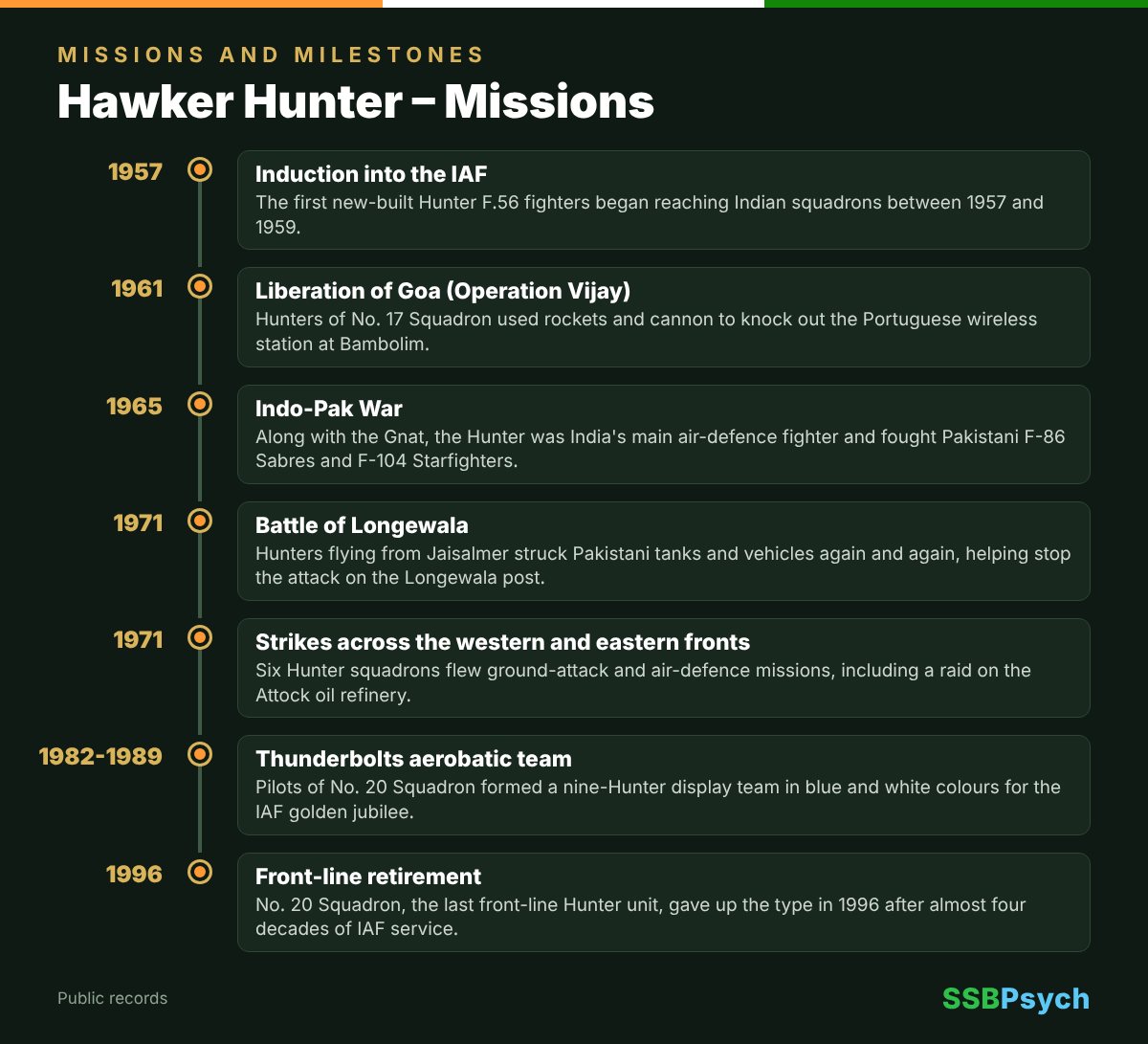
- 1957 – Induction into the IAF: The first new-built Hunter F.56 fighters began reaching Indian squadrons between 1957 and 1959.
- 1961 – Liberation of Goa (Operation Vijay): Hunters of No. 17 Squadron used rockets and cannon to knock out the Portuguese wireless station at Bambolim.
- 1965 – Indo-Pak War: Along with the Gnat, the Hunter was India’s main air-defence fighter and fought Pakistani F-86 Sabres and F-104 Starfighters.
- 1971 – Battle of Longewala: Hunters flying from Jaisalmer struck Pakistani tanks and vehicles again and again, helping stop the attack on the Longewala post.
- 1971 – Strikes across the western and eastern fronts: Six Hunter squadrons flew ground-attack and air-defence missions, including a raid on the Attock oil refinery.
- 1982-1989 – Thunderbolts aerobatic team: Pilots of No. 20 Squadron formed a nine-Hunter display team in blue and white colours for the IAF golden jubilee.
- 1996 – Front-line retirement: No. 20 Squadron, the last front-line Hunter unit, gave up the type in 1996 after almost four decades of IAF service.

Where It Was Based and Who Flew It
Over its long career the Hunter flew from many IAF bases. Publicly reported examples include Hindon and Pathankot for No. 20 Squadron, Jaisalmer during the Longewala battle, Pune for Hunters taking part in the Goa operation, and Kalaikunda in West Bengal, which later hosted the target-towing flight. No. 17, No. 20 and No. 37 Squadrons are among the units that flew the type.
An IAF fighter squadron is usually commanded by a Wing Commander. Under him or her, Squadron Leaders lead flights, while Flight Lieutenants and Flying Officers make up most of the pilots. The squadron also has engineering officers, technicians, armourers and many airmen who keep the jets ready.
To fly a fighter like the Hunter, a cadet first had to join through the NDA or a direct-entry route, then complete flying training at the Air Force Academy and advanced jet training, before converting to the Hunter at an operational conversion unit. In general terms it took a couple of years of training and a few hundred flying hours before a young pilot was ready for squadron service, and the same broad path exists for today’s fighter pilots.
Strengths and Limitations
- Strength: four 30 mm cannons gave it heavy firepower for its era.
- Strength: sweet, forgiving handling made it a favourite with pilots and ideal for aerobatics.
- Strength: a strong airframe that could often survive battle damage and bring its pilot home.
- Strength: quick-change gun pack and simple systems meant fast turnaround between sorties.
- Limitation: it was subsonic in level flight, so newer supersonic fighters could outrun it.
- Limitation: no radar-guided missiles in Indian service, so it fought mainly with guns.
- Limitation: the Avon engine was thirsty, which limited range without drop tanks.
Legacy of the Hawker Hunter
The Hunter is long retired, but its story lives on. The Indian Air Force Museum at Palam in New Delhi displays a Hunter in the striking Thunderbolts colour scheme, a reminder of the days when nine Hunters wrote patterns across the sky. The Thunderbolts were an inspiration for later IAF display teams, and today the Surya Kiran team carries that same spirit forward.
The Hunter also bridged two eras. It arrived when the IAF was still learning the jet age and left when Russian MiGs, French Mirages and Anglo-French Jaguars ruled the flight line. The pilots who learned their trade on it went on to lead the IAF in later decades.
Why It Matters for SSB and AFCAT Aspirants
Questions on India’s wars and aircraft are common in the AFCAT, NDA and CDS written exams, and in the SSB interview an officer may ask about a battle you admire. The Battle of Longewala is a favourite topic, and knowing that Hunters from Jaisalmer helped win it shows real depth. The Hunter also teaches a lesson the IAF values: a well-handled aircraft and a brave crew can matter more than raw speed.
During group discussions or lecturettes, you can use the Hunter to talk about joint army and air force operations, the importance of air power in ground battles, and how air display teams build public pride in the forces.
Did You Know?
- The IAF was the first air force to order the two-seat Hunter T.66 trainer.
- The Hunter could go faster than sound, but only in a steep dive.
- India’s Hunter fleet included refurbished aircraft bought back from Belgium and the Netherlands.
- Hunters knocked out the Bambolim wireless station during the 1961 liberation of Goa.
- The Thunderbolts flew nine Hunters in blue and white from 1982 to 1989.
- No. 20 Squadron flew Hunters for over three decades before giving them up in 1996.
- A Thunderbolts-painted Hunter is preserved at the IAF Museum, Palam, New Delhi.
Quiz: Test Your Knowledge of Hawker Hunter
Click an option to see if you are right. Your score updates live.
Hawker Hunter: Frequently Asked Questions
The Hunter could reach about 1,150 km/h at sea level, close to Mach 0.94. It could break the sound barrier only in a steep dive.
Front-line Hunter squadrons retired by 1996, when No. 20 Squadron gave up the type. A small target-towing flight kept a few flying for some more years.
It saw action in the 1961 liberation of Goa and in the 1965 and 1971 wars with Pakistan, including the famous Battle of Longewala.
Four 30 mm ADEN cannons, plus unguided rockets, bombs and drop tanks on four under-wing hardpoints.
The Indian Air Force Museum at Palam, New Delhi, displays a Hunter painted in the colours of the Thunderbolts aerobatic team.
This is part 31 of 50 in SSBPsych’s Indian Air Force aircraft series – a new aircraft every evening at 6 PM.
Sources: en.wikipedia.org, bharat-rakshak.com, bharat-rakshak.com, en.wikipedia.org, en.wikipedia.org.
Preparing for NDA, CDS, AFCAT or your SSB? Join SSBPsych’s online and offline batches – explore our courses or call +91 8076540582.